Yes, AI-generated ads can work as well as ads made by people, and sometimes better.
The catch is that shoppers don't punish ads for being made by AI.
They punish ads that look made by AI, or that say so.
That explains a confusing pair of headlines.
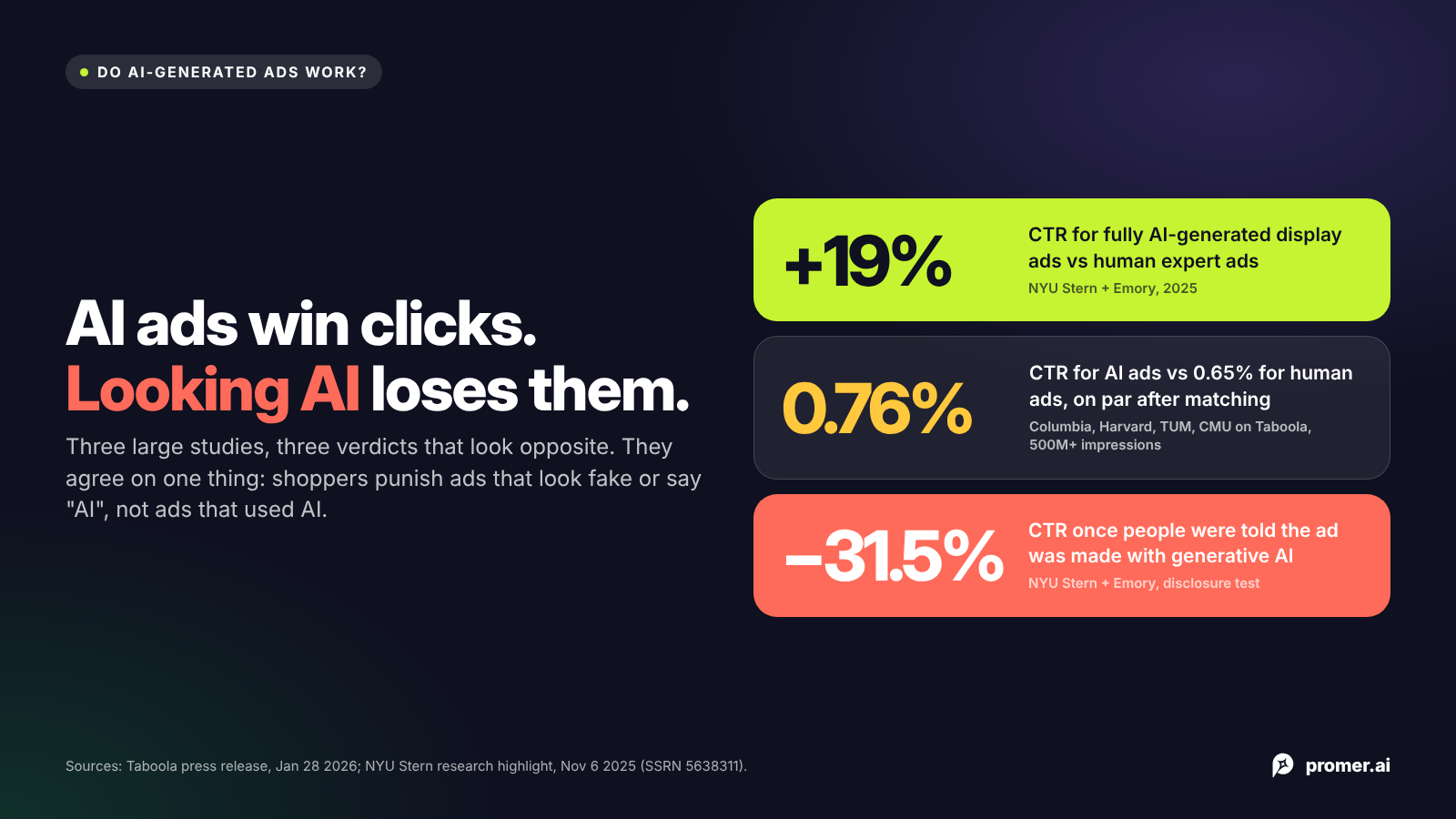
In January 2026, researchers from Columbia, Harvard, TUM and Carnegie Mellon reported on over 500 million ad impressions: AI ads clicked at 0.76% against 0.65% for human-made ads.
A year earlier, NielsenIQ wired up shoppers' brains and found AI ads read as "annoying," "boring" and "confusing," with weaker memory activation even when the ads were good.
A third study from NYU and Emory found AI ads lifted clicks by up to 19%, then lost 31.5% of their clicks once people were told AI made them.
If you're deciding whether to put AI creatives into your Facebook account, those three results give you a usable rule.
This post walks through what each study measured, why they disagree, what Meta's AI labels mean for your ads, and a small test you can run on your own store.
Key takeaways
- In a matched comparison of hundreds of thousands of live ads (500M+ impressions, 3M clicks), AI-made ads performed on par with human-made ads, and showed no drop in conversions.
- NielsenIQ's study of 2,000+ people (about 150 measured with EEG) found AI ads rated less engaging and remembered less, even the high-quality ones.
- The two agree on one thing: ads that look artificial lose. In the Columbia/Taboola data, ads perceived as AI underperformed whether or not AI made them.
- Telling people an ad is AI-generated cut click-through rate by 31.5% in the NYU/Emory study, which matters because Meta now adds an "AI info" label to many AI-made ads.
- Use AI for the product side of the ad (scenes, layouts, variants). Keep proof real: reviews, customer faces, results and offers.
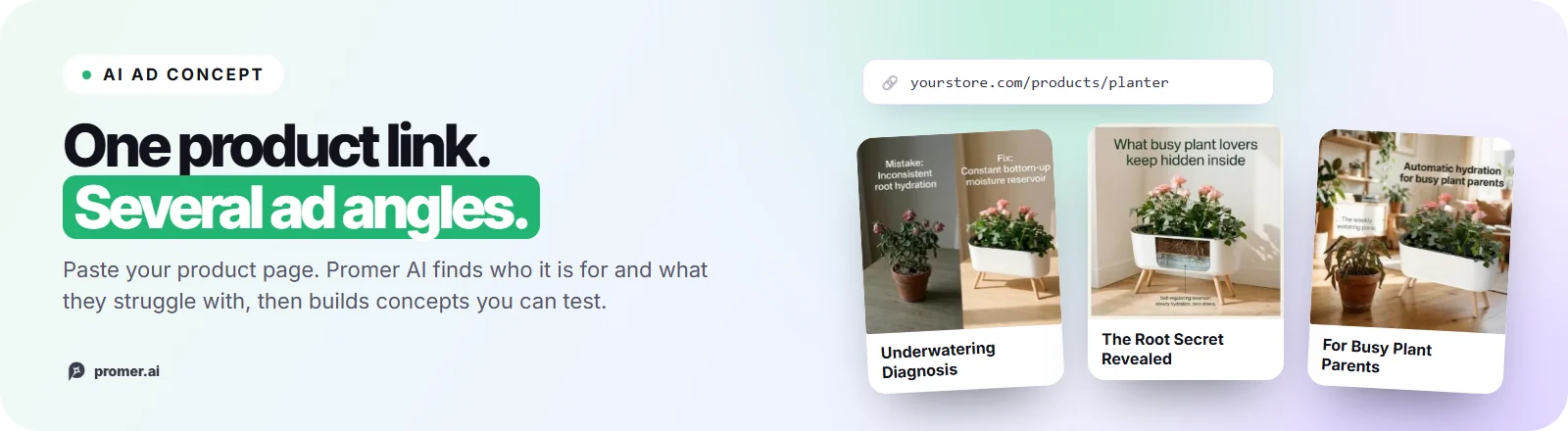
Want to test AI on the product side first? Promer AI's AI Ad Concept reads your product page and returns finished static ad concepts, each with its own angle.
Generate ad concepts for my product →
What the 2 big studies actually found
The quickest way to see why they disagree is to look at what each one measured.
One counted clicks on live ads.
The other measured what happens in people's heads while they watch.
Study 1: 500 million impressions say AI ads hold their own
Researchers from Columbia, Harvard, the Technical University of Munich and Carnegie Mellon analyzed live ads on Taboola's network, the native ad units you see under news articles.
The study was announced by Taboola on January 28, 2026, and covered hundreds of thousands of ads, more than 500 million impressions and 3 million clicks from 2025.
The design is what makes it worth reading.
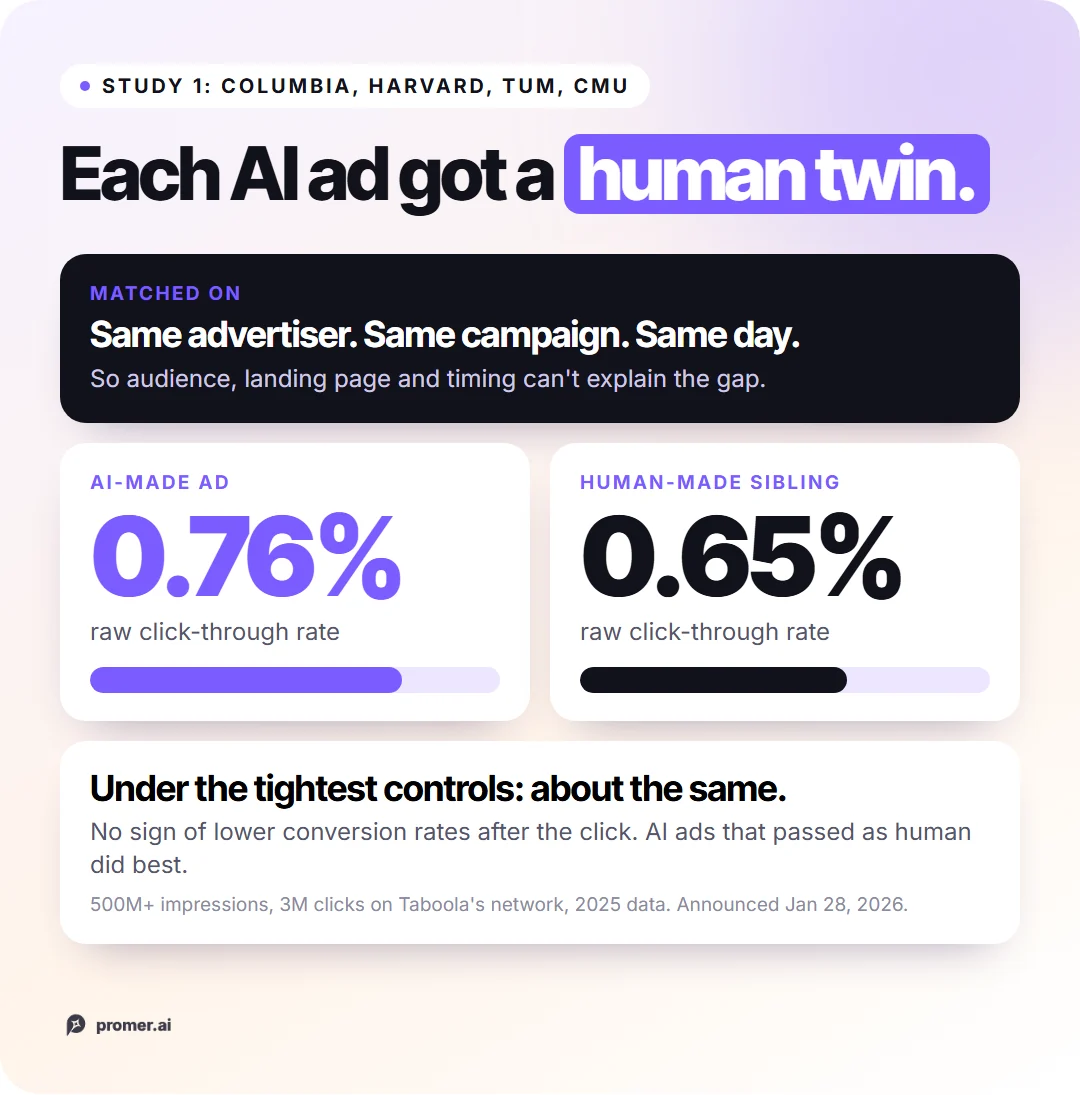
Each AI-generated ad was matched with a human-made "sibling" from the same advertiser, same campaign, same day.
That strips out the usual excuses: different audiences, different landing pages, a better week.
The results:
- Raw click-through rate was 0.76% for AI ads and 0.65% for human ads.
- Under the tightest controls, the two performed about the same.
- AI ads that people didn't recognize as AI did best of all, beating both human ads and AI ads that looked artificial.
- Nearly half of the AI ads were perceived as human-made.
- The researchers found no sign of lower conversion rates downstream.
Two caveats before you quote it.
Taboola sells AI ad tools and announced the study, so the full paper is the place to check method, not the press release.
And Taboola's own AI tool tended to add large, clear human faces, which the study found made any ad feel more human.
Some of the AI "win" may be a faces win.
Study 2: shoppers' brains say AI ads are forgettable
NielsenIQ (NIQ) took the opposite route.
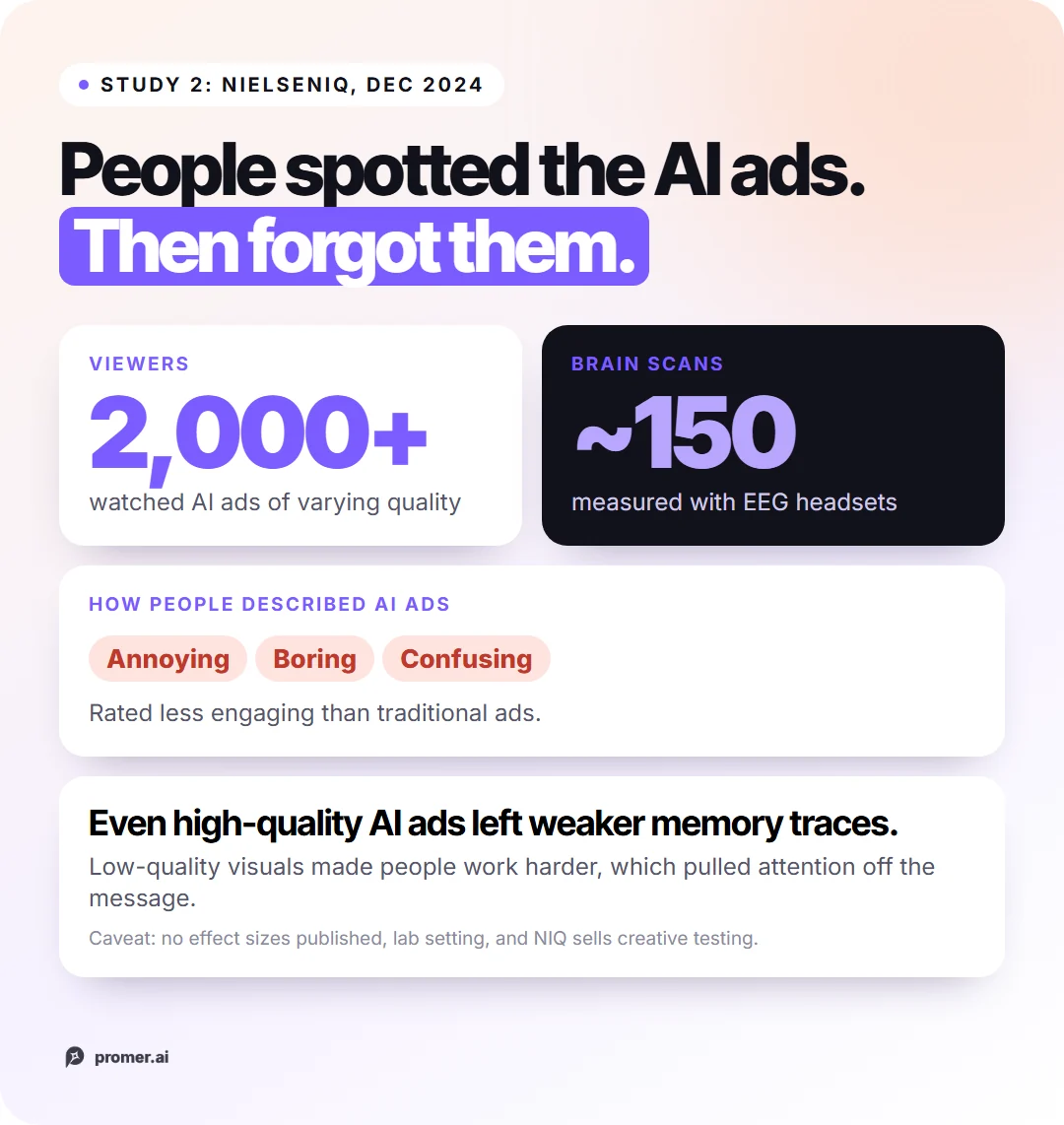
In December 2024 it published results from more than 2,000 people who watched AI-generated ads of varying quality, about 150 of them while wearing EEG headsets.
NIQ found that people spotted most AI ads, rated them less engaging than traditional ads, and described them as annoying, boring and confusing.
Even the ads judged high quality produced weaker memory activation.
Low-quality visuals made people work harder to process the ad, which pulled attention away from the message.
Caveats here too. NIQ published no effect sizes, didn't say how many ads it tested, and sells creative testing, so it has a reason to say "test before you run."
And the people knew they were in a study watching ads, which is not how anyone scrolls Instagram.
The tiebreaker: the label is what costs you
A third study connects the two.
Anindya Ghose and Hyesoo Lee at NYU Stern, with Vilma Todri and Panagiotis Adamopoulos at Emory, compared three kinds of display ads in a field study on Google's Display Network: ads made by human experts, human ads edited with generative AI, and ads generated fully by AI.
The working paper was posted to SSRN in November 2025.
- Fully AI-generated ads lifted click-through rate by up to 19% over the human-made ads.
- Human ads touched up with AI showed no significant gain, and sometimes did worse.
- Disclosing that an ad was made with generative AI cut click-through rate by 31.5%.
So the same AI ad can beat a human one and then lose a third of its clicks the moment a label says "AI."
That's the whole disagreement in one study.
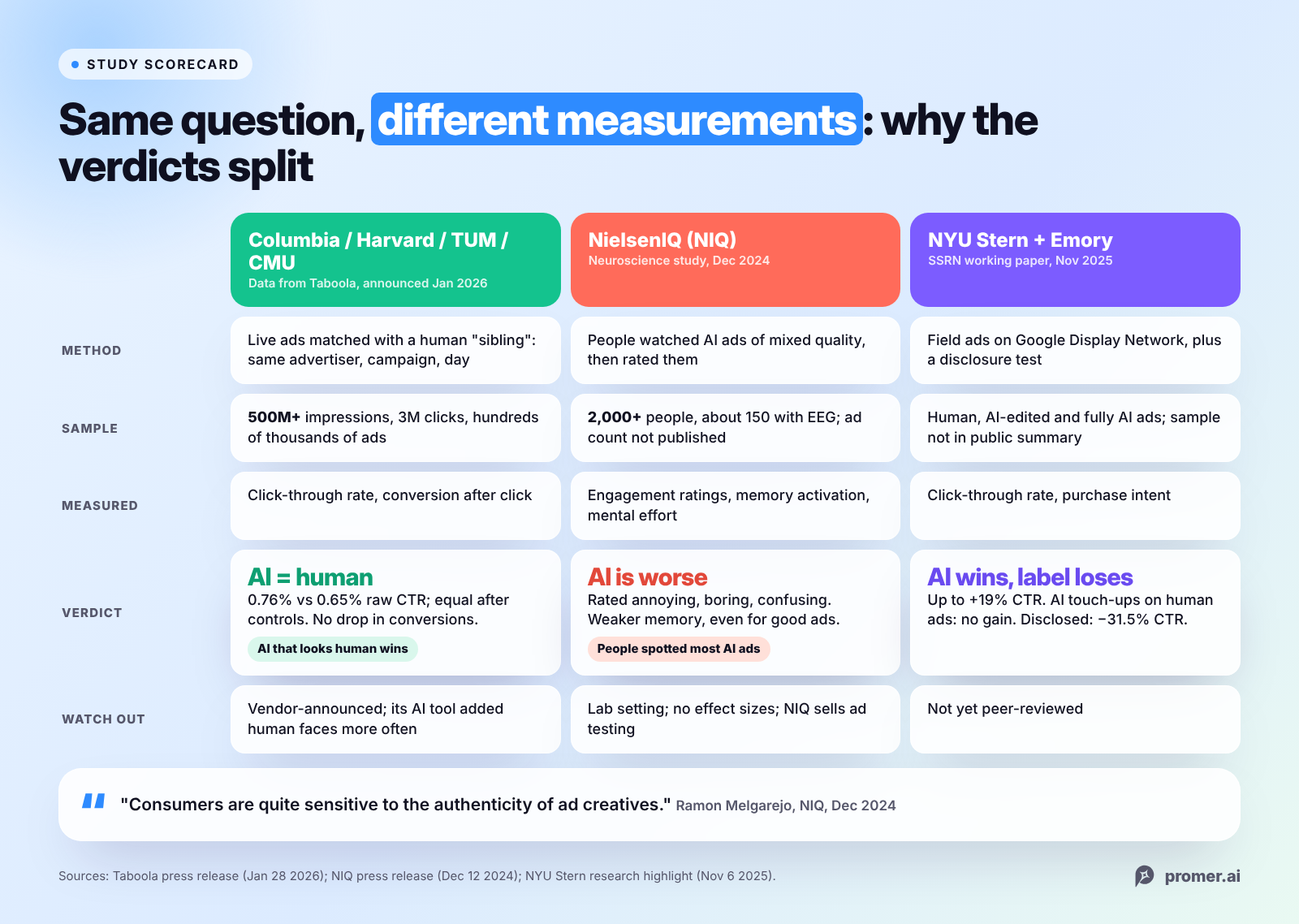
Three studies, three measurements. Sources: Taboola (Jan 2026), NIQ (Dec 2024), NYU Stern (Nov 2025).
Why the studies disagree: 3 things they measured differently
Put side by side, the studies aren't really arguing.
They answer different questions.
1. Clicks today vs memory later. Taboola and NYU counted clicks on live ads.
NIQ measured engagement and memory. An ad can earn a click and still leave no trace of your brand.
For a small store paying for purchases this week, clicks and conversions matter more.
For a brand that wants people to remember it in six months, the NIQ result is a real warning.
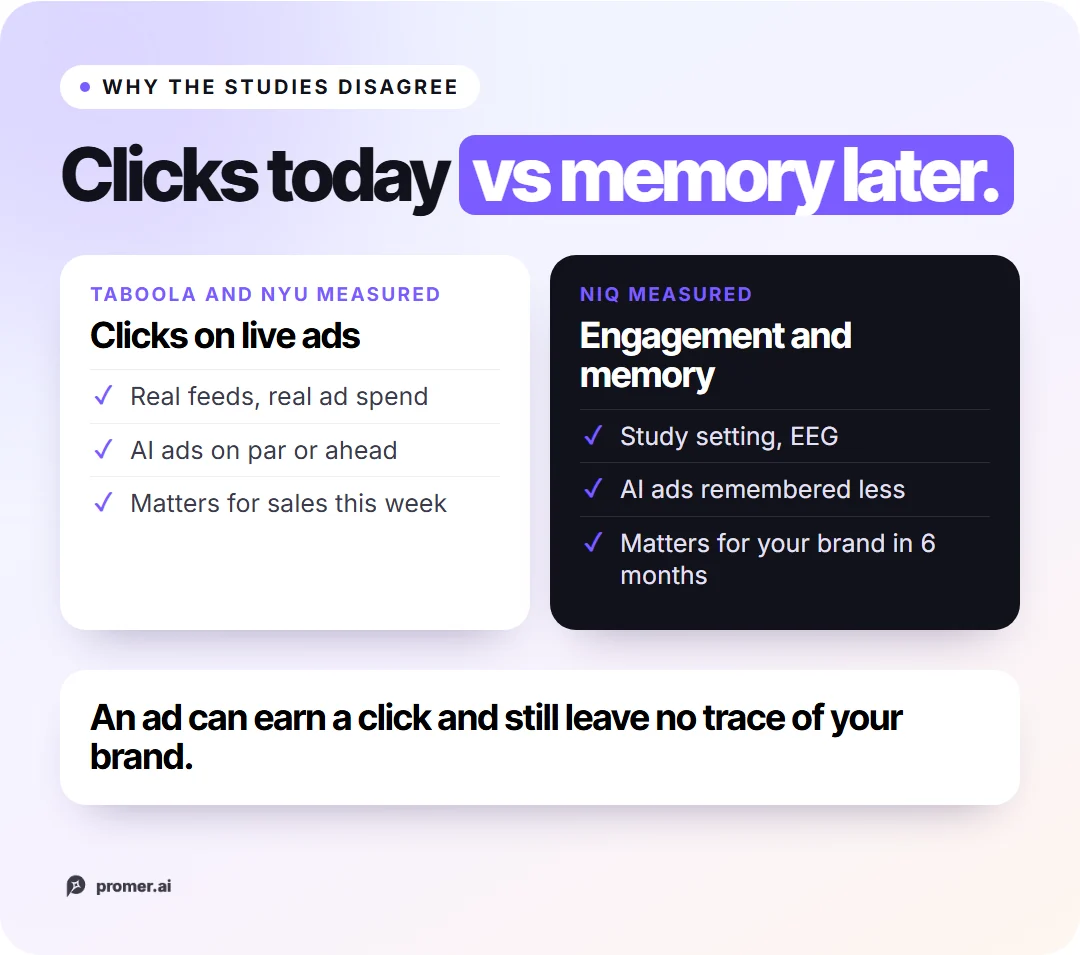
2. Ads that are AI vs ads that look AI. NIQ's participants mostly recognized the AI ads.
In the Taboola data, nearly half of the AI ads passed as human, and those were the winners.
Every study points the same way: the penalty follows the look, not the tool.
Taboola's researchers flagged the giveaways as overly polished visuals, heavy saturation and strong symmetry.
Many of the AI in advertising examples that drew backlash fit the same pattern: audiences reacted to what looked faked.
3. What "AI" meant. "AI-generated ad" covered very different things across the studies: fully generated display images, AI ads built inside an ad network's tool, and video ads of mixed quality.
None of them tested what most merchants worry about most, an AI person pretending to be a real customer, which is the format behind many AI UGC ads.
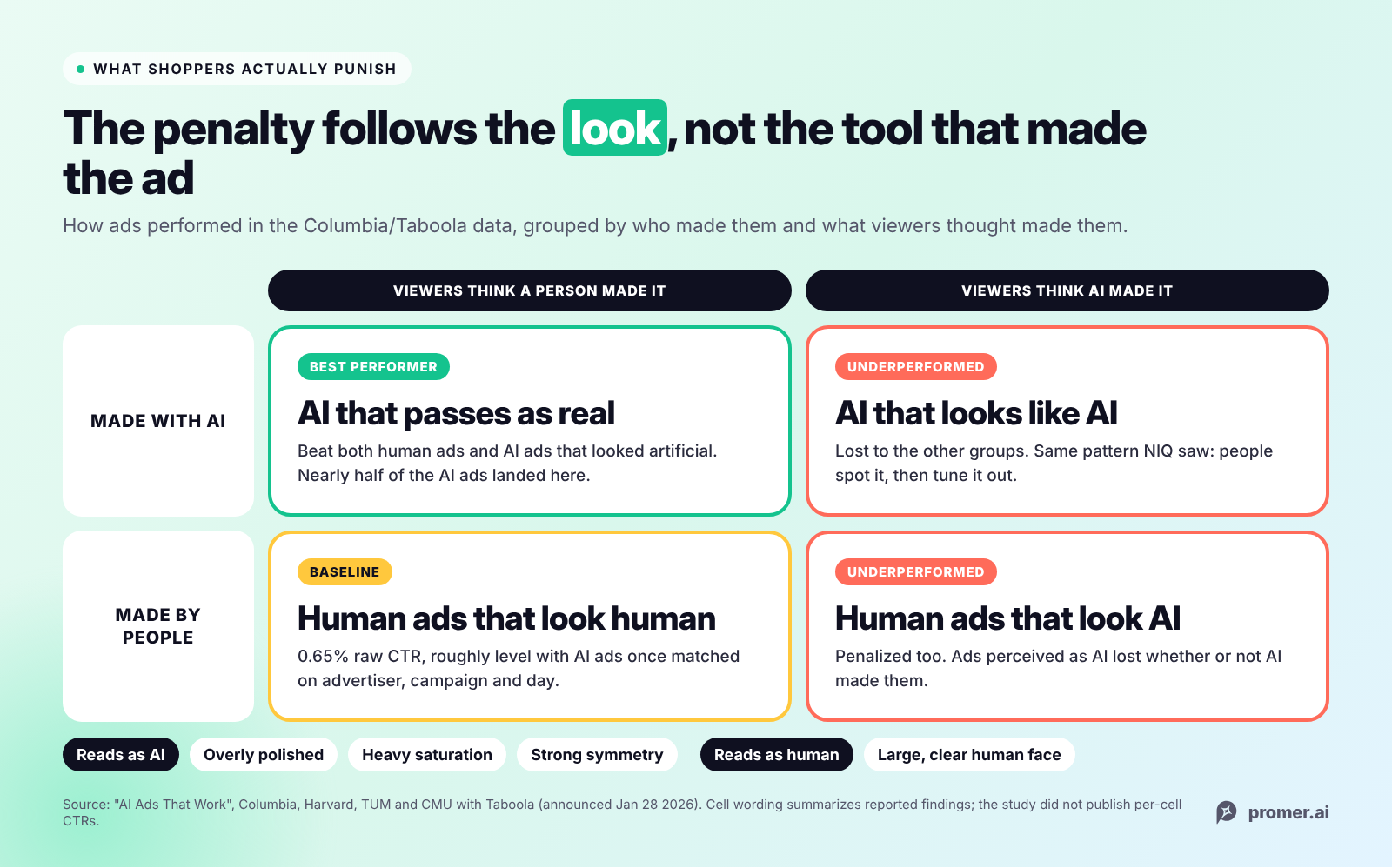
The penalty follows the look. Summary of findings from the Columbia/Taboola study.
The practical reading: AI is not the problem. Looking fake is, and being labeled is.
What Meta's AI labels mean for your ads
This is where the 31.5% number gets personal, because Meta now labels AI ads for you.
Meta's rules, from its February 2025 announcement (updated June 1, 2026):
- Ads created or significantly edited with Meta's own generative AI tools get an "AI info" label. It sits in the "About this ad" section behind the three-dot menu, or next to the "Sponsored" tag.
- If Meta's tools add a photorealistic AI-generated person, the label goes next to "Sponsored," where everyone sees it.
- Small edits that don't add a photorealistic person don't get a label.
- Ads made with third-party AI tools get the "AI info" label when Meta detects industry-standard signals in the file, such as C2PA content credentials that tools like Photoshop and DALL-E can attach.
Notice how this lines up with the research.
A product photo with an AI-generated background usually earns, at most, a label buried in a menu that few people open.
An AI person in your ad earns the visible label, the exact kind of disclosure that cost 31.5% of clicks in the NYU study.
AI people are also the content most likely to look artificial.
Two penalties for the same choice.
Don't try to dodge labels by stripping metadata.
Disclosure rules are tightening, not loosening, and an ad that gets caught looking deceptive costs you more than a label does.
Pick creative where a label doesn't hurt.
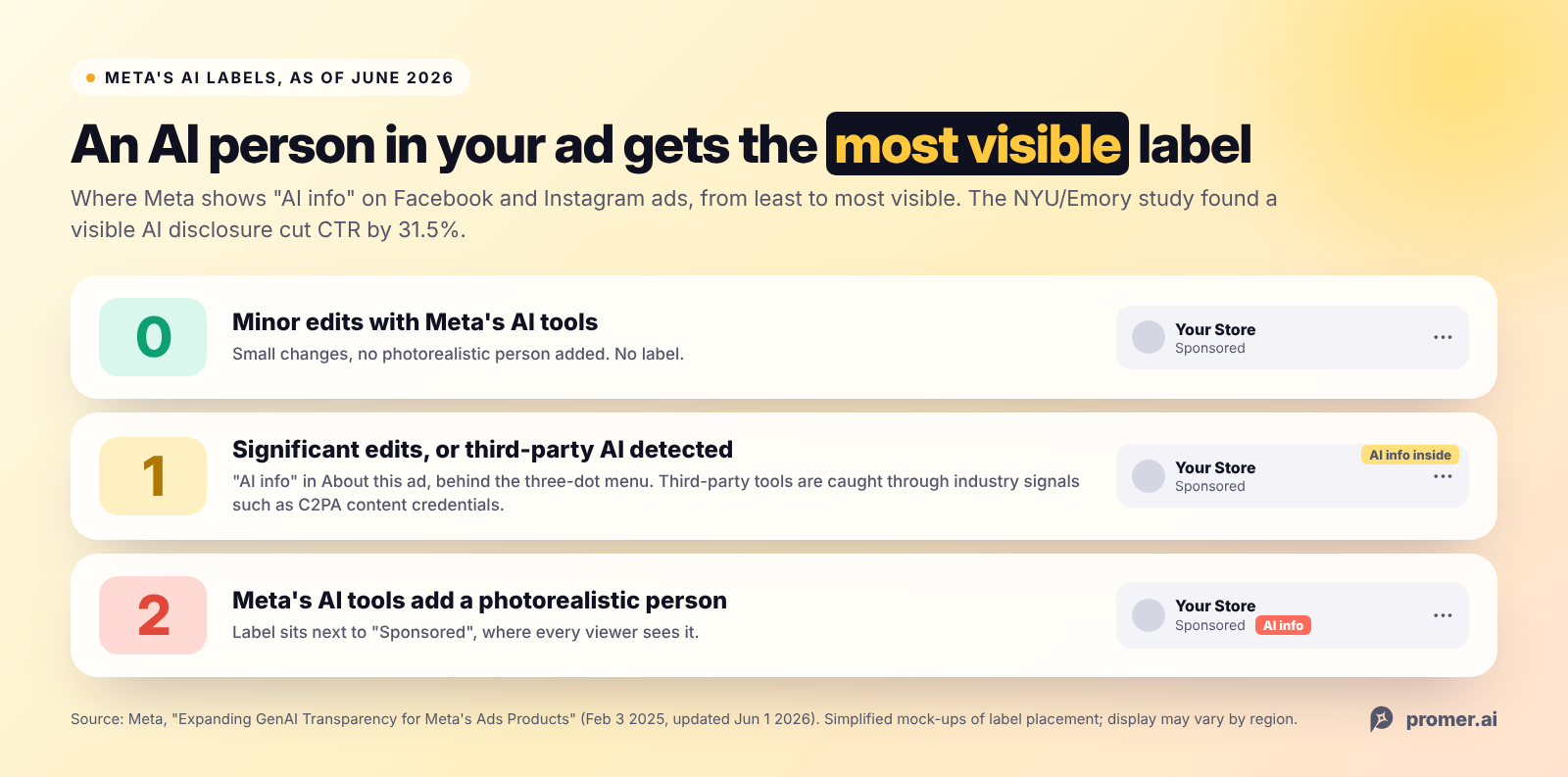
Where Meta shows "AI info" on ads, per Meta (updated June 2026). Simplified mock-ups.
The rule: AI for the product, real for the proof
The evidence supports a simple decision rule.
Use AI for the product side of the ad. Lifestyle scenes, backgrounds, seasonal versions, layout variations, new angles, text overlays.
Nobody reads a background as a promise, so these parts carry the least deception risk, rarely trigger a visible label, and are where speed matters most.
Meta says over 8 million advertisers now use at least one of its AI creative tools, mostly small businesses, so the bar for "more versions, faster" has moved.
Keep proof real. Customer reviews, customer faces, testimonials, before-and-after results, ratings, guarantees and offers.
A shopper reads these parts as evidence.
If the evidence is invented, you have a trust problem, an FTC problem with fake reviews, and, if the face is AI, a likely label.
A quick way to sort any element: would the ad be lying if this part were made up?
A pot sitting on a sunny windowsill that it fits on is fine.
A smiling "verified buyer" who never existed is not.
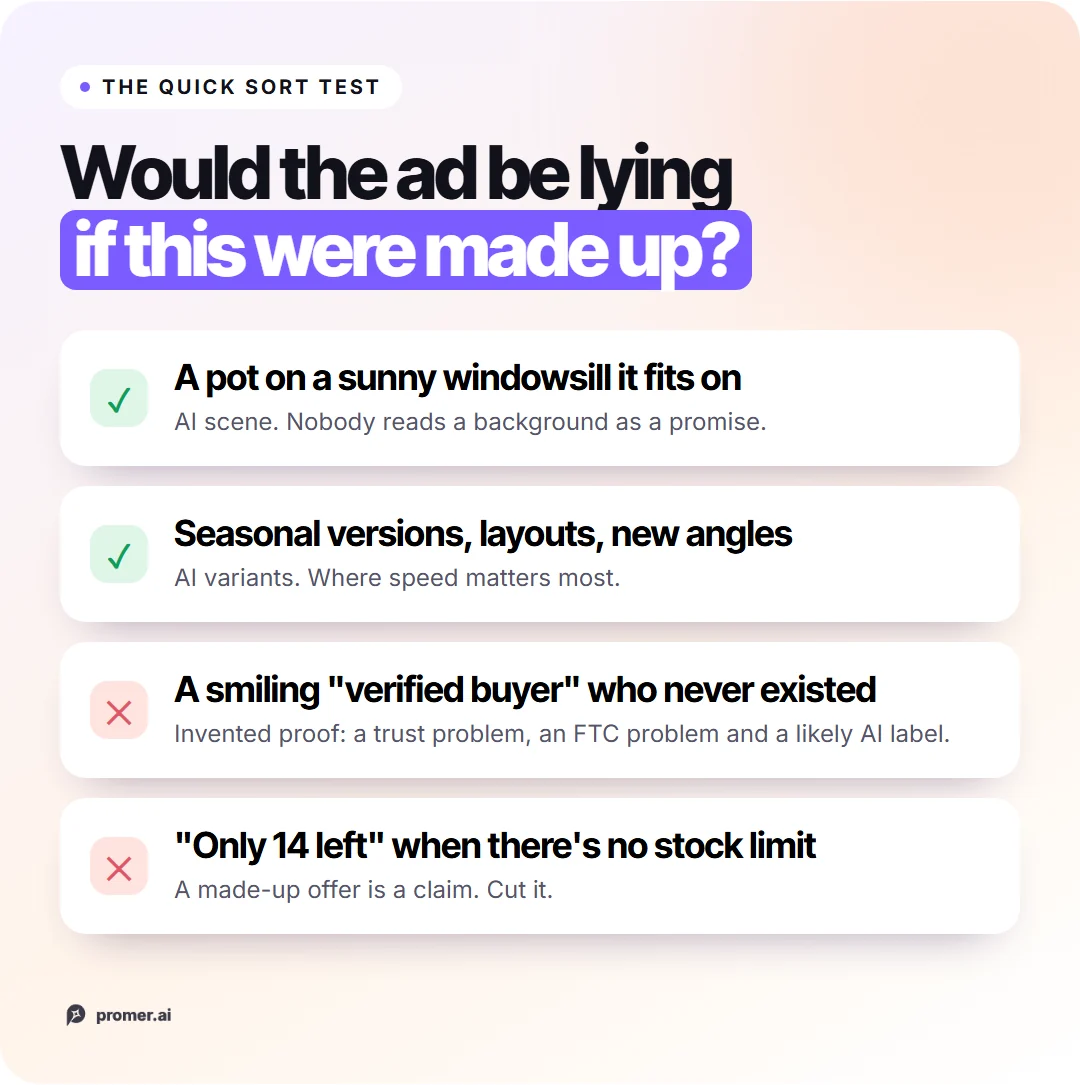
If you need real proof to put into ads, customer review mining shows how to pull angles and quotes from reviews you already have.
For product photos specifically, our side-by-side test of AI product photography vs real photos shows which placements each one should own.
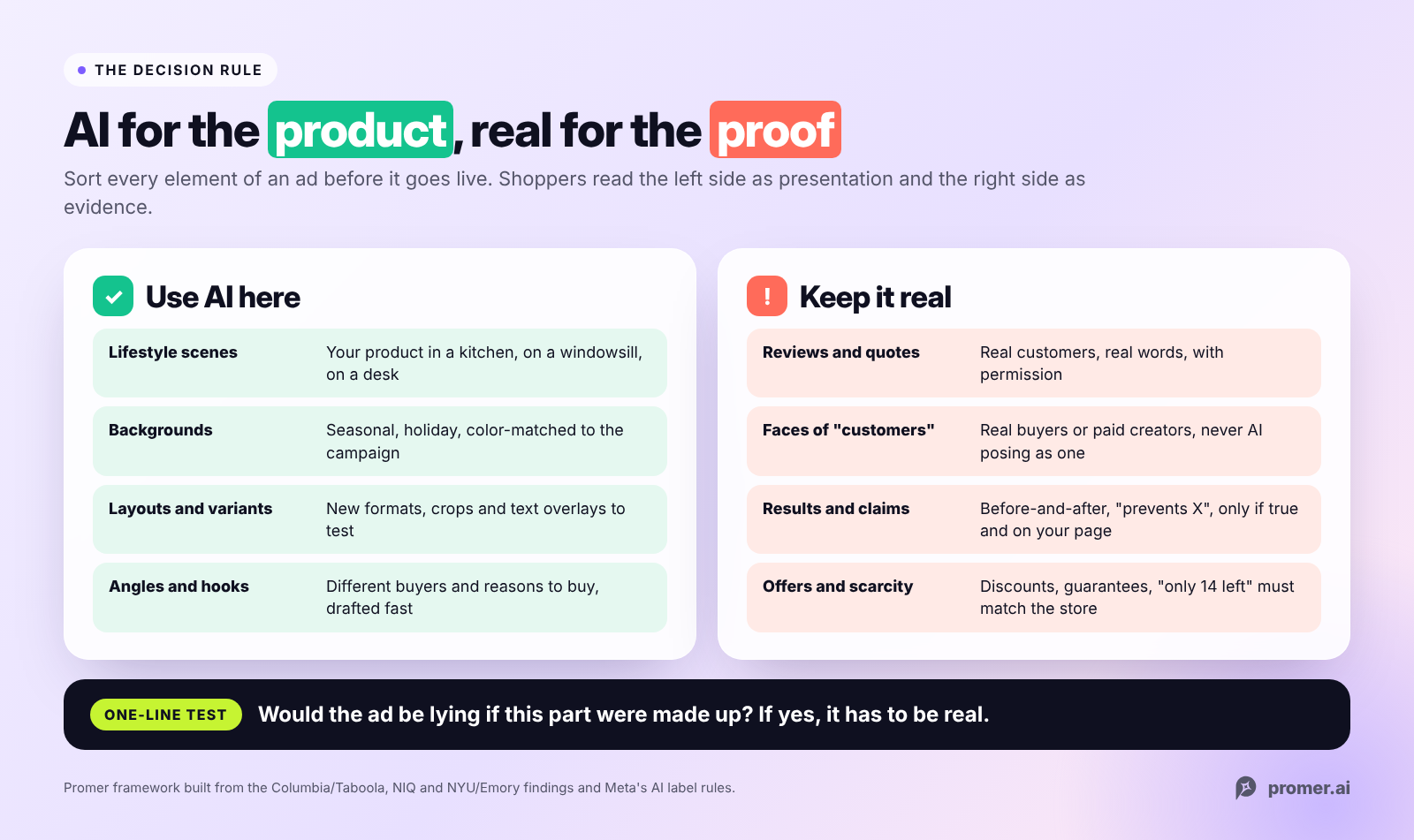
AI for the product, real for the proof.
Need AI scenes for your product, not AI customers? Promer AI's AI Photoshoot turns your own product photos into new studio shots in different styles, ready to use in ads.
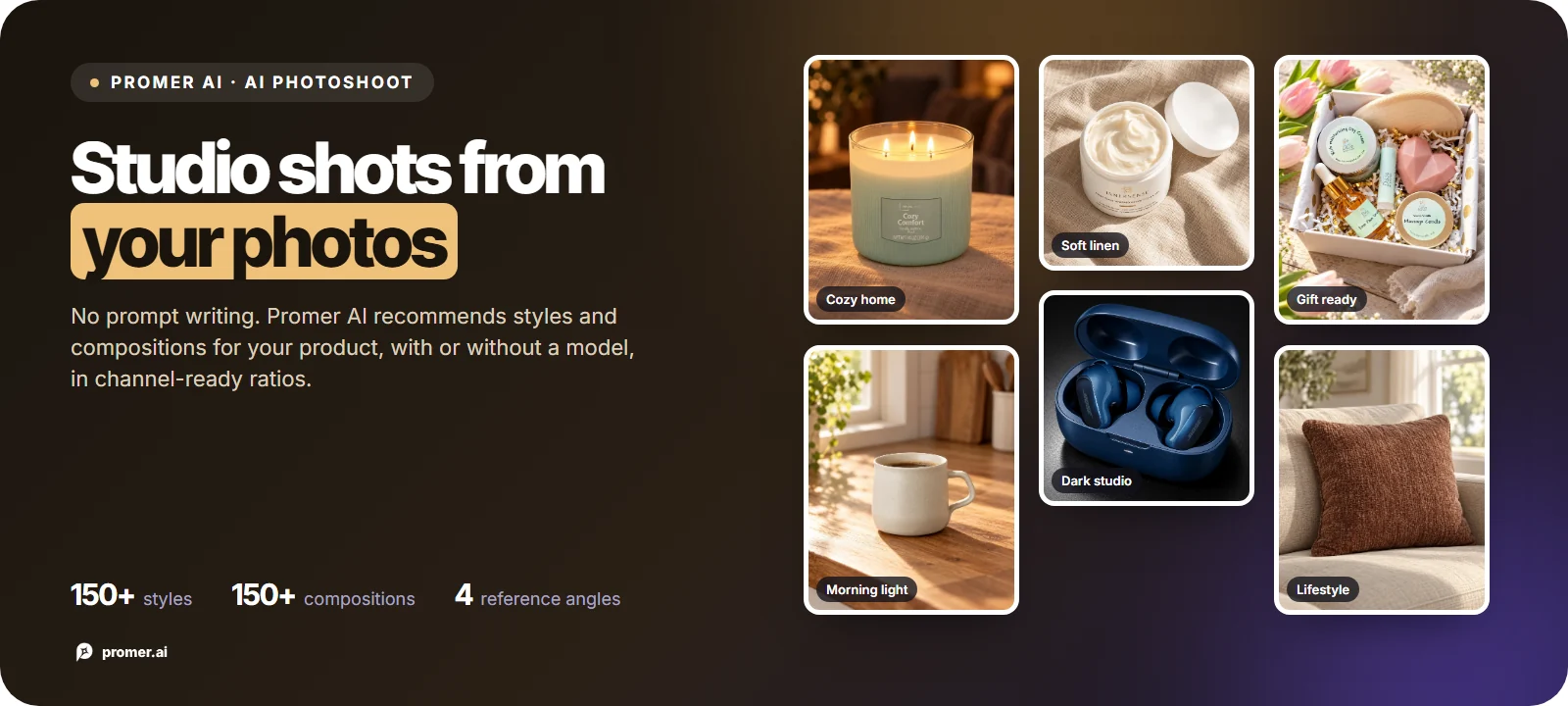
Make AI scenes for my product →
Test it on your own store: a 3-ad experiment
The studies tell you what happens on average across thousands of advertisers.
Your store isn't average, so check it with a test small enough to run this month.
Set up three ads for one product, same copy, same offer, same audience:
| Ad | Creative | What it tests |
|---|---|---|
| A | Your best real product photo | Your baseline |
| B | AI product scene (no people), same product, same headline | Does AI on the product side help? |
| C |
Skip the fourth ad you might be tempted to make, the AI person holding your product.
Even if it clicks, it's the version most likely to get a visible label and to make a real customer feel misled.
Judge on the right metric for your budget. On a small budget, judge creatives on click-through rate first, not purchases.
From our creative testing math for small budgets, spotting a real difference between a 1.5% and a 2.0% CTR takes about 10,780 impressions per ad, roughly $151 per ad at a $14 CPM.
That's about $450 for all three.
Telling purchase rates apart (1.4% vs 2.1%) takes around 5,500 landing page visits per ad, which most small stores can't afford per test.
Then check what happened after the click. A creative that wins clicks but sends people who bounce isn't a winner.
Compare add-to-cart rate for the three ads once each has 300+ landing page visits.
If you're testing AI video or AI UGC as well, this guide on the ROI of AI-generated UGC ads covers hook rate and CPA checks that fit video.
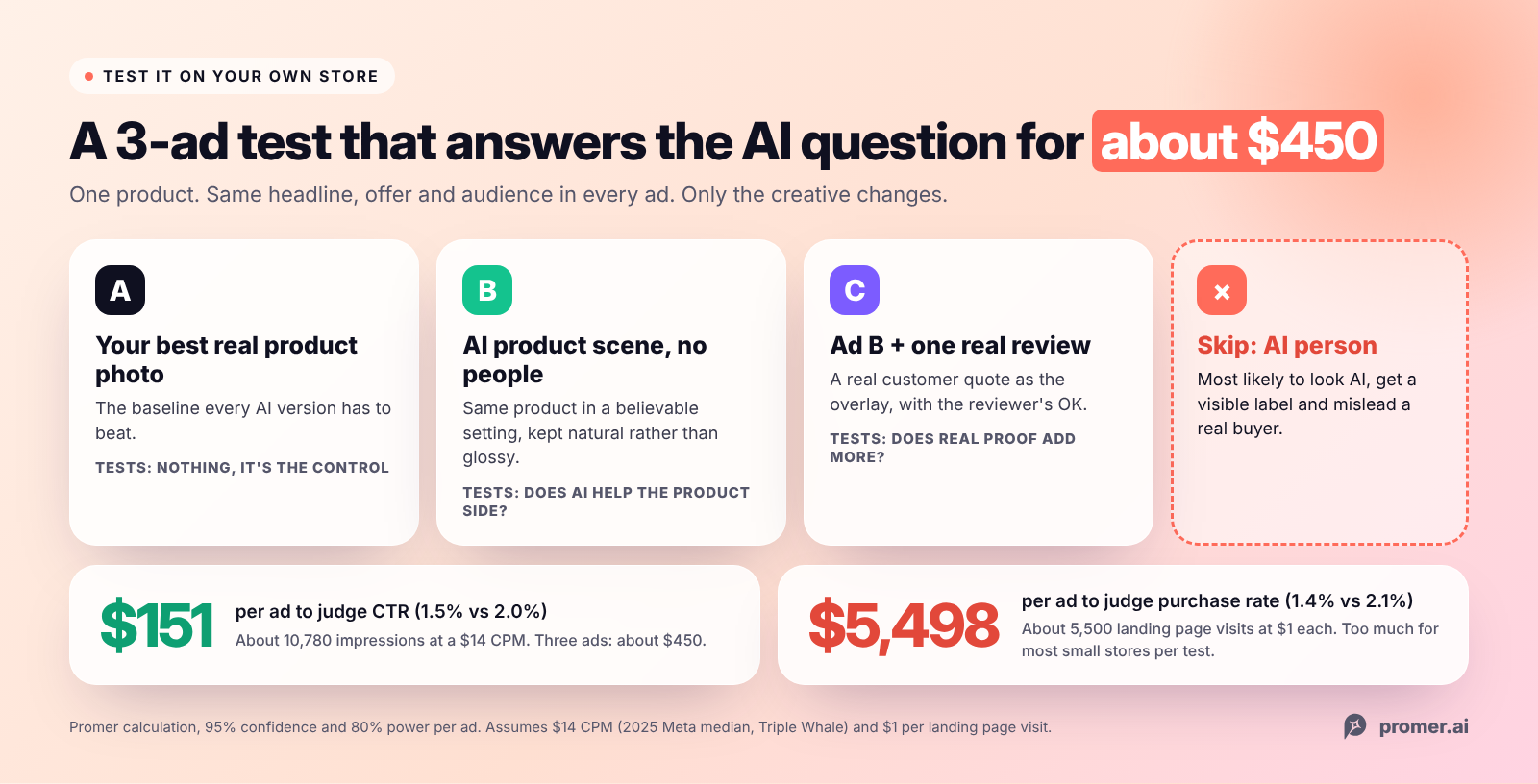
A 3-ad test you can run for about $450.
Reading the result:
- B beats A on CTR: AI scenes earn their place. Make more product-side variants.
- B and A tie: AI still wins on cost and speed. Use it to produce more angles, not to replace good real photos.
- B loses to A: look at the AI version with fresh eyes. Too glossy, too saturated, too perfectly symmetrical? Those were the AI giveaways in the Taboola data. Tone it down and retest once.
- C beats B: real proof is doing the work. Put real reviews into more of your AI-made creatives.
How to do this with Promer
Promer is built for the product side of this rule.
You paste a product URL or upload a product photo, and it reads the product page, works out who the buyer is and what's stopping them, then generates finished ad concepts in a creative theme you pick, such as Problem & Solution, Before & After or Testimonial.
We ran it on a real product to show both the speed and the limits.
The product was the $48.99 Self-Watering Pot with Water Gauge from SnugGreen, a store run by the author.
We chose the Testimonial theme on purpose, since it's where the "keep proof real" rule gets tested.
One run (15 credits, a couple of minutes) returned five finished concepts.
The product side was strong. Promer pulled the right buyer from the page (people who keep killing herbs on a windowsill), and every image showed the long white planter with its dark rim and gauge window in a believable kitchen or window scene.
Shooting the same scenes for real would need props, a location and a photographer.
The proof side needed work, which is exactly what the research predicts:
- The quotes were credited to people who don't exist, such as "Elena M., Verified Buyer," "Maya K., Brooklyn apartment dweller," and "Chef Marcus, Farm-to-Table Culinary Consultant." The last one is an invented expert endorsement.
- One concept added "Only 14 Units Left in Stock." The store has no such stock limit.
- Every image put a photorealistic AI person, or AI hands, next to the product. That's the content most likely to read as AI, and the kind Meta labels most visibly when its own tools add it.
- The product insights listed "prevents root rot," a claim the product page never makes.
None of this is unusual for AI ad tools.
Ask any model for a testimonial ad and it will write a testimonial, because that's the format you asked for.
The fix is quick: keep the scenes, replace the invented quotes with real reviews (or drop the quote and lead with the gauge), and delete the stock line.
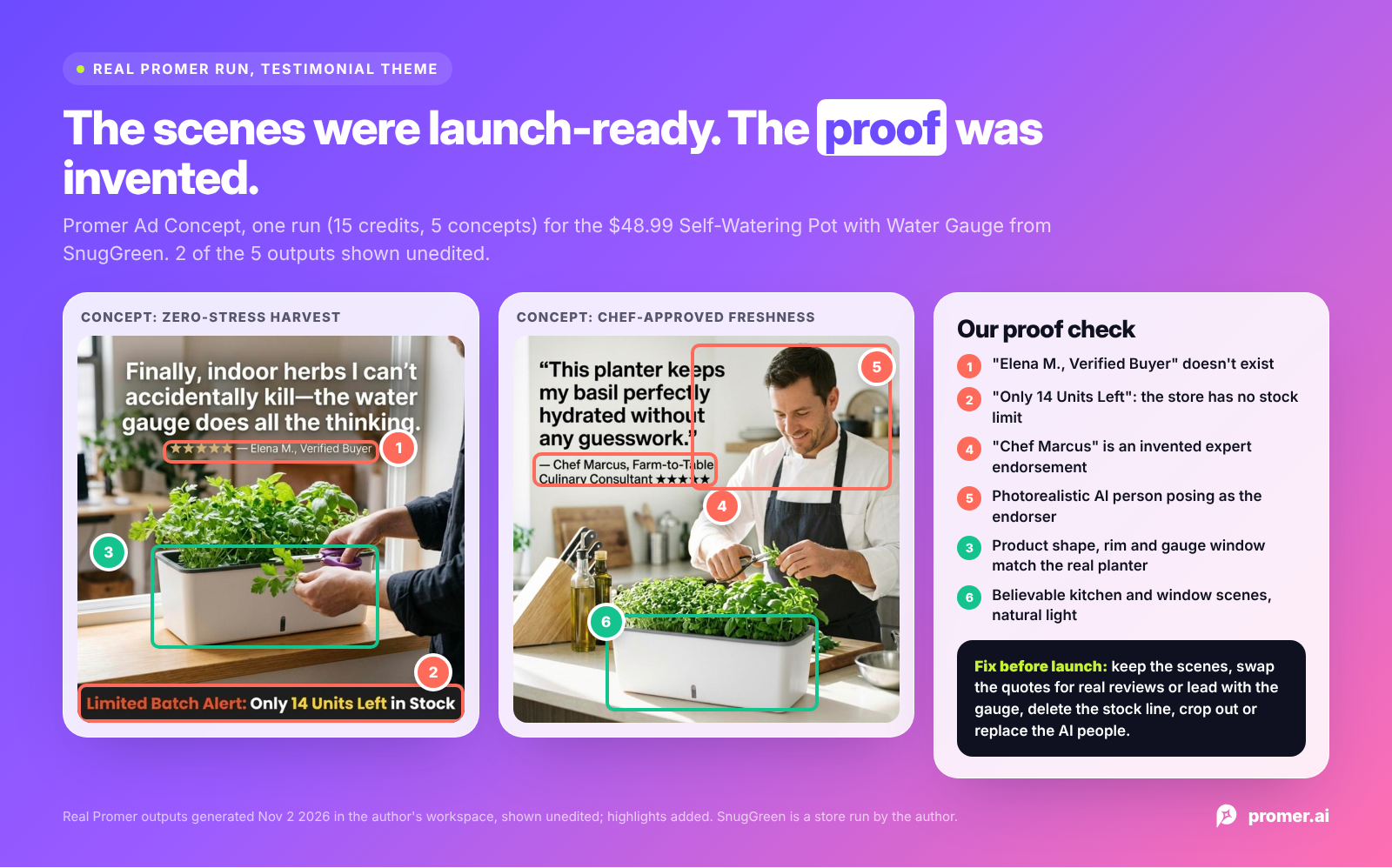
Real Promer outputs, generated Nov 2, 2026, shown unedited with highlights added. SnugGreen is a store run by the author.
That's the right way to use any AI ad tool, Promer included: let it handle research, angles and layouts in minutes, then do a two-minute proof check before anything goes live.
Keep the scenes and the angles.
Swap invented quotes for real reviews, and cut any claim your product page doesn't make.
For a step-by-step on the rest of the workflow, here's how to make product ads with AI from a single product link.
Try Ad Concept on your own product, then run the three-ad test above against your best real photo.
Mistakes to avoid
Judging "AI ads" as one thing. An AI background behind a real product photo and an AI-generated spokesperson are different bets with different risks.
Test them separately.
Shipping the glossiest version. The more polished and symmetrical an AI image, the more it reads as AI.
Pick the version that looks like a good photo, not a render.
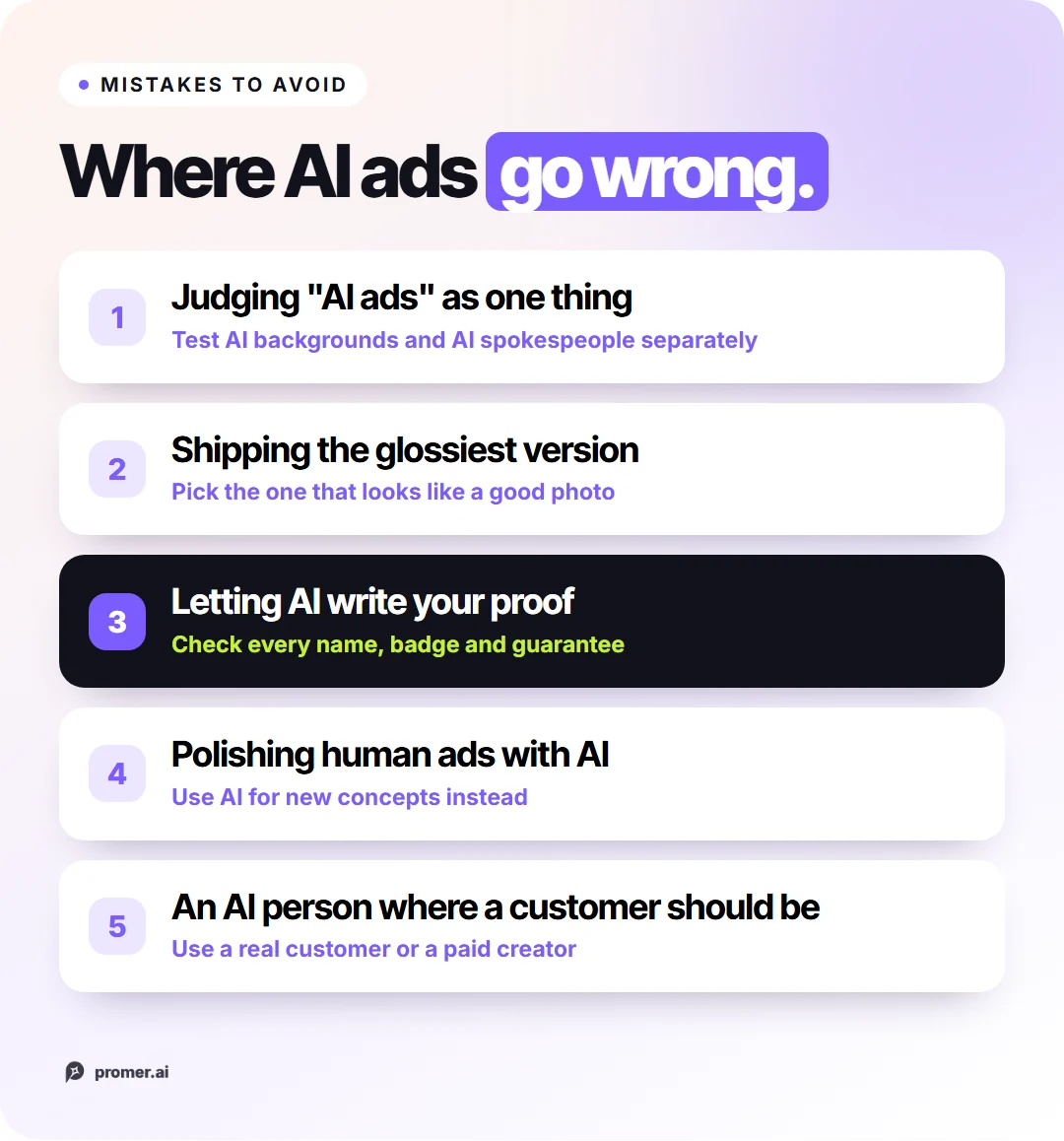
Letting AI write your proof. AI tools fill gaps with plausible details: a customer name, a guarantee, a "chef-approved" badge.
Every one of those is a claim.
Check each against your product page and your real reviews.
Editing human ads with AI and expecting a lift. In the NYU/Emory study, AI touch-ups on human-made ads showed no significant gain.
If you use AI, use it to create new concepts, not to polish old ones.
Putting an AI person where a customer should be. If you want a face in the ad, use a real customer or a creator you paid.
AI avatars can work for product explainers, but not as fake buyers.
FAQ
Do AI-generated ads perform better than human-made ads?
On average, they perform about the same, and sometimes better.
A matched study of hundreds of thousands of live ads (500M+ impressions) found AI ads on par with human ads after controls, at 0.76% vs 0.65% raw CTR.
An NYU/Emory field study found fully AI-generated display ads lifted CTR by up to 19%.
The ones that win are the ones that don't look artificial.
Do people trust AI-generated ads?
Less, once they notice. NielsenIQ's study of 2,000+ people found AI ads rated less engaging and described as annoying, boring and confusing, with weaker memory activation.
The Columbia/Taboola researchers saw the same thing in click data: the ads people took for AI lost, even when a person had made them.
Trust drops when an ad looks fake or is labeled AI, not because AI was used somewhere in the process.
Does Meta label AI-generated ads?
Yes. Ads created or significantly edited with Meta's generative AI tools get an "AI info" label in "About this ad" or next to "Sponsored."
If Meta's tools add a photorealistic AI person, the label shows next to "Sponsored."
Ads from third-party AI tools are labeled when Meta detects industry signals such as C2PA content credentials in the file.
Does an AI disclosure label hurt ad performance?
In one field study, yes. Researchers at NYU and Emory found that telling people an ad was made with generative AI cut its click-through rate by 31.5%.
Meta's label usually sits behind the ad menu, so the effect may be smaller there, but a label next to "Sponsored" is visible to everyone.
That's a reason to avoid AI-generated people in ads.
Should small ecommerce stores use AI ads?
Yes, for the product side of the ad: scenes, backgrounds, layouts and new angles.
That's where AI saves the most time and carries the least risk.
Keep reviews, customer faces, results and offers real.
Then test an AI version against your best real photo on click-through rate before you scale it.
Do AI-generated ads hurt conversion rates?
The large Columbia/Taboola study found no evidence that AI ads lowered conversion rates after the click.
That's one study on one ad network, so check it on your own store: compare add-to-cart rate for AI and real creatives once each ad has a few hundred landing page visits.
What makes an ad look AI-generated?
The Columbia/Taboola researchers named overly polished visuals, heavy color saturation and strong symmetry as the main giveaways.
Large, clear human faces made ads feel more human.
In product ads, also watch for warped labels, wrong product proportions and impossible lighting, which tell shoppers the image isn't real.
The bottom line
AI-generated ads work best when nobody can tell, and lose when the ad looks fake or carries a visible label.
That isn't a reason to avoid AI.
It's a reason to aim it at the parts of the ad that don't need to be real, and keep the parts that do.
Run the three-ad test, keep your proof honest, and let the numbers from your own store decide how far to push it.