AI UGC is video ad creative generated entirely by AI - script, presenter, and voice - built to copy the format of real user-generated content without a real creator filming it.
It is not user-generated content in the literal sense, since no user generated it. What it borrows is the format: a casual, direct-to-camera or hands-on style that reads as personal rather than produced, the same visual language that makes real UGC feel trustworthy in a feed full of brand ads.
This is a different question from what UGC ads are as a category.
UGC ads are paid creative built from customer-style content, and they can be sourced from real creators or generated by AI - the ad format is the same either way. AI UGC is specifically the production method: no creator, no filming, no shipping a product to someone's house. A product goes in, and a rendered video comes out, generated by an AI model, an AI voice, and an AI-written script standing in for what a human creator would normally do.
This article covers what AI UGC actually is, how the generation process works end to end, where it genuinely helps and where it doesn't, and how to start producing it without overclaiming what it can do.
Key Takeaways
- AI UGC is AI-generated video that mimics the format of real user-generated content - it is a production method, not a claim that real customers made it
- The technical process combines an AI model (avatar), an AI voice, and an AI-generated script, rendered into a finished video
- AI UGC removes the filming and creator-booking bottleneck, not the need for a strong hook, angle, and message
- It performs best for testing hook and format variations at volume; real creator UGC still carries more weight for trust-dependent, hero-campaign moments
- Disclosure and honesty matter - AI UGC should not be presented as a genuine customer testimonial when it isn't one
AI UGC vs UGC Ads: Where the Line Actually Sits?
The confusion between these two terms is common enough to be worth clearing up directly before going further.
- UGC ads are a category of paid creative - ads built to look and feel like content a real customer made, rather than a produced brand commercial. A UGC ad can come from an actual paying customer, a paid UGC creator hired to produce customer-style content, or an AI tool. The format - casual framing, direct address, personal tone - is what defines the category, not who or what made it.
- AI UGC is one specific way to produce that format: entirely through AI generation, with an AI model standing in for the presenter and an AI voice standing in for narration, built from a script the AI also generates or helps generate. It is a production method sitting inside the broader UGC ad category, not a separate ad format of its own.
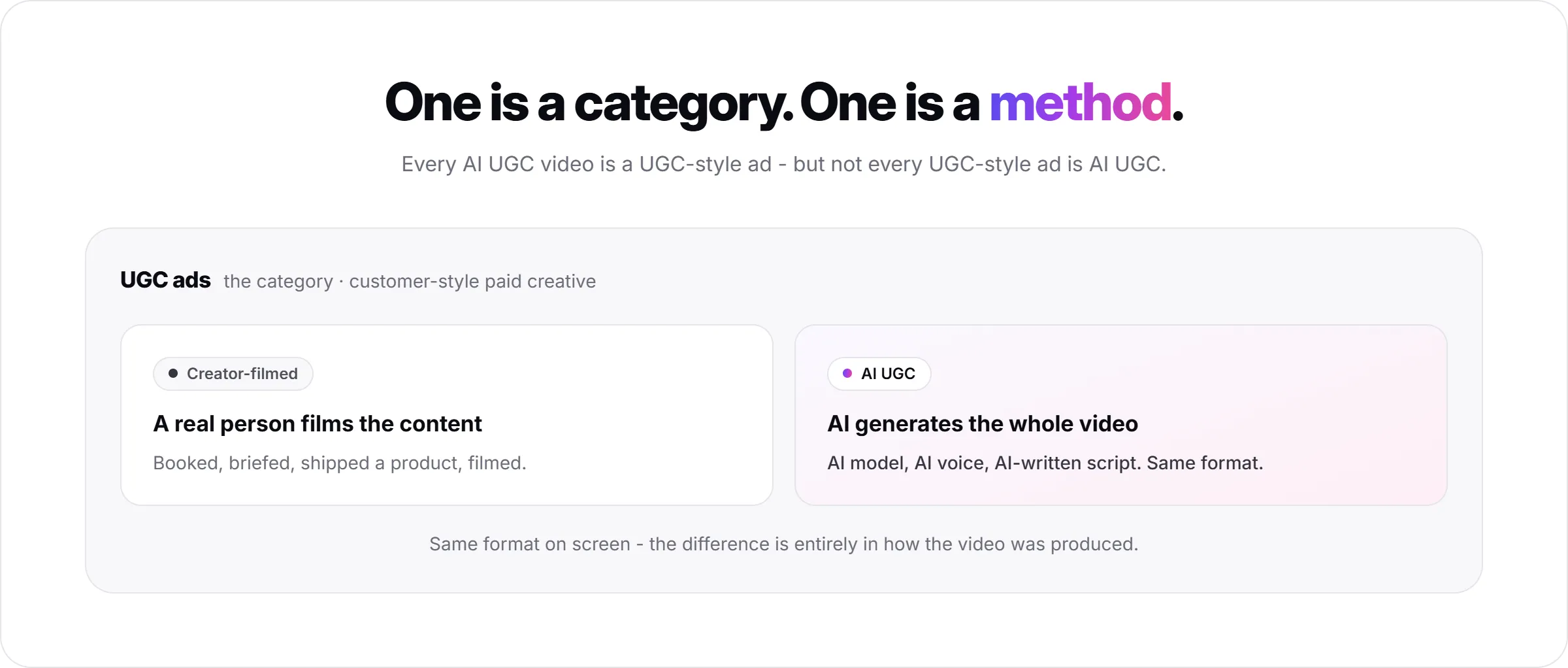
Put simply: every AI UGC video is a UGC-style ad, but not every UGC-style ad is AI UGC. A creator-filmed testimonial and an AI-generated testimonial can use the exact same format and structure - the difference is entirely in how the video was produced, not in what it looks like on screen.
How AI UGC Actually Works?
AI UGC generation runs through a small number of components chained together, and understanding each one clarifies what the AI is actually doing versus what still requires human input.
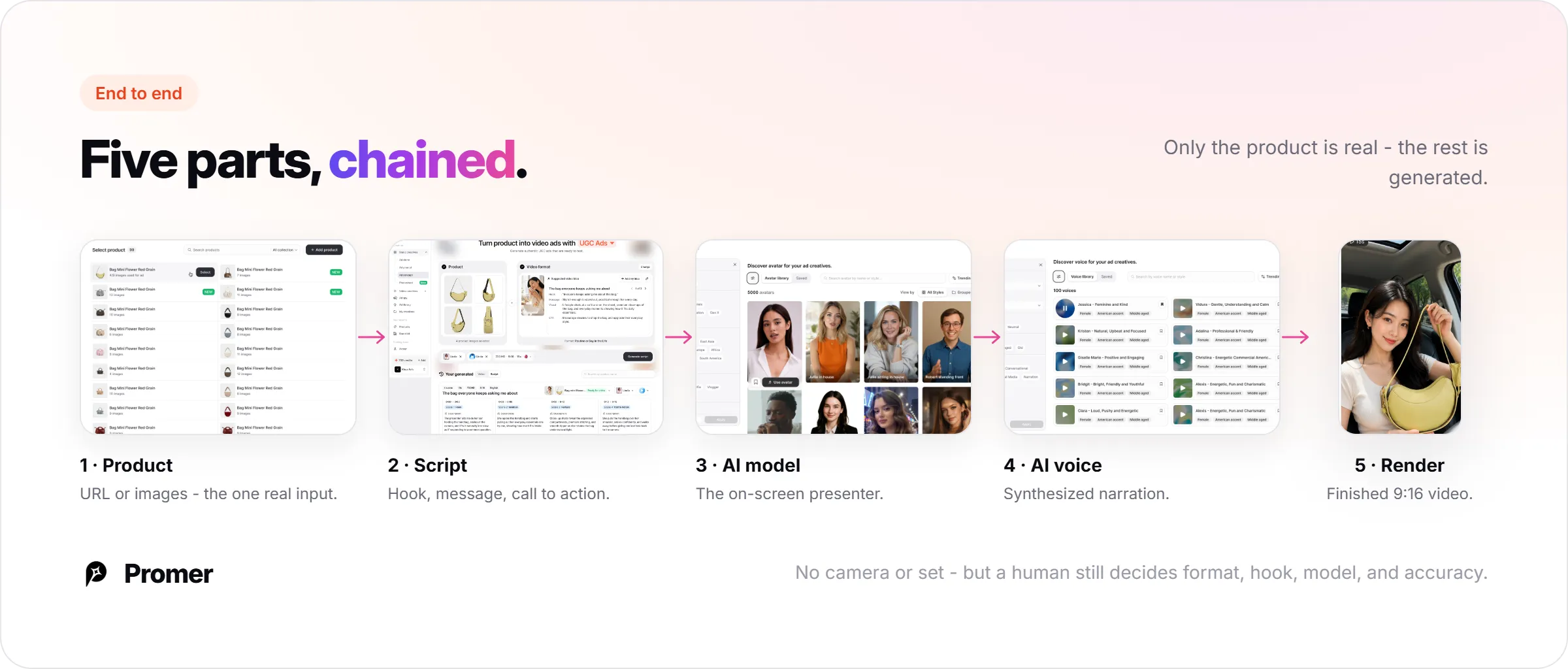
- Product input. The process starts from a product - typically a URL or a set of product images. This is the one input that isn't AI-generated; it's the real product the ad needs to represent accurately.
- Script generation. The AI generates or suggests a script structured around a specific format - a testimonial, a demo, a problem-and-solution narrative - broken into a hook, a message, and a call to action. This is where the "video idea" comes from: what the presenter says, in what order, and why.
- AI model (avatar). A generated or licensed AI presenter appears on screen, selected from a library rather than filmed live. Model libraries typically let you filter by attributes like age, gender, region, and presentation style, so the "presenter" matches the audience the ad is aimed at.
- AI voice. A synthesized voice reads the script, matched to the AI model in tone and language. Voice libraries typically filter by language, accent, gender, and use case, since a voice built for a product review sounds different from one built for casual narration.
- Rendering. The script, model, and voice are combined into a finished video, typically formatted vertically (9:16) to match Reels, Stories, and TikTok, where most UGC-style ads run.
None of these steps require a camera, a filming schedule, or a real person on set. What they still require is a human decision at nearly every step: which format fits the product, which hook is worth testing, which model and voice actually match the target customer, and whether the finished script is accurate before it renders.
What AI UGC Solves - and What It Doesn't?
AI UGC exists because traditional UGC production has a structural bottleneck: every video depends on booking a creator, waiting for filming, and reviewing footage before it's ready to test. That bottleneck caps how many hook or format variations a team can realistically produce in a given cycle, regardless of budget.
AI UGC removes that specific bottleneck. Generating a new variation - a different hook, a different format, a different presenter - doesn't require a new booking or a new shoot, so the cost and time per variant drop enough to test meaningfully more ideas in the same cycle.
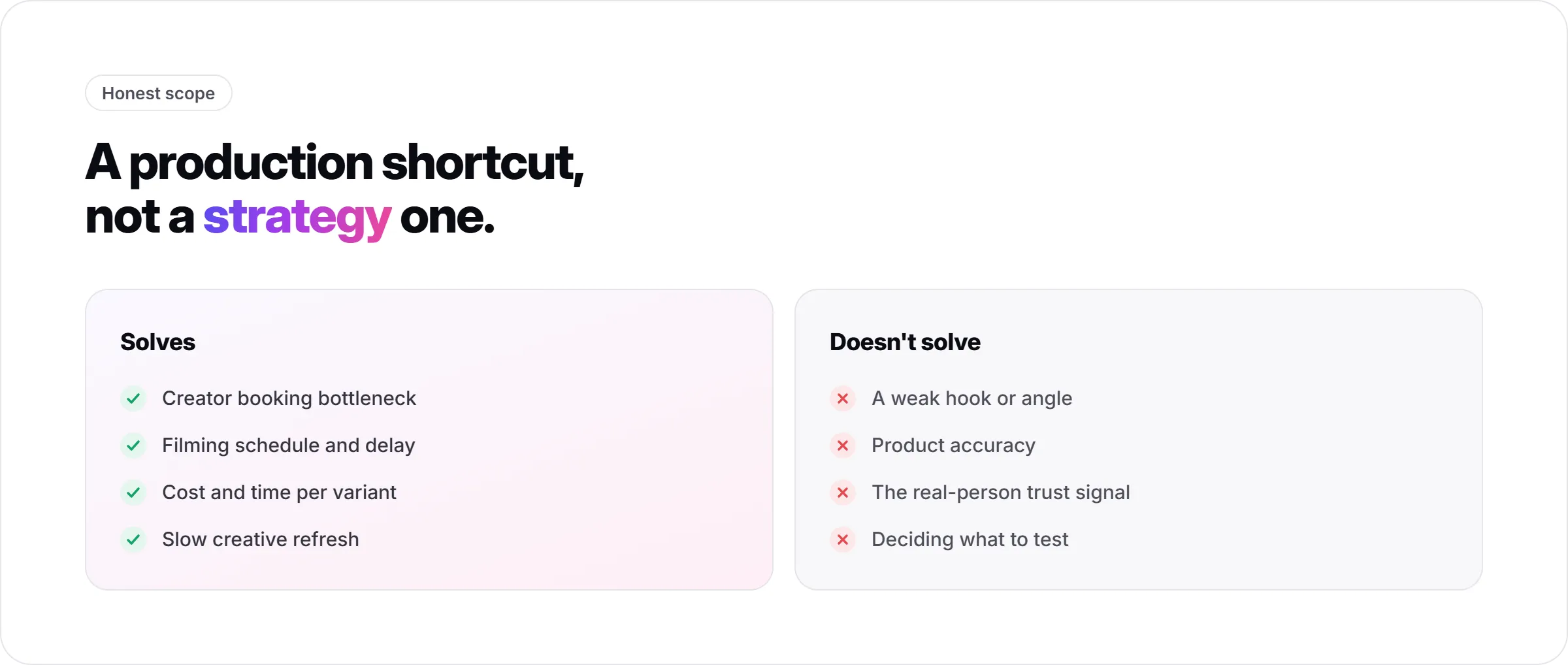
What AI UGC does not solve is the judgment layer that decides whether an ad works in the first place. A weak hook underperforms whether an AI model delivers it or a real creator does. Product accuracy still matters - an AI-generated video can misrepresent a product just as easily as a bad creator brief can, and arguably more easily, since there's no human on set catching an obvious mismatch in the moment. AI UGC is a production shortcut, not a strategy shortcut.
There's also a trust dimension that production speed doesn't touch. Real UGC carries implicit social proof - a viewer's assumption that a real customer is speaking. AI UGC doesn't carry that same assumption once a viewer recognizes it as AI-generated, which is why disclosure matters and why AI UGC tends to perform differently depending on how much the specific ad leans on "this is a real person telling you this worked" versus "here's a clear, well-produced explanation of the product."
When AI UGC Works Well (and When Real Creators Still Win)?
AI UGC is strongest in situations where volume and iteration speed matter more than individual-video authenticity signals:
- Hook and angle testing - running several distinct openings against the same audience to find which one earns attention, where the cost of testing five AI variants is far lower than booking five creator shoots
- Format testing - trying a testimonial against a POV demo against a problem-and-solution structure for the same product, without needing five separate creators
- Fast creative refresh - replacing a fatigued ad quickly, since UGC-style ads lose performance faster than produced ads once an audience has seen the pattern a few times
- Multi-market or multi-language variants - producing the same core concept in different languages without recasting creators for each market
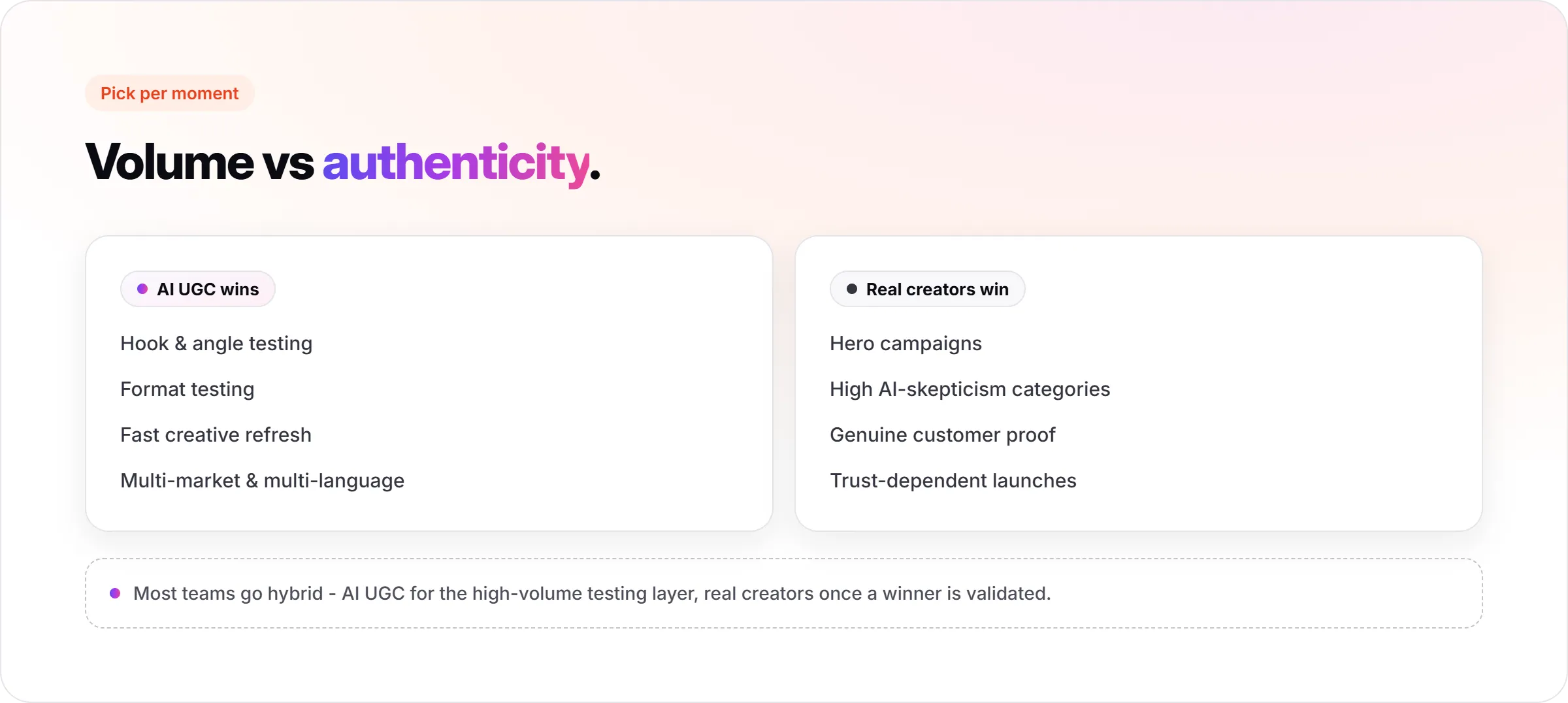
Real creators still tend to win in situations where authenticity itself is the point, not just the format:
- Hero campaigns where a single, high-trust asset carries disproportionate weight - a flagship testimonial, a launch video
- Categories with high AI skepticism - certain health, wellness, and high-consideration purchases where audiences scrutinize authenticity more closely
- Genuine customer proof - when the actual claim being made is "a real customer says this," AI generation undermines the specific thing the ad is trying to prove
Most teams that use AI UGC well don't treat it as a wholesale replacement for creators. They use it for the high-volume testing layer, then bring in real creators once a structural winner - a hook, a format, an angle - has already been validated through ad creative testing at lower cost.
How to Start Producing AI UGC?
Getting started with AI UGC follows a consistent shape across most tools, even though the interface details vary:
- Add a product - by URL or by uploading clear product images, ideally from multiple angles
- Choose a format - a testimonial, a demo, a problem-and-solution structure, or a day-in-the-life scene, matched to how the product is actually used
- Review or write the video idea - the hook, message, and call to action the AI suggests, adjusted if the angle doesn't fit
- Select an AI model and voice - matched to the audience the ad is meant to reach
- Generate the script, then the video - reviewing the script before rendering catches errors while they're still cheap to fix
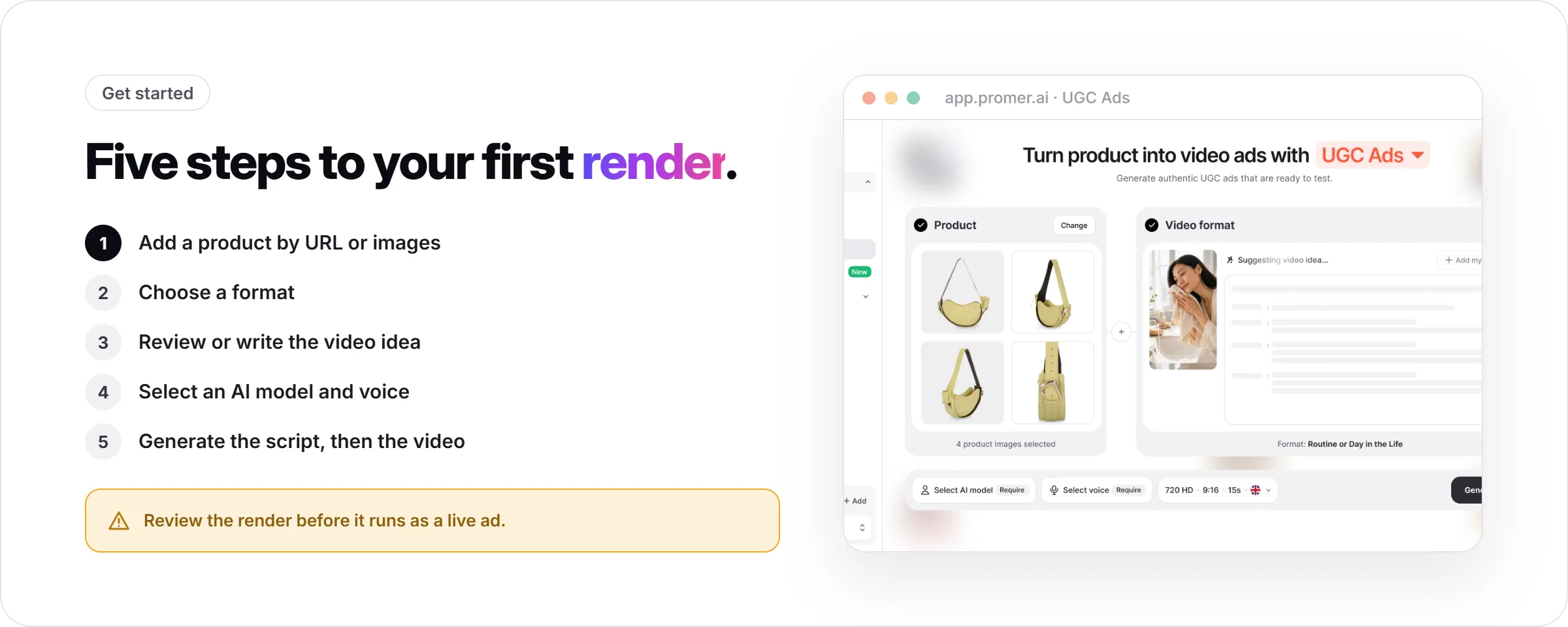
For a full walkthrough of this process, how to make AI UGC videos breaks down each step in more depth.
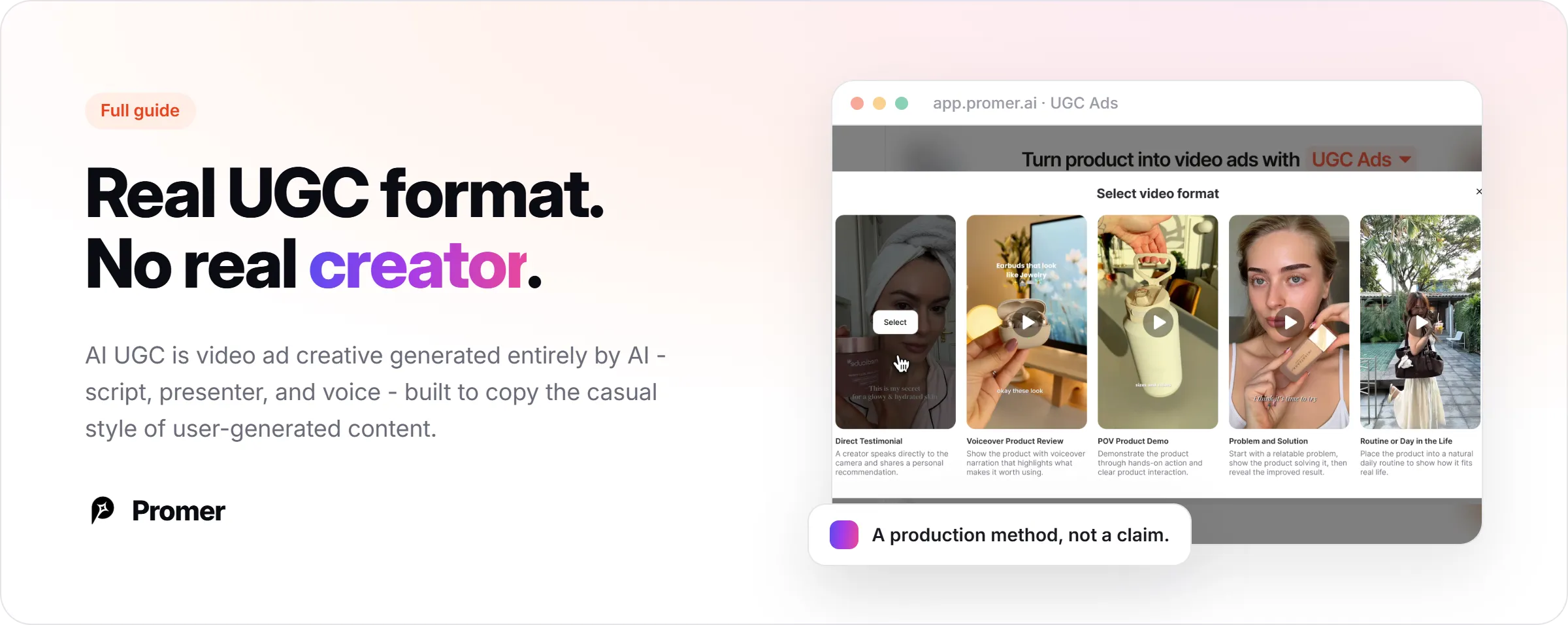
Promer AI's AI UGC video generator follows this structure directly: select a product, pick from formats like Direct Testimonial, Voiceover Product Review, POV Product Demo, Problem and Solution, or Routine or Day in the Life, then let the AI suggest a hook, message, and visual direction before generating a scene-by-scene script and rendering the final video.
The output should still get a human review before it runs as a live ad. AI-generated creatives can contain small errors in claims or product representation, and catching those before publishing matters more than the speed of production itself.
FAQs about AI UGC
Is AI UGC the same thing as UGC ads?
No. UGC ads are a category of paid creative built to look like real customer content, and they can come from real creators or from AI. AI UGC is specifically the AI-generated production method - one way of making a UGC-style ad, not the category itself.
A creator-filmed testimonial and an AI-generated testimonial can look nearly identical on screen. The difference is entirely in how they were produced.
Is it legal or ethical to use AI UGC in ads?
Generally yes, provided the ad doesn't claim to be a real customer when it isn't one. Meta, TikTok, and other platforms have introduced AI-content disclosure requirements in recent years, so checking current platform policy before launching is worth doing regardless of how convincing the AI model looks.
The ethical line is usually about the specific claim being made, not the technology itself. An AI-generated product demo is different from an AI-generated video presented as an actual customer's genuine testimonial.
Does AI UGC perform as well as real UGC?
Results vary by product, audience, and category, so there's no universal answer. AI UGC shares the same format logic as real UGC - a hook, a relatable framing, a clear message - which is part of why it can perform comparably in testing, especially for hook and format experiments.
The more reliable performance driver is still the hook and product fit, not whether a real person or an AI model delivered the line. Testing your specific product against your specific audience is the only way to know for certain.
Can I use AI UGC for every type of ad?
No. AI UGC tends to work well for testing, iteration, and volume-driven campaigns, but it's a weaker fit when the entire point of the ad is proving that a real customer had a real experience. High-consideration categories and hero campaigns often still call for real creator content.
Most teams that scale successfully use AI UGC for the testing layer and bring in real creators once a winning angle is confirmed, rather than treating it as an either-or choice.
How is AI UGC different from a regular AI avatar video?
AI UGC specifically mimics the casual, creator-style format of real UGC - a testimonial, a POV demo, a day-in-the-life scene - rather than a formal presenter video. The pacing, framing, and voice choices are built to feel like something a real customer might have posted, not a polished corporate video.
A generic AI avatar video can use the same underlying avatar and voice technology without that specific format logic, which is what separates a UGC-style ad from a standard explainer or presenter video.
What tools can generate AI UGC ads?
Several platforms offer AI UGC generation, typically differing in avatar libraries, script quality, and how much creative control they give over the format and hook. Promer AI is one option built specifically for ecommerce product ads, generating the video directly from a product URL or images rather than requiring a separate creative brief.
Comparing a few tools on script quality and avatar realism for your specific product category is worth doing before committing, since output quality varies more between tools than the underlying concept does. Starting with an AI ad generator built specifically for ecommerce product ads is a reasonable first test, since it removes the extra step of adapting a general-purpose AI video tool to product advertising.
Will AI eventually replace real UGC creators entirely?
Unlikely, based on current usage patterns. AI UGC solves a volume and speed problem, but it doesn't replicate the specific trust signal of a real person genuinely using and vouching for a product, which still matters for certain campaigns and categories.
The more common pattern among teams that scale is a hybrid approach: AI-generated volume for testing hooks and formats, and real creator content reserved for campaigns where authenticity itself is the selling point.