UGC ads can convert up to 6–10x higher than standard creative. See what UGC ads mean, the formats that perform, real examples, and what they cost.
UGC ads, user-generated content ads, are paid advertisements built from real customer content or creator-made content designed to feel native to social feeds. The content can be a customer review, an unboxing video, a before-and-after photo, or a talking-head clip shot on a phone.
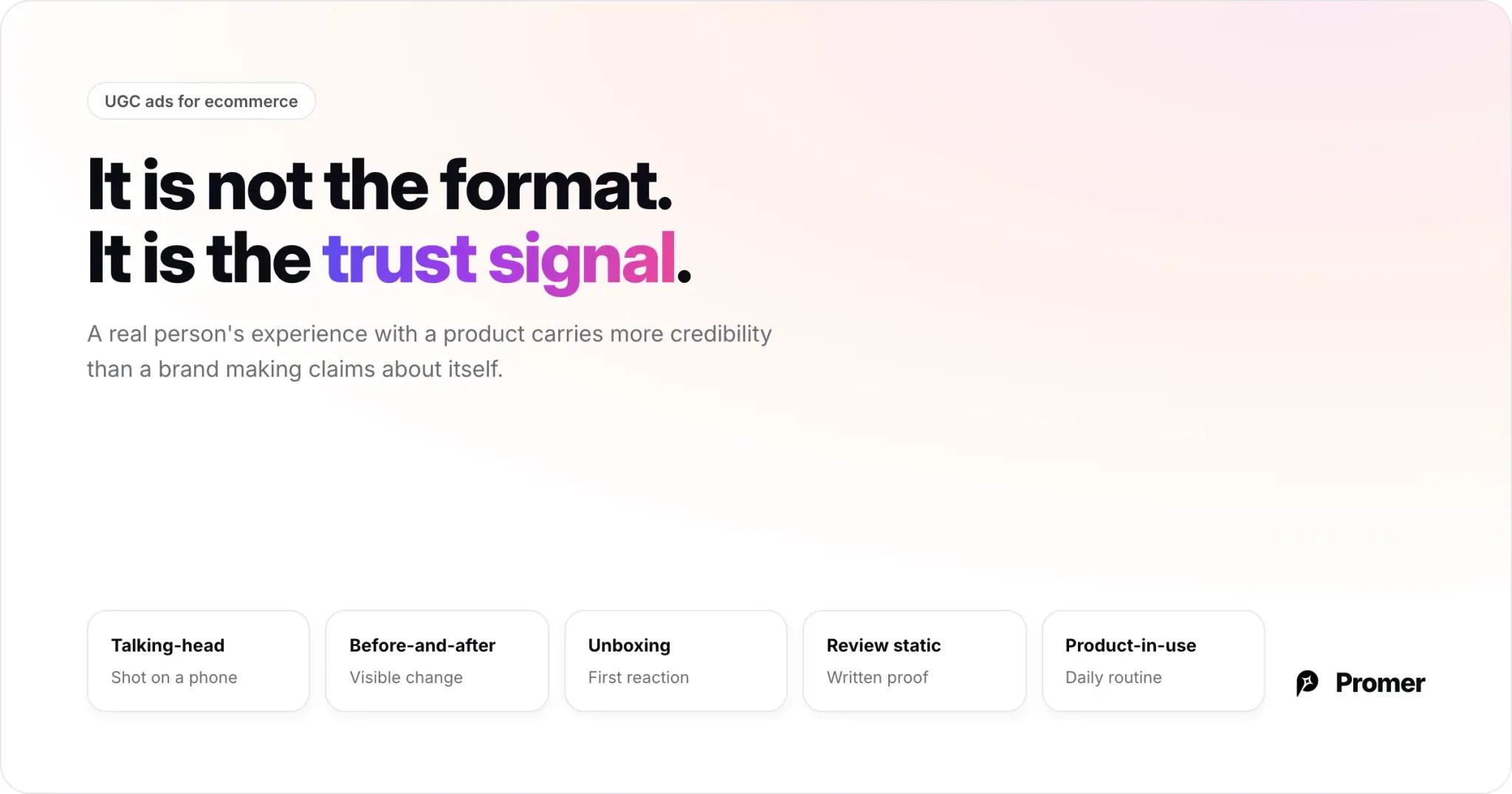
Unlike conventional brand creative, UGC puts a person at the center of the product story. They might explain a problem, demonstrate the product, share their experience, or show a result.
And despite the name, modern UGC ads do not always come from existing customers. Brands can also commission UGC creators to produce this style of content specifically for paid campaigns.
This article covers what UGC ads are, why they work, the different types, how ecommerce teams source and use them, and where UGC fits in a broader creative testing system for performance marketing teams running paid social ads.
Key Takeaways
- UGC ads are paid ads built from real customer or creator-made content, including reviews, videos, photos, testimonials, and product demonstrations.
- UGC is particularly useful in ecommerce for social proof, product demonstration, and objection handling.
- UGC and professionally produced static ads serve different jobs. The best creative systems use both
- The angle and hook still matter in UGC ads. Raw authenticity without performance logic can still underperform.
- UGC creators do not necessarily need a large following. Brands can hire them specifically to produce creative for paid campaigns.
What Are UGC Ads?
UGC stands for user-generated content. A UGC ad is a paid advertisement that uses content created by a real customer, or creator-made content produced in a UGC style, rather than conventional brand-produced creative.
Traditional UGC comes from actual customers.
A customer might voluntarily post a review, an unboxing video, a before-and-after photo, or a clip of themselves using the product. A brand can get permission to turn that content into paid advertising.
Modern UGC advertising also includes content commissioned specifically for ads. Brands can hire UGC creators to produce person-led, social-native creative without buying access to a large creator audience.
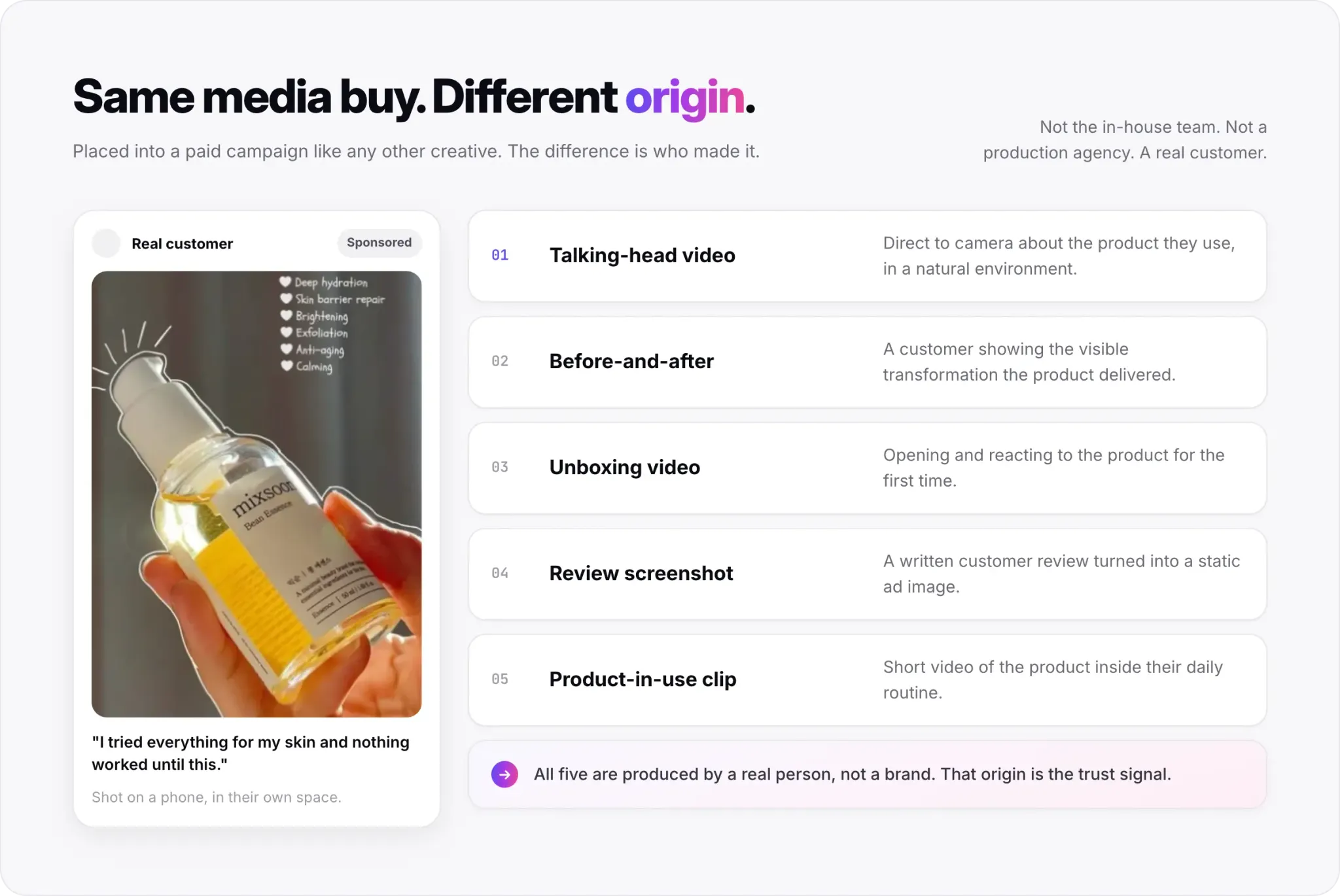
UGC ads can take many forms. The most common in ecommerce are:
- Talking-head videos: A customer or creator speaking directly to camera about the product, shot on a phone in a natural environment.
- Before-and-after photos: A person showing a visible change before and after product use.
- Unboxing videos: A customer or creator opening and reacting to a product.
- Review creatives: A written customer review turned into a static or video ad.
- Product-in-use clips: Short videos of someone using the product in their daily routine.
What all of these have in common is a person-led, social-native creative style rather than the visual language of a conventional brand commercial.
For a full breakdown of each format, see different styles of UGC ads and when to use each one.
UGC Ads at a Glance
In one sentence:
UGC is the content. A UGC ad is that content, or content produced in the same style, being used as paid advertising.
UGC Ads by the Numbers
The case for UGC isn't just a feeling. A handful of numbers from independent research make the gap concrete.
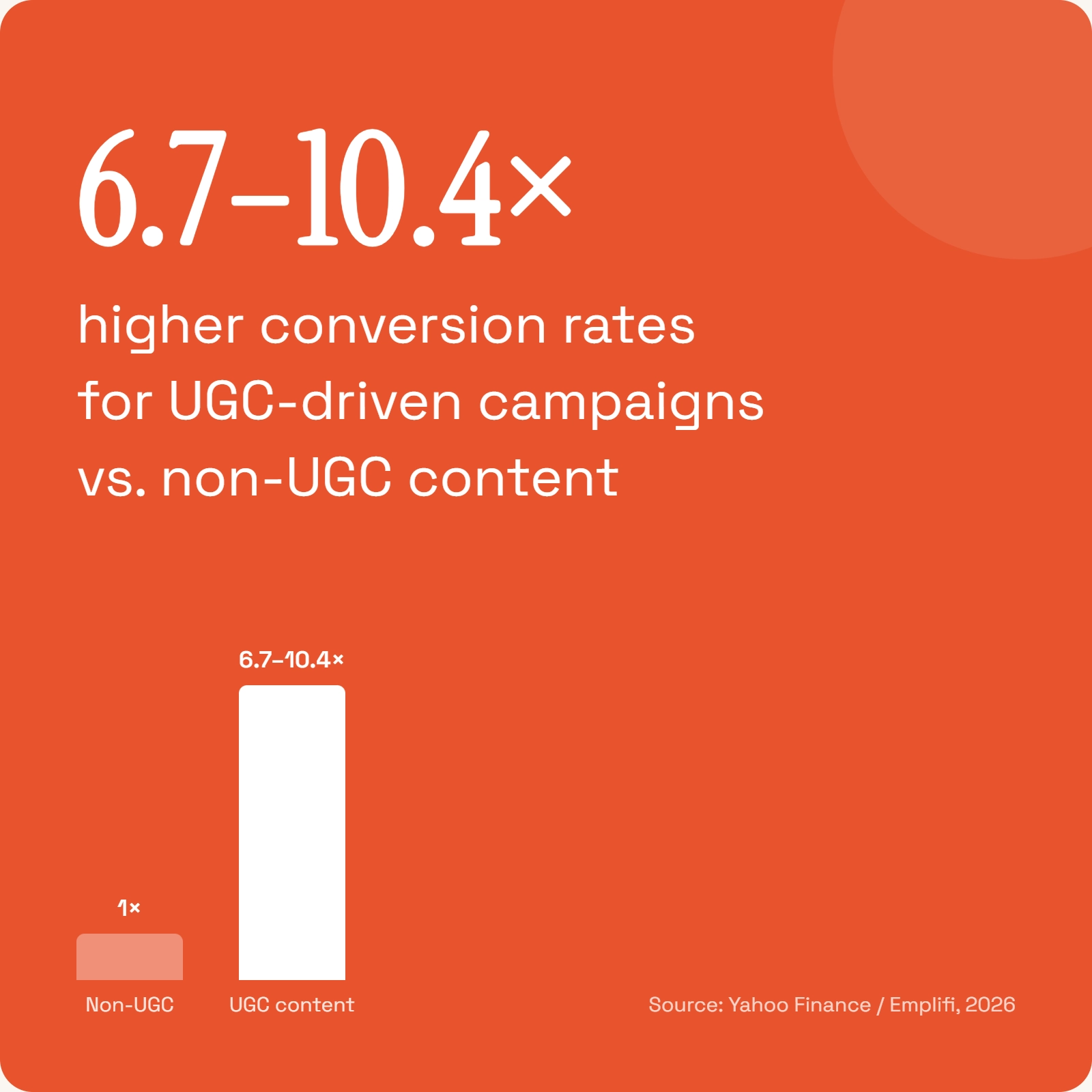
UGC-driven campaigns see 6.7-10.4x higher conversion rates than non-UGC content. (Source: Yahoo Finance / Emplifi, 2026)
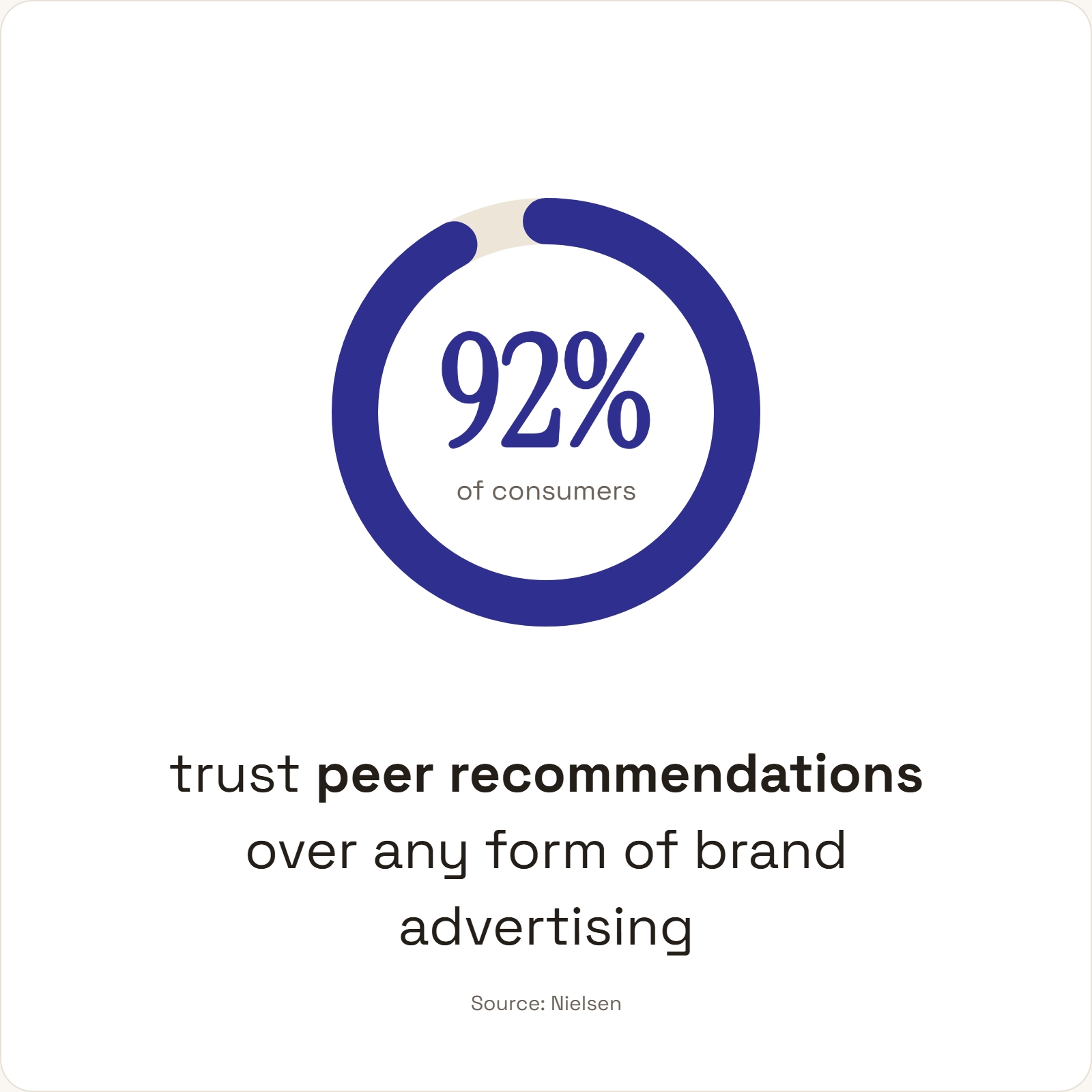
92% of consumers trust peer recommendations over any form of brand advertising. (Source: Nielsen)
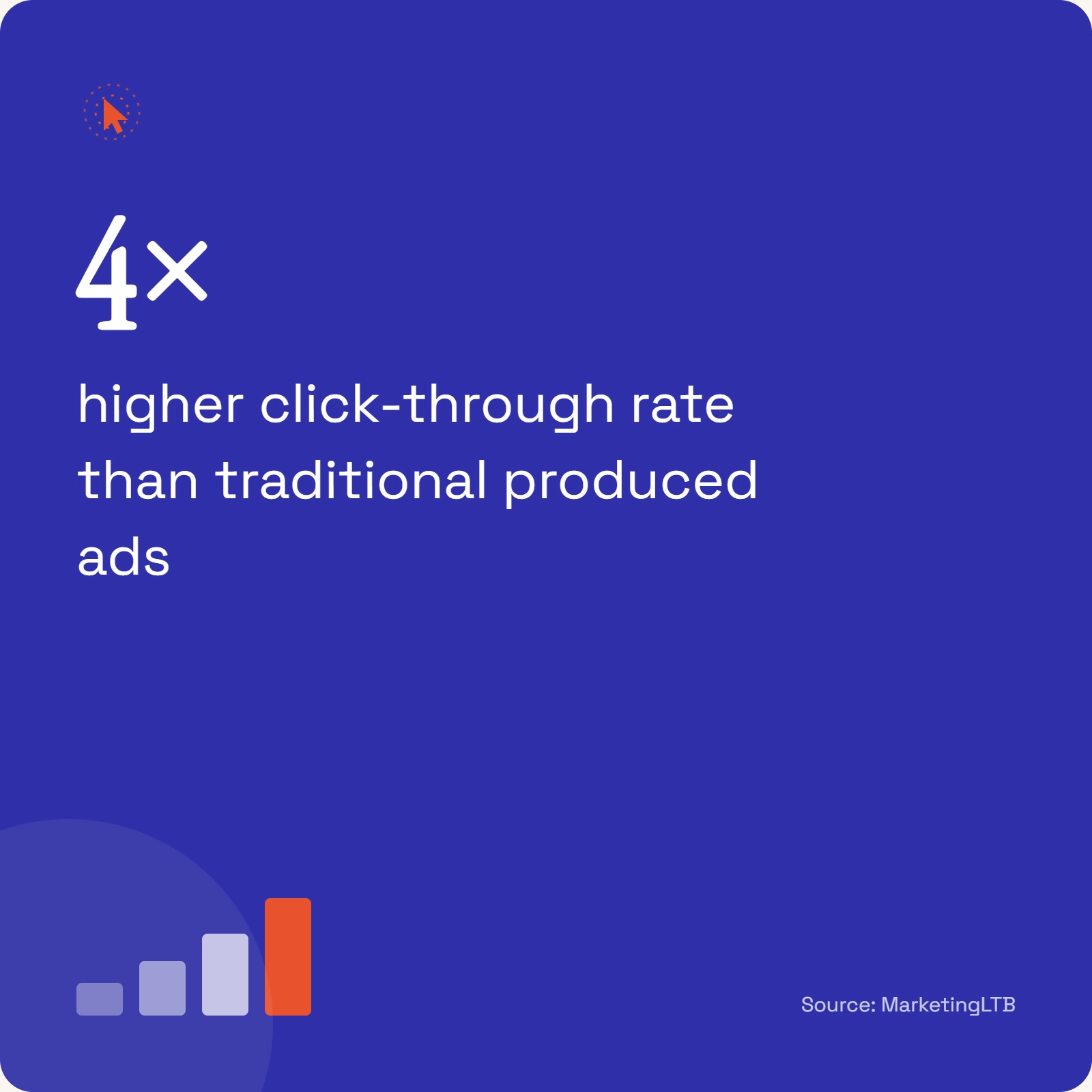
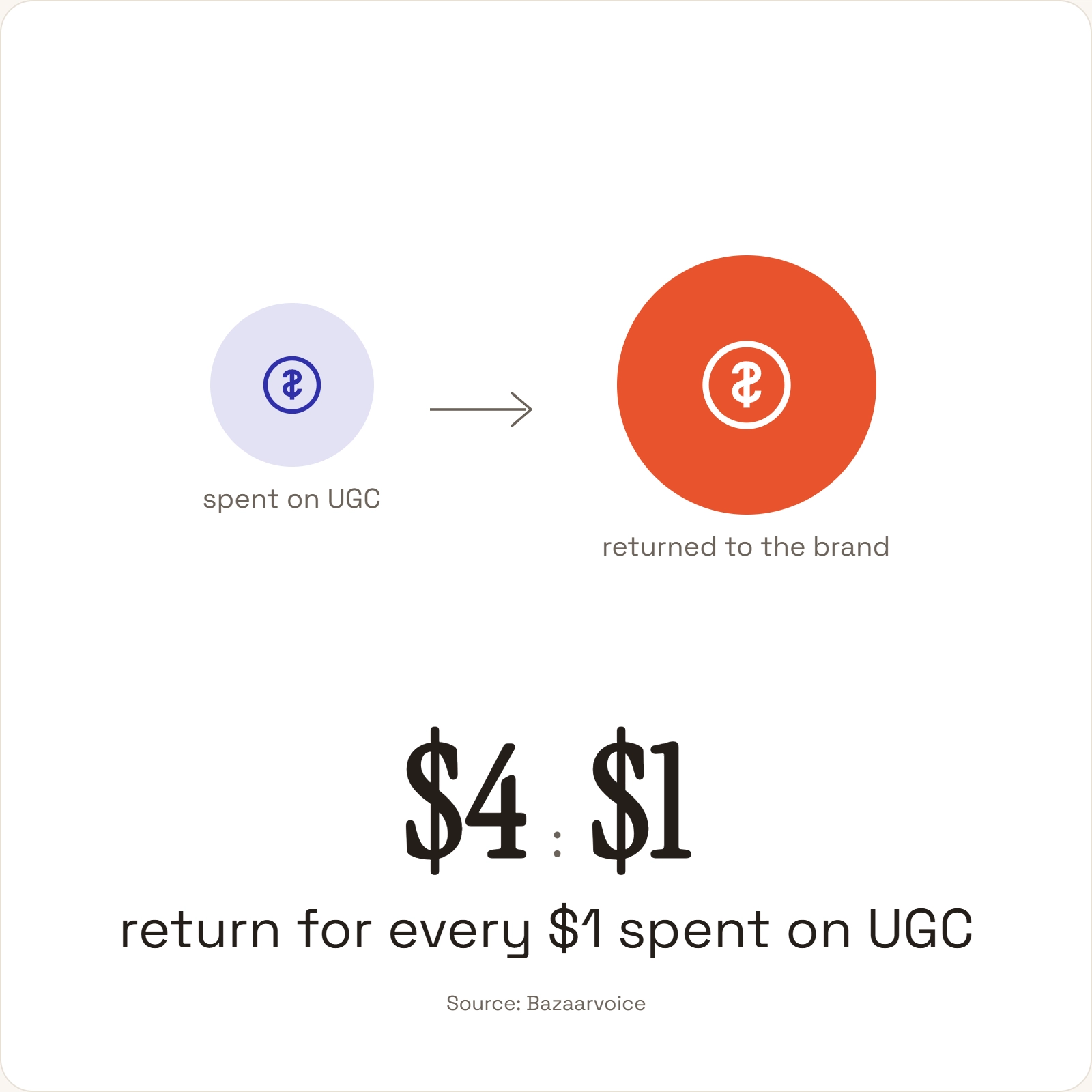
UGC-style ads see a 4x higher click-through rate than traditional produced ads (MarketingLTB), and brands see roughly a $4 return for every $1 spent on UGC (Bazaarvoice).
UGC vs. UGC Ads: What's the Difference?
UGC and UGC ads are closely related, but they are not exactly the same.
Imagine a customer buys a dress and posts a TikTok showing three ways to style it.
That's organic UGC.
The fashion brand gets permission to use that TikTok in a paid Meta campaign.
That's a UGC ad.
The brand could also hire a UGC creator to make a similar styling video specifically for advertising.
Why UGC Ads Work in Ecommerce?
UGC ads perform in ecommerce for one core reason: social proof. A potential customer is more likely to trust what another customer says about a product than what a brand says about itself.
This is especially true on social platforms where the feed is already full of friend and creator content. A UGC-style ad blends into the environment. A produced brand ad stands out as an ad. When the viewer's guard goes up, the message gets filtered out before it can land.
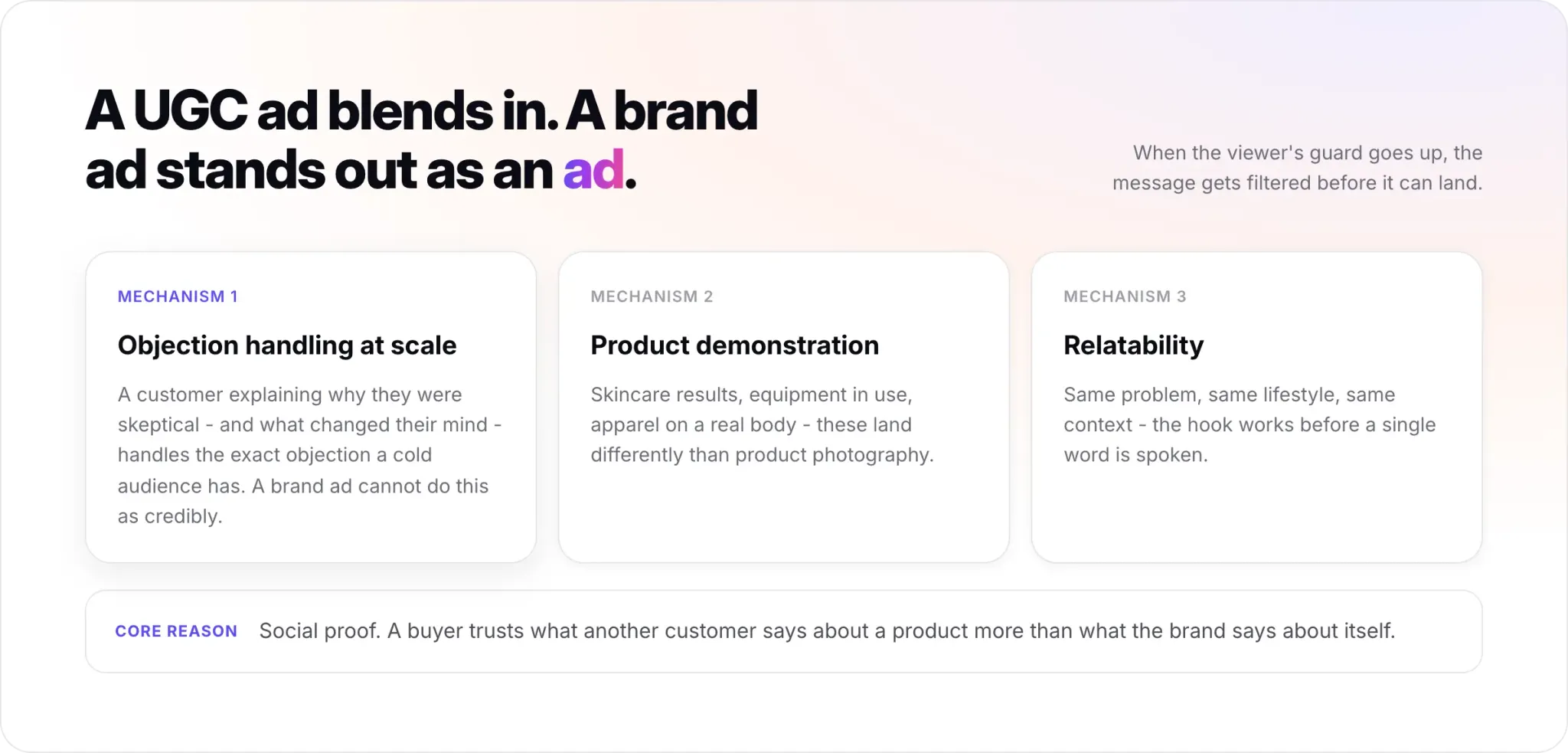
Three specific mechanisms make UGC ads effective for ecommerce:
- Objection handling at scale. A customer explaining why they were skeptical about the product before trying it, and what changed their mind, can address the same objection a potential customer may have.
- Product demonstration. Seeing a real person use a product in a real environment can communicate things that a studio shot cannot. Skincare being applied, fitness equipment in use, apparel on a person, or a kitchen product solving an actual problem.
- Relatability. When the person in the ad matches the viewer’s situation, same problem, lifestyle, use case, or context, the creative can establish relevance before the product is fully explained.
UGC isn’t effective just because it looks authentic. The format creates the context. The hook, angle, product insight, and execution still have to do the selling.
What UGC Can Show That Product Copy Can’t
This is why the strongest UGC concepts often start with a customer question, not a product feature.
UGC Ads vs Professionally Produced Ads
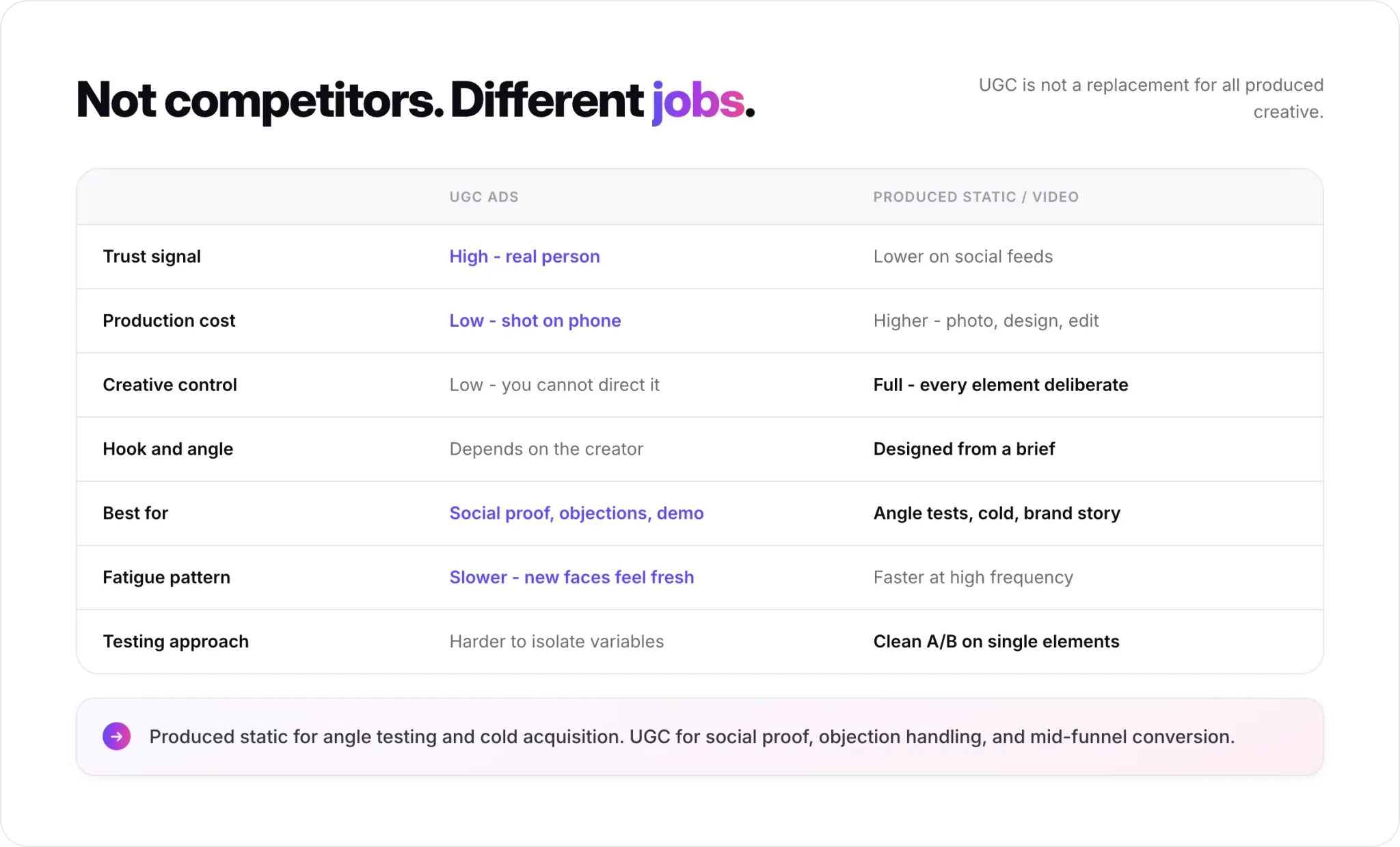
UGC ads and produced brand creatives are not competitors - they serve different jobs in a creative system. Understanding the difference prevents teams from treating UGC as a replacement for all produced creative.
The gap is widest in categories where the buyer's real question is:
"Will this work for someone like me?"
Fitness products are a clear case. Professional video with studio lighting and produced transitions shows what a product looks like, but a UGC clip of someone using the same product mid-workout at home answers a different question by putting the product into a relatable context.
Produced ads still earn their place when visual control, product detail, brand presentation, or structured creative testing matters.
The most effective ecommerce creative systems can use both. Produced creative for controlled messaging, visual concepts, and structured testing. UGC for social proof, objection handling, demonstrations, and customer perspectives.
Don’t Ask “UGC or Professional?”
Ask:
If they need to see the product work, show it.
If they need to believe someone like them uses it, put the product in that person’s context.
If they need to understand the value proposition quickly, a controlled static or produced creative may communicate it better.
If they need social proof, UGC may be the stronger format.
The customer problem should choose the format, not the other way around.
Types of UGC That Perform in Ecommerce
Not all UGC performs equally in paid ads. The most useful formats in ecommerce are tied to specific creative jobs.
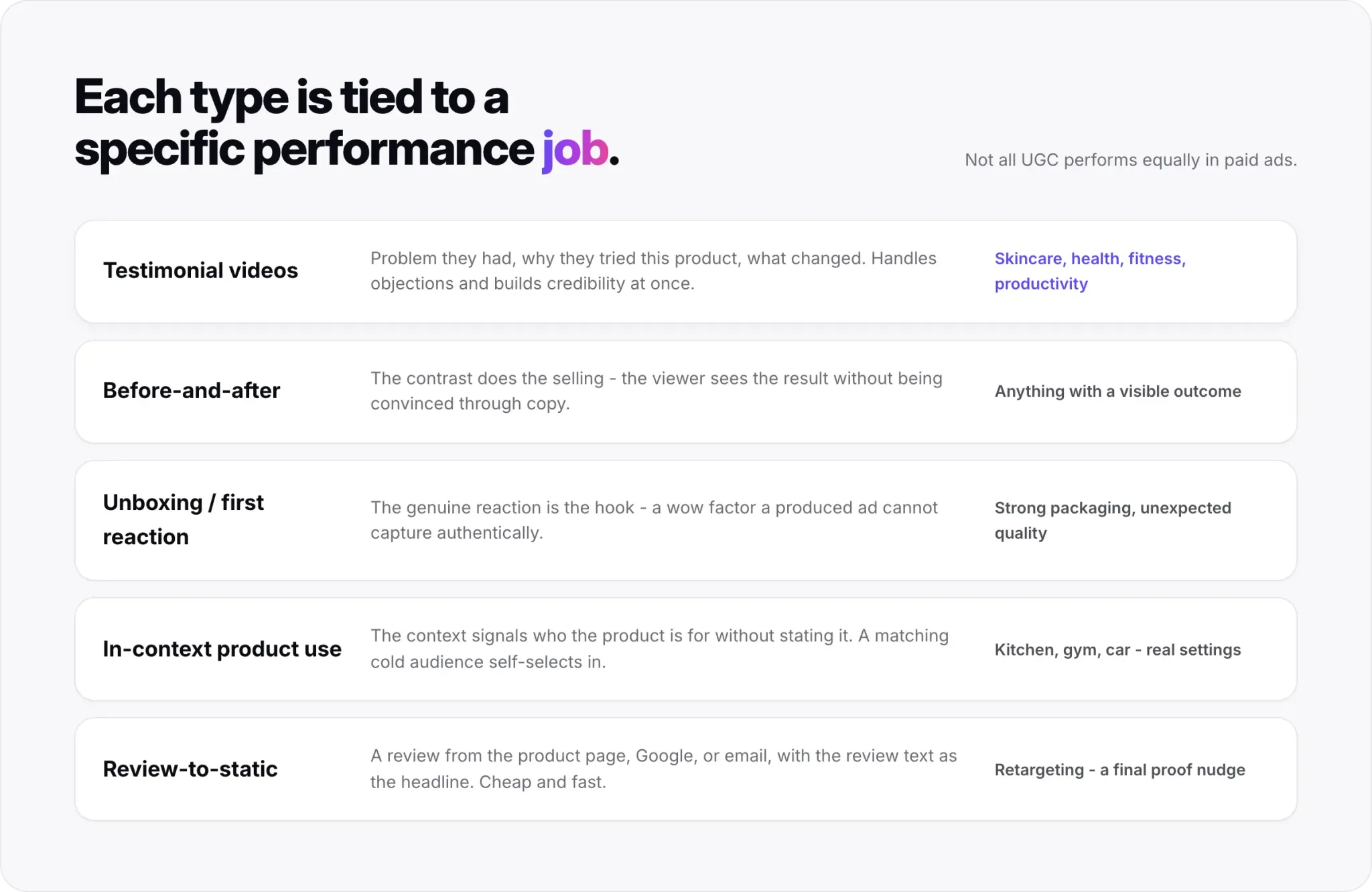
Testimonial videos.
A customer explaining their experience before and after using the product.
The structure is simple:
Problem → Why they tried the product → Experience → Result
This format handles objections and builds credibility at the same time. It works particularly well for products where the customer’s experience is central to the purchase decision.
Creative job: Build confidence.
Example hook: “I almost didn’t buy this because…”
Before-and-After Comparisons
Visual proof that the product delivers a visible outcome.
Static or video. The contrast does much of the explaining because the viewer can see the difference rather than relying entirely on copy.
Creative job: Make the outcome visible.
Structure:
BEFORE → PRODUCT → AFTER
This works best for products with a legitimate, visually demonstrable result.
For categories such as health, beauty, or wellness, ensure transformation and performance claims comply with applicable advertising requirements and platform policies.
Unboxing and First-Reaction Clips
A customer receiving and opening the product for the first time.
The reaction can become the hook, especially for products with strong packaging, distinctive design, unexpected quality, or an interesting first-use experience.
Creative job: Turn product discovery into the opening.
Useful moments include:
- opening the packaging
- revealing what’s inside
- touching the material
- seeing the actual size
- setting it up
- trying it for the first time
In-Context Product Use
Short clips of a customer using the product naturally, in their kitchen, at the gym, in their car, at work, or anywhere else the product belongs.
The context signals who the product is for without explicitly stating it.
Creative job: Make the use case instantly recognizable.
A travel organizer shown while someone packs for five days communicates more than the same organizer photographed against a blank background.
Review-to-Static Conversions
A customer review, pulled from the product page, email, or another authorized source, turned into a static ad image with the strongest part of the review as the headline.
Creative job: Turn customer language into an advertising angle.
For example:
★★★★★ “Finally, leggings that don’t roll down when I run.”
The useful part isn’t just the five-star review.
“Don’t roll down when I run” is the customer insight.
That insight can become another static ad, a video hook, or a creator brief.
The Same Product Can Produce Very Different UGC Ads
Take one hypothetical carry-on bag.
ANGLE: Space
“Everything I packed for five days in one carry-on.”
ANGLE: Objection
“I thought this shoe compartment was a gimmick until…”
ANGLE: Problem
“If your clean clothes always end up touching your shoes…”
ANGLE: Demonstration
No introduction. Open the bag and show exactly how much fits.
ANGLE: Comparison
“Why I stopped using my old carry-on.”
Same product.
Five different reasons to care.
That’s why the angle matters more than simply deciding to “make a UGC video.”
Direct Testimonial
A creator speaks directly to the camera and shares a genuine personal recommendation.
Voiceover Product Review
Show the product with voiceover narration that highlights what makes it worth using.
Routine or Day in the Life
Place the product naturally into an everyday routine to show how it fits real life.
→ For a full library of real UGC ad examples by category, see UGC ad examples.
What Makes a Good UGC Ad?
Authenticity is not a substitute for performance logic.
A good UGC ad combines five things: a strong hook, one clear selling angle, relevant product context, believable proof, and a natural next step.
The content can still look casual and spontaneous. What matters is that there is a clear advertising idea underneath it.
A real customer talking on camera about a product they like is authentic - but if the hook does not stop the scroll in the first two seconds and the angle does not match the viewer's situation, the ad still underperforms.
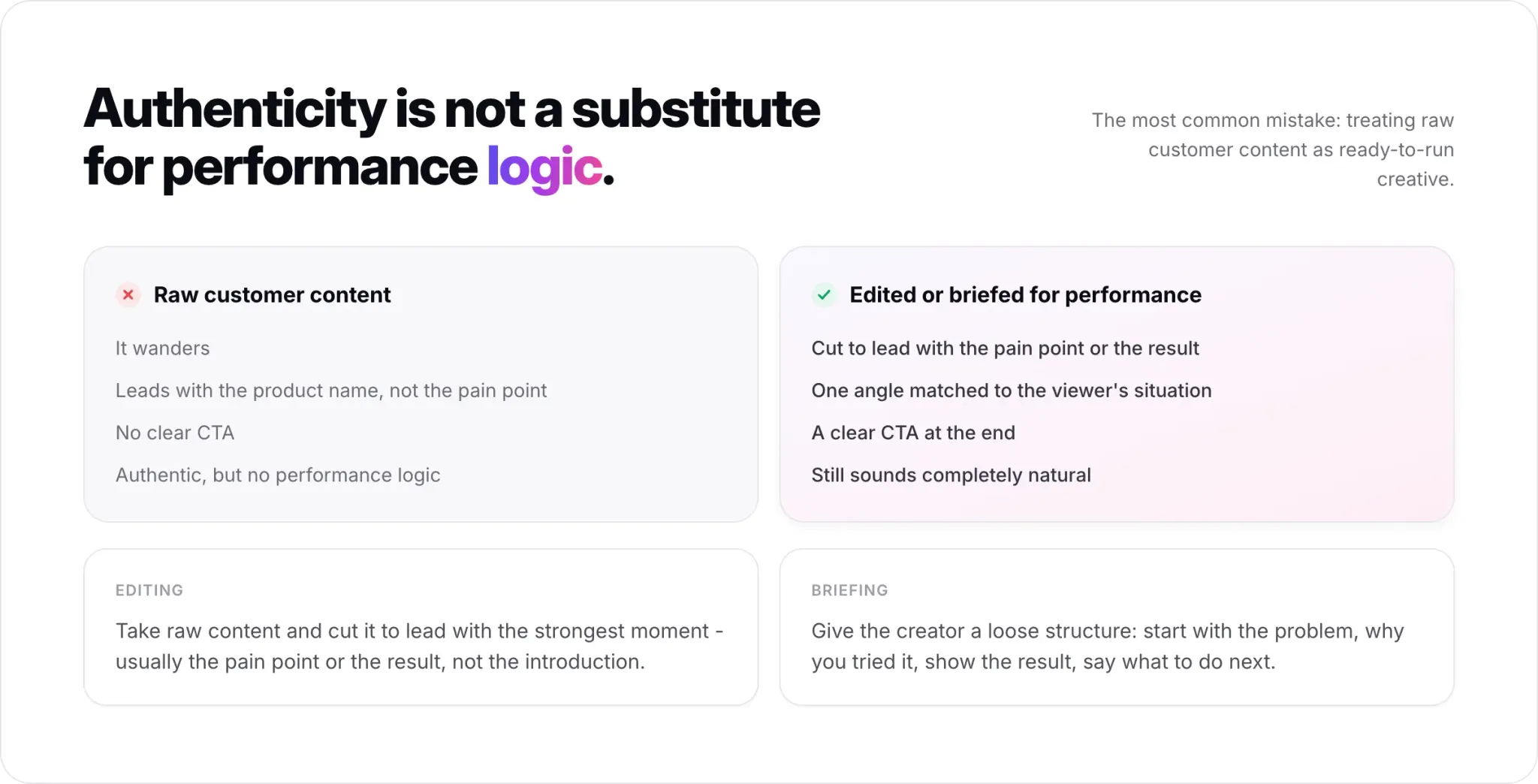
The most common UGC ad mistake in ecommerce is treating raw customer content as ready-to-run creative.
Most customer videos are not structured around a performance brief. They wander. They lead with the product name instead of the customer's pain point. They lack a clear CTA.
The authenticity is there but the performance logic is missing.
Effective UGC ads are either edited for performance or briefed for it.
Editing means taking raw customer content and cutting it to lead with the strongest moment, usually the pain point, objection, demonstration, or result rather than the introduction.
Briefing means giving the creator a loose structure:
Hook → Problem → Product → Proof → CTA
The content can still sound natural. It is simply structured around an advertising idea.
A Simple Framework for Building UGC Ads
A UGC ad doesn’t have to start with a script. Start with five decisions:
1. Audience
Who should see themselves in this ad?
Not just “women aged 25–34.”
Think about the situation they’re in, the problem they’re trying to solve, or the outcome they want.
2. Angle
Why should this person care about the product?
The same product can be sold through a problem, benefit, comparison, transformation, objection, or use case.
Pick one.
3. Hook
What makes the angle worth paying attention to?
The hook can be a line, a visual, a problem, a result, or an unexpected product moment.
4. Proof
What can you show that makes the message believable?
Don’t just say the product works.
Demonstrate it. Compare it. Show the result. Put it into context.
5. Format
What’s the clearest way to tell this story?
That might be a testimonial, product demo, before-and-after, unboxing, comparison, or something else entirely.
Put it together:
Audience → Angle → Hook → Proof → Format
For example, take a carry-on bag:
Audience: Travelers who overpack Angle: Fit more without checking a bag Hook: “Everything I packed for five days fits in here.” Proof: Pack the bag on camera Format: Product demonstration
The product hasn’t changed.
The advertising idea has.
That’s the difference between simply making UGC and building a UGC ad around a reason to buy.
UGC Ad Hooks You Can Test
The hook is the first reason someone has to pay attention. It can be something the creator says, something they show, or a result the viewer immediately wants to understand.
A good hook doesn’t just stop the scroll. It should lead naturally into the product, selling angle, and proof.
A strong hook earns attention. The rest of the ad has to make that attention worth keeping.
Raw UGC vs. Performance-Ready UGC
RAW OPENING
“Hey guys, I wanted to show you this product I’ve been using for the last couple of weeks…”
↓ CUT TO THE ACTUAL IDEA ↓
PERFORMANCE OPENING
“I stopped doing X after I found this.”
Same person.
Same product.
Same experience.
Different entry point.
Before reshooting an entire UGC ad, ask whether the strongest moment already exists somewhere later in the footage.
Turn Your Product Into a UGC Ad
Have a product URL? Start there.
Promer analyzes your product, audience, pain points, and selling angles, then turns them into UGC ad concepts and creatives.
Free to try.
How Ecommerce Teams Source UGC for Ads?
There are 3 practical sources of UGC for ecommerce paid ads, each with different tradeoffs.
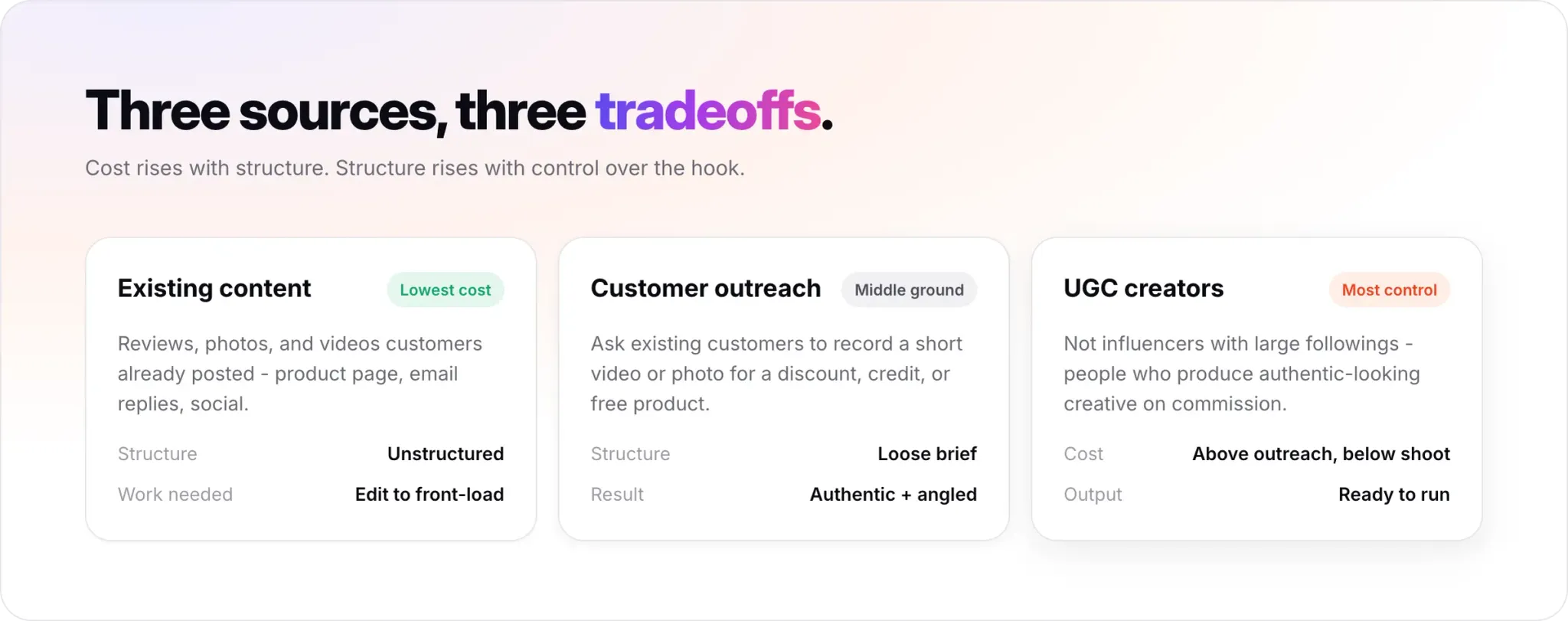
Existing Customer Content
Reviews, photos, and videos customers have already posted organically, on the product page, in email replies, or on social media.
This is usually the lowest-cost source.
The tradeoff is that it is unstructured: the content exists, but it may not be built around a performance hook.
Repurposing it for ads typically requires editing to front-load the strongest moment.
Brands should obtain appropriate permission and usage rights before using customer content in paid advertising.
Direct Customer Outreach
Reach out to existing customers and ask them to record a short video or photo, sometimes in exchange for a discount, store credit, free product, or another incentive.
The team can provide a loose brief:
- what to cover
- what to show
- approximate length
- key product details
without scripting it into a produced ad.
This gives the team more structure while preserving the customer’s own experience and language.
UGC Creators
UGC creators produce UGC-style content on commission.
Unlike traditional influencer partnerships, a large following is not necessarily what the brand is buying. The creator can be hired primarily to produce a creative asset for the brand’s paid campaigns.
This gives teams more control over the structure, hook, angle, and deliverables while maintaining a person-led, social-native execution.
Which UGC Source Should You Use?
UGC creators and influencers can overlap, but the buying logic is different.
With UGC creation, you’re primarily buying creative.
With influencer marketing, you’re usually buying creative + distribution.
How Much Do UGC Ads Cost?
For context: UGC-based campaigns report 25–40% lower cost per acquisition than fully produced campaigns (MarketingLTB), which is why most ecommerce teams treat UGC as the higher-ROI line in the creative budget, not the cheaper-but-worse one.
Create UGC Ads From Your Product With Promer AI
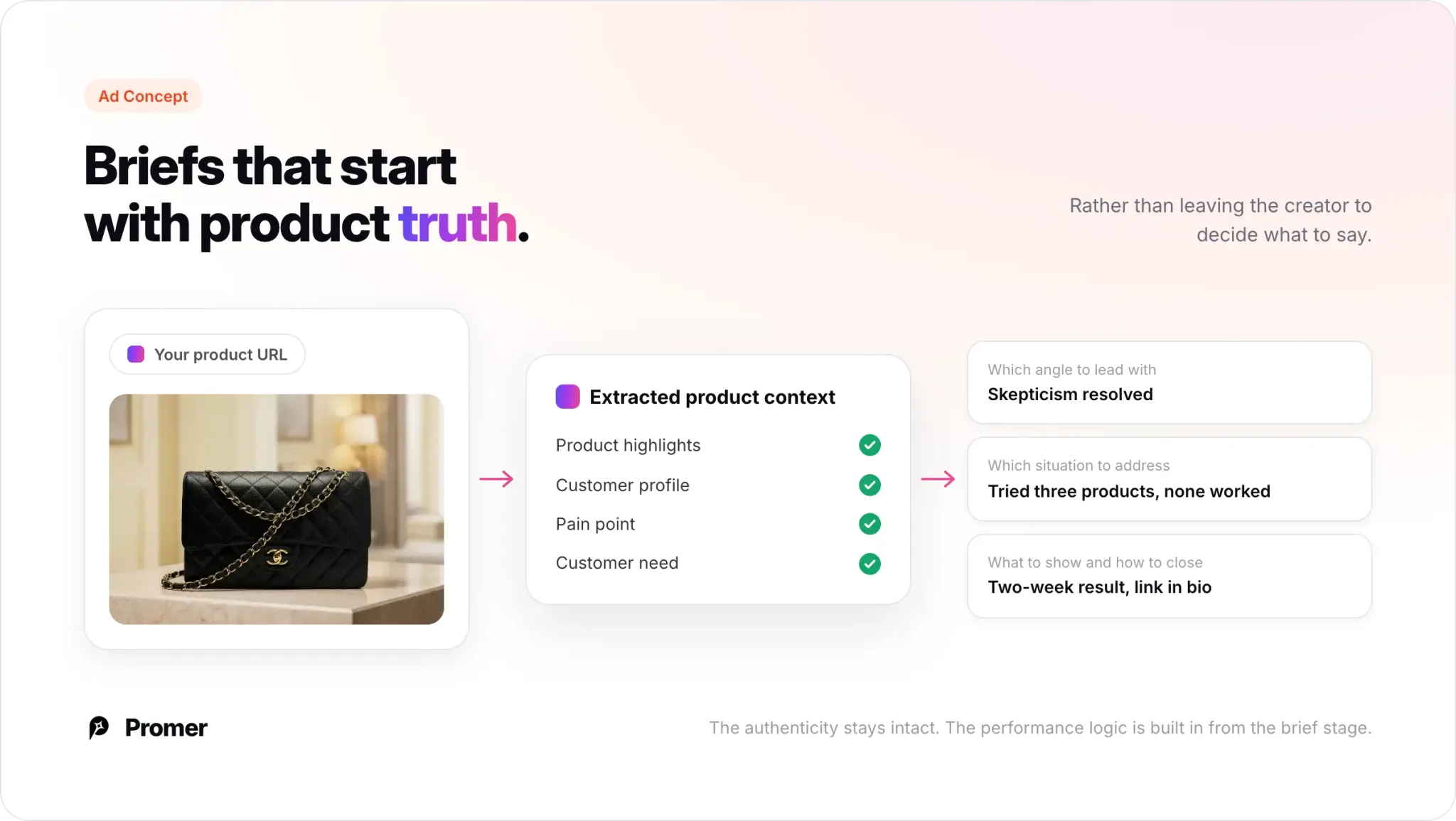
Promer starts with the product.
Paste a product URL and Promer analyzes the product, audience, pain points, and selling angles before turning that context into UGC ad concepts and creatives.
Instead of starting with a blank script, you can start with:
Audience Who should recognize themselves in this ad?
Angle What’s the one reason they should care?
Hook What earns the next second?
Proof What should the ad show instead of simply claim?
Format What’s the best way to tell the story?
The goal isn’t to generate more UGC for the sake of volume. It’s to create UGC around a clear advertising idea.
Have a product in mind?Create a UGC ad →
Research Before You Brief
Promer’s Ad Spy and Winning Ad Library can also be used before production to research ecommerce ads and creative patterns.
When reviewing another ad, don’t stop at: “This looks good.”
Break it down:
HOOK | What earns the first few seconds?
ANGLE | Why should this customer care?
PRODUCT PROOF | What does the ad show instead of claim?
CONTEXT | Who is this creative speaking to?
CTA | What happens next?
Then turn the underlying insight into a new creative direction for your own product.
The workflow becomes:
Research → Customer insight → Angle → Hook → UGC brief → Creative → Test
This means UGC starts with product and customer context rather than leaving the creator to decide everything from scratch.
FAQs About UGC Ads for Ecommerce Advertisers
What does UGC ads mean?
UGC ads means user-generated content ads: paid ads that use genuine customer content or creator-style creative. Common formats include testimonials, product demos, reviews, unboxings, and before-and-after videos.
What is a UGC ad?
A UGC ad is a paid advertisement that uses customer-created or UGC-style content as its creative. It can originate from an actual customer's organic post or be produced by a commissioned UGC creator specifically for advertising.
How much do UGC ads cost?
Costs range from $0 for existing customer content (plus usage rights and light editing) to $150–$300 per deliverable for commissioned UGC creators, averaging around $198 in 2026.
Are UGC ads more effective than professionally produced ads?
It depends on the campaign goal and the audience stage.
UGC ads typically outperform produced ads on social proof, objection handling, and mid-funnel conversion - especially on platforms like Meta where the feed is full of creator content and produced ads stand out as ads. The authenticity signal works in UGC's favor when the viewer's primary barrier is trust.
Produced static ads outperform UGC for angle testing, cold audience acquisition, and brand narrative - because every element is intentional and testable. The most effective ecommerce creative systems use both formats for the jobs they are each best suited to.
How do I get permission to use customer content in paid ads?
You need explicit permission before running any customer content as a paid ad - organic posts or reviews on your product page do not give you the right to use that content in paid media.
The standard approach is to ask directly: reply to the customer's post or email requesting permission to use their content in advertising, and get a written yes. Many brands include a consent clause in their UGC incentive programs - when a customer submits a photo or video in exchange for a discount, they agree to usage rights as part of the submission.
For UGC creators you commission, include usage rights and paid media rights explicitly in the creator agreement before the content is produced.
What is the difference between UGC ads and influencer marketing?
UGC ads use content from real customers - people who bought and used the product. Influencer marketing pays creators with an existing audience to promote the product to their followers.
The key difference is distribution. In UGC ads, the brand controls the distribution through paid media - the content is used as a creative asset in a paid campaign. In influencer marketing, the creator distributes to their own audience organically or through boosted posts.
UGC ads are generally cheaper to produce and scale because they do not require paying for the creator's audience reach. Influencer marketing reaches the creator's existing audience but production costs are higher and the brand has less control over creative direction.
Is UGC suitable for all ecommerce products?
UGC works best for products where the customer's experience is visible, relatable, or demonstrable - skincare, apparel, fitness equipment, food, home products, wellness. Products where a real person's before-and-after, daily use, or genuine reaction can carry the message.
UGC is less effective for products where the benefit is invisible or highly technical - complex B2B tools, industrial equipment, or products requiring significant explanation before the benefit is understood. In those cases, a produced ad with a structured explanation typically outperforms a customer talking naturally about their experience.
How do I get UGC if my brand is new and has no existing customers?
Commission UGC creators. UGC creators produce authentic-looking content on behalf of brands without requiring the creator to have used the product long-term - they receive the product, produce the content, and deliver it as a creative asset.
The output looks & feels like organic customer content because the creator shoots it naturally, on their own device, in their own environment. For a new ecommerce brand with no existing customer base, commissioned UGC creators are the most practical way to produce social proof creative before organic reviews accumulate.
Should I edit UGC before running it as a paid ad?
Yes. In most cases. Raw customer content is authentic but rarely structured around a performance hook. Most customer videos wander, lead with the product name instead of the customer's pain, or lack a clear CTA.
Editing for performance means cutting to lead with the strongest moment - usually the pain point or the result - and trimming everything that does not serve the hook, angle, or CTA. The content still sounds and looks natural after editing. The goal is not to make it look produced - it is to make it perform. A two-second tighter opening and a clear CTA at the end can significantly improve CTR and conversion rate on content that was already authentic.





![Top 12 UGC Ad Examples That Actually Convert [With Examples]](https://static.promer.ai/blogs/n-images/3cd09dc0-1bd2-808e-8101-f6eb4138680d-thumbnail.webp)