Ad creative testing is the process of running controlled experiments on individual elements of your ad creatives to identify what drives performance. You change one element, measure the result against a control, apply the learning, and repeat.
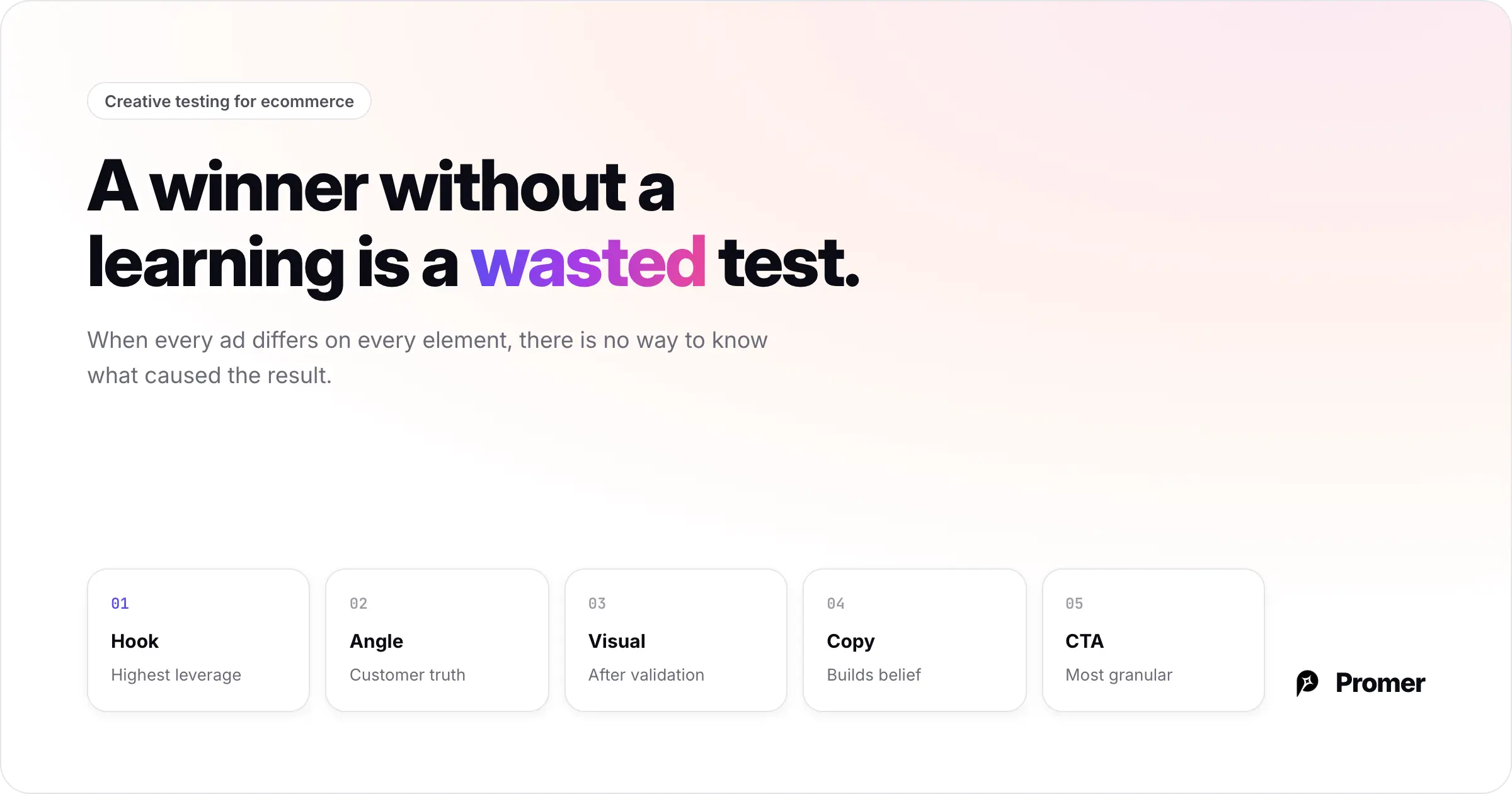
Most ecommerce teams test creatives without a system. They produce multiple ads, run them simultaneously, and declare a winner based on whichever ad gets the best result. But when every ad looks different - different hook, different angle, different visual, different CTA - there is no way to know what caused the result. The winner is identified, but the learning is lost.
This article covers what ad creative testing is, how to set up a clean test, what elements to test first, how to interpret results, and how to build a testing process that produces compounding learning over time.
Key Takeaways
- Ad creative testing is a controlled experiment - change one element at a time to know what caused the result
- Test the hook first - it has the highest impact on early performance and fatigues fastest
- A test needs enough spend and time to produce statistically meaningful data before being called
- When a test shows no clear winner, the element tested did not move the needle - test a different element
- Every test result is an input to the next brief - a testing process that produces learning compounds over time
What Ad Creative Testing Is?
Ad creative testing is the practice of changing one element of an ad - hook, angle, visual, copy, CTA, or format - and measuring the performance difference against a version where that element is unchanged. The goal is not to find a good ad. The goal is to understand which specific creative decisions drive which specific outcomes.
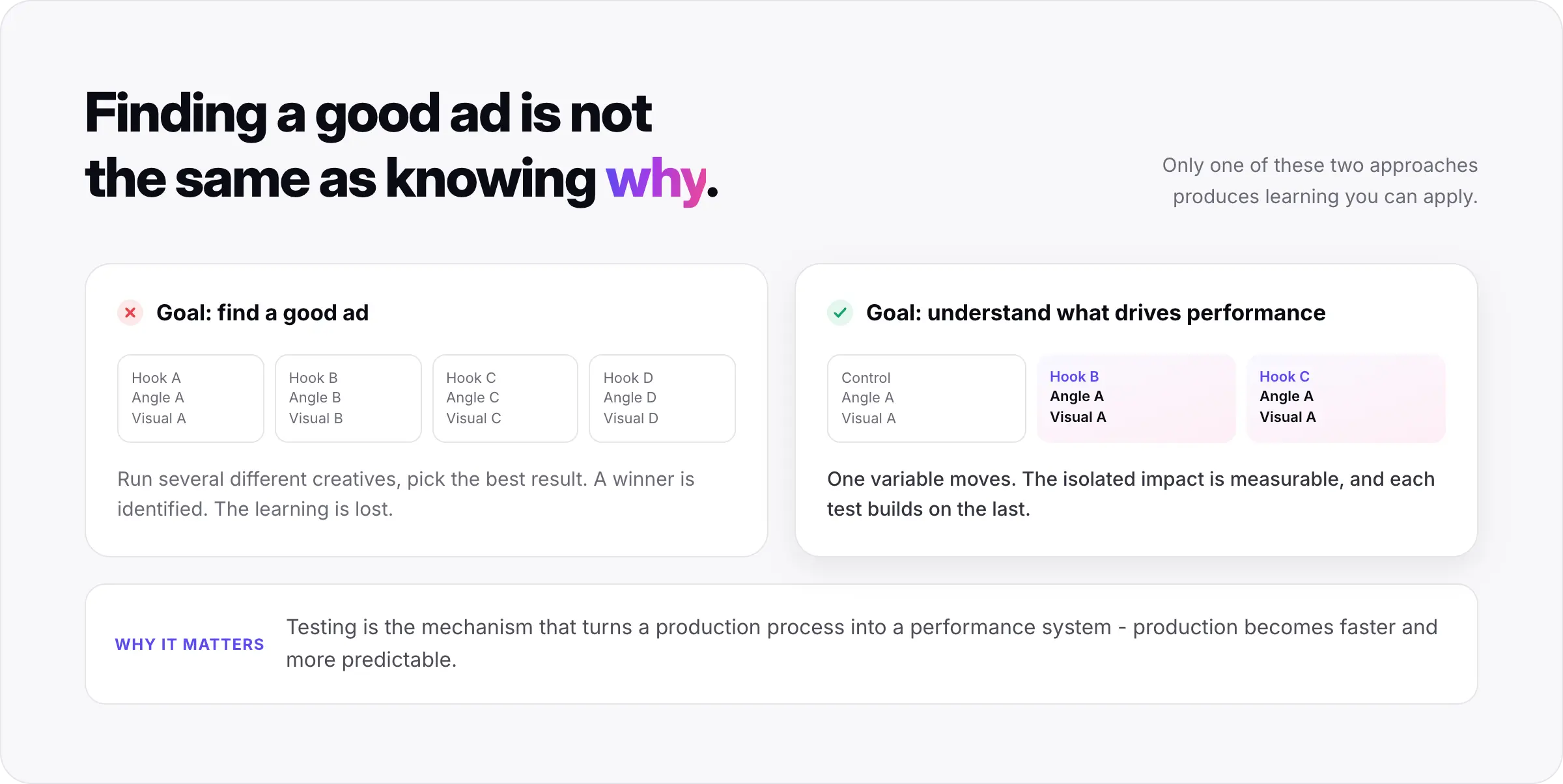
The distinction matters because it changes how tests are structured. If the goal is to find a good ad, you run multiple different creatives and pick the one that performs best. If the goal is to understand what drives performance, you change one variable at a time and measure the isolated impact. Only the second approach produces learning you can apply to the next round.
For ecommerce teams running direct response campaigns, creative testing is the mechanism that turns a production process into a performance system. Each test builds on the last. Over time, the team develops a clear picture of what hook types, angles, and formats work for their product and audience - and production becomes faster and more predictable as a result.
What to Test in Ad Creatives?
There are 5 elements worth testing in ecommerce ad creatives. Each operates at a different stage of the ad and influences a different metric.
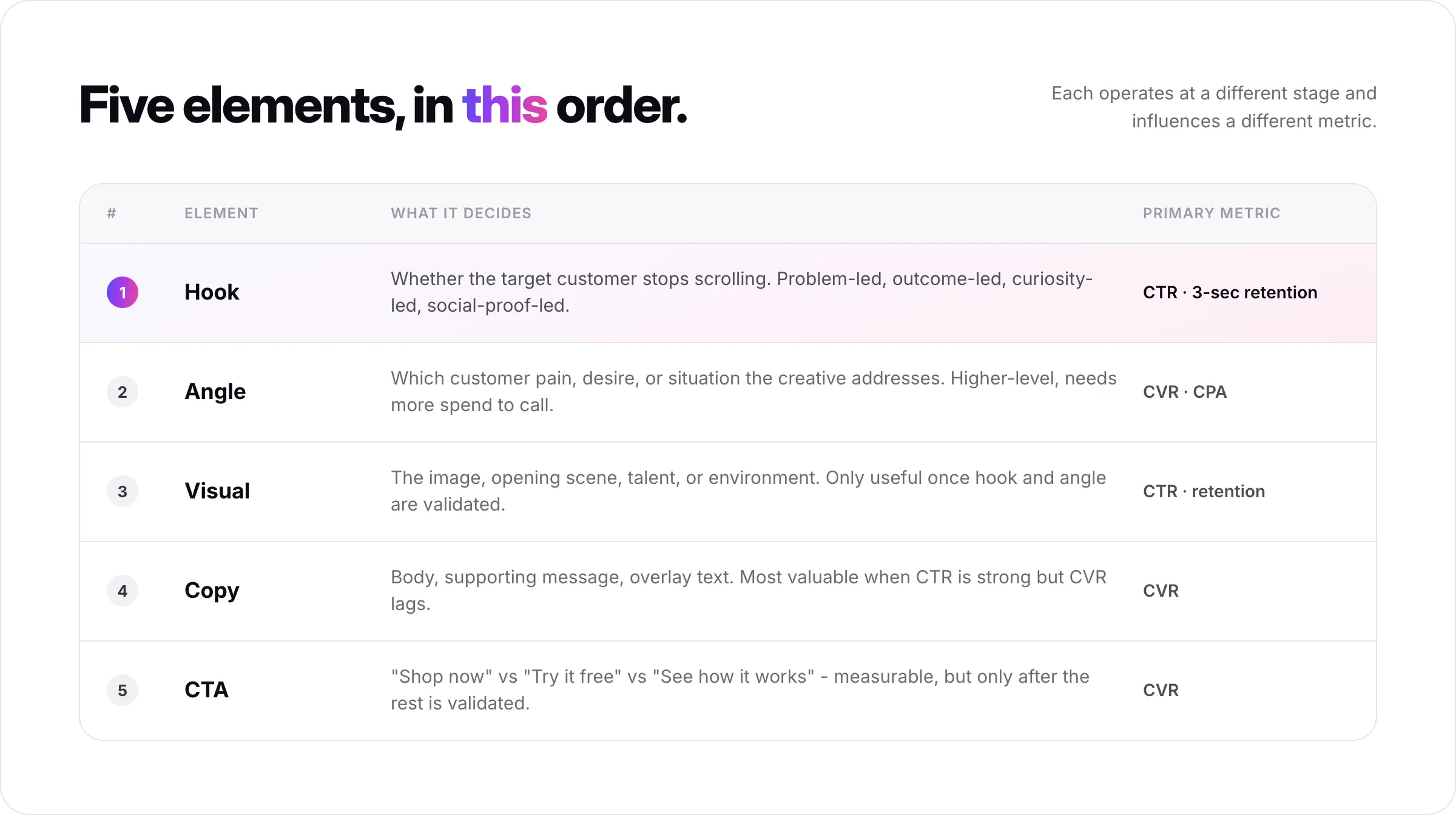
- Hook - the first frame of a video or the headline of a static ad. The hook determines whether the target customer stops scrolling. It is the highest-leverage element to test because it affects every downstream metric. A weak hook means low CTR regardless of how strong the rest of the ad is. Test hook type first: problem-led ("Struggling with X"), outcome-led ("How to achieve Y"), curiosity-led ("What most brands get wrong about X"), or social proof-led ("Why Z customers switched").
- Angle - the strategic direction of the message. The angle defines which customer pain, desire, or situation the creative addresses. Two ads with the same hook type can take completely different angles. Testing angles tells you which customer truth your product resonates with most. This is a higher-level test than hook testing and typically requires more spend to call.
- Visual - the imagery or video content. For static ads, this means the product image, lifestyle image, or graphic style. For video, it means the opening scene, the talent, or the visual environment. Visual tests are most useful after the hook and angle are validated - changing the visual while the hook and angle are still uncertain produces confounded results.
- Copy - the body text, supporting message, or overlay text. Copy tests are most valuable when CTR is strong but conversion rate is underperforming. That pattern suggests the hook is working but the message is not building enough belief to drive action.
- CTA - the call to action. CTA tests are the most granular and typically the last element to test. "Shop now" versus "Try it free" versus "See how it works" can produce measurably different conversion rates for the same product, but only after the hook, angle, and message have been validated.
How to Set Up a Clean Ad Creative Test?
A clean test has three requirements: one variable, a control, and sufficient data before calling a result.
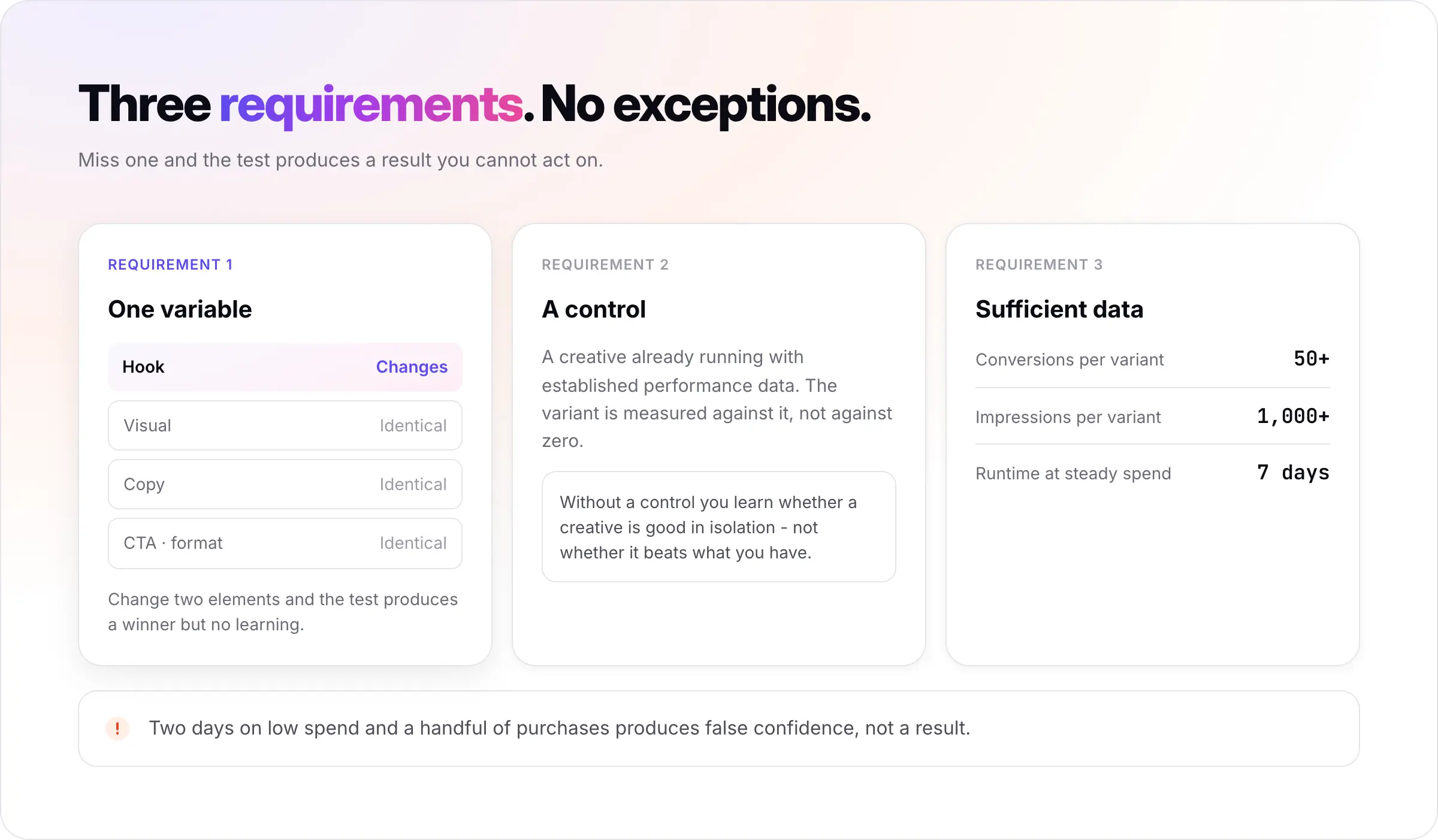
- One variable. Change one element between the test variant and the control. If the hook changes, everything else stays identical - same visual, same copy, same CTA, same format. If you change two elements simultaneously, you cannot attribute the result to either one. The test produces a winner but no learning.
- A control. Every test needs a baseline - a creative that is currently running and has established performance data. The test variant is measured against the control, not against zero. Without a control, you are comparing a new creative to nothing, which tells you whether it is good in isolation but not whether it is better than what you already have.
- Sufficient data before calling. Most ecommerce creative tests need a minimum of 50 conversion events per variant before results are statistically meaningful. Running a test for two days on low spend and declaring a winner based on a handful of purchases produces false confidence. As a practical benchmark: let a test run for at least 7 days at consistent spend before making a decision, and ensure each variant has received at least 1,000 impressions on the target audience.
How to Read Ad Creative Test Results?
Test results fall into four categories. Each one tells you something different about what to do next.
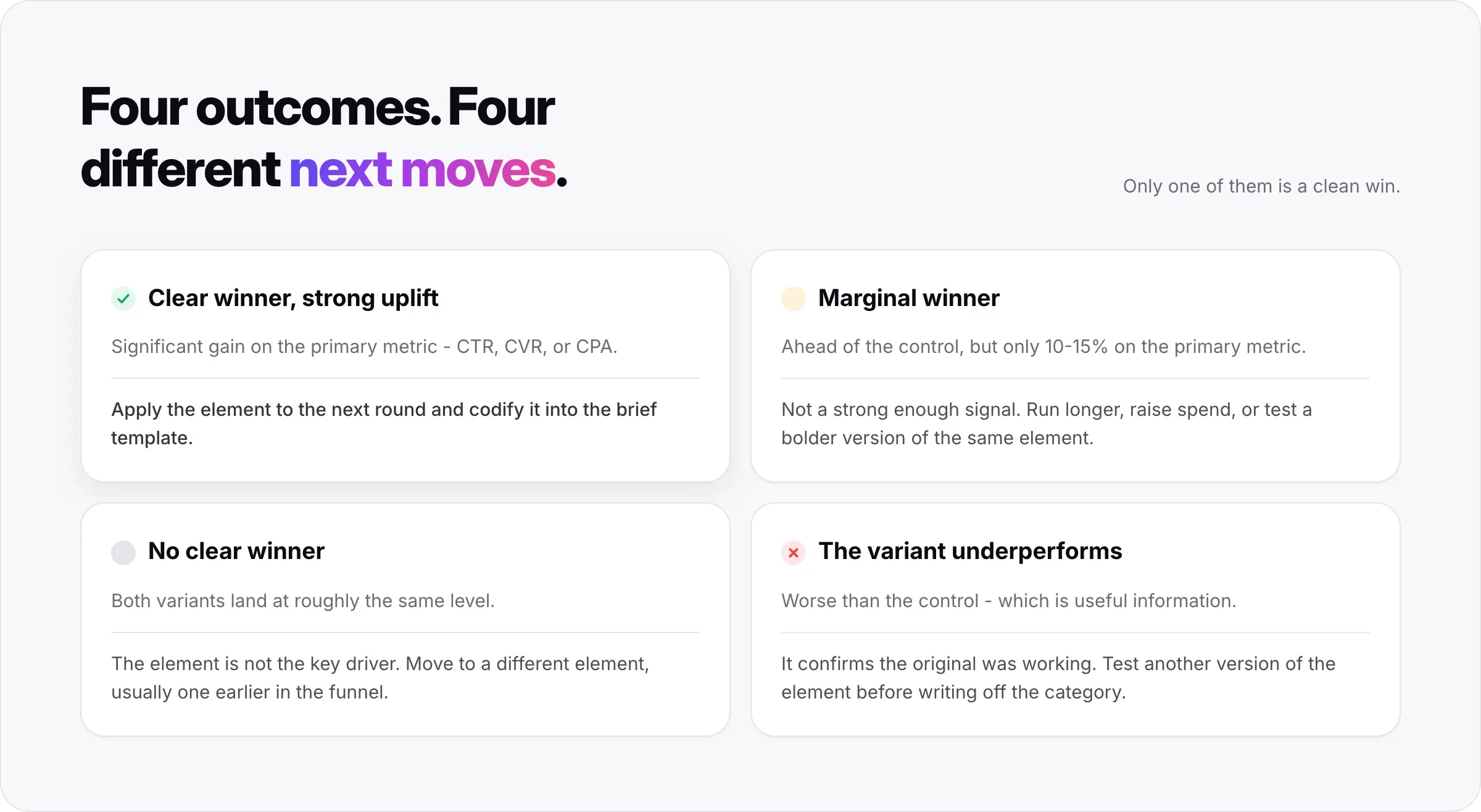
- Clear winner with strong uplift. The test variant significantly outperforms the control on the primary metric - CTR, conversion rate, or CPA. Apply the winning element to the next round of creatives and build new test variants on top of it. The learning is confirmed and should be codified into the brief template for this product.
- Marginal winner. The test variant outperforms the control but the difference is small - within 10-15% on the primary metric. This is not a strong enough signal to act on. Run the test longer or increase spend to see if the difference holds, or test a bolder version of the same element.
- No clear winner. Both variants perform at roughly the same level. This means the element you tested did not meaningfully influence the metric you were measuring. It does not mean the test failed - it means that element is not the key driver. Move to testing a different element, typically one earlier in the funnel.
- The variant underperforms. The new element performs worse than the control. This is a useful result - it confirms the original element was working and directs attention elsewhere. Do not abandon the angle or the format based on one underperforming variant. Test a different version of the same element before drawing conclusions about the category.
Display Ads vs Video Ads: Testing Differences
Static and video ad creatives require different testing approaches because they operate differently at the hook stage.
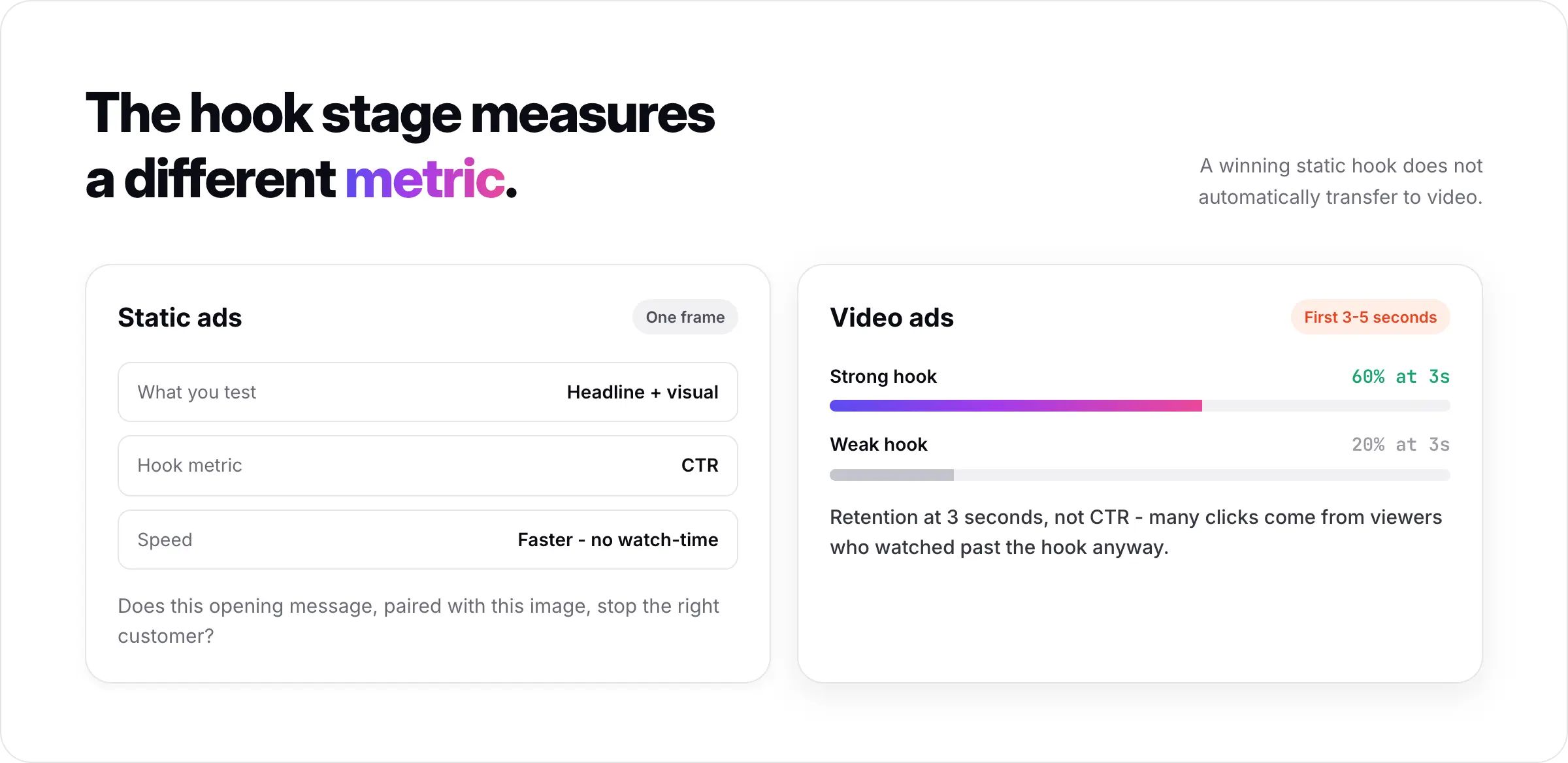
- For static ads, the hook is delivered in a single frame. The test is essentially a headline and visual test: does this opening message, paired with this image, stop the right customer? Static tests produce faster results because there is no watch-time variable. CTR is the primary hook-stage metric.
- For video ads, the hook plays out over 3-5 seconds. The primary hook-stage metric is not CTR but video retention at the 3-second mark. An ad that retains 60% of viewers through the first 3 seconds has a strong hook. An ad that retains 20% has a weak hook - regardless of its overall CTR, because many clicks come from viewers who watched past the hook anyway. Testing video hooks means testing the first 3-5 seconds specifically, not the full creative.
When running tests across both formats for the same product, do not assume a winning hook in static will automatically translate to video. The hook concept may transfer, but the execution needs to be tested separately in each format.
What to Do When a Test Shows No Clear Winner?
No clear winner is the most common outcome in ad creative testing - and the most misread. Most teams interpret it as a failed test. It is not. It is data.
When a test shows no clear winner, one of three things is true. First, the element tested does not meaningfully influence the metric being measured - the hook change did not affect CTR because both hooks were weak, not because hooks do not matter. Second, the test did not run long enough or accumulate enough data to detect a real difference. Third, the angle the entire test is built on is not resonating, which means changing individual elements will not move the needle until the angle itself is addressed.
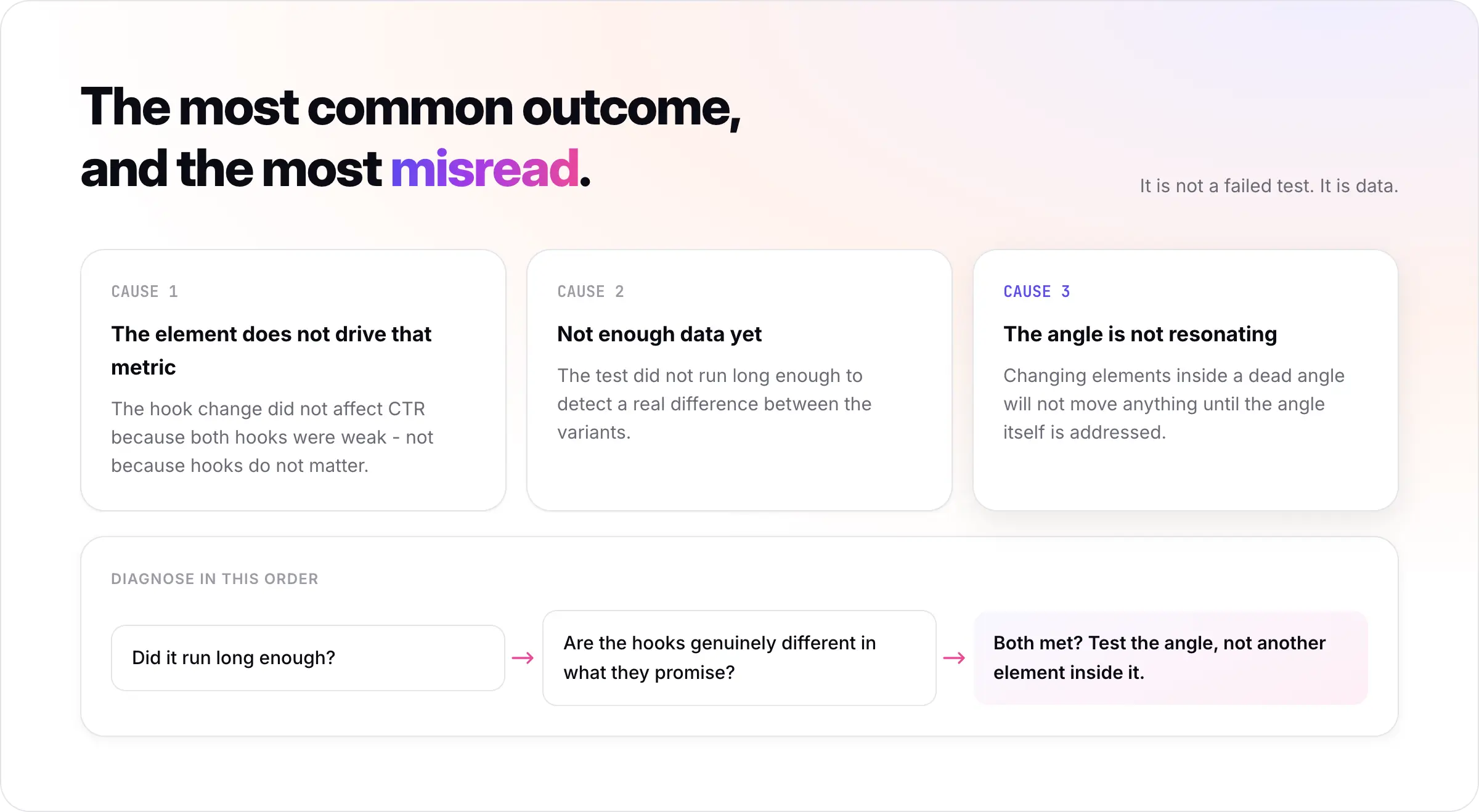
The correct response to a no-winner result is to diagnose first. Check whether the test ran long enough. Check whether the hook types being tested are genuinely different in what they promise. If both conditions are met and there is still no winner, test the angle - not a new element within the same angle.
How to Build a Testing Process That Compounds Over Time?
A single test produces a single data point. A testing process that is structured correctly produces compounding learning - each round informs the next, and the team's understanding of what works builds over time.
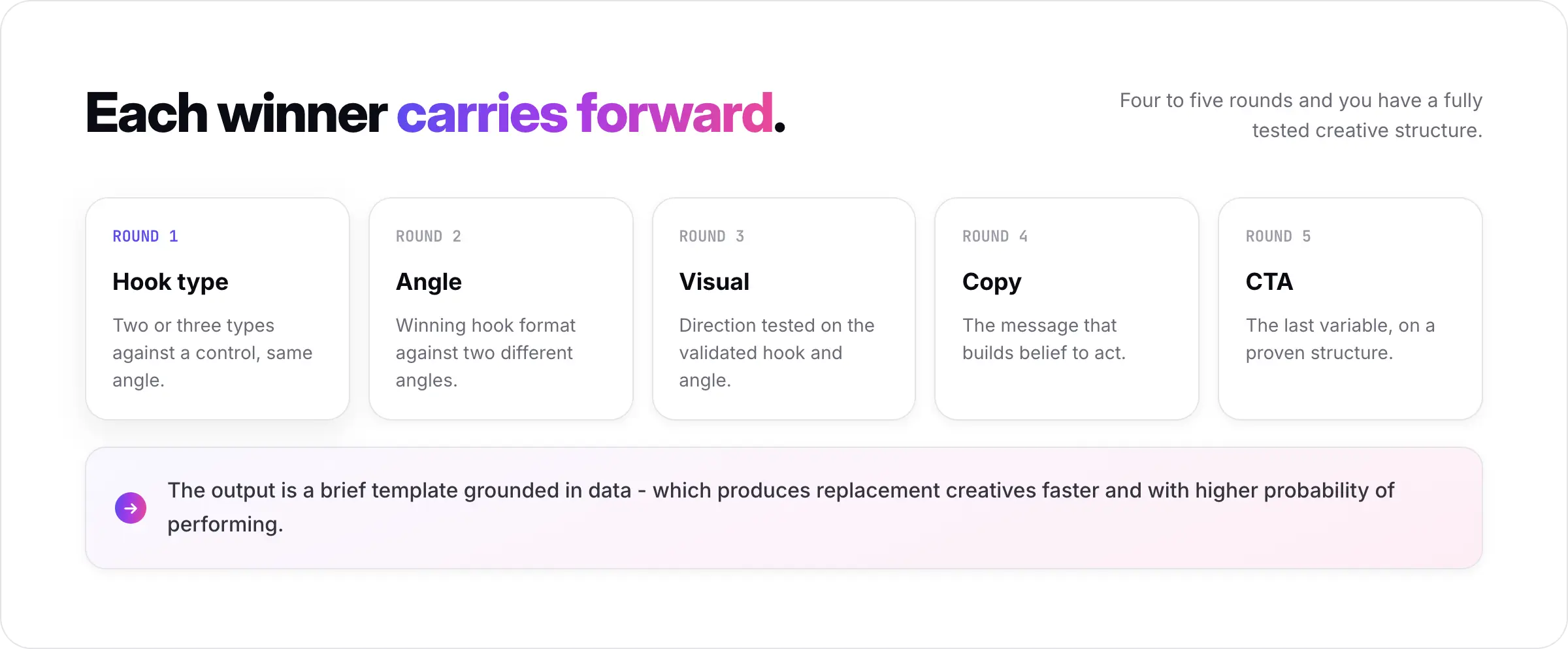
The structure is simple. Start with the highest-leverage element - the hook. Test two or three hook types against a control on the same angle. Apply the winning hook type to the next round. Then test the angle: take the winning hook format and run it against two different angles. Apply the winning angle. Then test the visual, then the copy, then the CTA.
At each stage, the element being tested is the only variable. The winning version from the previous stage carries forward. Over four to five rounds, the team has validated the hook type, the angle, the visual direction, the message, and the CTA - and has a fully tested creative structure that can be used as the brief template for future rounds, including refresh creatives when fatigue sets in.
This is what separates a team with a testing system from a team that runs tests occasionally. The system produces a brief template grounded in data. The template produces replacement creatives faster and with higher probability of performing.
How Promer AI Fits Into a Creative Testing Process?
The most time-consuming part of running a structured creative testing process is brief development - producing hook variants and angle directions that are genuinely different from each other and grounded in product truth rather than guesswork.
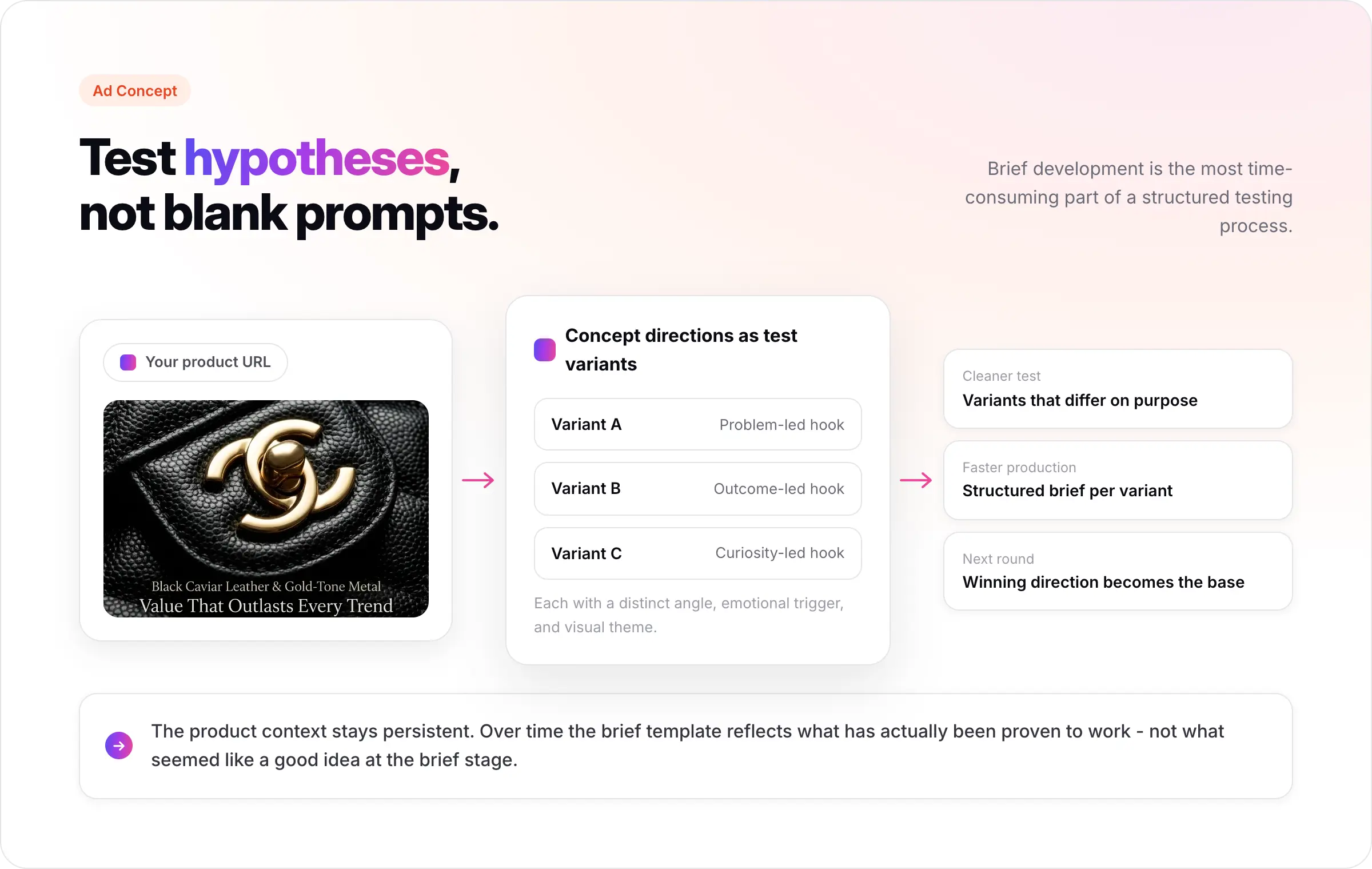
When you paste a product URL into app.promer.ai, Promer extracts the product context and generates multiple concept directions before any design begins - each with a distinct angle, hook type, emotional trigger, and visual theme. These concept directions are, in effect, a set of test hypotheses built from product context. Rather than writing hook variants from a blank prompt, the team starts from a structured brief for each variant - which makes the test cleaner, the production faster, and the results more interpretable.
As test results come in, the winning concept direction becomes the foundation for the next round of brief development in Promer AI. The product context stays persistent. The brief evolves based on what the tests have confirmed. Over time, the brief template reflects what has actually been proven to work for that product - not what seemed like a good idea at the brief stage.
FAQs About Ad Creative Testing for Ecommerce
What is the difference between A/B testing and multivariate testing for ad creatives?
A/B testing changes one element between two variants and measures the isolated impact of that single change.
Multivariate testing changes multiple elements simultaneously across multiple variants and uses statistical modelling to attribute performance differences to specific combinations of changes.
For most ecommerce teams, A/B testing is the more practical and reliable approach. Multivariate testing requires significantly more spend and impressions to reach statistical significance, and the results are harder to act on without a large data science infrastructure.
Start with A/B testing and build toward multivariate only when the volume supports it.
How long should I run an ad creative test before calling a result?
Run a test for at least 7 days at consistent spend before making a decision, and ensure each variant has received at least 50 conversion events and 1,000 impressions on the target audience.
Calling a test too early - after 2-3 days or a handful of conversions - produces false winners driven by statistical noise rather than real performance differences.
If the test has run for 7 days and neither variant has reached the conversion threshold, extend the test or increase spend rather than calling it early.
How much budget should I allocate to ad creative testing?
As a practical benchmark, allocate enough per variant to reach 50 conversion events within a 7-14 day window. The exact budget depends on your product's conversion rate and average order value. If your campaign typically converts at 2% and your CPA is $30, a two-variant test needs roughly $3,000 over 7-14 days to produce statistically meaningful results.
Teams with lower conversion rates or higher CPAs need proportionally more budget per test. If budget is constrained, test higher-funnel elements first - hook and CTR tests require fewer conversion events to call than full-funnel conversion tests.
When should I re-test existing ad creatives?
Re-test an existing creative when it is showing early fatigue signals - rising frequency with falling CTR, or a CPA that has climbed without targeting or bidding changes. The re-test in this context is a refresh test: a hook variant or angle variant running against the fatiguing original to see if a specific change recovers performance.
Re-testing from scratch - building an entirely new creative with no connection to the previous one - makes sense only when a full refresh cycle has been run and no variant has recovered performance, indicating the angle itself is no longer resonating.
How do I test seasonal or time-limited ad creatives?
Seasonal creative tests have a shorter window and require a different approach than evergreen tests. The most efficient method is to take the current winning creative structure - the proven hook type and angle - and create a seasonal variant that changes only the hook and offer to reflect the seasonal context.
Run the seasonal variant against the evergreen control from day one of the seasonal period, with enough budget to accumulate data within the first 5-7 days. If the seasonal variant underperforms, revert to the evergreen control rather than testing further. Seasonal periods are too short to run a full testing sequence from scratch.
What should I test first if I have never run a structured creative test before?
Start with the hook. Write two or three versions of the hook for your current best-performing ad - keeping the angle, visual, copy, and CTA identical across all variants.
Use different hook types: one problem-led, one outcome-led, one curiosity-led. Run them against each other for 7 days with consistent spend.
The variant with the highest CTR and strongest 3-second video retention indicates which hook type resonates most with your audience. That result becomes the foundation for every subsequent test and brief in this product's creative system.