How to Evaluate ROI of AI-Generated UGC Ads?
ROI on AI-generated UGC ads is measured the same way as any paid ad - cost against the revenue or conversions it produces - but the cost side changes because production no longer depends on booking and filming a creator. That shift is what makes AI UGC ROI worth evaluating separately: the per-variant cost drops enough that the breakeven math looks different from traditional UGC, even when the ad itself performs identically.
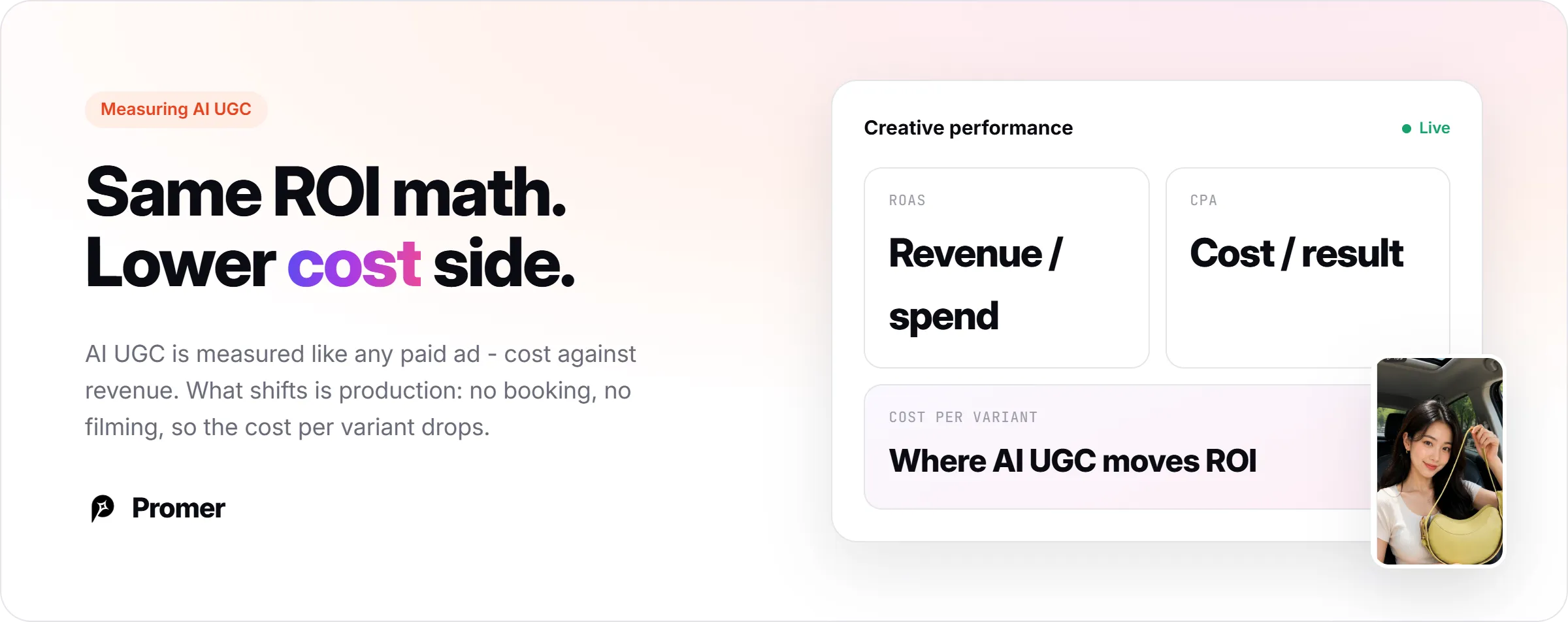
Evaluating this fairly means tracking the same performance metrics you'd use for any ad, then comparing them against a cost base that reflects how AI UGC is actually produced, not against a vague sense that "AI is cheaper."
This article covers what to measure, how to calculate the cost side correctly, and how to test AI UGC against real creator content without skewing the comparison.
Key Takeaways
- ROI on AI UGC ads still comes down to cost versus revenue or conversions, not a separate metric of its own
- The main ROI shift versus traditional UGC is on the cost side - fewer bookings, faster iteration, lower cost per variant
- Hook hold rate (3-second view rate) is a leading indicator worth tracking before conversion data is available
- A/B testing AI UGC against real creator content works only when every other variable - offer, CTA, targeting - stays fixed
- Review generated creatives before counting them in performance data, since errors in claims or product details can distort results
Start With the Same Metrics You'd Use for Any Ad
AI-generated UGC ads don't need a separate measurement framework. The core metrics are the same ones used to evaluate any paid creative:
- Hook hold rate (3-second video view rate) - the leading indicator of whether the opening seconds earn attention
- Click-through rate (CTR) - how many viewers act on the ad once the hook has held them
- Cost per acquisition (CPA) or cost per purchase - the bottom-line efficiency number
- Return on ad spend (ROAS) - revenue generated per dollar spent, when revenue data is available
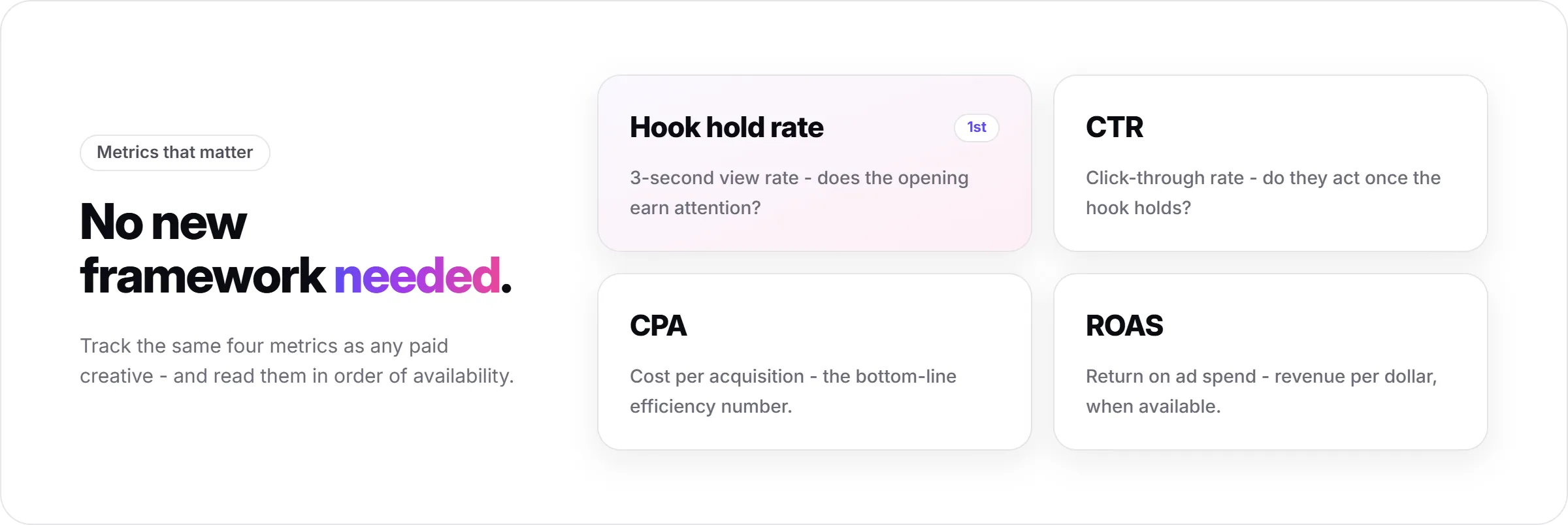
Hook hold rate deserves attention first, because it's available before conversion data accumulates and it isolates the one variable AI generation touches most directly - the opening seconds of the script. If fewer than roughly a quarter of impressions result in a 3-second view, the hook is the problem, regardless of what happens further down the funnel.
Calculate Cost Per Variant, Not Just Cost Per Ad
The clearest financial signal for AI UGC ROI is cost per variant, not cost per finished ad. Take your total monthly spend on creative production - tool subscriptions, any remaining creator fees, editing time - and divide it by the number of distinct ad variants you actually tested that month.
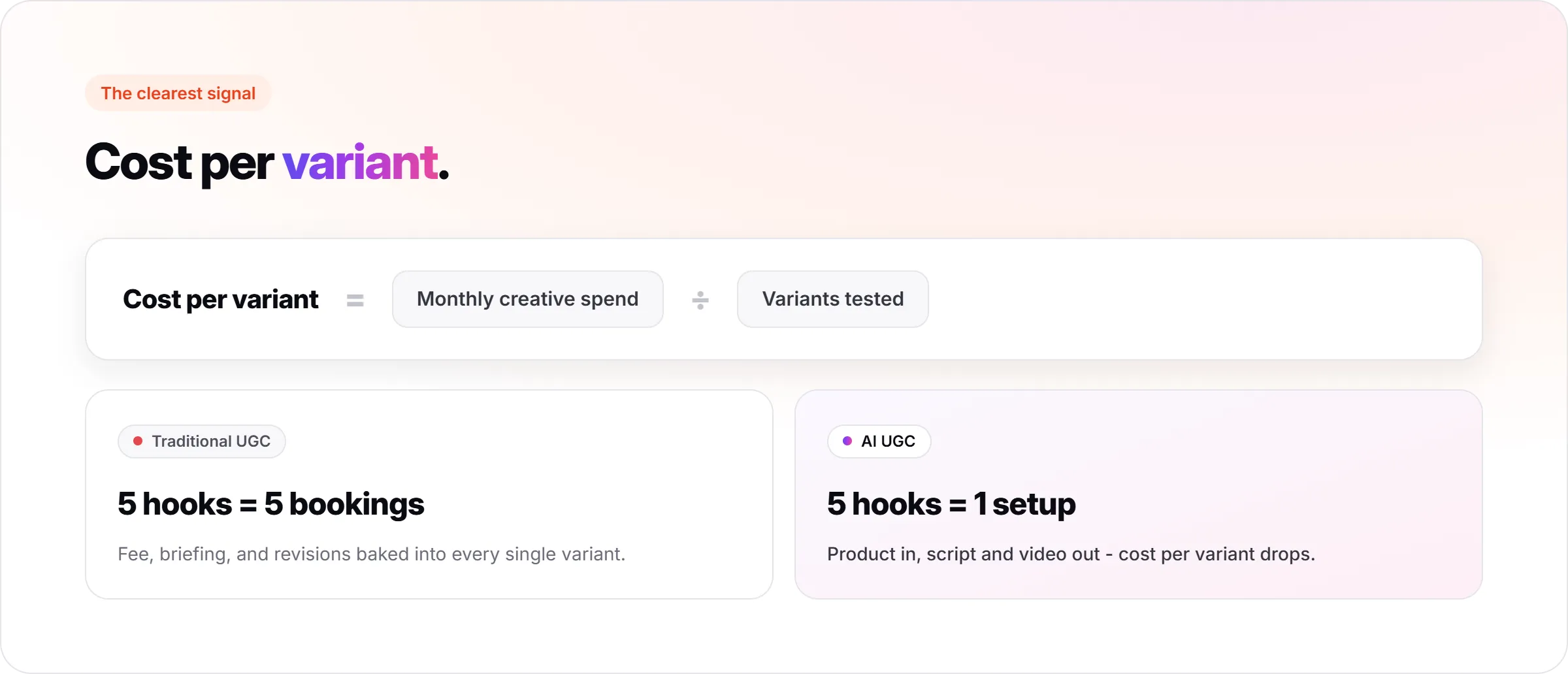
This number is what changes most between traditional and AI-generated UGC. A traditional creator video carries a fee, briefing time, and revision rounds baked into every variant, so testing five hooks means paying for five full production cycles. An AI UGC workflow - product in, script and video out - lets you test the same five hooks without five separate bookings, so the cost per variant drops even before any performance difference shows up. This is the same math behind scaling UGC ad creative production - the ROI gain and the production gain are the same underlying shift.
The harder number to quantify, but often the more valuable one, is the revenue recovered from creative that would otherwise have gone stale. If creative fatigue typically sets in within a few weeks for UGC-style ads, the ability to produce a replacement without a new booking has a real dollar value, even if it doesn't show up in a single ad's ROAS.
Test AI UGC Against Real Creator Content Fairly
A fair test isolates the one variable you're actually evaluating - whether the ad is AI-generated or creator-filmed - and holds everything else constant. Same offer, same CTA, same targeting, same spend level, same format (testimonial vs testimonial, not testimonial vs POV demo). Changing more than one variable at a time makes it impossible to know what caused a performance difference. This is standard ad creative testing discipline, applied specifically to the AI-vs-real comparison.
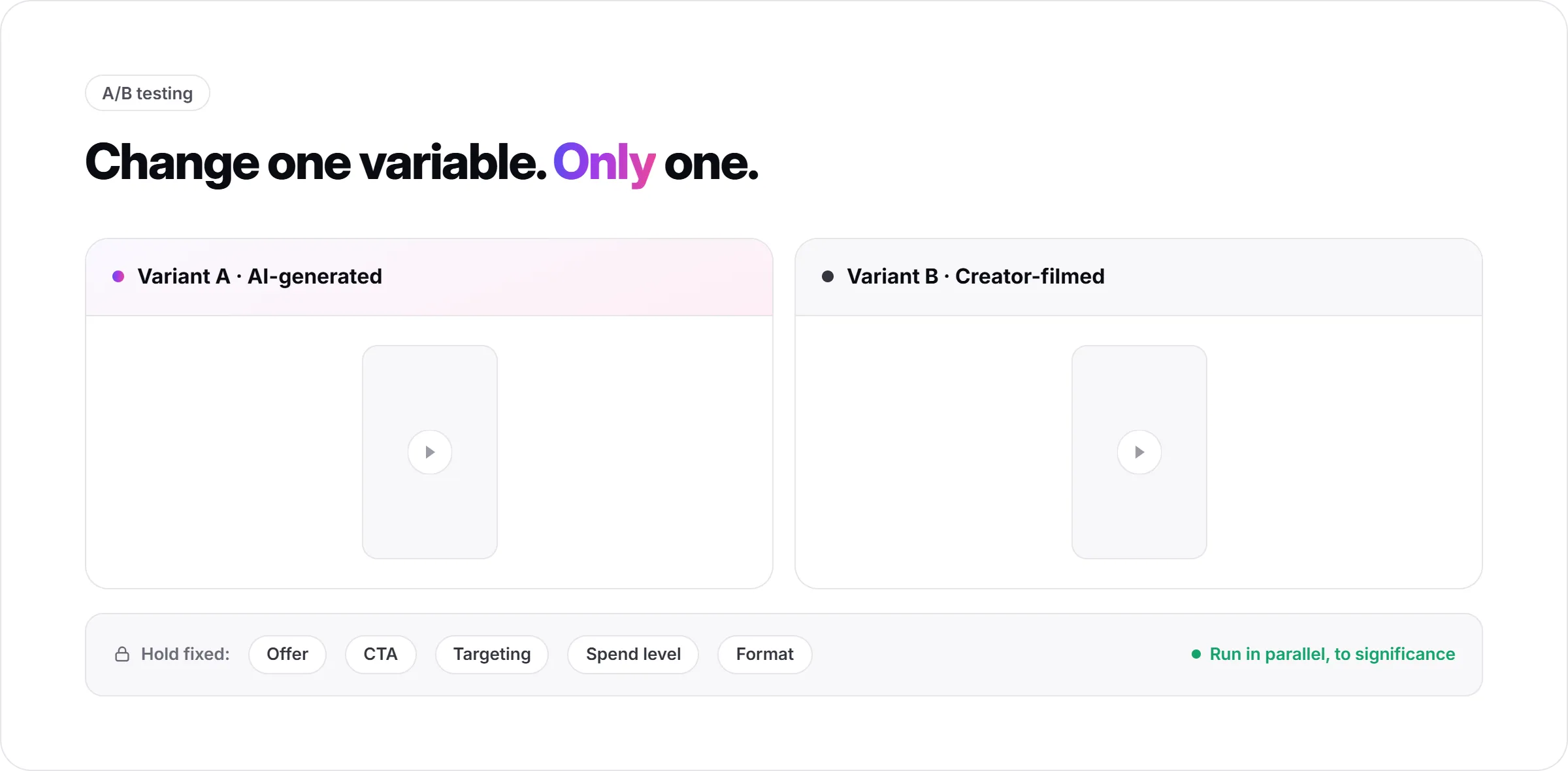
Run both versions in parallel rather than sequentially, since audience behavior shifts over time and a sequential test conflates timing with creative type. Give each variant enough spend to reach statistical relevance before drawing conclusions - a handful of clicks on either side isn't enough to call a winner.
Neither format wins universally. AI-generated UGC often wins on cost per variant and iteration speed, since generating a new hook or format doesn't require rebooking a creator. Creator-filmed content can carry more built-in trust for hero campaigns or categories where audience skepticism toward AI content runs high. The honest comparison reports both sides rather than declaring a universal winner.
Watch for the Errors That Distort ROI Data
AI-generated creatives can contain small errors in claims, pricing, or product details, and a factual error in a live ad affects performance in ways that have nothing to do with whether AI UGC works as a format. Reviewing every script and video before it counts toward performance data - not just before it goes live - keeps a bad batch from skewing the ROI comparison in either direction.
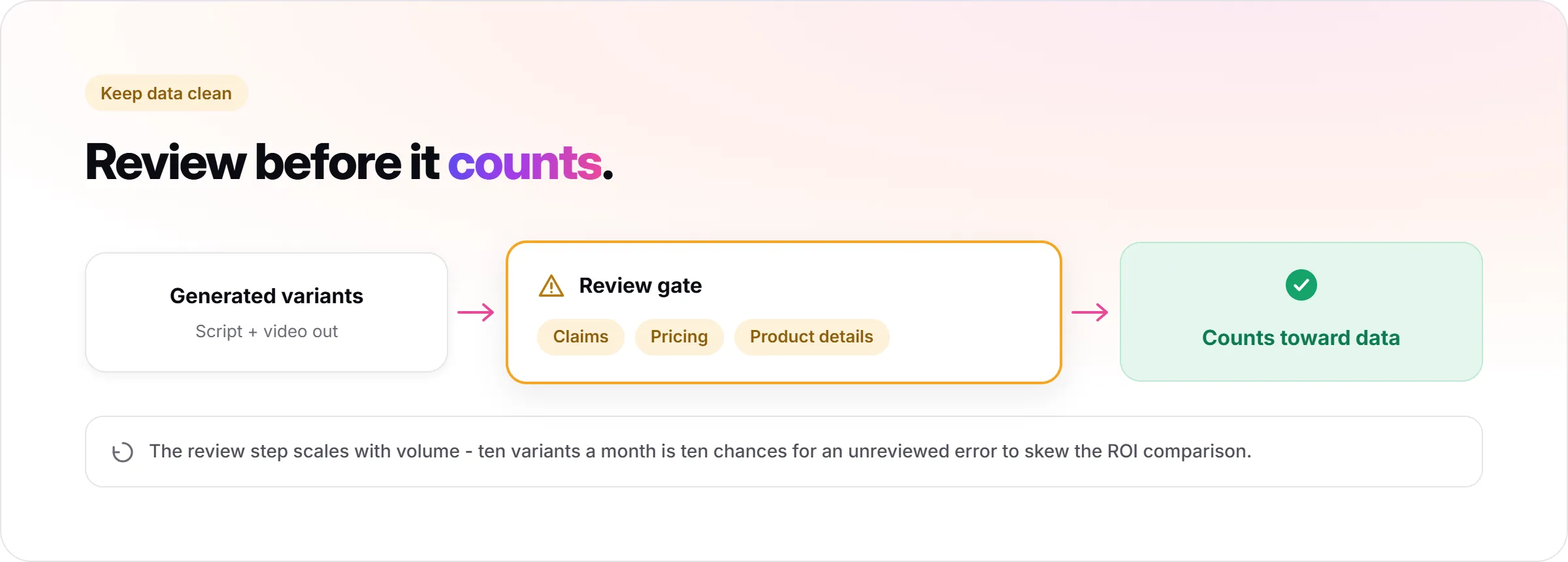
This matters more as testing volume increases. A team running ten AI UGC variants a month has ten chances for an unreviewed error to enter the data set, so the review step scales with volume rather than becoming optional once production speeds up.
FAQs about Evaluating AI UGC Ad ROI
What's the difference between measuring ROI on AI UGC ads versus regular ads?
There's no separate ROI formula for AI UGC ads - the same cost-versus-return calculation applies. What changes is the cost side: production no longer requires booking a creator, so cost per variant is usually lower, which shifts the breakeven point rather than the metric itself.
Treat AI UGC as a production method, not a different category of ad, when setting up your measurement framework.
What metrics matter most for AI-generated UGC ads?
Hook hold rate (3-second view rate), click-through rate, cost per acquisition, and ROAS cover most of what matters, in roughly that order of availability. Hook hold rate is worth checking first since it's available earliest and flags a weak opening before conversion data accumulates.
Prioritize the leading indicator over the lagging one when a campaign is new - by the time CPA data is reliable, you've already spent the budget that a bad hook wasted.
How do I calculate cost per UGC ad variant?
Divide your total monthly creative production spend - tool costs, any remaining creator fees, editing time - by the number of distinct variants tested that month. This is different from cost per finished ad, since it accounts for the iteration itself, not just the final asset.
A lower cost per variant means you can test more hooks and formats for the same budget, which is often where AI UGC's real ROI shows up rather than in any single ad's performance.
Should I A/B test AI UGC against real creator UGC?
Yes, if you want an honest performance comparison rather than an assumption. Hold every variable fixed except the production method - same offer, CTA, targeting, and format - and run both in parallel with enough spend to reach statistical relevance.
Don't expect a universal winner. Results vary by product, audience, and category, so the point of the test is to learn what works for your specific ads, not to settle the debate generally.
How long before I can tell if an AI UGC ad is working?
There's no fixed timeline, since it depends on daily spend and audience size, but hook hold rate is often readable within the first day or two of impressions, well before CPA or ROAS data is reliable. Waiting for full-funnel conversion data before making any decision means missing the chance to catch and fix a weak hook early.
Set a spend or impression threshold in advance - rather than a fixed number of days - so the decision to keep or kill a variant is based on data volume, not a calendar date.
Does AI-generated UGC perform worse than real UGC?
Performance varies by product, audience, and execution, so there's no universal answer either way. AI UGC shares the same format logic as real UGC - relatable hooks, casual pacing, first-person framing - which is part of why it can perform comparably in testing.
The more reliable driver of performance is still the hook and product fit, not whether the content is AI-generated or creator-filmed. Testing your specific product against your specific audience is the only way to know for certain.
If you haven't produced an AI UGC variant yet, how to make AI UGC videos walks through the production steps this ROI framework assumes you already have running - and pairing that workflow with an AI ad generator is what makes running this test on your own product practical.