How to Scale UGC Ad Creative Production?
Scaling UGC ad creative production means building a repeatable system - not hiring more creators - so you can test more hooks and formats in less time. Manual UGC production hits a ceiling fast because every asset depends on a person: booking a creator, briefing them, waiting for filming, then reviewing footage. That ceiling is coordination, not creative talent, and it caps most teams at a handful of new assets a month regardless of budget.
The way past that ceiling is to generate UGC ads at scale using AI for the repetitive parts of production - script variations, avatar and voice selection, rendering - while keeping human judgment on the parts that actually decide performance: the hook, the format choice, and what to test next.
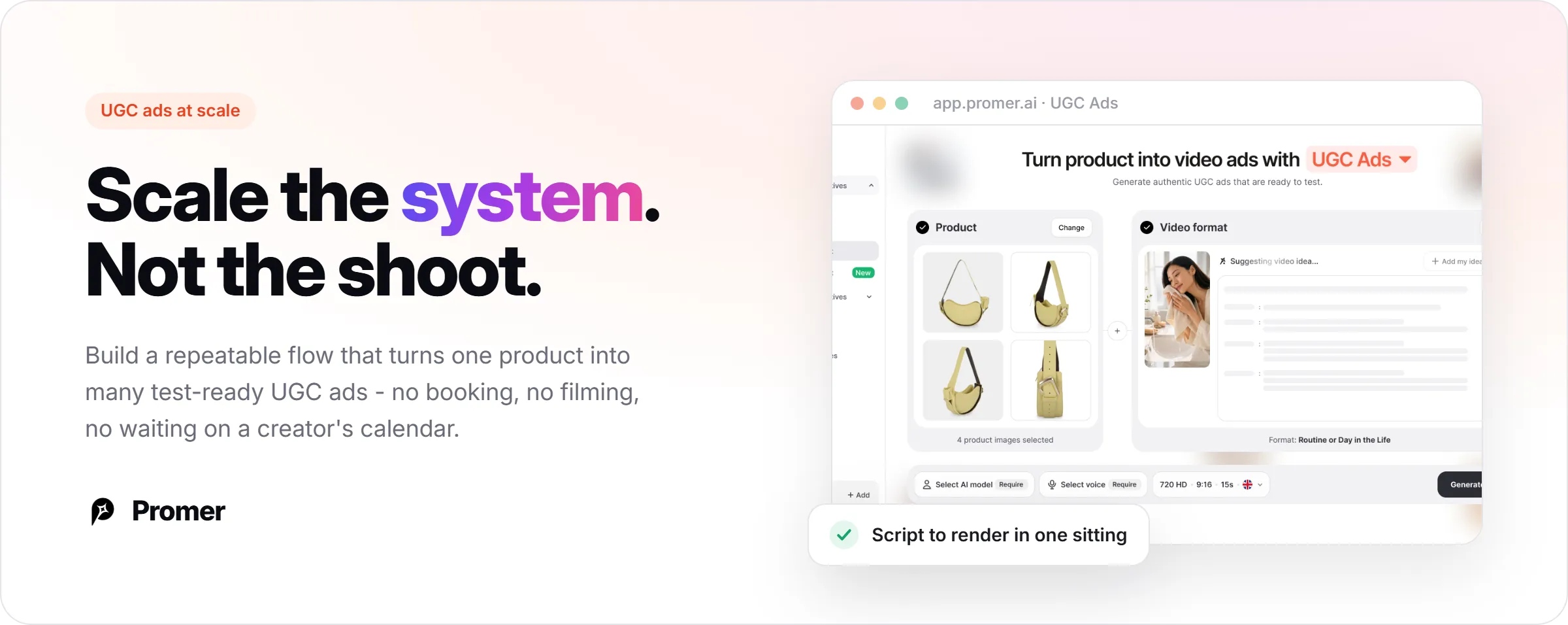
This article covers the system: what actually needs to scale, how AI removes the production bottleneck, and how to structure testing so volume turns into insight instead of noise.
Key Takeaways
- The real bottleneck in UGC production is coordination overhead, not creator supply or budget
- Scaling means testing more hook and format variations per cycle, not producing more finished ads for their own sake
- AI UGC tools remove the filming and scheduling step, letting you go from script to rendered video without booking a creator
- A repeatable structure - same product input, new hook or format each time - produces cleaner test data than one-off variations
- Creative fatigue sets in fast on UGC-style ads, so scaling production is also about keeping a refresh pipeline running, not a single batch
Why Manual UGC Production Doesn't Scale?
A typical UGC creator cycle runs through sourcing, briefing, filming, review, and revisions, and each stage depends on someone else's schedule. Even with a reliable creator roster, this usually caps output at a handful of finished videos per cycle, because every new hook or angle means a new booking.
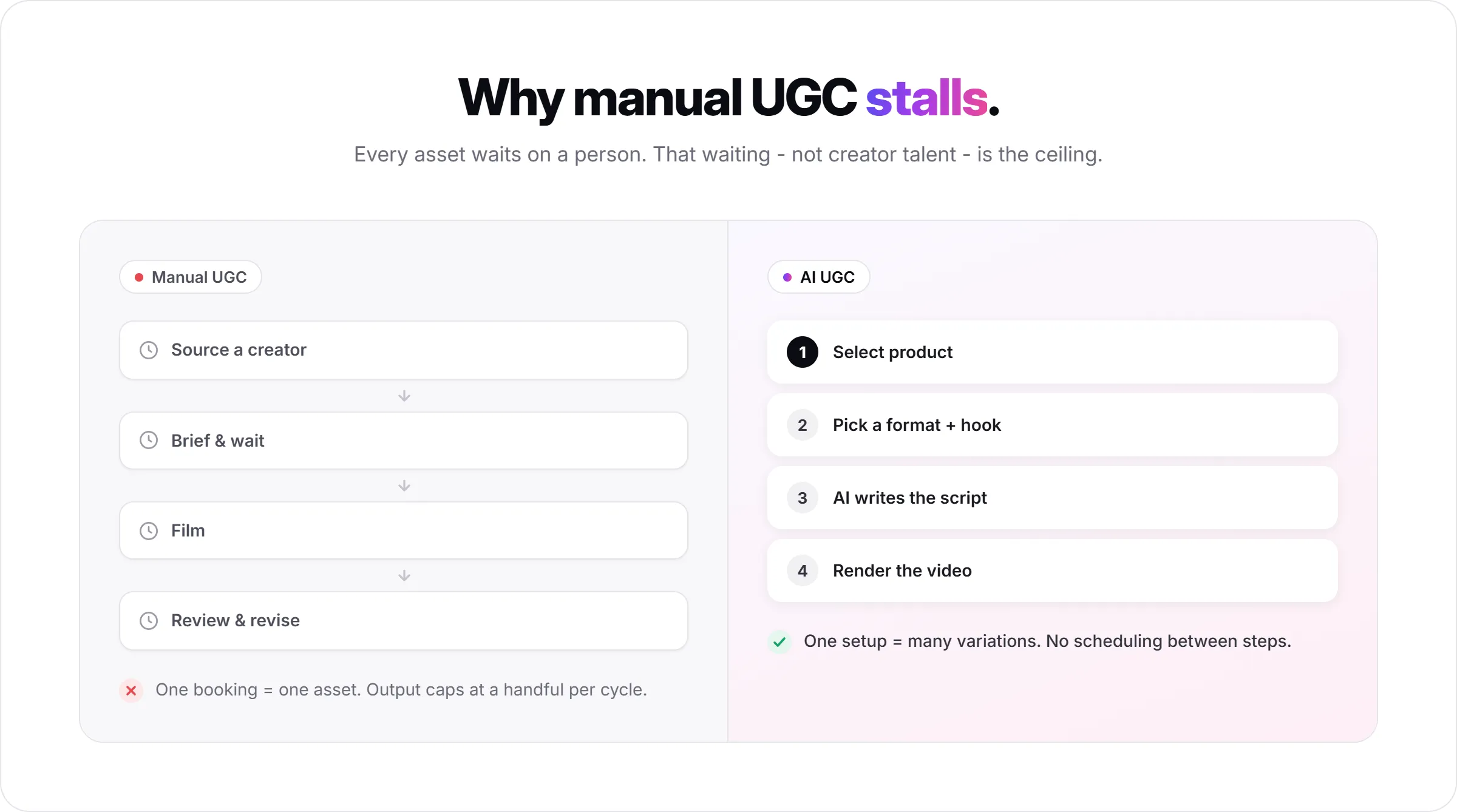
The cost problem compounds the scheduling problem. A finished creator video carries the raw fee plus briefing time, revision rounds, and asset handling, and none of that overhead shrinks as you order more. Testing five hooks the traditional way means five separate bookings, not one booking with five variations - and spotting high-converting UGC ads before you scale spend on them gets harder when each variation is this expensive to produce.
This is the actual constraint teams hit when they try to "scale UGC": not a lack of good creators, but a production pipeline that only moves one asset at a time.
What Changes When You Generate UGC Ads With AI?
An AI UGC workflow replaces the booking-and-filming stage with a direct input-to-output flow: product images in, script and video out, in one session.
Promer AI's ai ugc video generator works this way - select a product, pick a video format (Direct Testimonial, Voiceover Product Review, POV Product Demo, Problem and Solution, or Routine or Day in the Life), and the AI suggests a hook, message, and visual direction to build the script from.
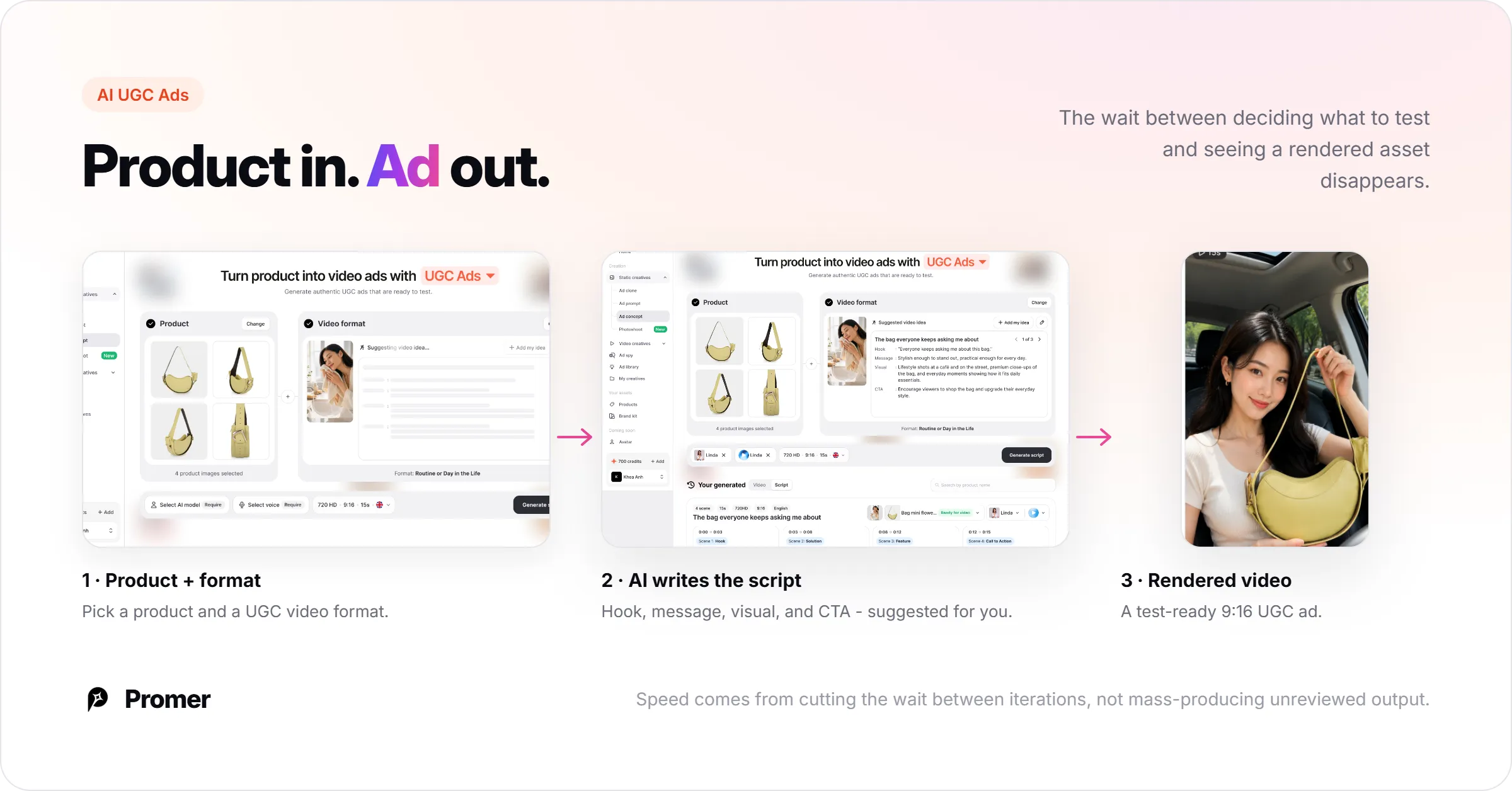
This does not remove the need to decide what to test. It removes the wait between deciding and having a rendered asset to look at. Where a creator cycle might take a week to produce one variation, an AI UGC flow can take you from a product to a reviewable script in the same sitting, because there's no scheduling dependency between steps.
What it does not do is generate dozens of finished videos in a single click. Each AI UGC video still runs through the same structured flow - product, format, idea, AI model, voice, script, render - so the speed gain comes from cutting the wait between iterations, not from mass-producing unreviewed output. That distinction matters for how you plan a testing cycle.
Building a Testing Cadence Instead of a One-Time Batch
Scale comes from running this flow repeatedly with one variable changed at a time, not from generating a large batch once and hoping something in it performs. The highest-leverage variable to test first is the hook, since a hook that fails in the first few seconds means the rest of the ad never gets evaluated at meaningful scale.
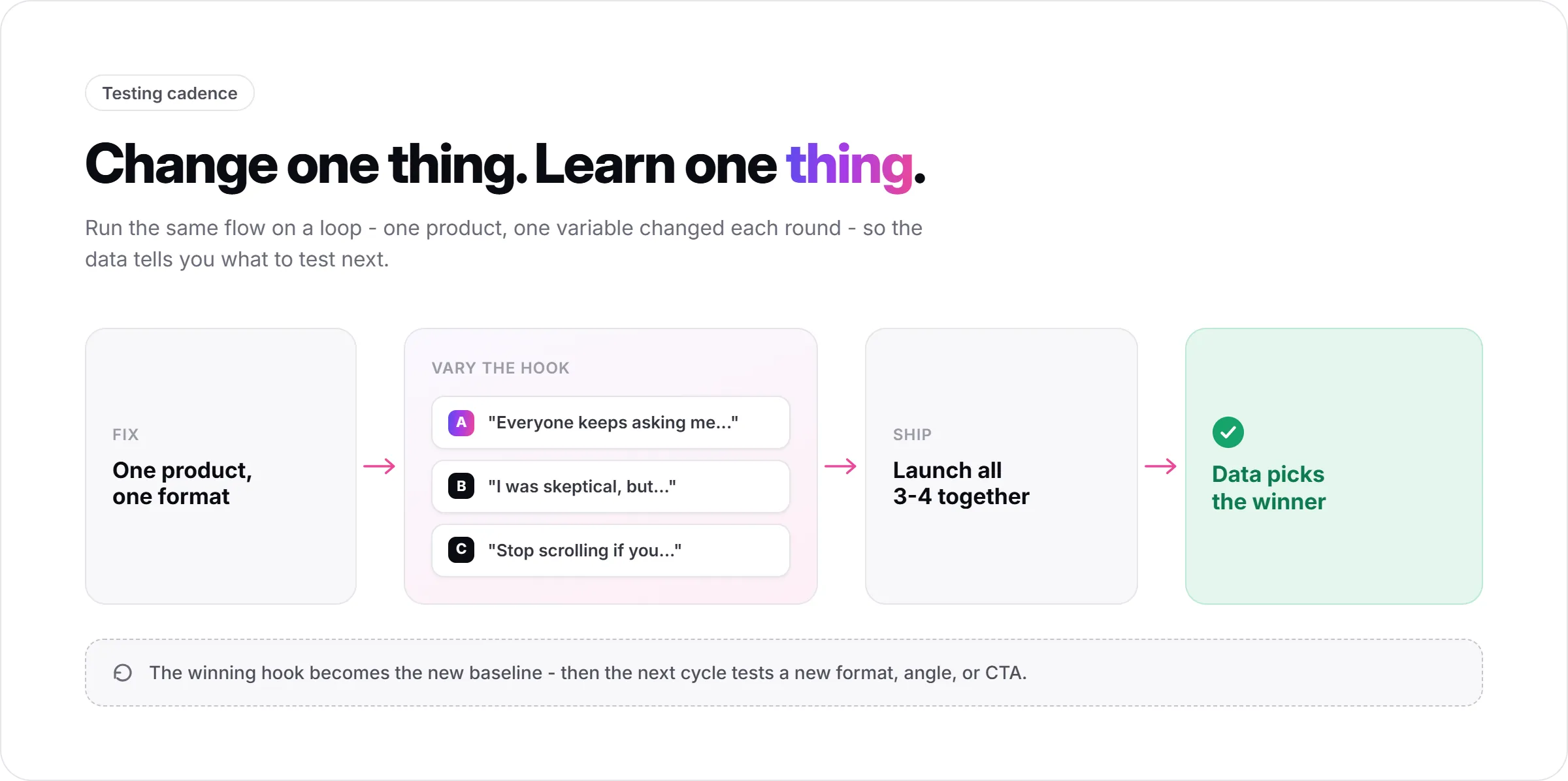
A practical cadence looks like: pick one product, generate 3-4 versions of the same format with a different hook in each, launch them together, and let the data decide which hook earns a second round of testing - a new format, a new visual direction, or a script rewrite around what worked. This is standard ad creative testing practice, just applied to a faster production cycle. Promer AI supports this directly by suggesting alternative video ideas (browsable as 1 of 3) for the same product and format, so testing a different angle doesn't mean starting the setup from zero each time.
Once a structural winner emerges, that becomes the new baseline for the next cycle rather than a one-off success. This is what separates a testing system from a batch of disconnected experiments - each cycle should tell you something specific enough to shape the next one.
Keeping Pace With Creative Fatigue
UGC-style ads lose performance faster than studio-produced creative because the audience recognizes the pattern once they've seen it a few times. Recent UGC ad performance benchmarks reflect this pattern across accounts, not just anecdotally. This means scaling production isn't a one-time project - it's an ongoing pipeline that has to keep producing fresh variations as older ones fatigue.
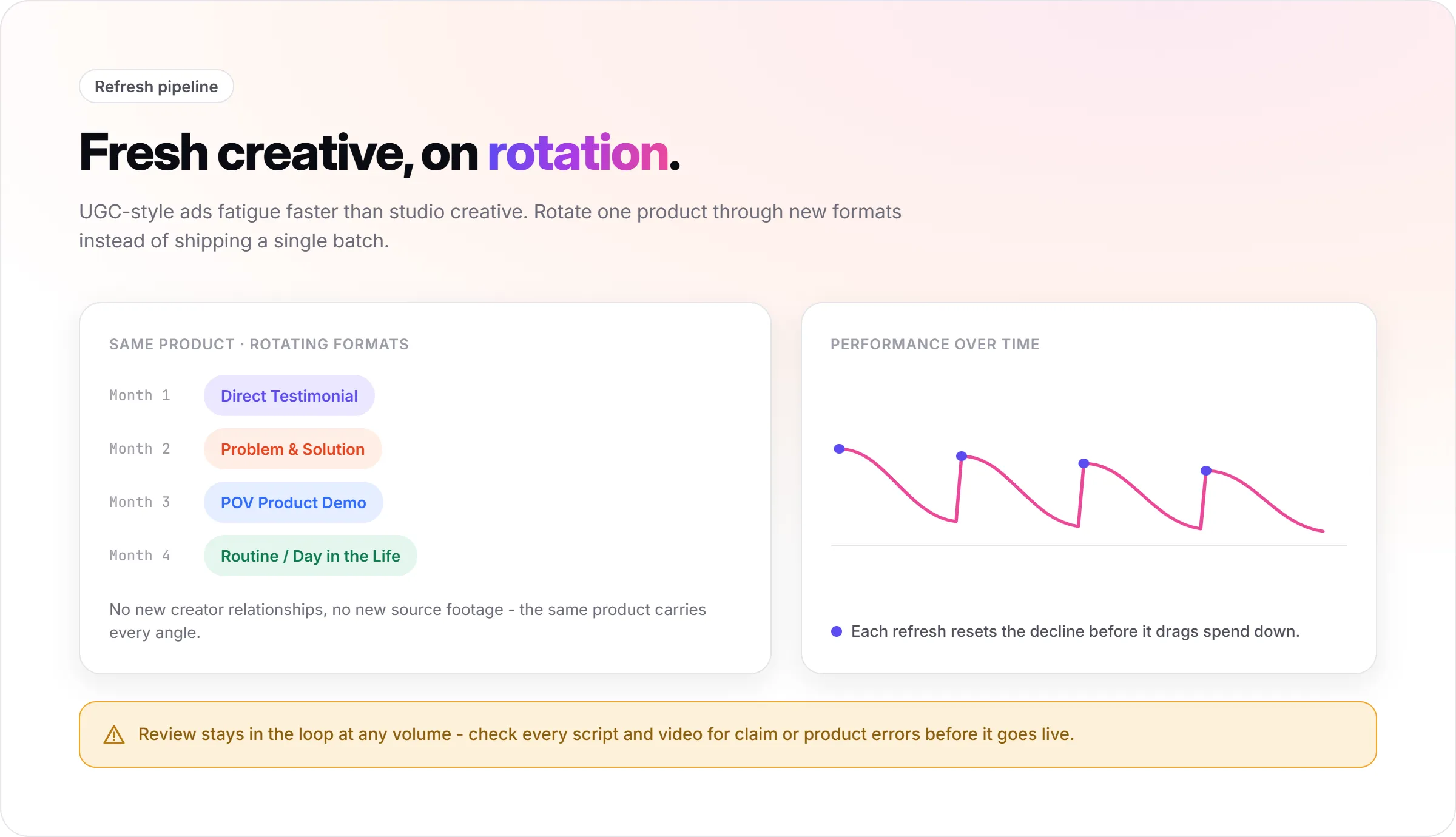
Treating your product library and format list as a rotation, rather than a single campaign, keeps the pipeline moving without starting from scratch each time. The same product can carry several format types (a testimonial this month, a problem-and-solution angle next month) without needing new creator relationships or new source footage.
Review remains part of the process regardless of volume. AI-generated creatives can contain small errors in claims or product details, so every script and video should get a check before it goes live, even when production speed is high.
FAQs about Scaling UGC Ad Creative Production
What does it actually mean to scale UGC ads?
Scaling UGC ads means increasing how many hook and format variations you can test per cycle, not just producing more finished videos. The goal is faster iteration, not higher raw output for its own sake.
A team that produces 20 versions of the same weak hook hasn't scaled anything meaningful. A team that tests 5 distinct hooks and identifies a clear winner has, even with a smaller total asset count.
Can I generate UGC ads without hiring creators?
Yes. AI UGC tools generate the script, AI model (avatar), and voice directly from product images, without booking or filming a real creator.
You still make the creative decisions - product, format, hook, messaging - the AI removes the scheduling and filming dependency, not the judgment calls that decide whether an ad works.
How many UGC ad variations should I test at once?
There's no universal number, since it depends on budget and audience size, but testing 3-5 hook variations of the same format at a time is a common starting cadence. Testing more than that without enough spend behind each version usually produces inconclusive data rather than a clear winner.
Isolate one variable per test round - the hook, the format, or the CTA - rather than changing several elements at once, so you know what actually caused a difference in performance.
How fast does UGC ad creative fatigue set in?
Fatigue timelines vary by audience size, spend level, and how saturated the format already is, so there's no fixed number that applies to every account. What's consistent is that UGC-style ads tend to fatigue faster than studio-produced creative, because their casual format becomes recognizable to a repeat viewer more quickly.
Watching engagement and hook-rate metrics for early signs of decline is more reliable than working off a fixed calendar, since fatigue speed depends on how much of your audience has already seen the creative.
Should I use AI, human creators, or both to scale UGC?
Many teams use a hybrid approach - a small number of creator-filmed ads for social proof and brand trust, paired with AI-generated variations for volume testing of hooks and angles. Neither approach is universally better; the right mix depends on budget, category, and how much your audience expects to see a recognizable creator.
AI production is typically the faster path for testing multiple structural variants without booking a new shoot for each one, while creator-filmed content can carry more built-in trust for hero campaigns.
Do I need a different UGC strategy for each ad platform?
Platform pacing differs enough that a script built for one platform often needs adjustment for another, even within the same UGC ad. TikTok audiences typically reward faster pacing in the opening seconds, while Meta feed placements are often watched with sound off, which changes how much the visual and captions need to carry the message on their own.
Building the core script and structure once, then adjusting pacing and format per platform, is usually more efficient than writing an entirely separate ad for each channel.
An AI ad maker like Promer AI can carry that core script across formats without rebooking a creator for each platform variant.