Most AI ad creative for luxury brands fails in one of two ways: a glossy, plastic-looking render that reads as cheap the second it hits the feed, or a well-made image with a discount badge stapled on top that undoes the price positioning.
These 11 examples of ai ad creative for luxury brands show what the alternative looks like, across fine jewelry, fragrance, watches, prestige beauty, handbags, and luxury accessories.
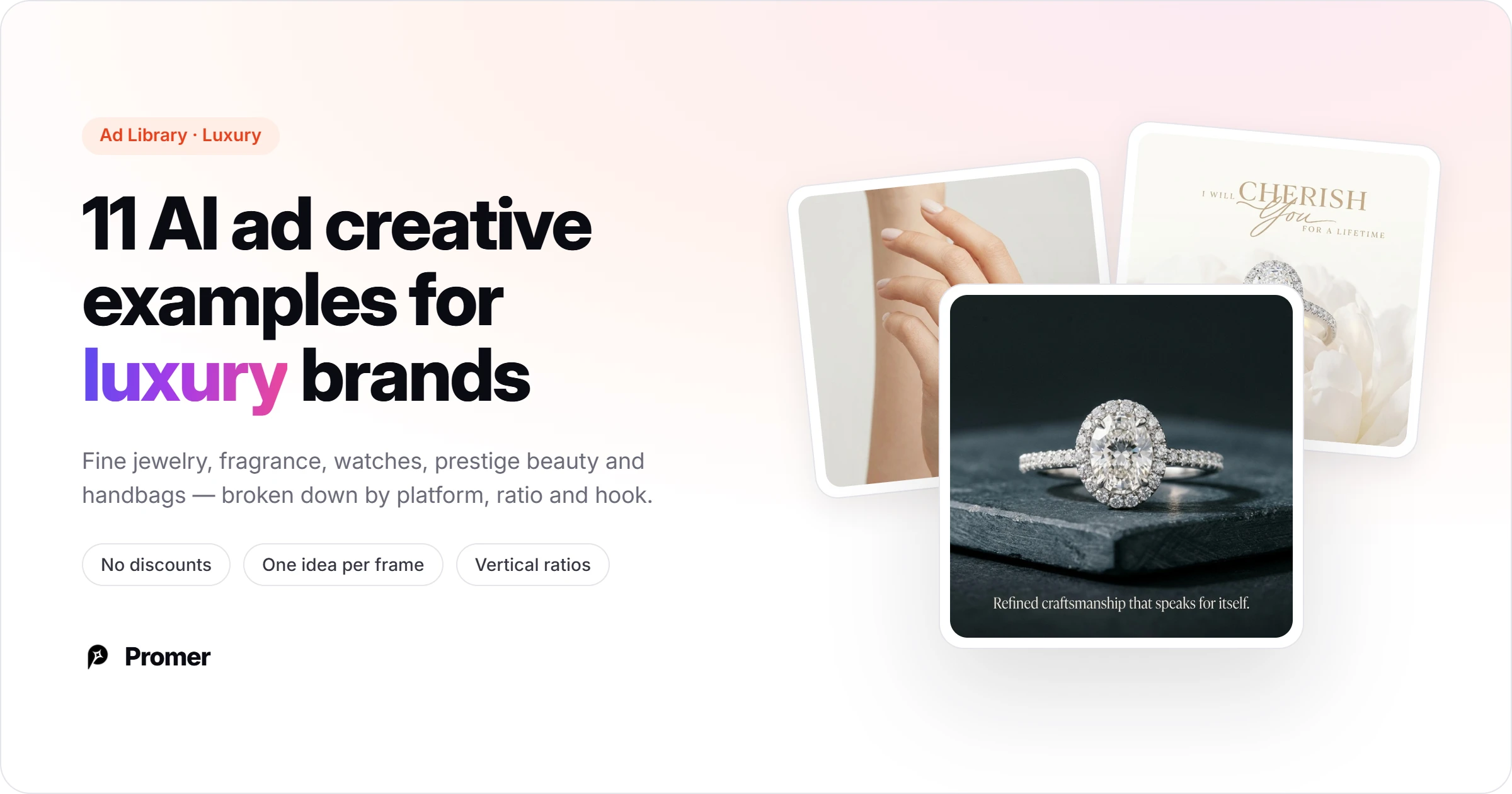
For luxury brands, AI works best when it scales brand codes you already own - the lighting, the restraint, the single idea per frame - not when it invents a new look from a blank prompt. The examples below are real luxury ads from Promer AI's ad library, chosen because their structure is something AI can reproduce faithfully with your own product.
This article covers why AI backfires faster in luxury than in mass-market categories, where AI belongs in a premium brand's creative pipeline, 11 luxury ad creatives broken down by platform, ratio, and hook, and how to recreate any of them without the result looking cheap.
Key takeaways
- Luxury audiences penalize ads that look low-effort: in published experiments, disclosed AI imagery made consumers rate luxury brands less favorably, while highly creative AI visuals reduced that penalty.
- The safest place for AI in a luxury brand is the variation layer - the 10 to 20 extra social assets that follow a hero campaign - not the hero campaign itself.
- None of the 11 examples uses a discount, and 10 of 11 carry no headline beyond a brand name or product label.
- All 11 run in vertical ratios (2:3, 3:4, 4:5, or 9:16), and six use a human hand or body as the only prop next to the product.
- One visual device per frame - a macro detail, a texture, a surreal pairing, a single color block - does the job a paragraph of copy would do in a mass-market ad.
Why AI ad creative backfires faster for luxury brands
Luxury pricing is justified by perceived craft, so anything that signals "this took no effort" hits a luxury brand harder than a mass-market one. A 2025 study in the Journal of Advertising Research, summarized by Tarleton State University, ran three experiments and found that luxury ads disclosed as AI-generated lowered brand favorability because viewers assumed less effort went into them.
The same research found one important exception: highly creative, unusual AI visuals significantly reduced that negative effect. The penalty lands on AI imagery that imitates a standard campaign and looks generic, less on imagery that does something a conventional shoot could not.
Two 2025 campaigns showed the same pattern in public. Guess ran AI-generated models in the August issue of American Vogue and drew boycott calls over beauty standards and replaced talent. In December, Valentino posted AI-generated visuals for its DeVain handbag, labeled them as AI, and still drew comments calling them "cheap," "lazy," and "disturbing," as reported by Glossy.
For a premium ecommerce brand running paid social, the takeaway is simple. AI-assisted creative has to clear a higher bar for craft and originality in luxury than in any other category, and the fastest way to clear it is to start from a structure that already reads as premium.
Where AI fits in a luxury brand's ad creative pipeline
Luxury teams that use AI well typically keep the hero campaign photographic and use AI for the assets that follow it. Studios working with luxury clients describe the common brief as producing 10 or 20 additional assets that match a real shoot for social and digital, rather than replacing the shoot.
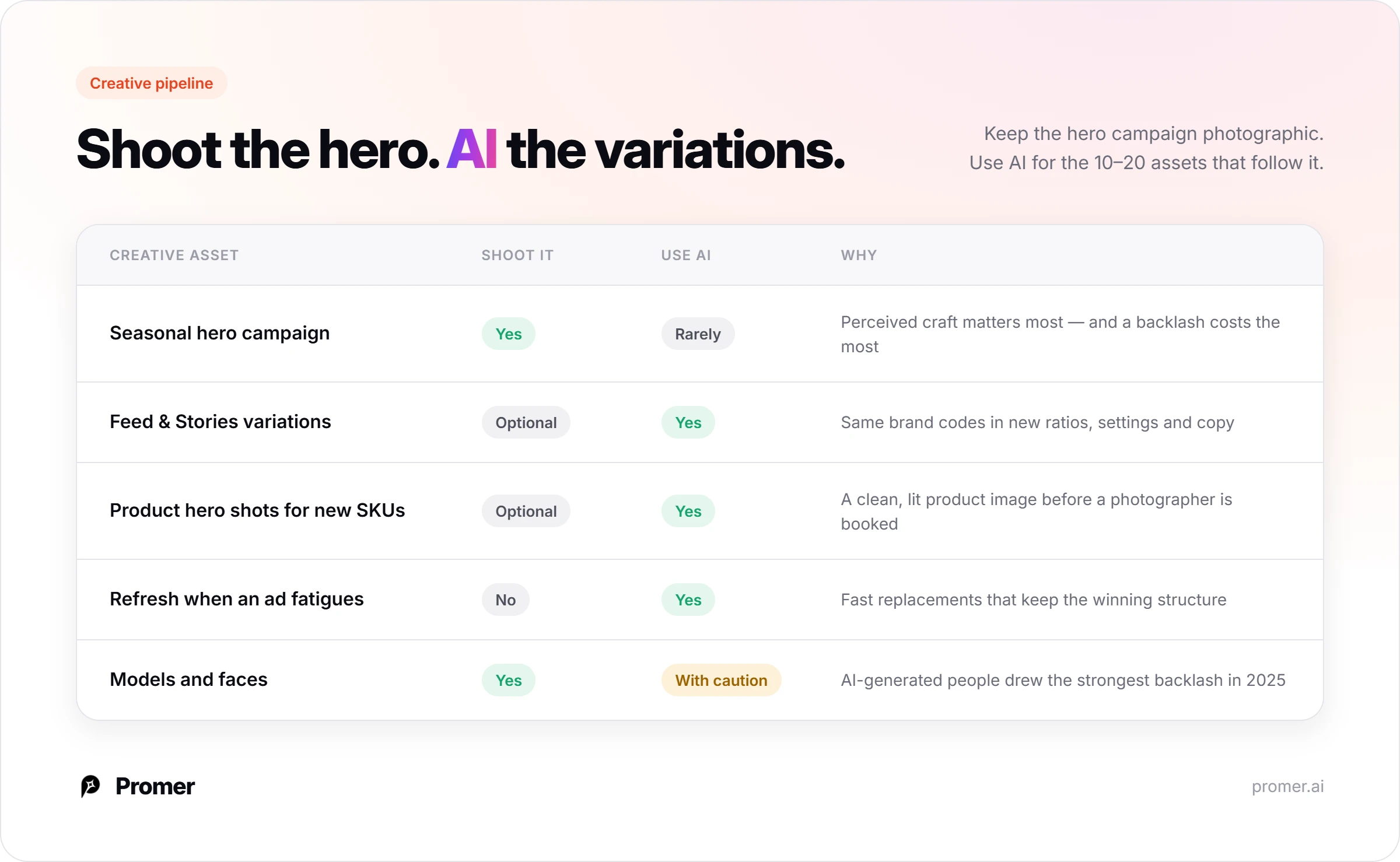
The examples below sit in the middle rows of that table: product-led static ads whose structure can be recreated with your own product, without inventing an AI model or a new brand world.
11 AI ad creative examples for luxury brands
Each one below lists its platform, ratio, and hook type first, so you can match the layout to your own product before you look at the image. A "Try AI Ad Clone" button sits under every creative if you want to jump straight into recreating it.
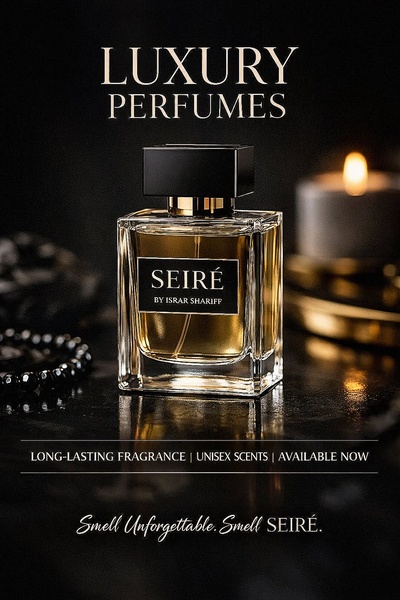
1. SEIRÉ Candlelit Dark-Mood Perfume Hero (Fragrance)
Platform: Instagram, Facebook | Ratio: 2:3 | Hook type: Sensory mood hook
A square glass bottle sits on a dark, reflective surface with a lit candle and black beads blurred behind it, under a serif "Luxury Perfumes" headline. A single thin rule separates three short benefits from a script-style tagline at the bottom.
Winning ingredients:
- Candlelight gives the dramatic, low-key lighting a believable source, so the mood feels staged on purpose
- Black, gold, and amber stay the only colors in the frame, matching the liquid inside the bottle
- Benefits are compressed into one divided line instead of a stack of badges
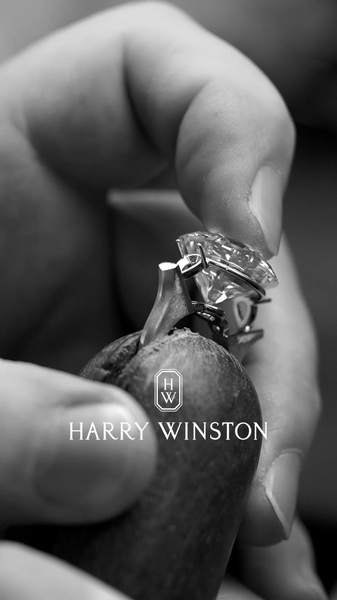
2. Harry Winston Monochrome Craftsmanship Macro (Fine Jewelry)
Platform: Instagram Stories, TikTok | Ratio: 9:16 | Hook type: Visual craftsmanship reveal
A jeweler's fingers hold a large diamond ring against a wooden bench pin, shot in tight black-and-white macro. The only text is the brand mark, placed low over the jeweler's hand.
Winning ingredients:
- Showing the human hand at work answers the "low effort" objection before anyone raises it
- Removing color forces attention onto the cut, the prongs, and the setting
- A full-screen 9:16 macro gives Stories viewers detail that a feed square would shrink away
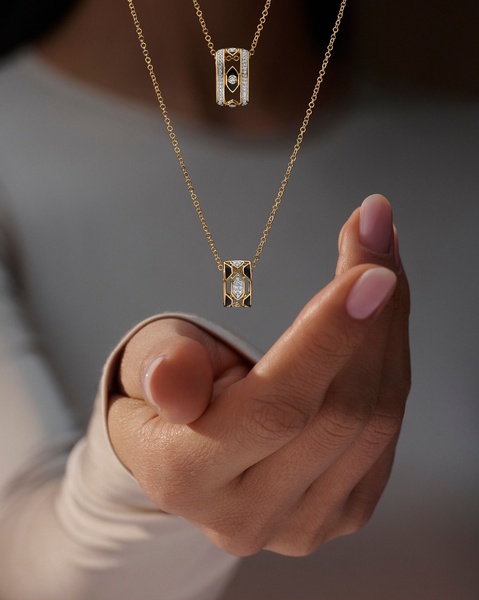
3. Floating Pendant Editorial (Fine Jewelry)
Platform: Instagram, Facebook | Ratio: 4:5 | Hook type: Surreal minimalism
Two gold pendants on fine chains hang in mid-air above an open hand, with the model's sweater and face soft-focused into a warm grey background. Nothing in the frame carries text.
Winning ingredients:
- The levitating pendants create a small visual puzzle that holds attention for an extra second
- The open hand gives scale, so the viewer knows exactly how large each pendant is
- Shallow depth of field keeps the gold and diamond detail as the only sharp element
4. Harry Winston Surreal Crane and Ring (Fine Jewelry)
Platform: Instagram, Pinterest | Ratio: 3:4 | Hook type: Surreal visual contrast
A crowned crane holds an emerald-cut diamond ring in its beak against a clean white background, with the brand name and a short list of boutique cities set in small type at the bottom.
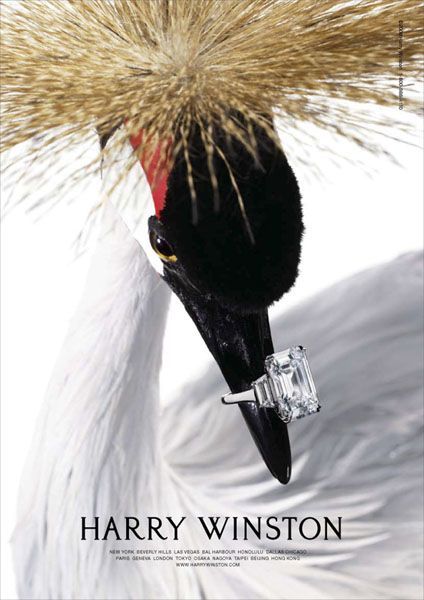
Winning ingredients:
- An unexpected pairing makes the ad memorable without a single claim, the kind of original concept research links to a smaller AI penalty
- Generous white space reads as confidence rather than emptiness
- Boutique cities under the logo work as quiet proof of scale instead of a "worldwide shipping" badge
5. Tom Ford Beauty High-Fashion Editorial Portrait (Prestige Beauty)
Platform: Instagram, Pinterest | Ratio: 3:4 | Hook type: Visual authority
A model with slicked-back hair holds a gold-edged compact mirror in one hand and a lipstick in the other, shot under hard, high-key light against white. The brand name runs across the bottom edge in bold capitals.
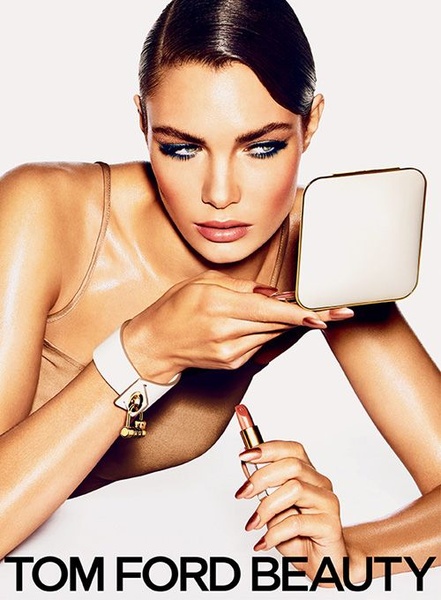
Winning ingredients:
- The product appears in use, so the ad sells the finished look rather than a tube
- Gold accents on the compact, cuff, and lipstick repeat the brand's palette three times in one frame
- A nude, white, and gold palette keeps the portrait premium without any styling clutter
6. Swarovski Gift Box Presentation (Crystal Jewelry)
Platform: Instagram, Facebook | Ratio: 3:4 | Hook type: Ethereal product framing
A tennis necklace and a pendant are draped over a green octagonal gift box, with a branded ribbon curling around the frame. The box, ribbon, and packaging are the only props.
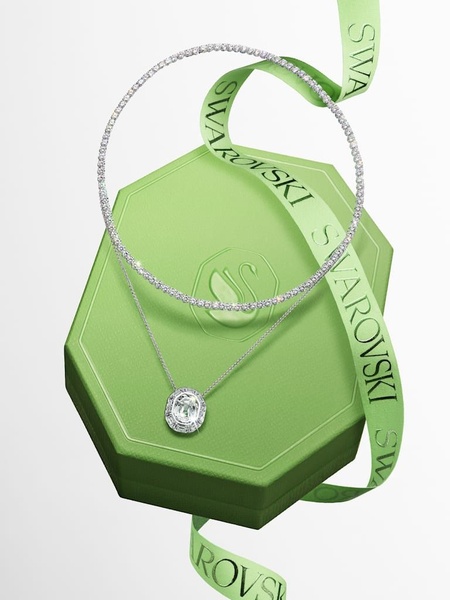
Winning ingredients:
- The packaging becomes the set, so the ad doubles as a gifting cue without saying "gift"
- A single brand color (green) against white makes the silver and crystal read clearly
- The ribbon carries the brand name, which removes the need for a separate logo block
7. Floral Watch and Cocktail Ring Composition (Watches and Jewelry)
Platform: Instagram, Pinterest | Ratio: 2:3 | Hook type: Visual texture framing
A raised hand wearing three floral cocktail rings is wrapped in pale orchids, with a rose-gold watch and stacked bracelets at the wrist. The white background and soft peach tones keep the whole frame airy.
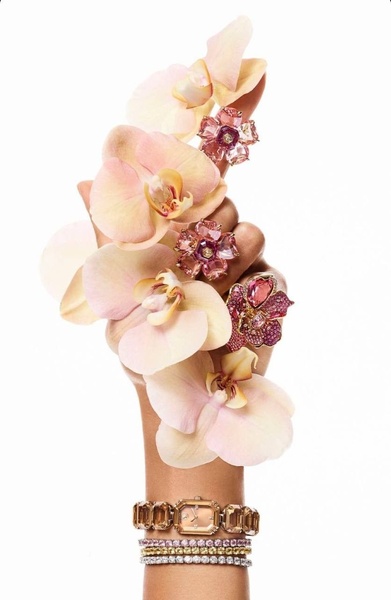
Winning ingredients:
- The orchids echo the flower-shaped rings, so the prop explains the design story visually
- A tall 2:3 frame fits the full arm, from orchids to watch, without cropping either
- Matching the flower tones to the stones keeps a busy composition cohesive
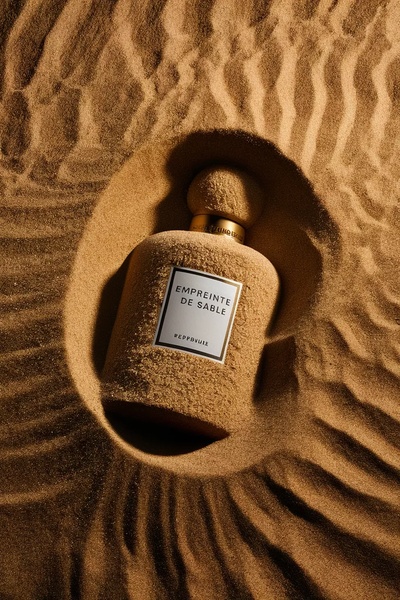
8. Perfume Bottle Buried in Sand (Niche Fragrance)
Platform: Instagram Feed, Pinterest | Ratio: 2:3 | Hook type: Texture-focused hero
A sand-coated perfume bottle lies in a shallow hollow surrounded by wind-rippled dunes, lit from one side so every ridge casts a shadow. The bottle's label carries the scent name and nothing else.
Winning ingredients:
- The setting makes the scent name literal, so the viewer can "smell" the ad from the image alone
- A single-tone palette of sand and brown makes the white label the only contrast point
- Raking side light turns a flat surface into tactile texture
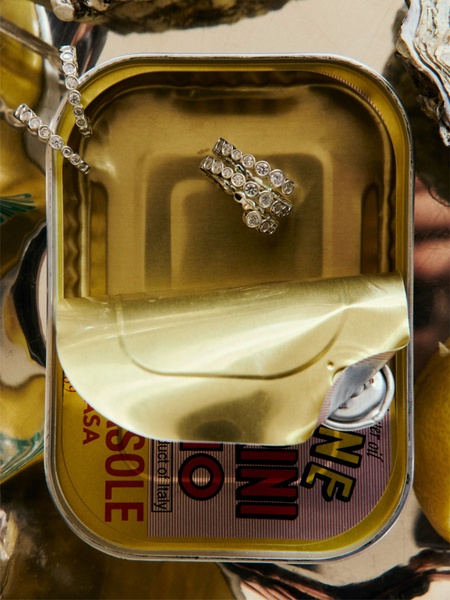
9. Diamond Rings in a Sardine Tin (Fine Jewelry)
Platform: Instagram, Pinterest | Ratio: 3:4 | Hook type: Visual dissonance
Two diamond-set rings rest inside an opened gold sardine tin, shot from directly above on a mirrored surface. The tin's printed label stays partly visible, which adds to the joke.
Winning ingredients:
- Placing fine jewelry in an everyday object stops the scroll through curiosity, not volume
- The gold tin matches the gold rings, so the contrast is in meaning, not in color
- A top-down, centered frame keeps the rings readable despite the unusual setting
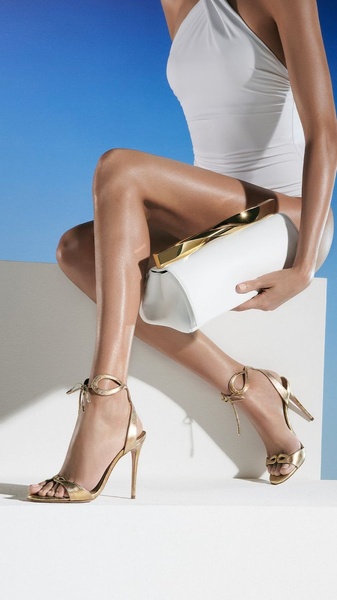
10. Cropped Clutch and Heels Hardware Shot (Handbags and Shoes)
Platform: Instagram Stories, TikTok | Ratio: 9:16 | Hook type: Visual minimalism
A model in a white swimsuit sits on a white block against a saturated blue sky, holding a white clutch with a sculpted gold clasp and wearing gold strappy heels. The crop cuts off at the shoulder, leaving the accessories as the subject.
Winning ingredients:
- Hiding the face keeps attention on the clutch and heels and lets the viewer picture themselves
- Gold hardware repeats on the bag and shoes, tying two products into one look
- White on blue gives sharp edges that hold up on a small Stories screen
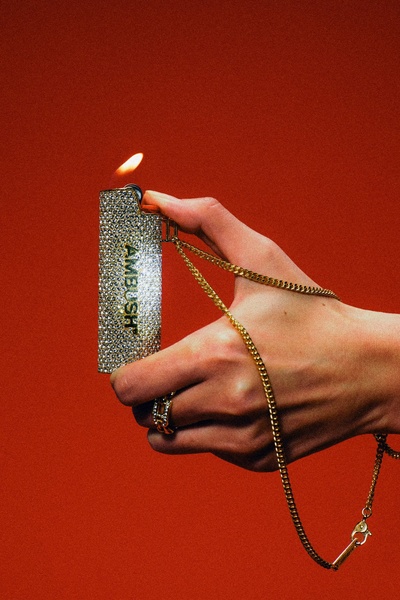
11. Ambush Crystal Lighter on a Red Color Block (Luxury Accessories)
Platform: Instagram, Pinterest | Ratio: 2:3 | Hook type: High-contrast color block
A hand holds a crystal-covered lighter mid-flame, with a gold chain looped through the fingers, against a flat, saturated red background. The brand name appears only on the lighter itself.
Winning ingredients:
- One saturated background color makes the product the only texture in the frame
- The lit flame adds a moment of action to an otherwise still product shot
- Branding on the product, not as an overlay, keeps the frame looking like editorial rather than an ad
The luxury brand codes to lock before you generate
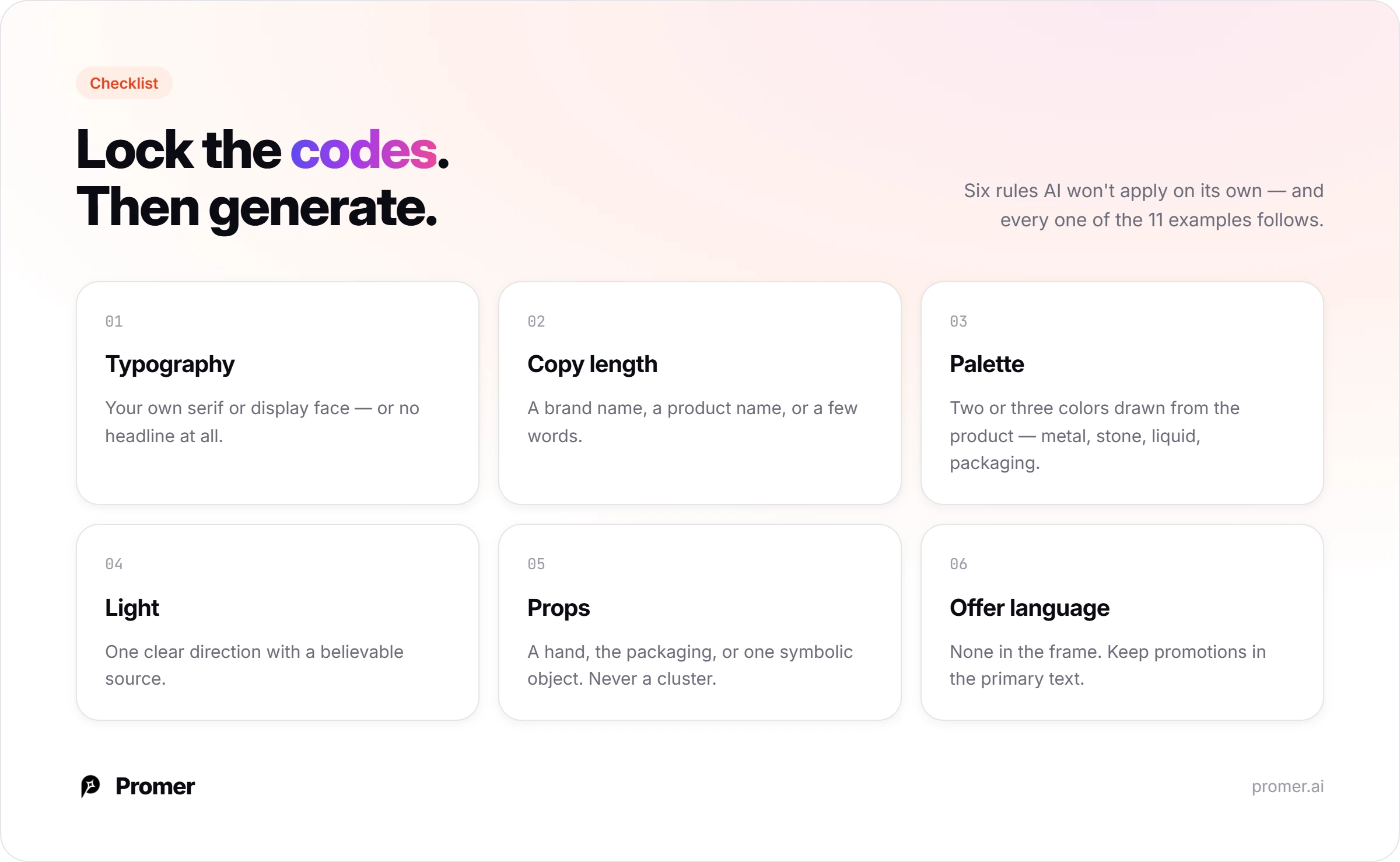
The 11 examples share a short list of rules that AI will not apply on its own. Writing these down before generating keeps every variation inside the brand instead of drifting toward a generic "premium" look.
- Typography: Your own serif or display face, or no headline at all. Large, generic sans-serif type is the fastest way to make a luxury ad read as a mass-market promotion.
- Copy length: A brand name, a product name, or a few words. Ten of the 11 examples carry nothing more.
- Palette: Two or three colors drawn from the product itself - the liquid, the metal, the stone, the packaging.
- Light: One clear light direction with a believable source, whether candlelight, raking side light, or hard studio flash.
- Props: A hand, the packaging, or one symbolic object. Never a cluster of lifestyle props.
- Offer language: None in the frame. If you must run a promotion, keep it in the primary text, not on the image.
For prompt-based workflows, the same codes translate directly into written direction - Promer AI's guide to AI prompts for perfume advertisement shows how lighting, setting, and mood are spelled out scene by scene for a fragrance.
How to apply these AI ad creative examples to your own luxury brand
The layouts above share a structure, not a product. A macro craftsmanship shot, a texture-led hero, or a surreal pairing works the same way for a demi-fine jewelry label, an independent perfumer, or a leather goods brand, as long as the codes above stay fixed.
If you want to browse more real jewelry and accessory campaigns before building your own, Promer AI's jewelry ad creative library groups them by product type, hook, and platform so you can shortlist the structures closest to your product.
Promer AI, an AI ad maker built for ecommerce, turns any of these structures into your own ad starting from your product page, not a blank canvas.
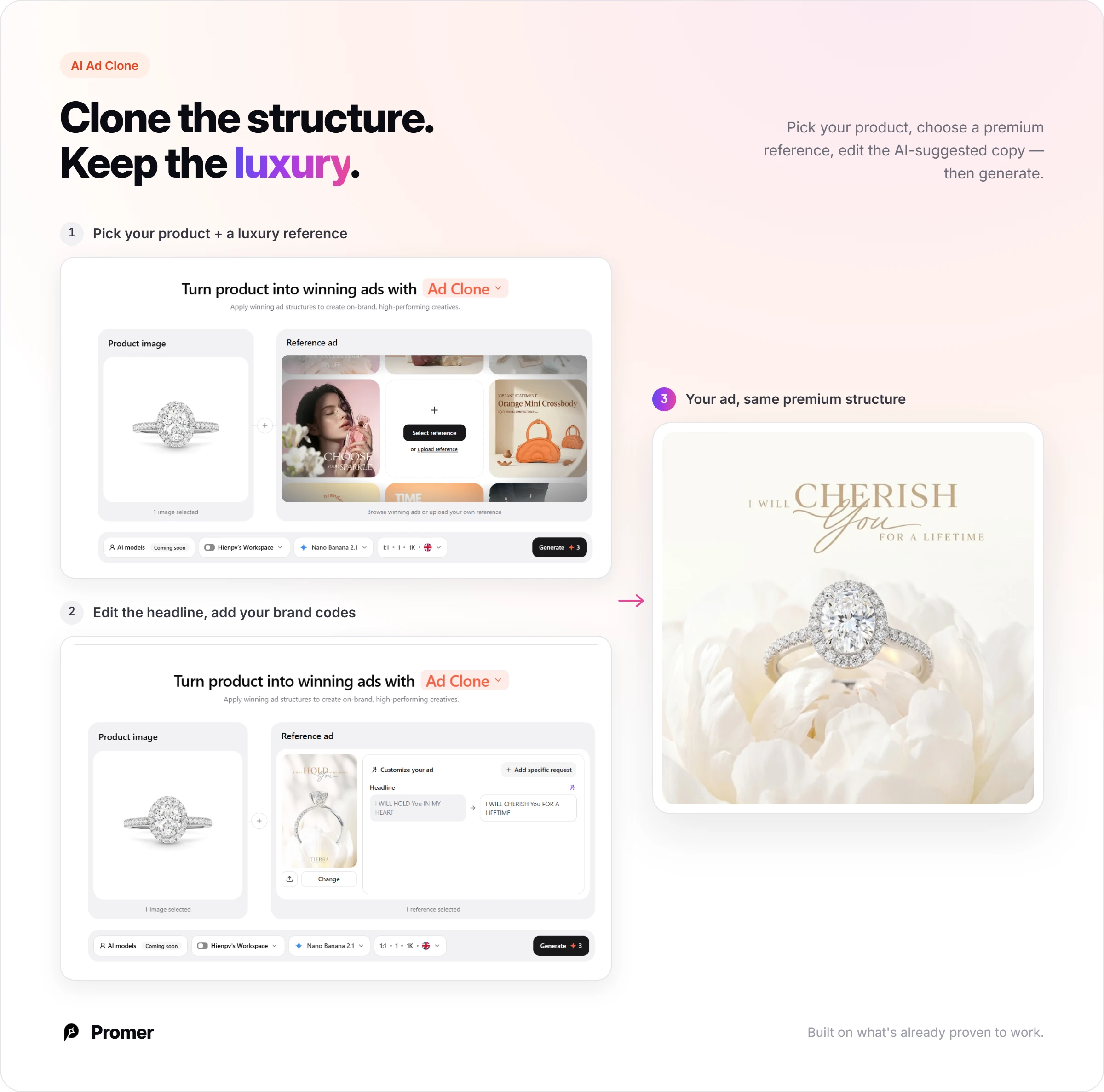
Promer AI's AI Ad Clone is the closest fit for luxury, because it starts from a reference that already looks premium. Pick your product, select one of the 11 creatives above as the reference, and the AI suggests a headline, body text, and CTA you can edit or clear individually. The "Add specific request" field is where you write your brand codes, for example "no discount badge, serif typography only, keep the candlelit lighting."
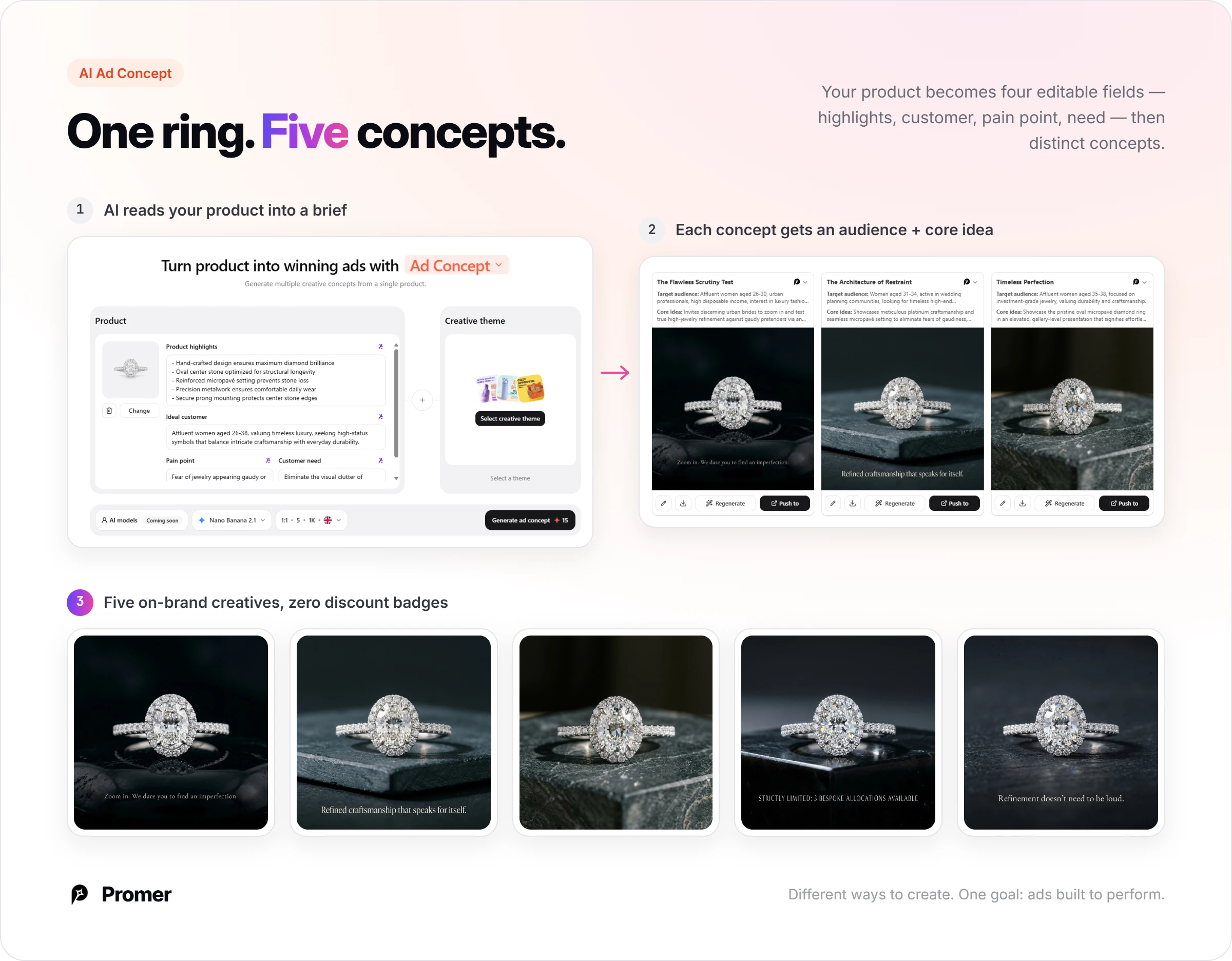
For new angles rather than a copy of one reference, Promer AI's AI Ad Concept reads your product into four editable fields - product highlights, ideal customer, pain point, and customer need - then generates several concepts from one product. Pairing it with the Storytelling creative mood, which Promer AI recommends for premium products, keeps concepts emotional instead of promotional.
Setting up a Brand Kit applies your logo, colors, and fonts automatically to every generation, which handles the typography and palette rules above without retyping them.
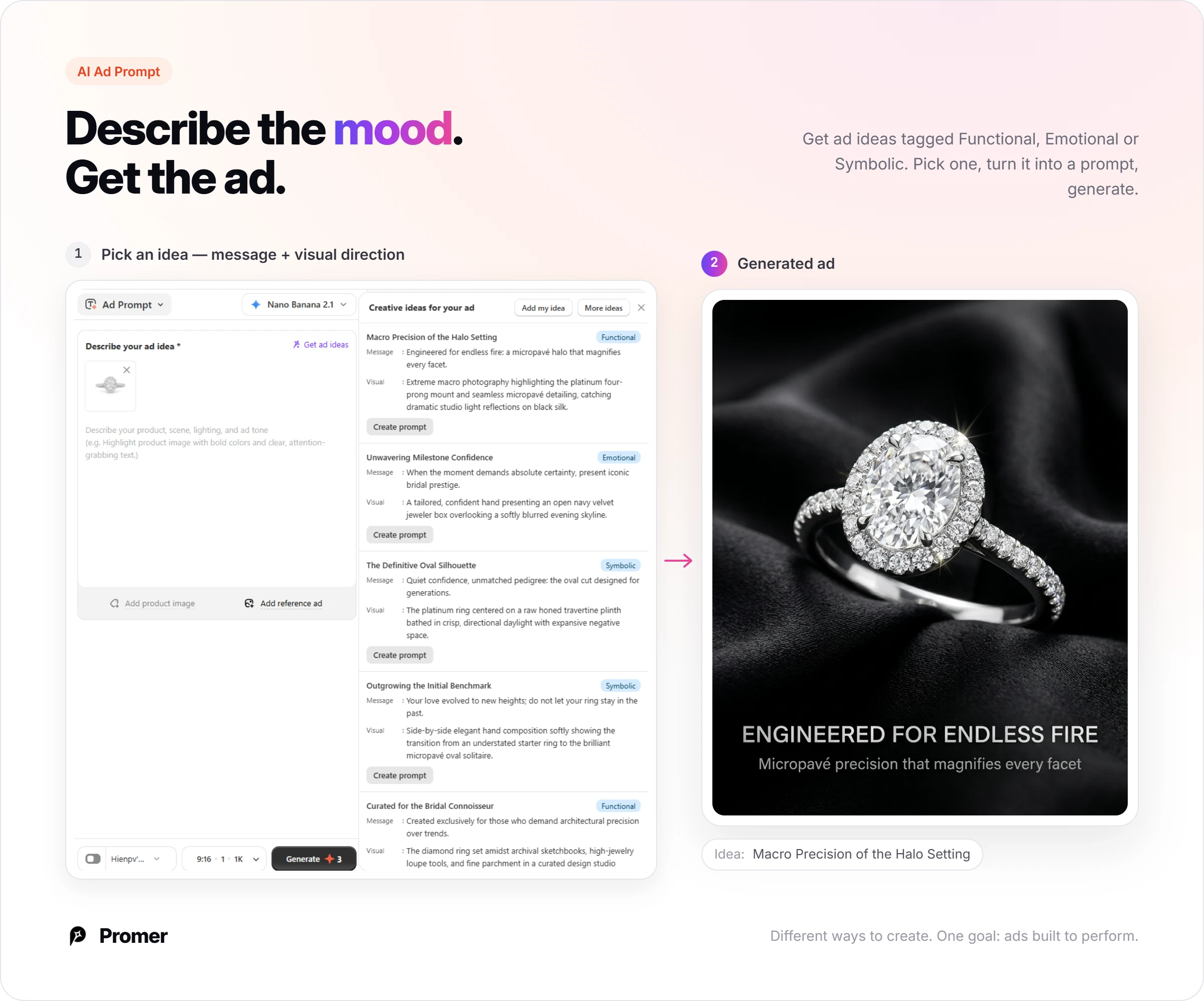
If you would rather describe the mood yourself, AI Ad Prompt suggests ad ideas tagged Functional, Emotional, or Symbolic, each with a message and a visual direction, and turns the one you pick into a ready prompt.
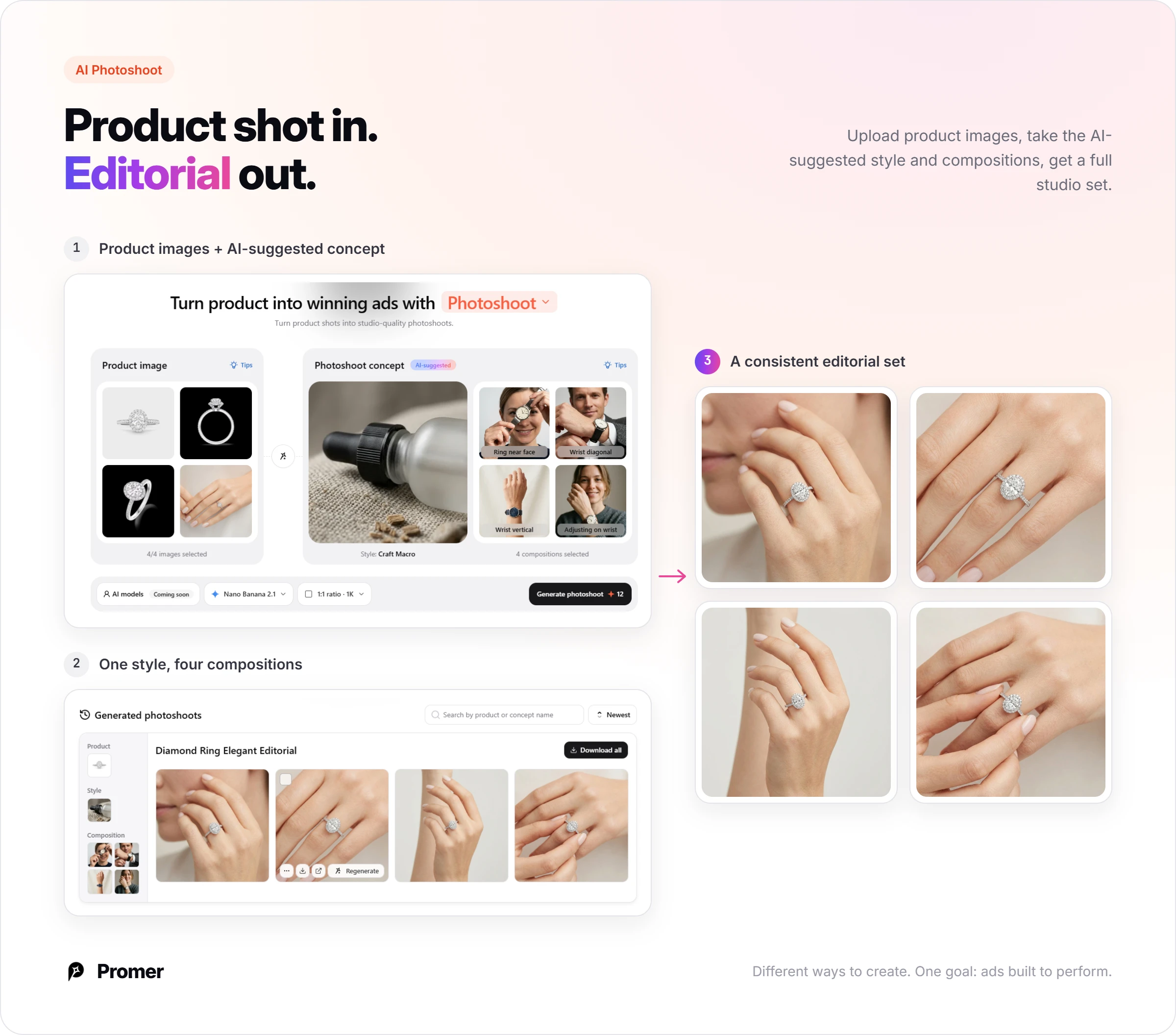
For new SKUs that have no campaign imagery yet, AI Photoshoot takes your plain product images, suggests a style and compositions, and returns an editorial set in one consistent look - the "product hero shots for new SKUs" row in the table above.
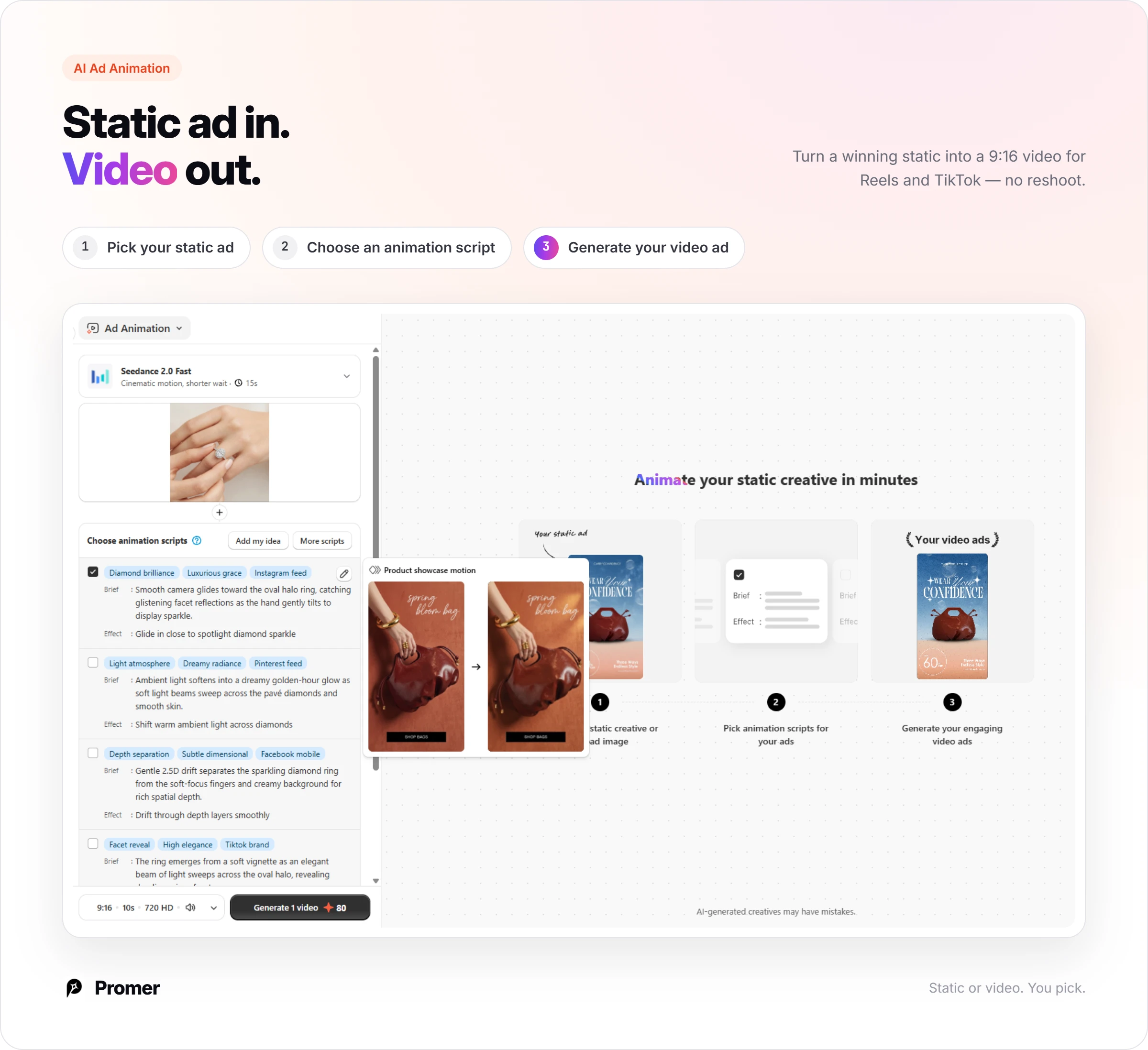
Once a static creative wins, AI Ad Animation can turn it into a short 9:16 video for Reels and TikTok without a reshoot.
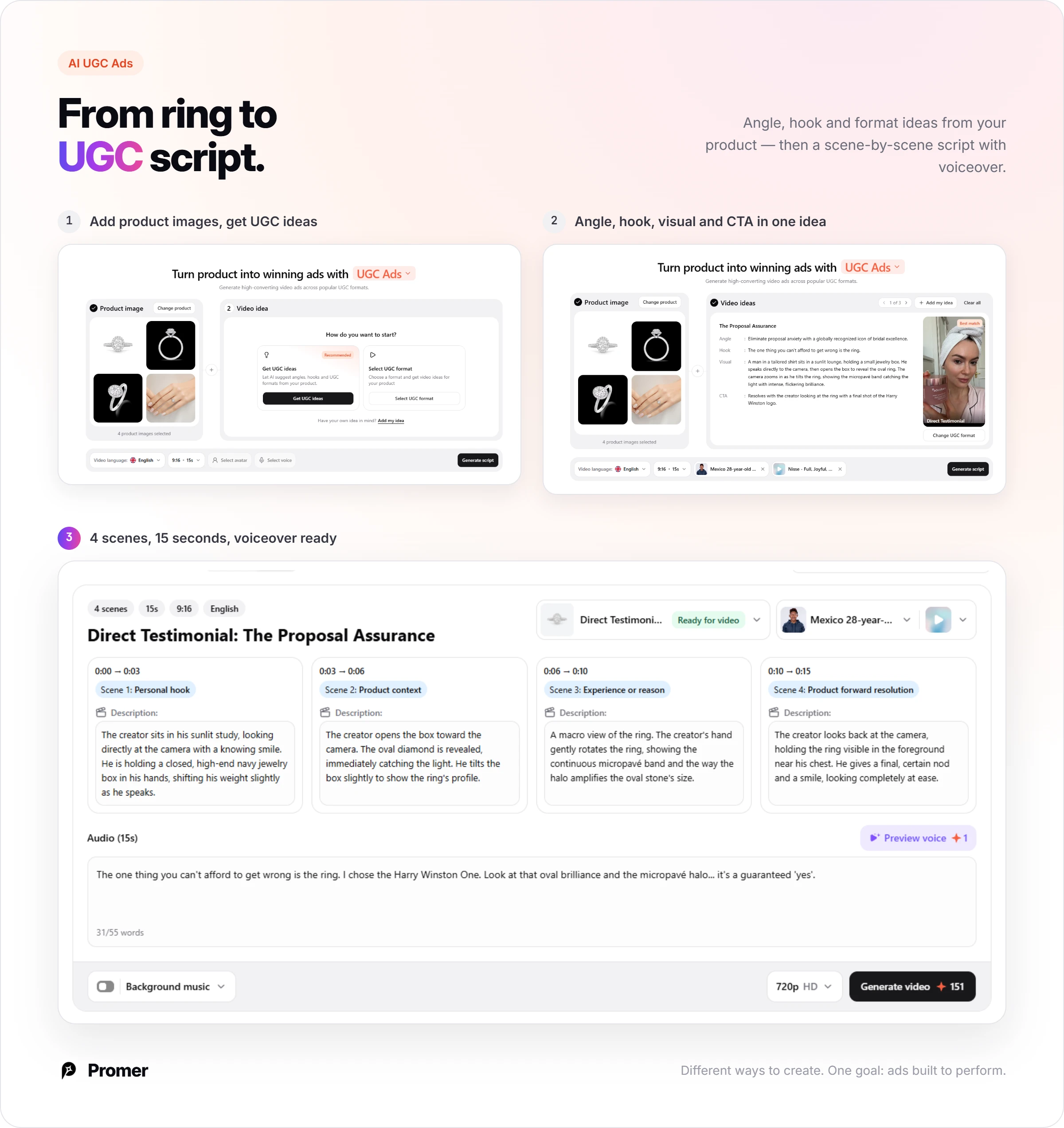
For TikTok and Reels, AI UGC Ads suggests angles, hooks, and formats from your product images, then writes a scene-by-scene script with voiceover. Keep it to social-native placements and out of the hero campaign: these videos use AI avatars, which falls under the "models and faces" row that luxury audiences judge most harshly.
Review every generated creative before it runs. AI-generated ads can have mistakes, and for luxury specifically, check stone shapes, prong counts, engravings, logos, and bottle proportions against the real product, since a wrong detail costs more trust here than in any other category.
Common mistakes luxury brands make with AI ad creative
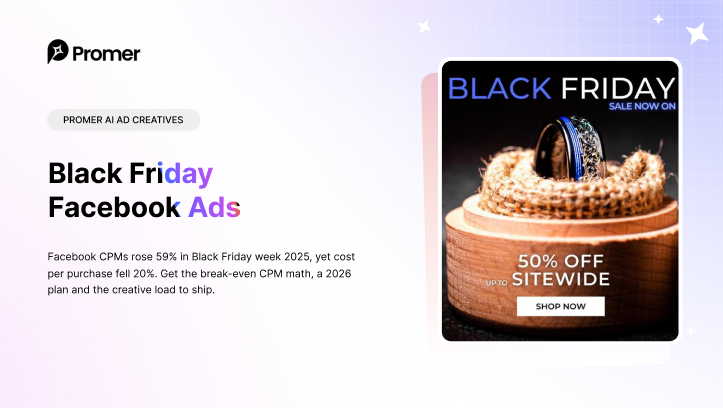
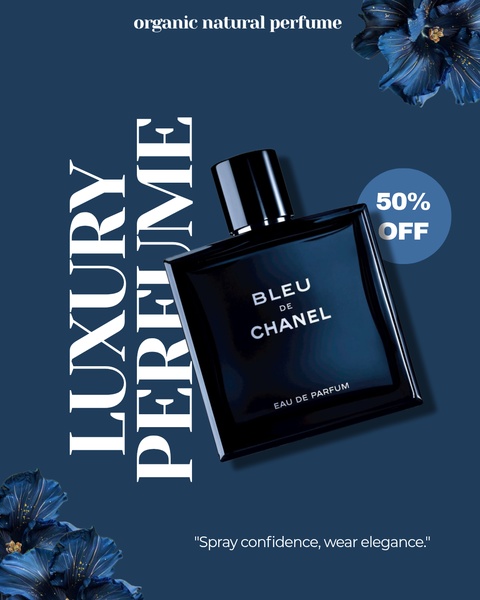
Putting a discount on a luxury image. A dark, elegant perfume shot with a "50% off" bubble, like the example below, borrows the look of luxury and then cancels it with mass-market price language.
Accepting the plastic AI finish. Over-smoothed metal, perfectly uniform sparkle, and skin with no texture are what audiences now recognize as AI. Real luxury imagery keeps grain, reflections, and small imperfections.
Getting the product details wrong. A ring with the wrong number of prongs or a bottle cap that changes shape between variations reads as counterfeit to the exact buyer who knows the product best.
Generating faces when the product is the hero. AI-generated models drew the strongest public backlash in 2025. Hands, cropped bodies, or no person at all carry most of the examples above.
Stacking claims and contact details. Phone numbers, "Buy now" buttons, and three-line benefit lists inside the image belong to marketplace ads, not to a brand asking a premium price.
When luxury brands should stick with a studio shoot
AI is the wrong tool for some luxury work, and saying so is part of using it well. A heritage house launching a seasonal campaign, a brand whose story depends on a named photographer or ambassador, or a couture label whose audience will scrutinize every frame should keep that work photographic.
Promer AI is built for the other side of that line: premium and accessible-luxury ecommerce brands that already run paid social, need more on-brand static ads than a shoot calendar can deliver, and want each variation to keep the structure that made the original work.
FAQs about AI ad creative for luxury brands
These are the questions premium brand marketers ask most before using AI for their ad creative.
Should luxury brands disclose AI-generated ad creative?
Disclosure is the honest default, but it raises the bar for the creative itself. Published experiments found that disclosed AI imagery lowered luxury brand favorability, mainly because viewers assumed less effort, while highly original AI visuals reduced that effect. Platform rules and local regulations on AI labeling also vary, so check current requirements for each placement and market.
Why did Valentino's AI ad get criticized?
Audiences judged it as low-effort for a couture price point. The DeVain handbag visuals were labeled as AI and still drew comments calling them cheap and lazy, which suggests the problem was the execution and the gap between brand and output, not the disclosure alone. A luxury brand's AI work is held to a higher standard than personal or mass-market content.
Can AI keep luxury product details accurate?
Often, but not reliably enough to skip a manual check. Clean, high-resolution product images with the full product in frame give AI the best chance of keeping stones, hardware, and logos correct. Every variation should still be compared against the real product before it runs, especially for jewelry and watches.
Do AI ad creatives work for luxury brands on Meta?
They can, when they follow the brand codes and avoid promotional language. Meta delivery now leans heavily on creative, so a steady supply of on-brand variations in feed and Stories ratios matters for premium brands too. Results depend on product, price point, and audience, so test structurally different variations rather than color tweaks of one ad.
Is AI ad creative cheaper than a luxury photo shoot?
Usually, for variations and product imagery, but it does not replace a hero shoot. One luxury-focused studio reported savings of up to 70% on AI ecommerce imagery and closer to 50% on campaign work compared with traditional production, based on its own client data. Your savings will depend on how much of your creative volume sits in the variation layer.
What makes AI ad creative look cheap for a luxury brand?
Generic typography, discount language, plastic textures, and too many elements in one frame. The 11 examples above avoid all four by keeping one visual idea, two or three colors, and little or no headline. Starting from a proven luxury reference instead of a blank prompt makes those rules much easier to hold.
Summary
The 11 examples of ai ad creative for luxury brands above follow one discipline: a single visual idea, built from brand codes the audience already trusts, with no promotional noise in the frame.
Keep the hero campaign photographic, use AI for the variations and refreshes around it, pick the reference structure closest to your product, and check every detail against the real thing before it runs.
Sources
- To, Wu, Kianian and Zhang, "When AI Doesn't Sell Prada: Why Using AI-Generated Advertisements Backfires for Luxury Brands," Journal of Advertising Research, 2025 (summary by Tarleton State University) - accessed 2026-10-30
- Glossy, "Luxury fashion's AI marketing experiments hit a turning point," December 2025 - accessed 2026-10-30
- ABC11, "Controversy stirs over AI-generated models in new Guess ads appearing in Vogue," 2025 - accessed 2026-10-30
- eWeek, "Valentino's ad sparks backlash about 'AI slop'," 2025 - accessed 2026-10-30