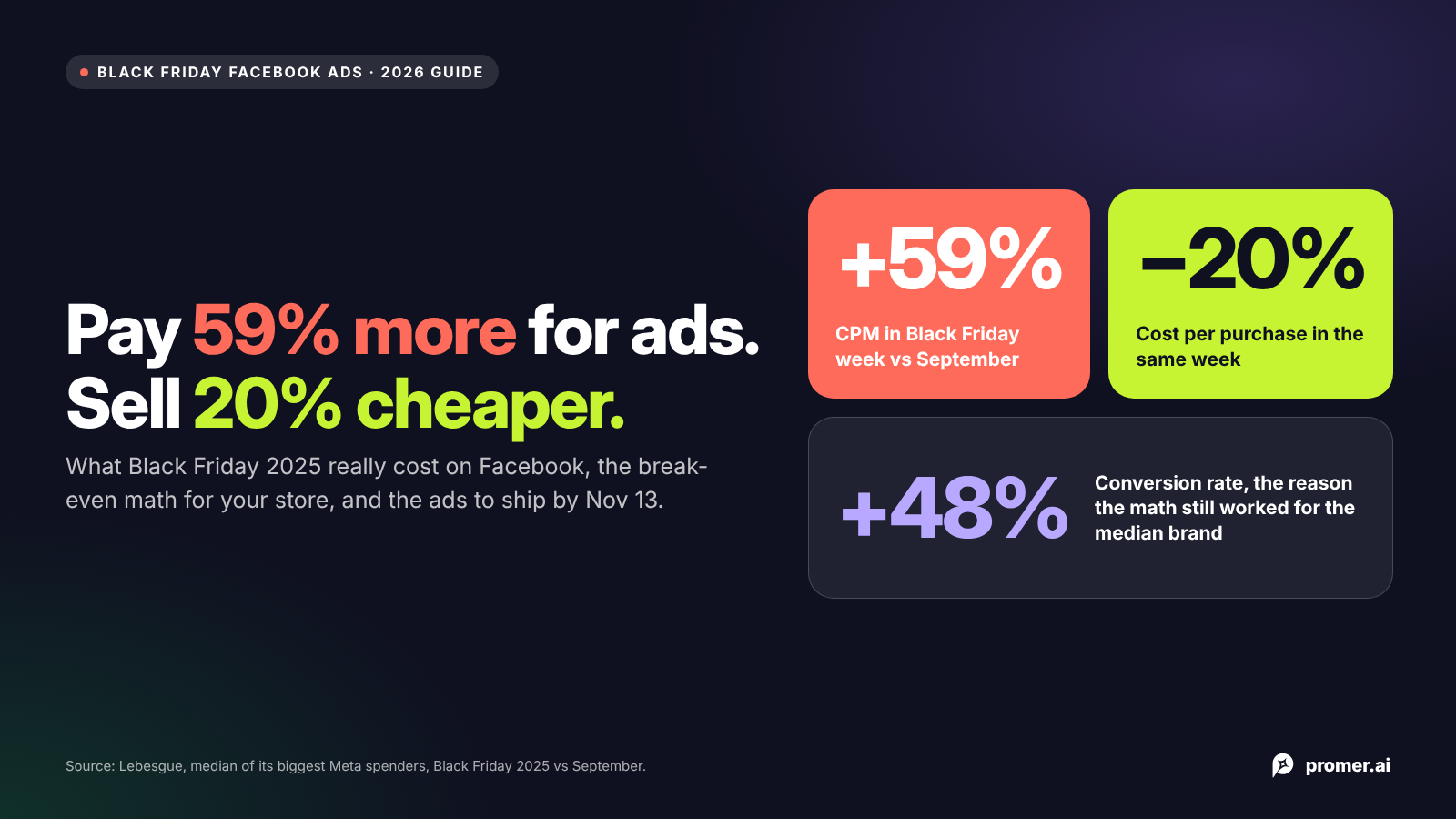
Black Friday Facebook ads get more expensive every year, and 2025 was no exception. According to Lebesgue's data on the biggest Meta spenders it tracks, the median brand paid 84% more per 1,000 impressions on Black Friday than its September average. Yet across Black Friday week, that same median brand paid 20% less for each purchase.
The auction gets pricier, but shoppers also get much easier to convert. The stores that come out ahead in November know which of those two forces is winning in their own account, and set their budget, discounts and creative around it.
This guide gives you the 2025 numbers, what to expect in 2026, a break-even CPM formula you can run in five minutes, a dated plan for the next four weeks, and the creative load to have ready by November 13. Black Friday 2026 falls on November 27.
Key takeaways
In 2025, the median brand's Facebook CPM ran 59% above September across Black Friday week and 84% above it on the day itself. Cost per purchase still fell 20%, because conversion rate rose 48%.
2026 starts from a higher base. Meta's average price per ad was up 12% year over year in Q2 2026, and 20% in the US and Canada.
CPM doesn't decide whether Black Friday makes money. Your break-even CPM does: 1,000 × CTR × conversion rate × contribution per order.
The discount is the cost most stores forget. In the worked example below, a 20% off offer turns a profitable Black Friday order into a $6 loss on cold traffic, while a free gift that costs $5 keeps it in profit.
Have 5 to 8 genuinely different ad concepts ready by November 13, each with a Black Friday version and a vertical cut. Meta treats near-identical variants as versions of the same ad.
Short on time to build five new concepts? Paste a product link into Promer and Ad Concept suggests several distinct angles for it, which you can turn into Black Friday versions in the same session. Try it with one product →
What Black Friday actually costs on Facebook
Expect the most expensive impressions of the year in the week of November 23, and expect them to cost more than last year's.
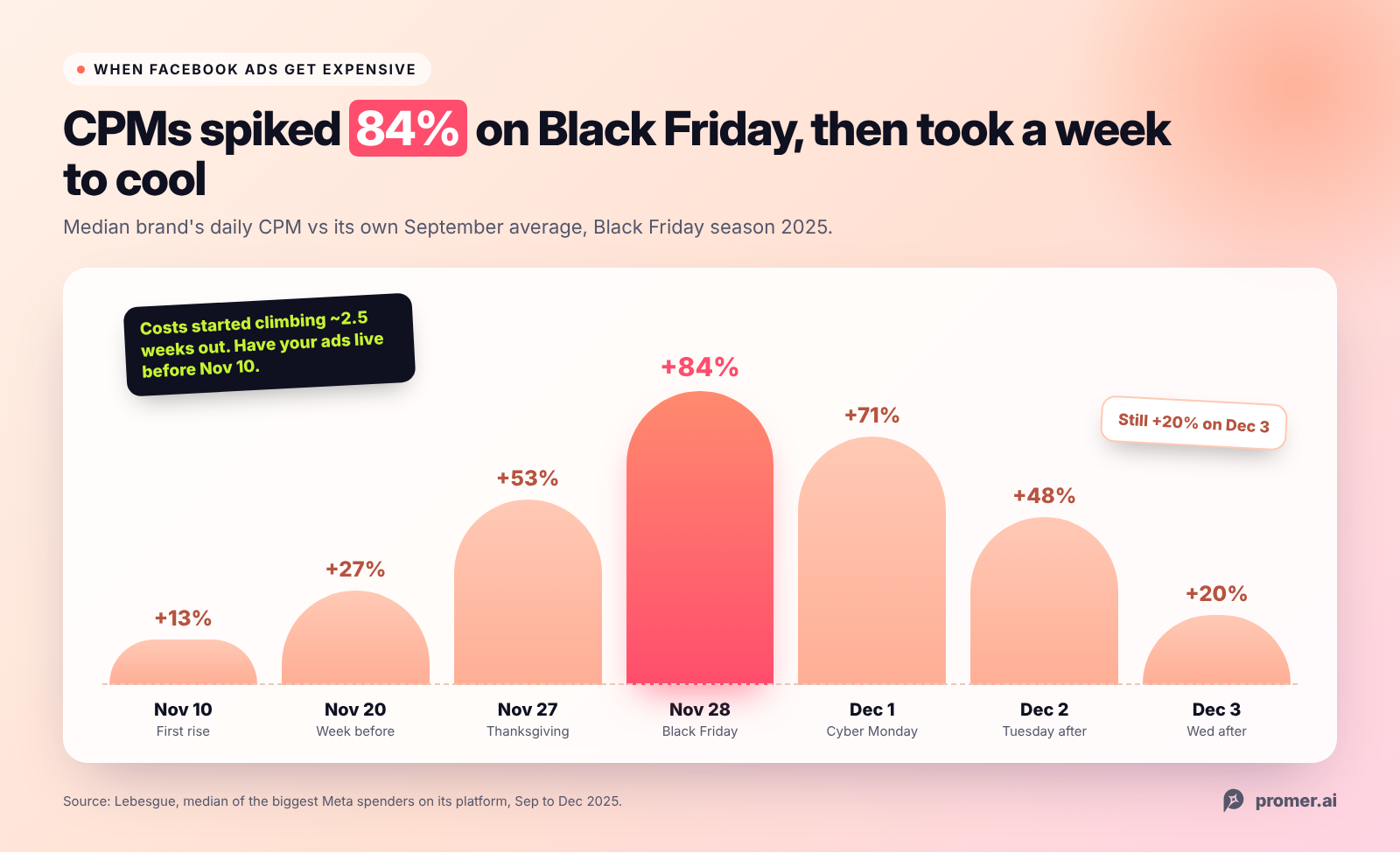
Lebesgue analyzed $22.6 million in Meta spend from its biggest spenders between September and November 2025. According to that data, here's how the median brand's CPM moved against its own September average:
The peak is the least useful part of that chart. Three other things matter more.
First, the start date moves. In 2025, CPM stayed within 7% of September until the week of November 10. The same brands saw costs climb from mid-October in 2024, when Black Friday week ran 80% above September instead of 59%. Watch your own weekly CPM from October onward rather than a calendar.
Second, your category changes the size of the jump. The median rise in Black Friday week was 116% for home and decor brands, 66% for fashion and footwear and 42% for beauty and supplements. The groups are small, so treat these as direction only.
Third, cutting spend doesn't help. One fashion brand spent 60% less than in September and still paid 78% more per 1,000 impressions. Everyone else in the auction sets the price.
For 2026, the base is higher. According to Meta's Q2 2026 earnings release, its average price per ad rose 12% year over year, and PPC Land's coverage of the same results puts the US and Canada increase at 20%. That figure is revenue per ad delivered rather than your CPM, but it shows which way the auction is leaning. According to Triple Whale's data from 33,000+ shops, Meta CPM over BFCM 2025 averaged $22.26, up 7.6% on 2024, while ROAS barely moved at 2.26.
The demand is there to pay for it. According to Adobe's 2026 holiday forecast, US online holiday spend will reach $275.1 billion across November and December, with $47.5 billion landing in the five days from Thanksgiving to Cyber Monday. The question is how much of that demand your ads can catch at a price your margin survives.
Why paying more can still mean selling cheaper?
CPM is only half of what a sale costs you. The other half is how many of those 1,000 impressions turn into orders:
Lebesgue's median brand, Black Friday week 2025 against its own September:
Metric
Black Friday week vs September
CPM
+59%
Conversion rate (purchases per link click)
+48%
Cost per purchase
−20%
Meta-reported ROAS
+19%
Now run those numbers back through the formula. A 59% higher CPM and a 48% higher conversion rate only produce a 20% lower cost per purchase if click-through rate also rose by about a third (1.59 ÷ 1.48 ÷ 0.80 ≈ 1.34). Lebesgue doesn't publish CTR, so that figure is our arithmetic. But it points at the part most stores miss: in deal week, shoppers click more and buy more, and both only happen if your ad gives them a clear reason to.
This isn't automatic, and not everyone saw it. Lebesgue's sample is its biggest spenders, and it notes that stronger offers, higher intent and a shift toward warm traffic all likely played a part. Triple Whale's wider panel of 33,000+ shops tells a flatter story for the same weekend: Meta ROAS up about 3% and cost per acquisition up about 2% year over year, at $34.06.
So yes, Black Friday can sell cheaper. It happens when your ads earn the extra clicks, your site converts the extra intent, and your discount leaves enough margin to pay for both. The discount is where most of the money leaks, and it's also the one part you can calculate before spending a dollar.
Your break-even CPM: The five-minute math
The highest CPM you can pay and still make money on the first order is:
Break-even CPM = 1,000 × CTR × Conversion rate × Contribution per order
Contribution per order is what's left of the order after product cost, shipping, payment fees, returns and the discount. ROAS HACK lays out the same formula with its own scenarios in its Black Friday 2026 ad cost breakdown. Below, it's applied to a typical small store.
The store. A $65 average order. Product, shipping, fees and a returns allowance come to $33, so each full-price order contributes $32.
A normal September. CTR of 1.5%, conversion rate of 3%, and a CPM of $14.19, the 2025 median for Meta according to Triple Whale's benchmark panel. Break-even CPM is $14.40, so first orders from cold traffic barely pay for themselves. That's normal.
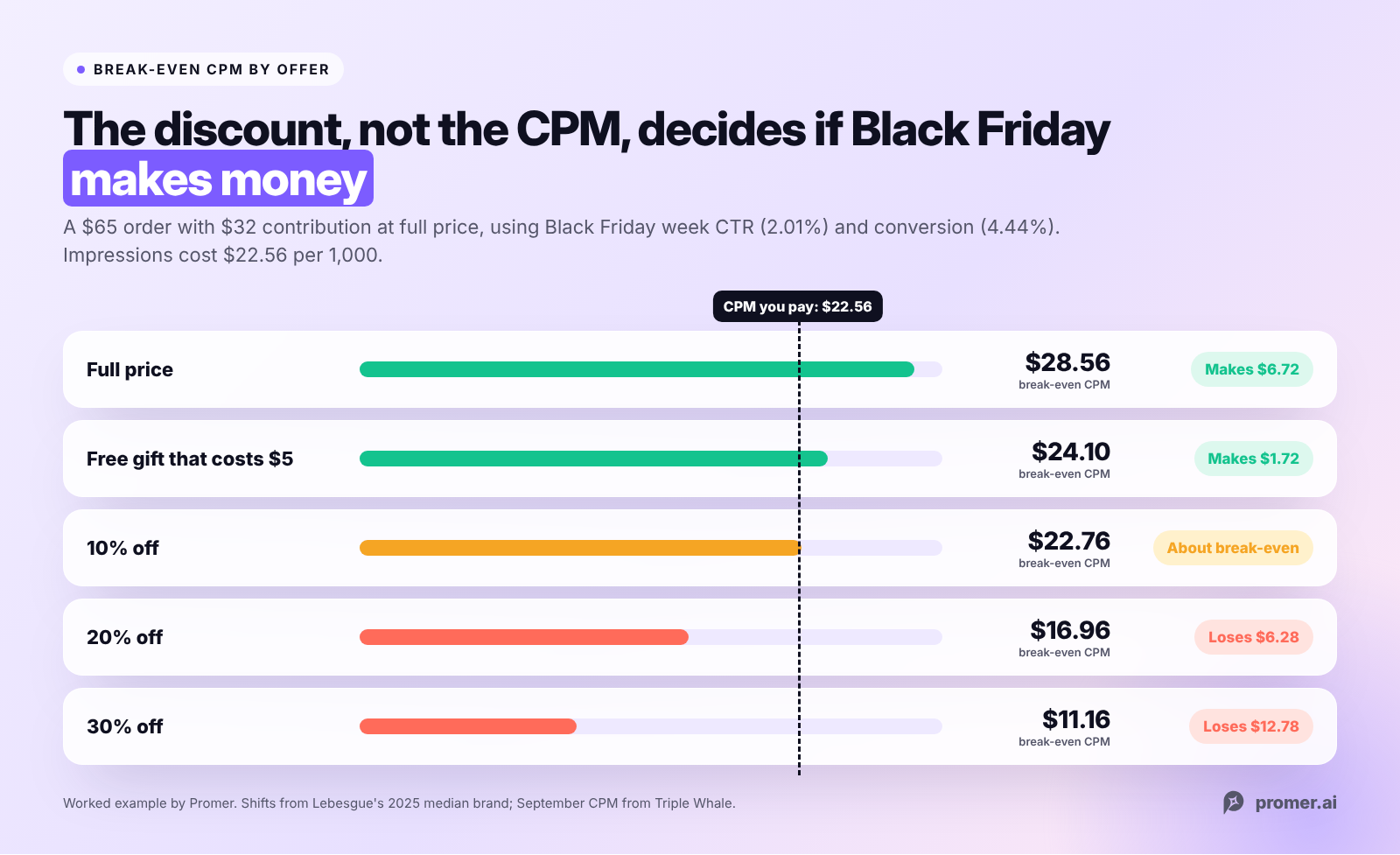
Black Friday week. Apply the median shifts from the previous section: CPM rises to $22.56, conversion rate to 4.44%, CTR to 2.01%. Each purchase now costs $25.28 in ads, 20% less than in September. Then the discount arrives:
At full price, every Black Friday order makes $6.72 after ad cost. At 10% off, it roughly breaks even. At 20% off, each first order loses $6.28. At 30% off, which Talk Business & Politics reports as the top of the Cyber Week discounts Adobe expects, it loses $12.78. A free gift that costs you $5 still clears $1.72, and it gives shoppers a reason to buy that isn't a percentage.
Four things follow from this.
Deep discounts and cold traffic are the expensive combination. Spend most of your deep-discount budget on people who already know you: past buyers, subscribers, cart abandoners and recent site visitors, where conversion runs far above cold traffic.
Protect contribution in the cold-traffic offer. Gifts with purchase, bundles and spend thresholds ("$15 off orders over $100") usually cost less margin than a flat percentage.
Losing money on the first order is sometimes fine. If your 60-day repeat rate pays it back, buy the customer. Just work out that number before Black Friday.
Use your own numbers. Pull last November's CTR, conversion rate and CPM from Ads Manager and your contribution after the discount you actually plan to run. If your break-even CPM lands below last year's peak-week CPM, cold prospecting that week will likely lose money on the first order.
Choose the offer before you build the ads
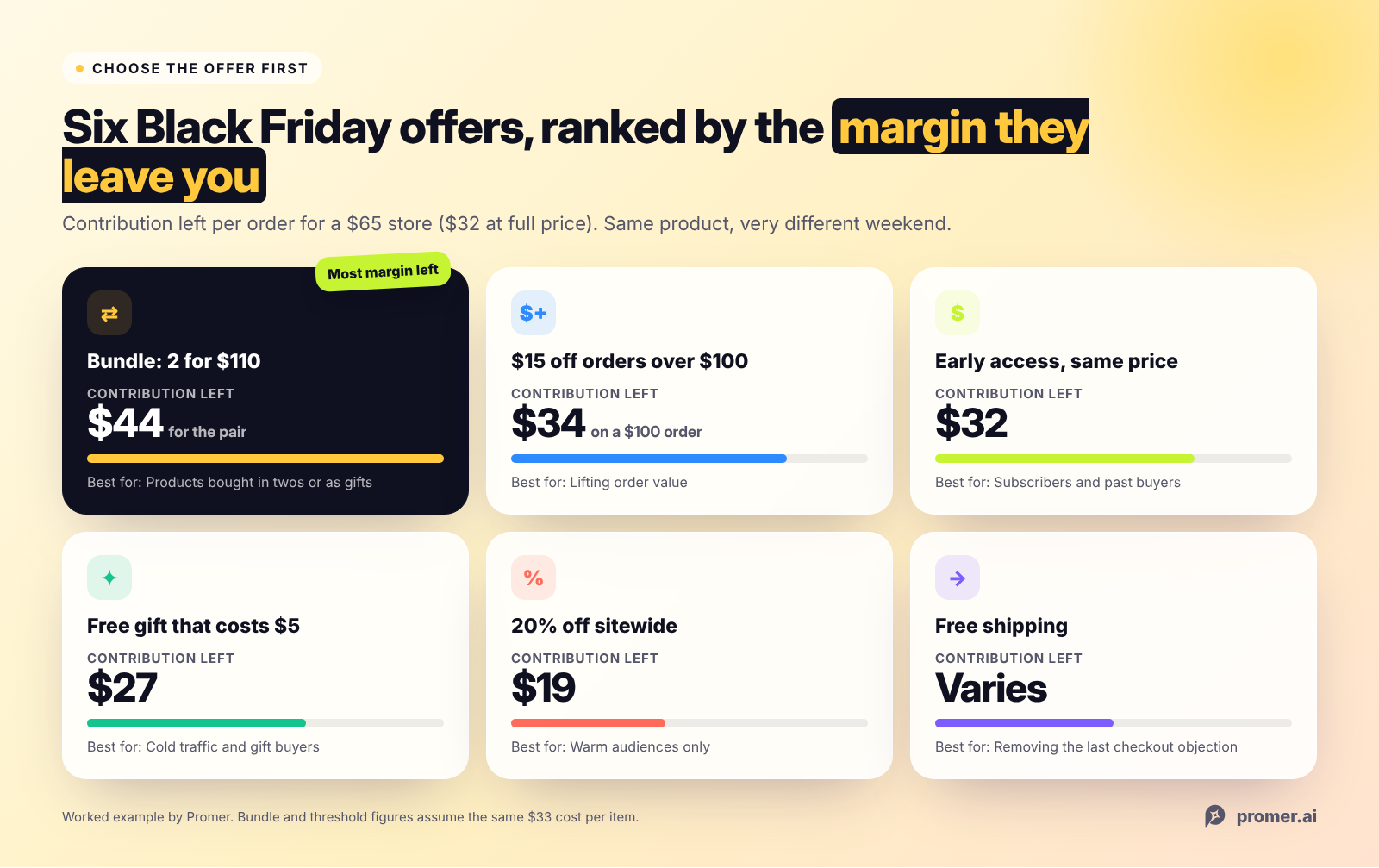
Most stores pick "20% off sitewide" by habit, then work out whether they can afford it. Do it the other way round. Each offer type costs a different share of your margin and persuades a different kind of buyer, so the offer decides which ads you need.
Using the same $65 store ($32 contribution per full-price order):
Offer
What it costs you per order
Contribution left
Works best for
Watch out for
20% off sitewide
$13
$19 (41% less)
Warm audiences who already want the product
Trains buyers to wait for sales
Free gift that costs you $5
$5
$27 (16% less)
Cold traffic and gift buyers
The gift has to feel worth having
$15 off orders over $100
$15, only on bigger carts
About $34 on a $100 order
Lifting order value
Fails if your range has few add-ons
Bundle: 2 for $110 instead of $130
$20 across two items
About $44 for the pair
Products people buy in twos or as gifts
Stock for both items
Free shipping
Whatever you used to charge for shipping
Depends on your rate
Removing the last checkout objection
Heavy or bulky products
Early access, same price
Nothing extra
$32
Subscribers and past buyers
Only works if your list is warm
The bundle is the one most small stores overlook. It gives a bigger headline saving than the gift, yet leaves more contribution in each order than a full-price single sale, because the second item comes with its own margin.
Then map offers to audiences, so each person sees the cheapest offer that still moves them:
Cold traffic: gift with purchase or a spend threshold. Lead the ad with the product, and use the offer as the reason to buy now.
Engaged but never bought: the bundle, with proof (reviews, demos) to answer why they hesitated.
Subscribers and past buyers: early access, then the deepest discount you can afford, since their conversion rate can carry it.
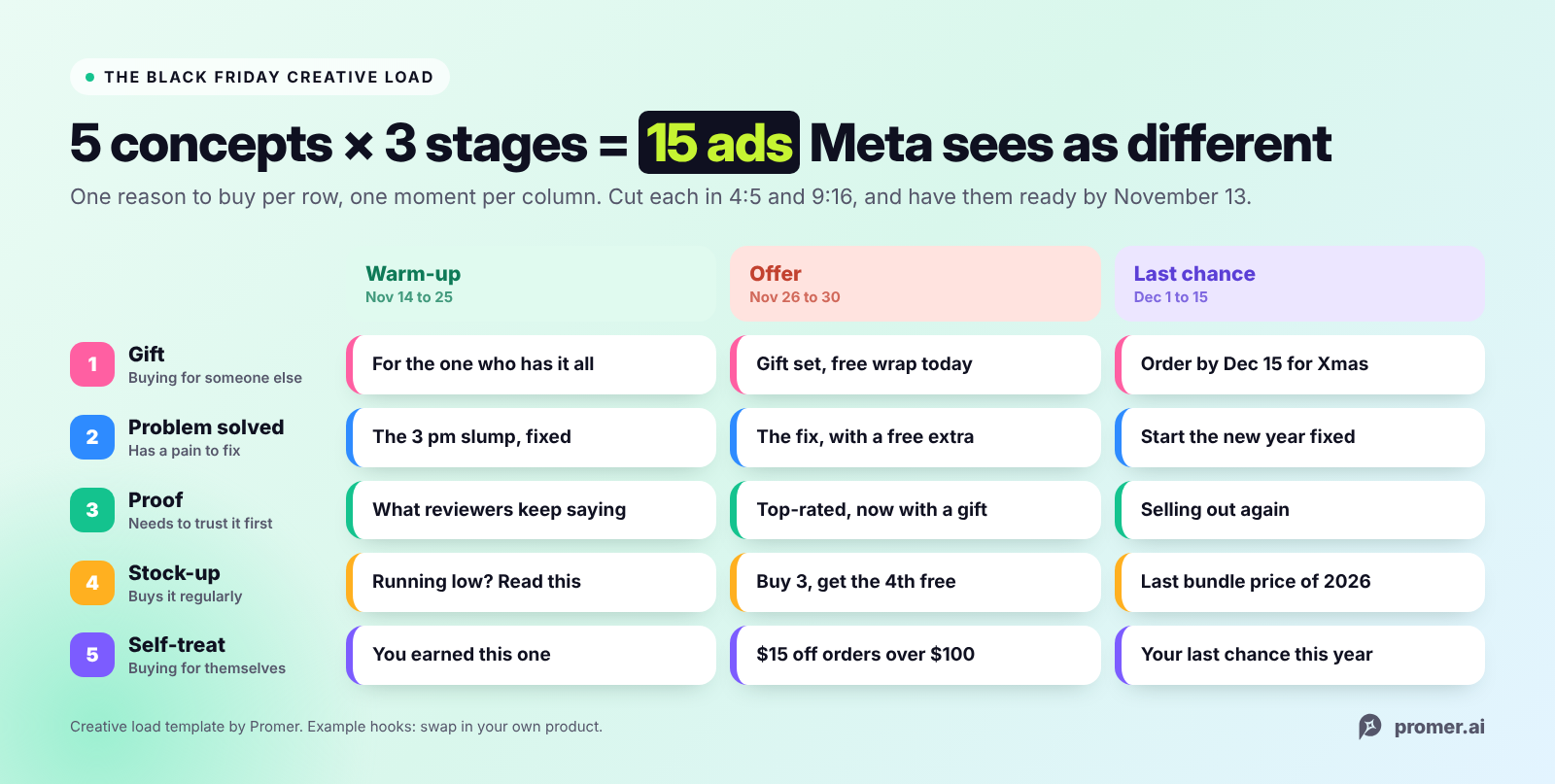
One offer per audience also keeps your creative load honest: each row of the grid below gets an offer version that matches who will see it.
The 2026 plan: 4 phases to November 30 and beyond
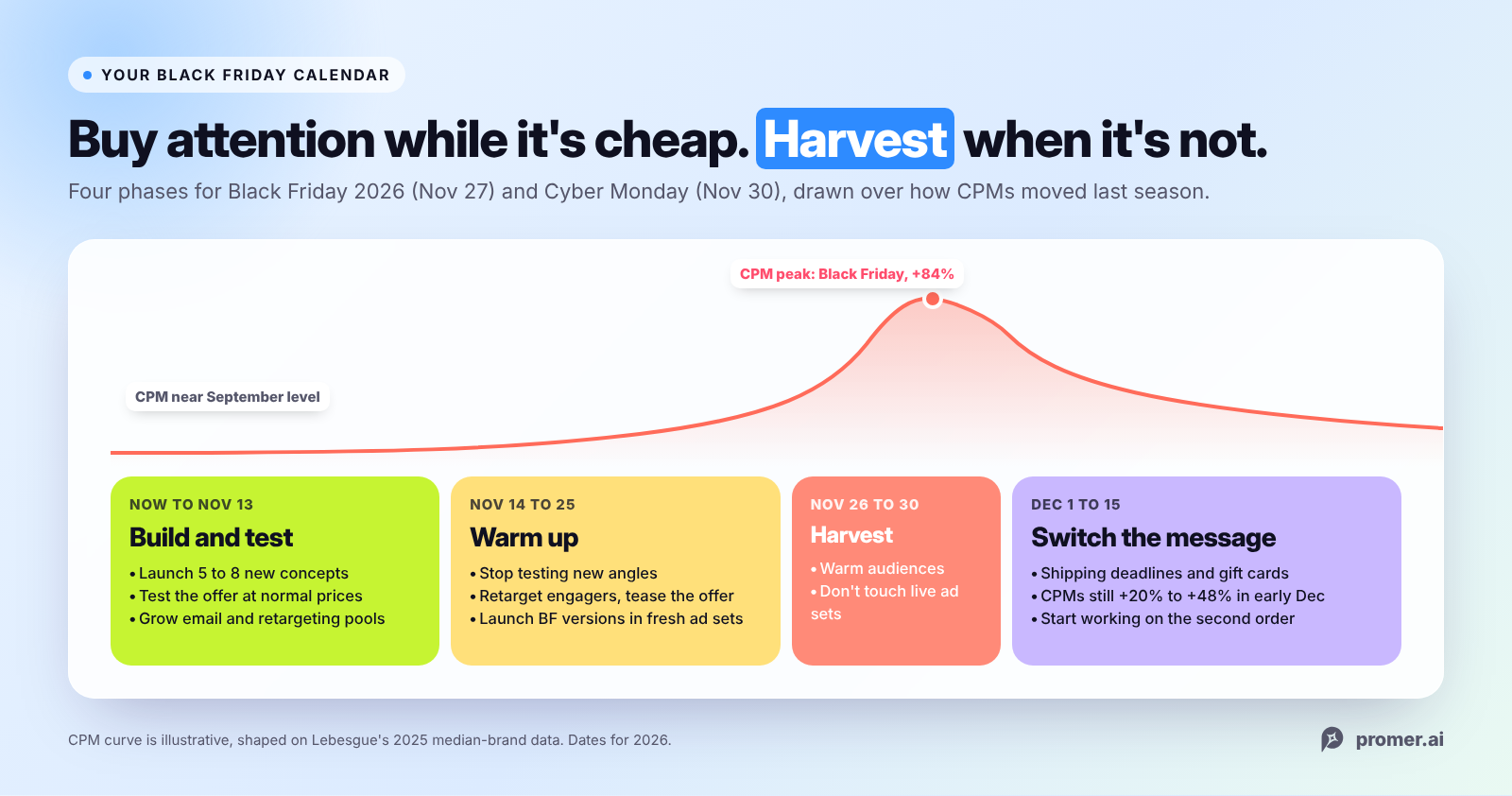
Buy attention while it's cheaper, and spend the most expensive week of the year on the people most likely to buy. Thanksgiving is Thursday, November 26, Black Friday is November 27 and Cyber Monday is November 30.
Now to November 13: build and test. Launch your new concepts this week so they have real data before the auction heats up. Test your offer at normal prices, run lead-in ads that collect emails for early access, and grow the retargeting pools you'll use later (video viewers, page engagers, site visitors). In 2025, CPMs stayed close to September until the week of November 10, but in 2024 they rose from mid-October, so check your own account rather than assuming you're early.
November 14 to 25: stop testing, start warming. Many agencies stop testing new angles after mid-November; eCommerce Circle's Black Friday plan, for example, draws the line at November 13. Retarget the people who engaged, tease the offer to your list, and keep prospecting under a cost cap set at your break-even CPM. Launch your Black Friday versions in fresh ad sets now, so they're out of learning before the peak.
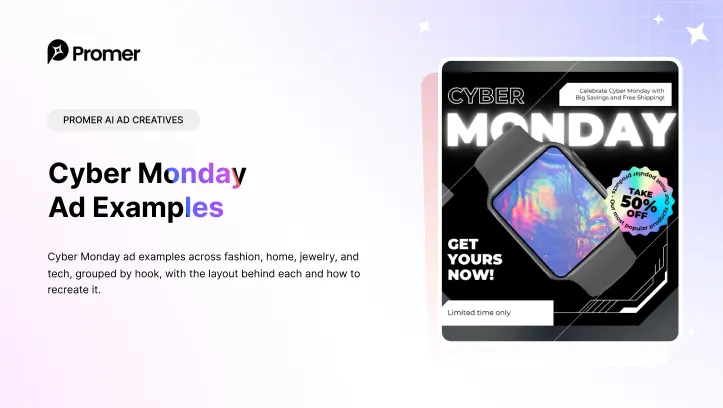
November 26 to 30: harvest. Put the heaviest budget on warm audiences, cap cost per purchase at your break-even, and leave live ad sets alone. Changing targeting or creative mid-weekend sends them back into learning when every impression is at its most expensive. Have your Cyber Monday "last chance" creative built and scheduled before Thursday; these Cyber Monday ad examples show the layout behind each hook. Adobe expects Cyber Monday to be the first $15 billion online shopping day.
December 1 to 15: don't switch off, switch message. In 2025, CPMs were still 48% above September the day after Cyber Monday and 20% above it two days later. Shift creative to shipping deadlines, gift cards and "still time to get it" angles, and start working on the second order. Customers bought at break-even in November only pay back if they buy again.
The creative load: What to have ready by November 13
Your creative decides who sees your ads now, so the Black Friday creative plan matters as much as the budget plan.
Since April 2025, Meta has told advertisers that creative diversification, not narrow targeting, is the main lever for finding buyers, according to Apogee's breakdown of the Andromeda update. The catch is what counts as "different." Ads that look or feel alike are treated as variations of one creative. Ten versions of the same video with a new background color or overlay give the system one idea to work with, not ten.
That's why the unit to plan in is the concept: a different reason to buy, aimed at a different buyer. Here's a load that fits a small team:
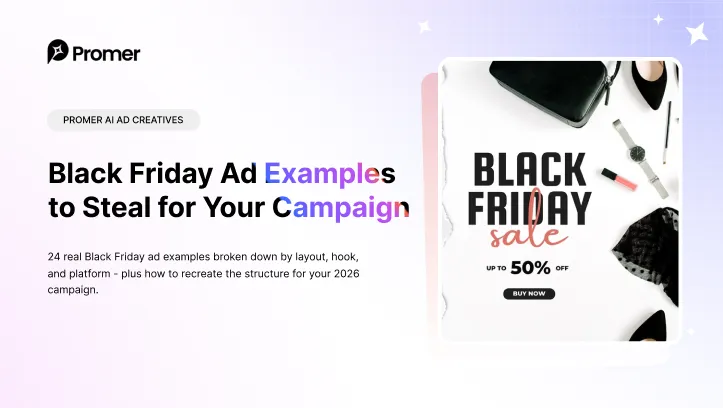
Need starting points for each row? These 24 Black Friday ad examples break down real layouts by hook and platform. For the proof row, a testimonial or review-style ad usually works best.
How many to run at once? According to AdScale's analysis of 1,200+ ecommerce ad accounts, ad sets with 4 to 6 active creatives earned about 22% higher CTR than ad sets with 1 or 2, and gains flattened past 7. Build more than you'll run, because most won't win: Motion's 2026 benchmark, as compiled by AdLiftr, puts the share of Meta ads that become winners at only 4% to 8%. If you haven't set up a clean test before, our guide to ad creative testing for ecommerce walks through it.
A few rules that keep the load useful:
Lead with the offer in the offer week. During Nov 26 to 30, the deal belongs in the first second of video and the first line of the image. That week, people are comparing deals more than discovering brands.
Match concepts to what people buy in that week. According to Adobe's forecast, Cyber Week sales of clothing basics will run 210% above September and personal care 150% above it. If you sell anything people restock, a stock-up concept is not optional.
Build the Black Friday version as a new ad. Build it in a fresh ad set before November 26 rather than swapping the image inside a live winner.
Watch CTR to spot fatigue. Everyone's CPM rises in November. Lebesgue's rule of thumb: when CPM and CPC rise while CTR falls, the creative is the problem. When CTR holds, the ad is fine and the auction is just expensive. When it is fatigue, replace it with a new concept rather than a recolor of the old one, so you keep the angle that worked.
Building the load in two weeks with Promer
Knowing what to make is the easy part. Making five genuinely different concepts, plus offer and last-chance versions of each, before November 13 and while packing orders is where small teams stall. It's the part we built Promer, an AI ad maker for ecommerce stores, to take off your plate.
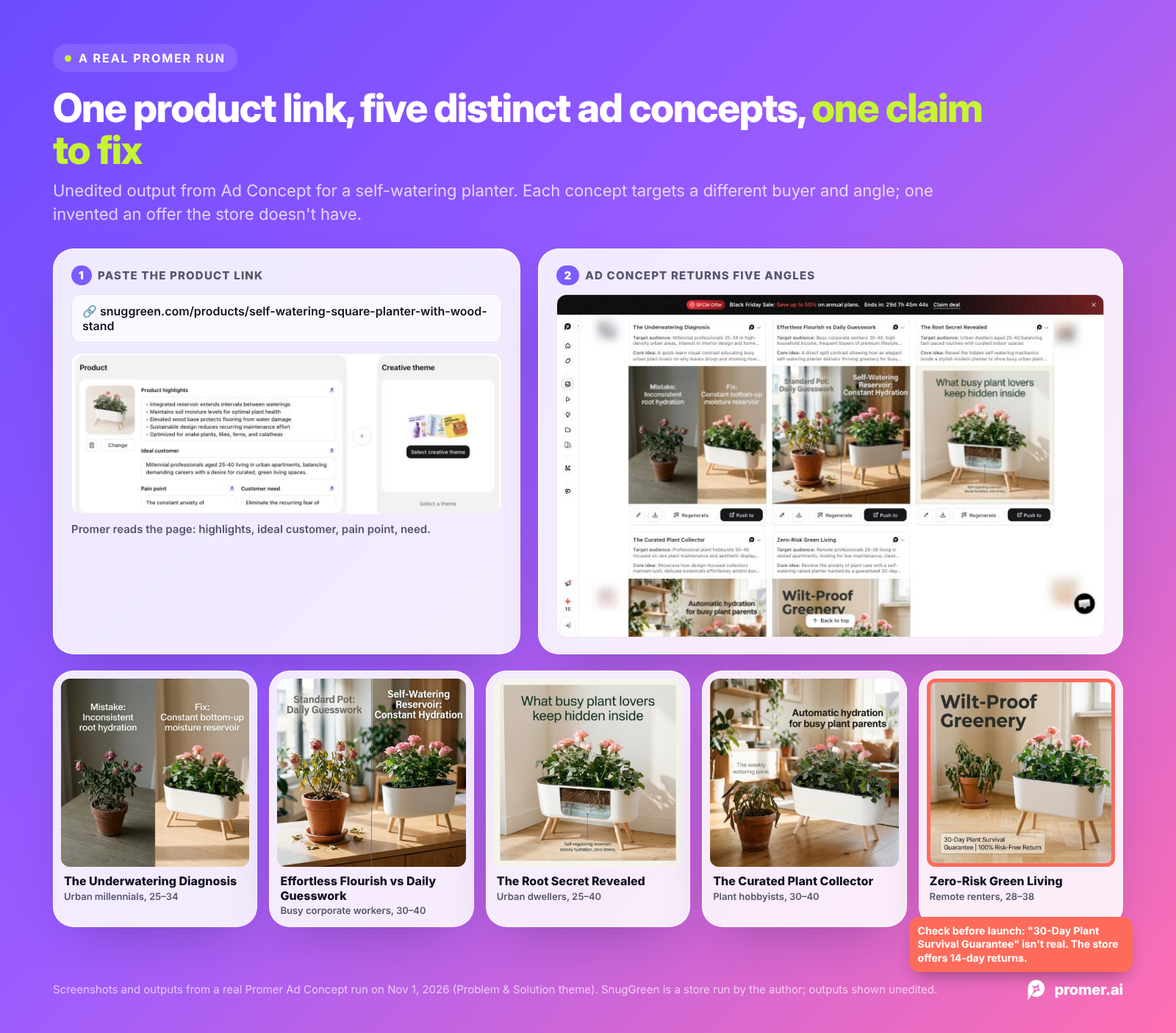
You paste a product link, and Promer works out what the product does, who tends to buy it and what the market around it looks like. Ad Concept then suggests several angles. Pick ones that land in different rows of the grid above, say a gift angle, a problem angle and a proof angle, and the set is diverse before you've designed anything.
If you've seen a Black Friday format that works, find it in Promer's winning ads library, or track it down in the Meta Ad Library, where an ad's run time tells you whether it's winning. Then use Ad Clone to rebuild the layout around your own product; Promer's Black Friday ad generator puts these steps for sale ads in one place. Ad Animation turns a finished static into a short motion version for Reels and Stories, in the ratio each placement needs. When the set is ready, you can push it to Meta from inside Promer.
Check every output before it goes live. In the real run above, four of the five concepts were usable as they came out, but one added a "30-Day Plant Survival Guarantee" the store doesn't offer (its actual policy is 14-day returns). In deal week, a made-up offer is worse than no ad at all, so read every claim, price and date against your own page. The review takes five minutes.
Six mistakes that burn Black Friday budget
Judging the weekend by CPM. A higher CPM is just the price of that week. Cost per purchase and contribution per order are the numbers that decide whether to scale.
Showing the deepest discount to everyone. Cold traffic plus 20% or 30% off is where first orders lose the most money. Save the deep offer for warm audiences and give cold traffic a margin-friendly one.
Cutting spend to wait out the spike. It rarely lowers what you pay per impression. In Lebesgue's data, one brand spent 60% less than in September and still paid 78% more per 1,000 impressions.
Testing new concepts on Black Friday. Peak week is the most expensive time to learn. Test before mid-November, scale what worked after.
Launching twenty near-identical variants. Different colors and headlines on the same idea read as one creative to Meta. Five real concepts beat twenty tweaks.
Trusting Meta ROAS over your margin. Reported ROAS can rise while profit falls, once discounts, returns and shipping come out. Check contribution from your store data, not only Ads Manager.
FAQ
How much do Facebook ads cost on Black Friday?
Across 33,000+ shops on Triple Whale, Meta CPM averaged $22.26 over the BFCM 2025 weekend, up 7.6% on 2024. Measured against their own baseline, Lebesgue's biggest spenders paid 59% more than in September across Black Friday week and 84% more on Black Friday itself. Meta's average price per ad was up 12% year over year in Q2 2026, so plan for a higher peak this year.
When do Facebook ad costs start rising before Black Friday?
There's no fixed date. In 2025, the median brand's CPM stayed within 7% of September until the week of November 10, then climbed into Black Friday. In 2024, the same brands saw the rise start in mid-October. Track your weekly CPM from October against your September average so you see the ramp in your own account.
Should I increase my Facebook ad budget for Black Friday?
Only up to the CPM your margin can carry. Your break-even CPM is 1,000 × CTR × conversion rate × contribution per order, after the discount you plan to run. Put most of the extra budget behind warm audiences such as past buyers, subscribers and cart abandoners, where conversion is highest and a deeper discount can still pay.
How many ad creatives do I need for Black Friday?
Plan for 5 to 8 genuinely different concepts, each with a Black Friday offer version and a vertical cut for Reels and Stories. Run about 4 to 6 active creatives per ad set; AdScale's data on 1,200+ ecommerce accounts found that range beat 1 or 2 creatives on CTR by about 22%. Near-identical variants don't count as extra concepts.
When should I launch Black Friday Facebook ads in 2026?
Launch and test new concepts by about November 13. Put Black Friday versions live in fresh ad sets before Thanksgiving on November 26, so they're out of learning before the peak. Concentrate budget on warm audiences from November 26 to 30, and have Cyber Monday creative scheduled in advance rather than built on the day.
Do Black Friday discounts hurt ad profitability?
They can, more than the CPM rise does. In our worked example, a $65 order makes $6.72 after ad cost at full price in Black Friday week, but a 20% discount turns it into a $6.28 loss on the first order. A free gift costing $5 kept the order profitable. Run the break-even formula with your own discount before you set the offer.
The short version
The stores that come out of Black Friday ahead usually aren't the ones paying least for impressions. They know their break-even CPM, keep the deep discount for people who already trust them, and walk into the peak with five real concepts instead of one ad in twenty colors.
You have until about November 13 to get the last part done.
Paste a product link, pick your angles, and have the first concepts ready today. There's a free plan, and paid plans start at $9 a month.
Sources
Lebesgue: Are Meta Ads Worth It on Black Friday? CPM and ROAS Data - https://lebesgue.io/facebook-ads/are-meta-ads-worth-it-black-friday - accessed 2026-11-02
PPC Land: Meta profit drops 8% to $15.8bn as legal charges hit ad gains - https://ppc.land/meta-profit-drops-8-to-15-8bn-as-legal-charges-hit-ad-gains/ - accessed 2026-11-02
Triple Whale: Black Friday Facebook Ads: Data, Strategies, and AI Automations for 2026 - https://www.triplewhale.com/blog/facebook-ads-bfcm - accessed 2026-11-02
Adobe: U.S. Holiday Shopping Season to Hit Record $275.1 Billion Online, Rising 6.7% YoY - https://news.adobe.com/news/2026/09/adobe-us-holiday-shopping-season-to-hit-record - accessed 2026-11-02
ROAS HACK: Black Friday 2026 Ad Costs: Break-Even CPM Math - https://roashack.com/blog/black-friday-2026-ad-costs/ - accessed 2026-11-02
Triple Whale: Facebook Ad Benchmarks by Industry (Updated 2026 Data) - https://triplewhale.com/blog/facebook-ads-benchmarks - accessed 2026-11-02
Talk Business & Politics: Online holiday sales expected to top $275 billion in 2026 - https://talkbusiness.net/?p=301512 - accessed 2026-11-02
eCommerce Circle: Meta Ads for Black Friday: Budget and Timing Plan - https://www.ecommercecircle.com.au/meta-ads-black-friday/ - accessed 2026-11-02
Apogee: Meta Andromeda: What It Changes for Your Ad Creatives - https://www.apogee.ad/en/blog/meta-andromeda/ - accessed 2026-11-02
AdScale: How Many Ad Creatives Per Ad Set? Data Says 4-6 Is the Limit - https://adscale.com/blog/how-many-ad-creatives-per-ad-set/ - accessed 2026-11-02
AdLiftr: Ad Creative Testing Stats for 2026 - https://adliftr.com/blog/ad-creative-testing-statistics-2026 - accessed 2026-11-02
Nana Phan has 16 years of experience across marketing, ecommerce, and SaaS, including running her own dropshipping business and nearly 8 years at FireGroup working on products for online merchants. Her experience spans both selling online and building software for the people behind those businesses.
As Head of Growth at Promer AI, she works across customer research, product, and marketing. She writes about ecommerce growth, ad creative, and practical applications of AI, informed by firsthand experience and conversations with merchants about the challenges they face.
You may also like
Black Friday Facebook Ads 2026: Pay 84% More, Sell Cheaper
Facebook CPMs rose 59% in Black Friday week 2025, yet cost per purchase fell 20%. Get the break-even CPM math, a 2026 plan and the creative load to ship.