Search "prompt for perfume advertisement" and most results hand you the same line: "luxury perfume bottle on marble, golden lighting, 8K." That produces a nice bottle, not an ad.
Perfume is glass and liquid, which means reflections, refraction, and a cap that has to read correctly, or the output looks like a stock render with your label pasted on.
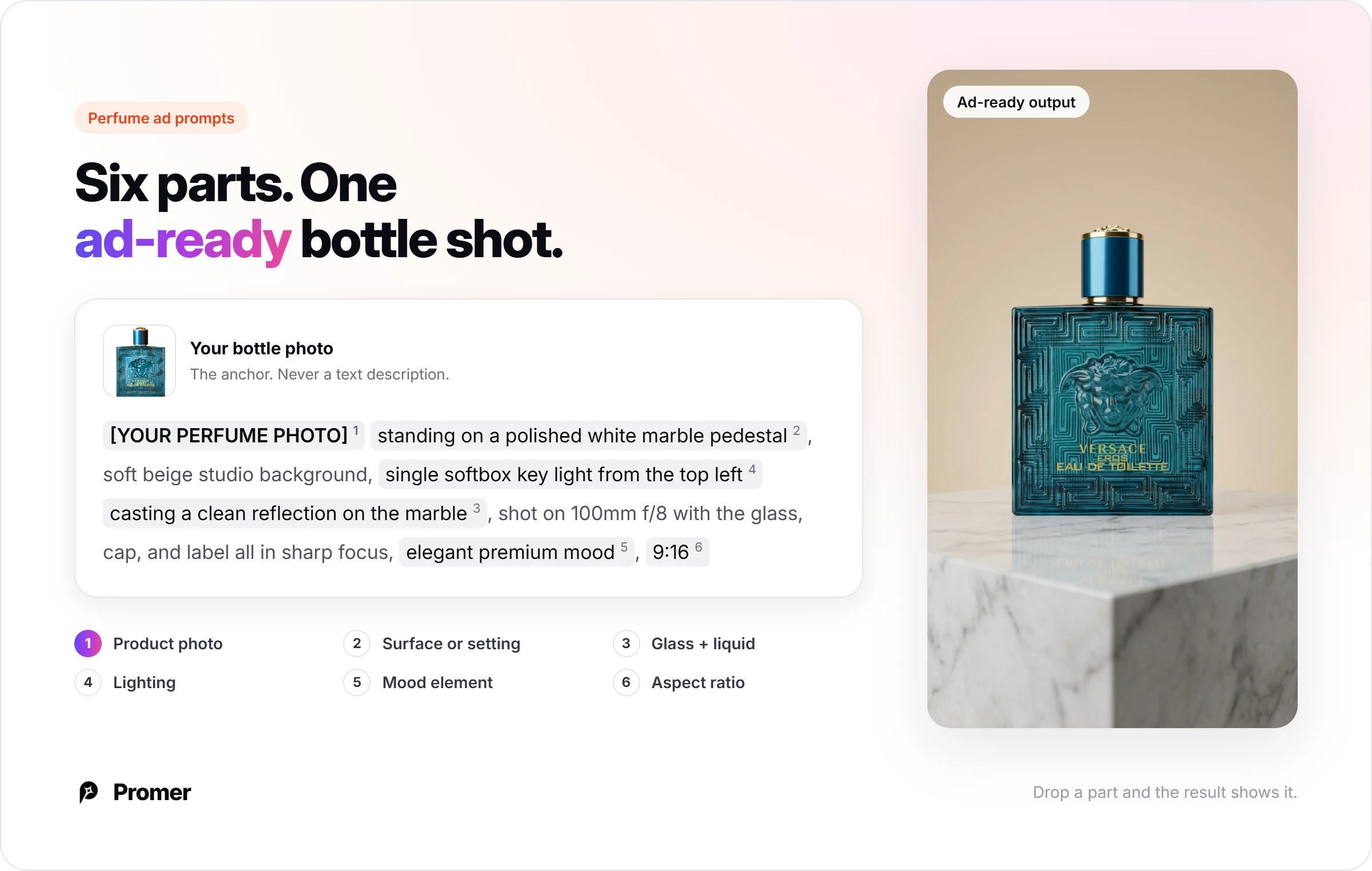
A prompt that produces an ad-ready perfume image needs six parts: your real bottle photo as the anchor, a surface or setting, how light hits the glass and liquid, a mood element that visualizes the scent, lighting, and an aspect ratio matched to where the ad runs.
Below are 16 prompts across the four shots a fragrance brand needs most: studio hero, atmosphere and mood, lifestyle and vanity, and material and liquid detail.
Every prompt uses [YOUR PERFUME PHOTO] as a placeholder. Swap it for your own bottle image before you run it; none of these are meant to invent a bottle shape from scratch. Each one can also be run directly in Promer AI's AI Ad Prompt: open it from the prompt card and it loads straight into the generator, with no copy-paste step in between.
Key takeaways
- Most perfume ad prompt lists skip how light hits the glass, and that's the part that breaks the shot. A bottle with no reflection control renders flat; one with too much renders as a generic glass blob instead of your actual bottle shape.
- Anchor the prompt to your real bottle photo, not a text description. Describing "a tall glass bottle with a gold cap" in words lets the model invent its own silhouette, cap shape, and label placement.
- Perfume ads need a mood element that stands in for the scent, since the product itself is invisible. Floating particles, mist, botanical props, or fabric all do this job; a bare bottle on a plain surface does not.
- Sixteen prompts are organized into four groups: studio hero shots, atmosphere and mood shots, lifestyle and vanity shots, and material and liquid detail shots.
The six-part formula behind every prompt below
Every prompt in this list follows the same structure. Drop a part and the result usually shows it: a bottle that doesn't match your real product, a cap that renders the wrong shape, or a reflection that looks like plastic instead of glass.
- Your actual bottle photo - written as
[YOUR PERFUME PHOTO], a placeholder for the real file you upload or reference, not a text description of the bottle. - Surface or setting - the marble, pedestal, vanity, or fabric the bottle sits on or is styled against.
- Glass and liquid behavior - how light passes through the glass, where the reflection falls, and what color the liquid reads as. This is the part most generic prompt lists skip, and it is what makes a bottle look like glass instead of rendered plastic.
- Lighting - where it comes from and how hard or soft it falls. This is what separates "photographed" from "rendered."
- Mood element - the particle, mist, botanical, or fabric detail that visualizes a scent no camera can show.
- Aspect ratio - matched to where the ad runs (1:1 for a Meta feed ad, 9:16 for Stories or Reels, 4:5 for a sales page).
The prompts below are copy-paste ready. Swap the bracketed placeholder for your own perfume photo before you run them.
Studio hero shots
These isolate the bottle against a clean or controlled background, built for the first frame of an ad or a product listing image.
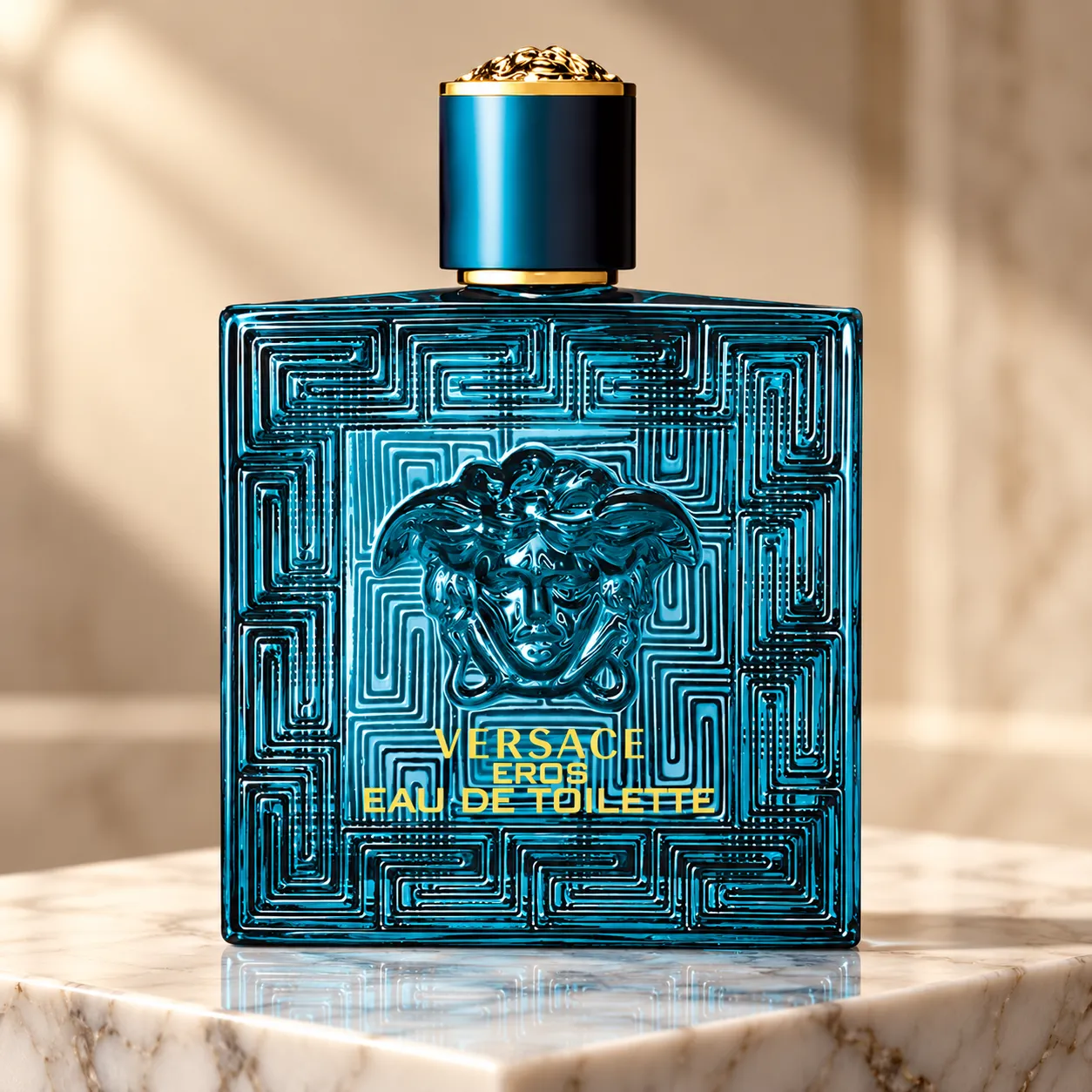
Marble pedestal hero
For a scroll-stopping first frame where the bottle itself is the entire story.
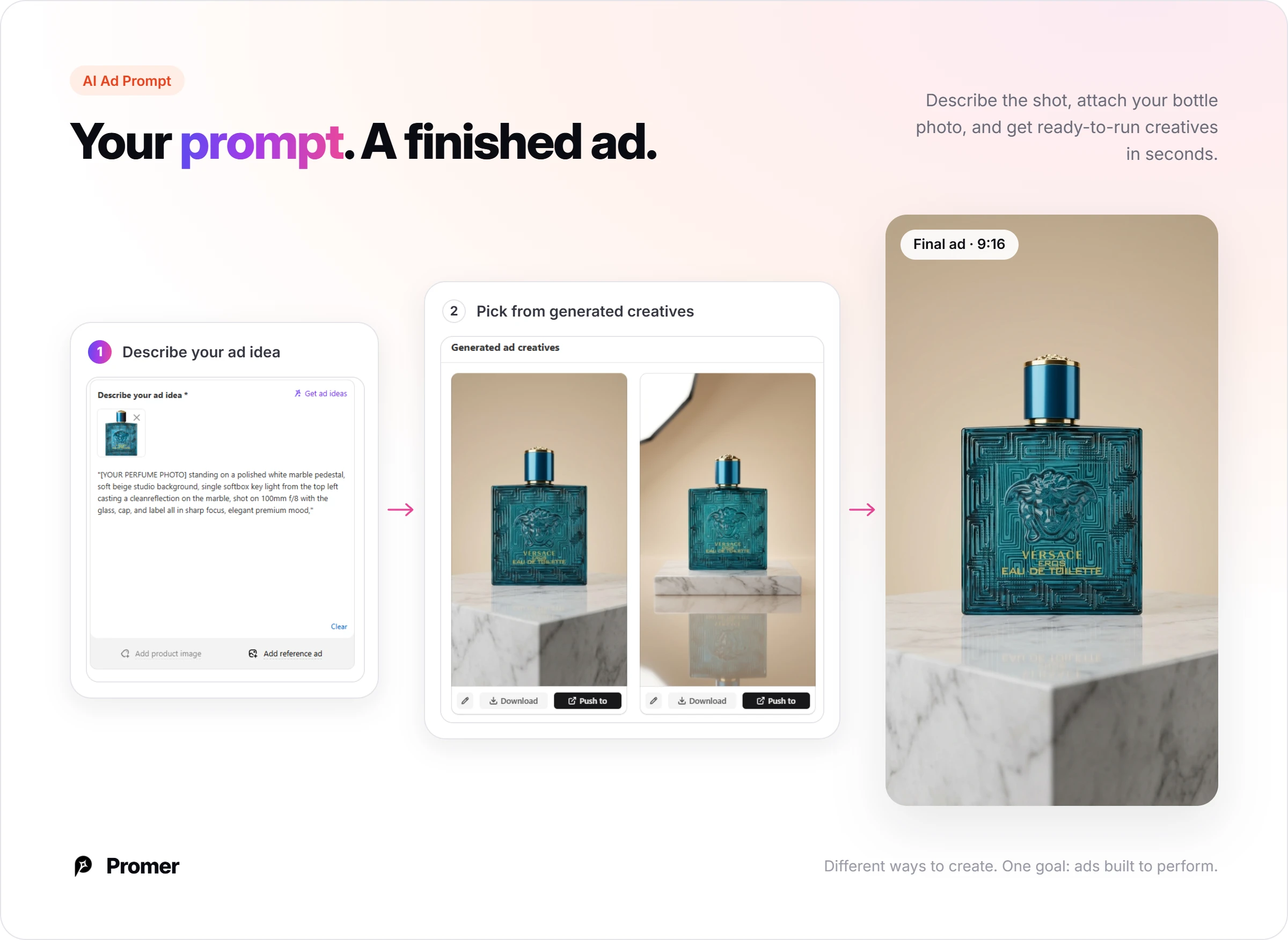
"[YOUR PERFUME PHOTO] standing on a polished white marble pedestal, soft beige studio background, single softbox key light from the top left casting a clean reflection on the marble, shot on 100mm f/8 with the glass, cap, and label all in sharp focus, elegant premium mood, 1:1."
Pro tip: ask for "one reflection, matched to the key light" explicitly. Unprompted, models often invent a second light source that makes the marble reflection point the wrong direction.
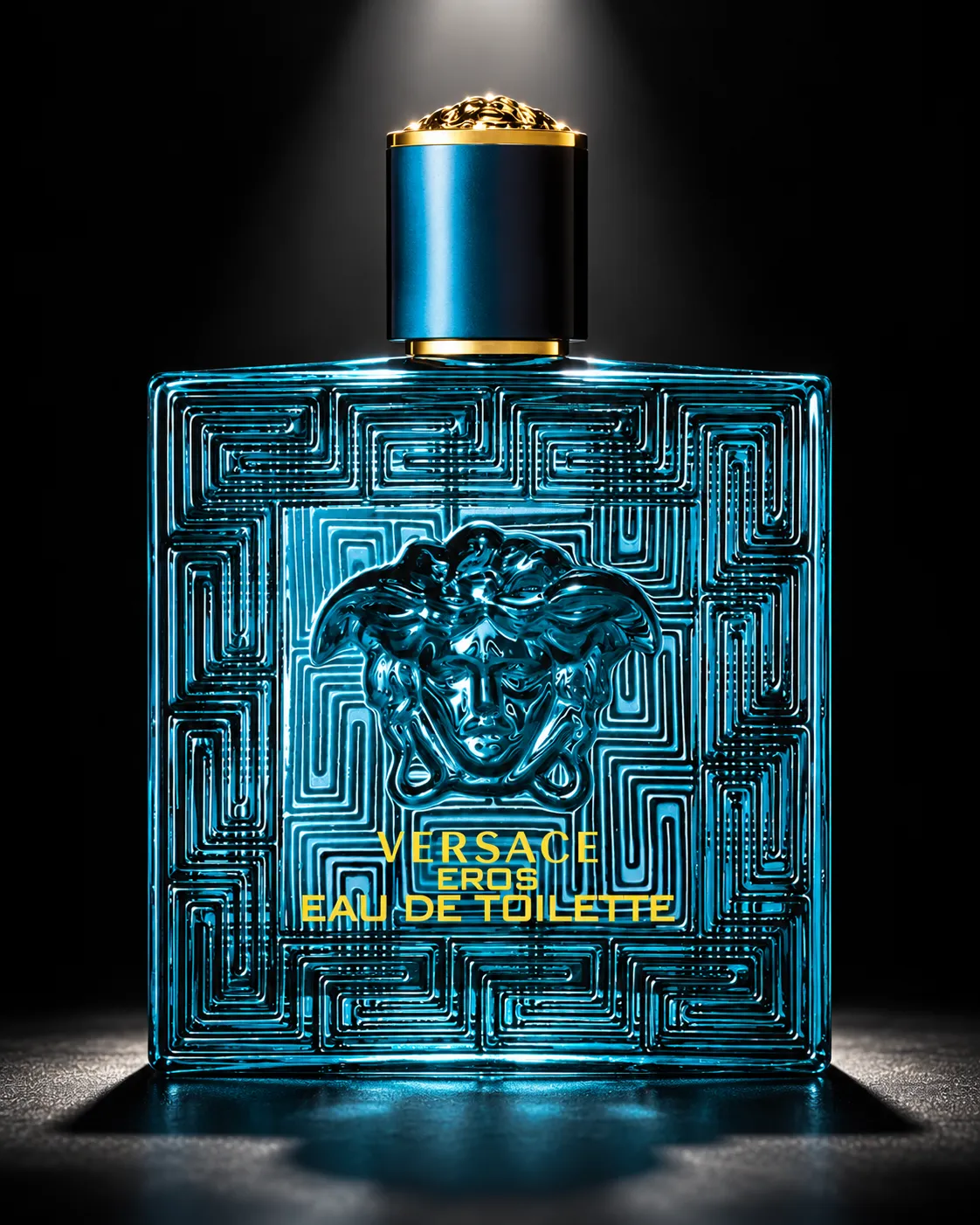
Black glass dramatic spotlight
For a bold, editorial-feeling hero shot that reads as a prestige launch.
"[YOUR PERFUME PHOTO] against a matte black background, a single hard spotlight from directly above creating a tight pool of light and a sharp shadow beneath the base, shot on 85mm f/5.6 with the glass facets and cap in crisp focus, dramatic editorial mood, 4:5."
Pro tip: specify "shadow beneath the base," not "shadow behind the bottle." A behind-the-bottle shadow flattens the glass; a beneath shadow keeps the three-dimensional form of the bottle intact.
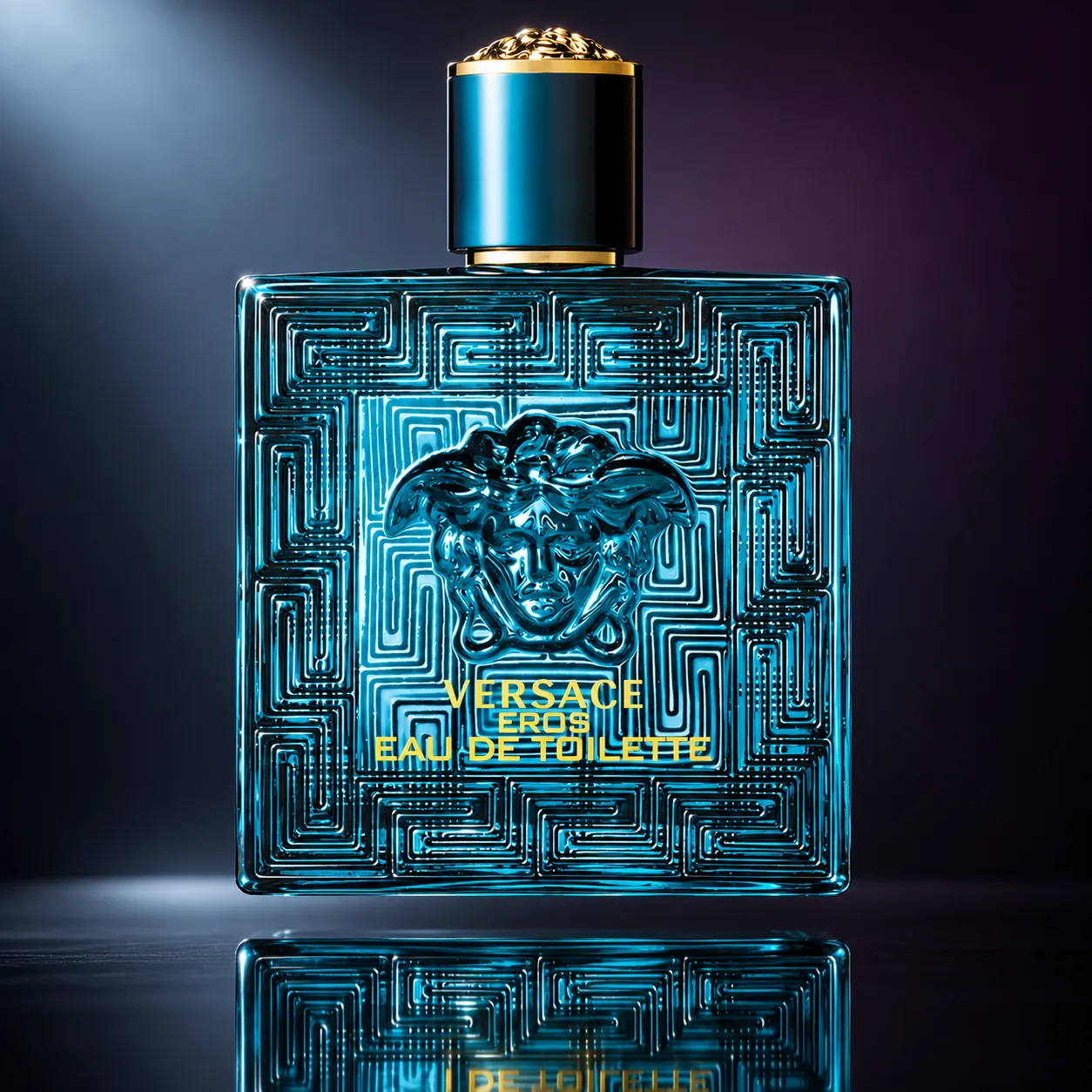
Floating bottle reflection shot
For a listing image or hero banner where the bottle needs to feel weightless and premium.
"[YOUR PERFUME PHOTO] floating slightly above a glossy black reflective surface, smooth gradient background from charcoal to deep plum, single softbox key light from the top left, shot on 50mm f/8 with a clean mirrored reflection directly beneath the bottle, clean commercial product mood, 1:1."
Pro tip: ask for "one shadow, one reflection" explicitly. Floating product shots are where models most often invent a second, physically inconsistent shadow or a doubled reflection.
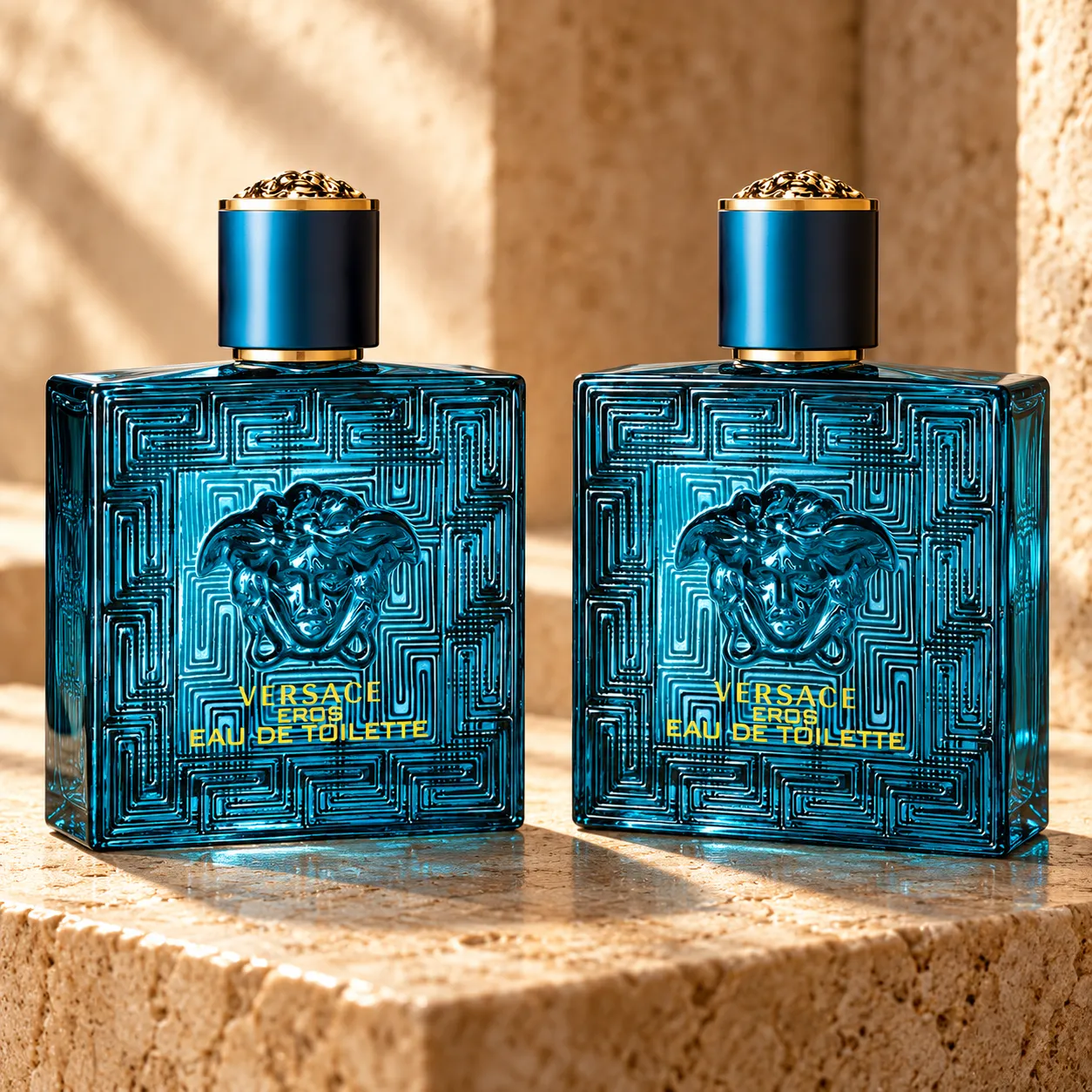
Paired bottles symmetry shot
For a brand-awareness ad or a two-SKU launch where the pair, not a single bottle, is the hero.
"[YOUR PERFUME PHOTO] shown as a symmetrical pair angled toward each other on a warm beige stone surface, soft natural light from the side casting gentle shadows between them, shot on 50mm f/5.6 with both bottles in full focus, calm premium mood, 1:1."
Pro tip: "angled toward each other" is doing real work. Two bottles shot dead straight and parallel tends to read as a stock catalog photo instead of a styled ad.
Atmosphere and mood shots
A perfume ad has to visualize a scent no camera can show. Particles, mist, and fabric are what carry that job; a bare bottle on a plain surface carries none of it.
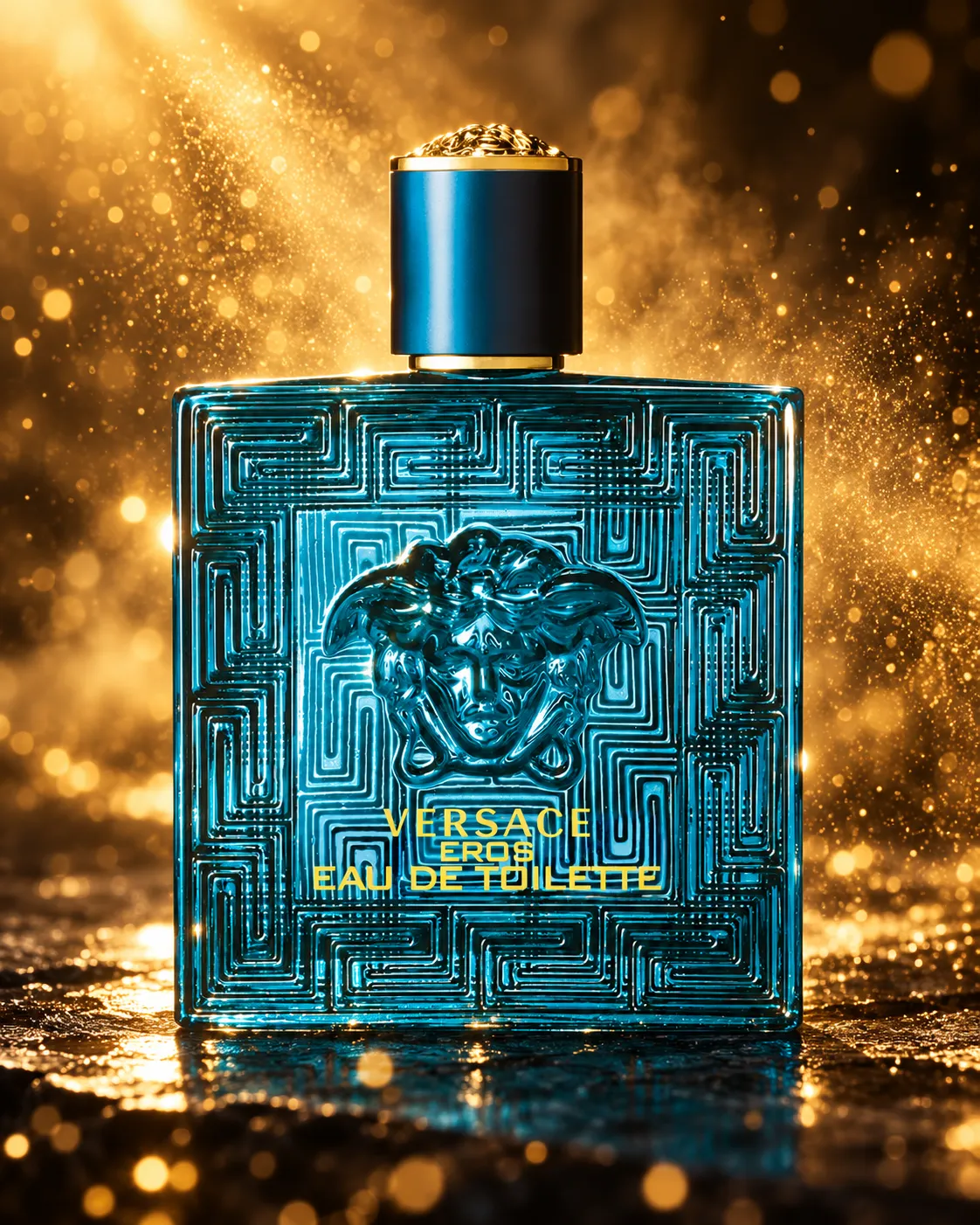
Golden particle mist shot
For a warm, opulent launch, especially an amber, vanilla, or oud fragrance.
"[YOUR PERFUME PHOTO] on a dark surface surrounded by fine floating golden particles catching warm backlight, soft golden haze in the background, shot on 85mm f/2.8 with the bottle sharp and the particles softly glowing, warm luxurious mood, 4:5."
Pro tip: specify "particles catching backlight," not "glitter." Backlit particles read as light and atmosphere; "glitter" tends to render as flat, graphic sprinkles sitting on top of the image instead of floating in the scene.
Backlit smoke trail shot
For a bold, smoky, or woody fragrance where drama matters more than softness.
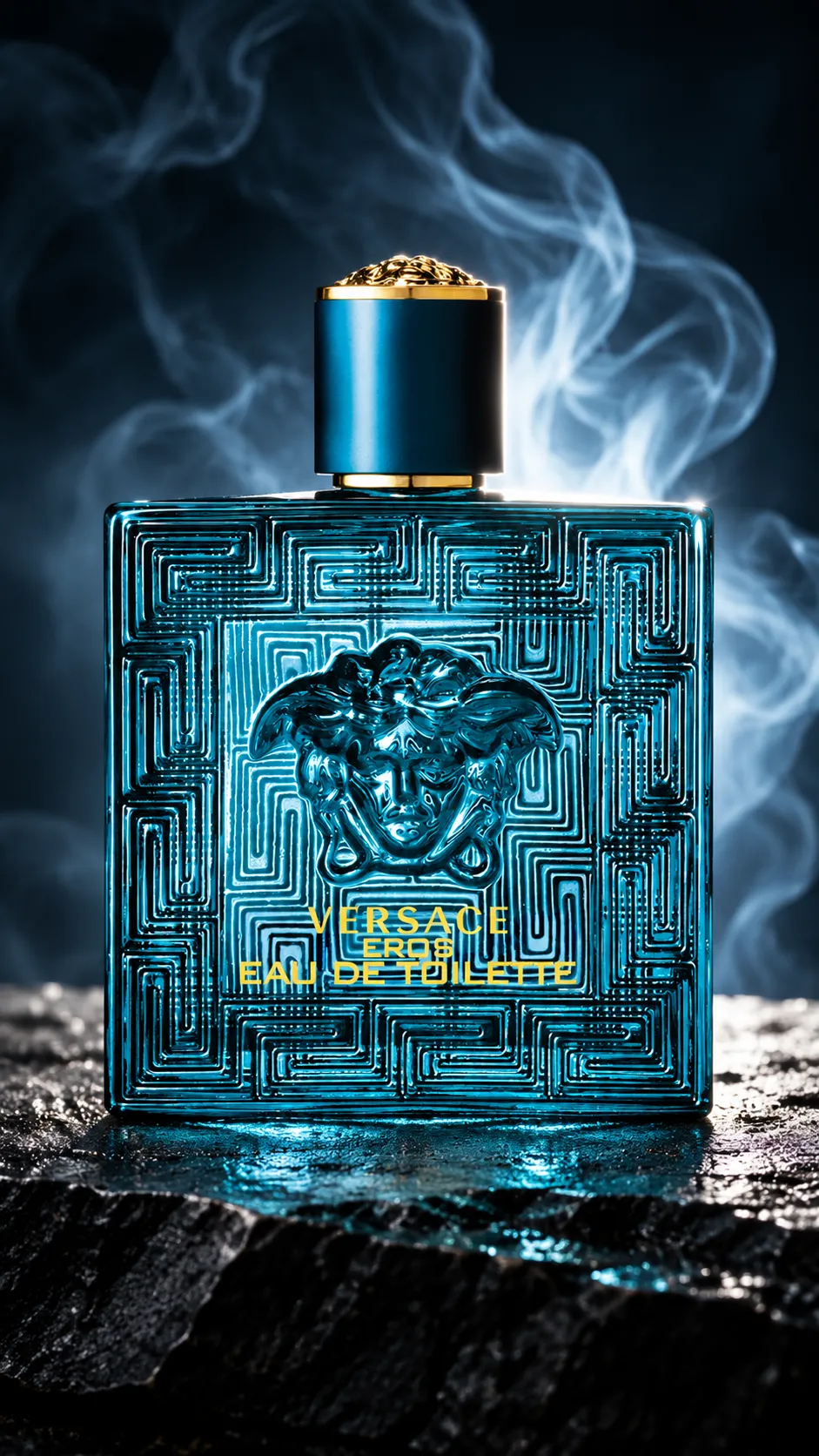
"[YOUR PERFUME PHOTO] on a black stone surface with a thin trail of smoke curling behind it, strong backlight silhouetting the smoke while the bottle stays front-lit, shot on 100mm f/4 with the smoke softly blurred and the bottle in sharp focus, moody dramatic mood, 9:16."
Pro tip: "the bottle stays front-lit" is the key phrase. Without it, a strong backlight meant for the smoke often throws the entire bottle into silhouette, losing the product.
Water droplet splash shot
For a fresh, citrus, or aquatic fragrance, where clarity and motion do the selling.
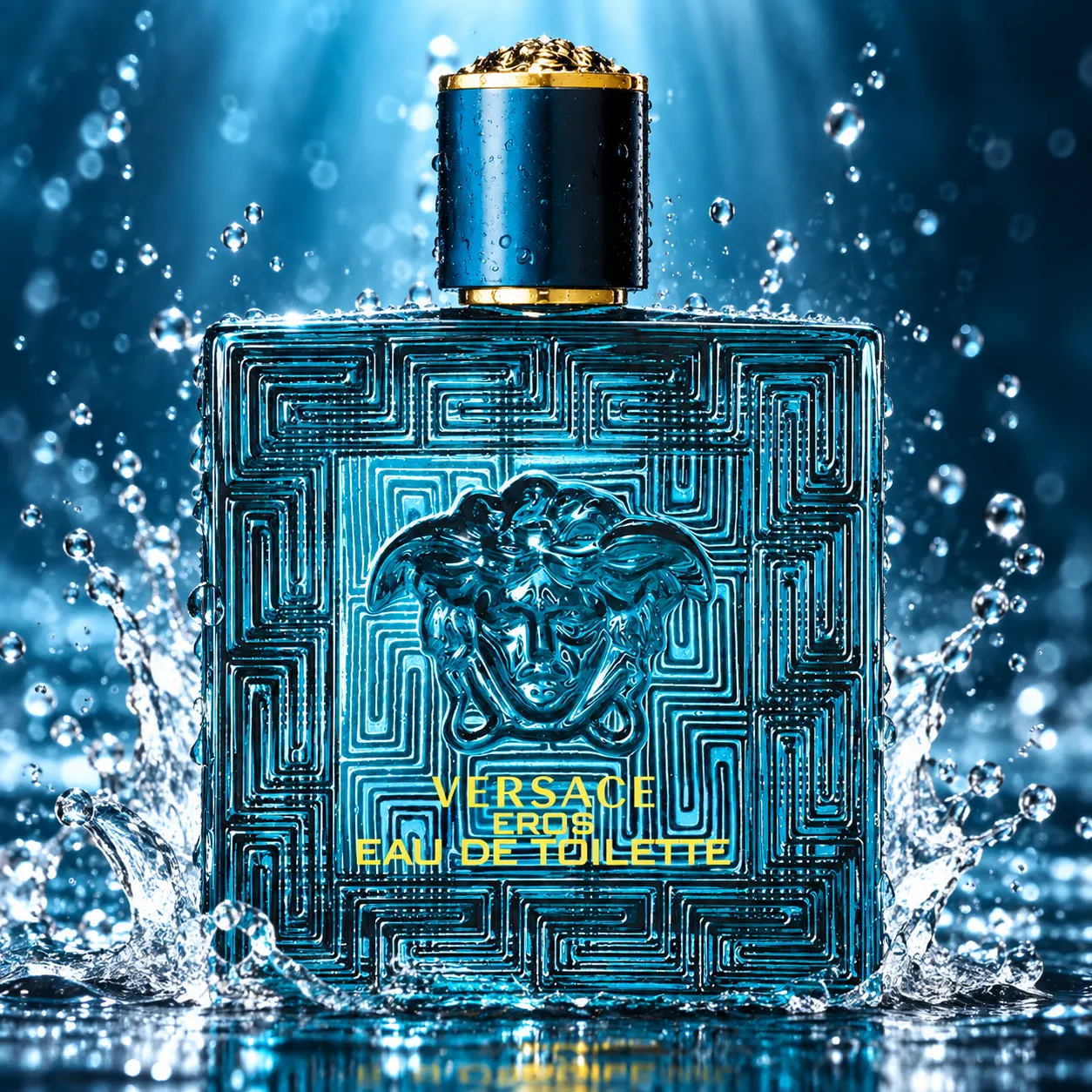
"[YOUR PERFUME PHOTO] with water droplets frozen mid-splash around the base, cool blue-toned lighting from above, shot on 50mm f/4 on a wet reflective glass surface with the splash in sharp focus, crisp fresh mood, 1:1."
Pro tip: "frozen mid-splash" matters because without a frozen-motion cue, water in AI-generated images often renders as a flat, static puddle instead of an actual splash.
Silk fabric drape shot
For a soft, feminine, or floral fragrance where texture carries the mood.
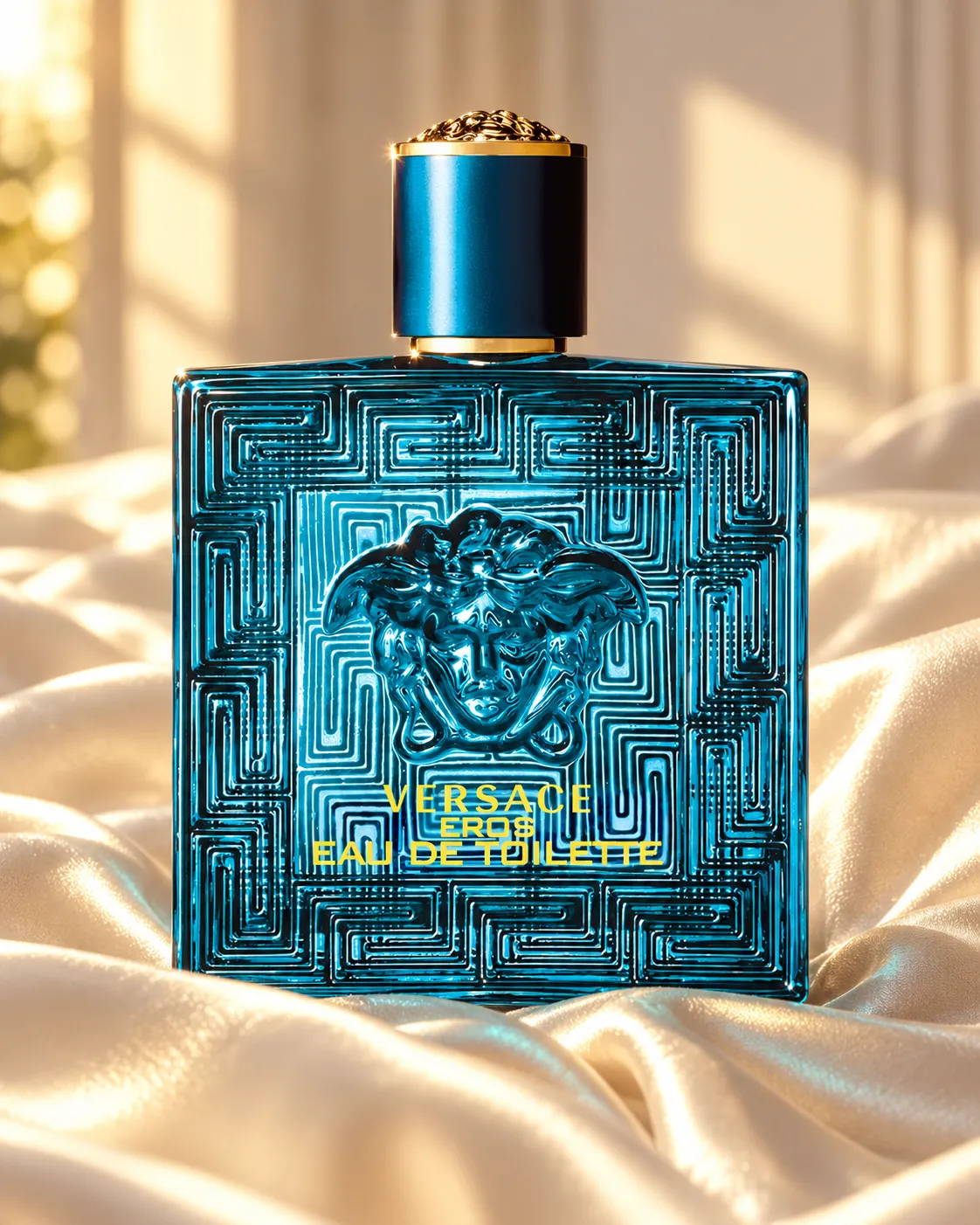
"[YOUR PERFUME PHOTO] resting on draped ivory silk fabric with soft folds catching the light, warm natural window light from the side, shot on 85mm f/2 with the fabric softly blurred behind the sharp bottle, romantic soft mood, 4:5."
Pro tip: "folds catching the light," not just "silk background." Flat, unlit fabric reads as a backdrop; fabric with visible light and shadow in its folds reads as a styled scene.
Lifestyle and vanity shots
These put the bottle into a real moment, which matters for ads where the ritual of wearing a scent sells harder than an isolated product shot.
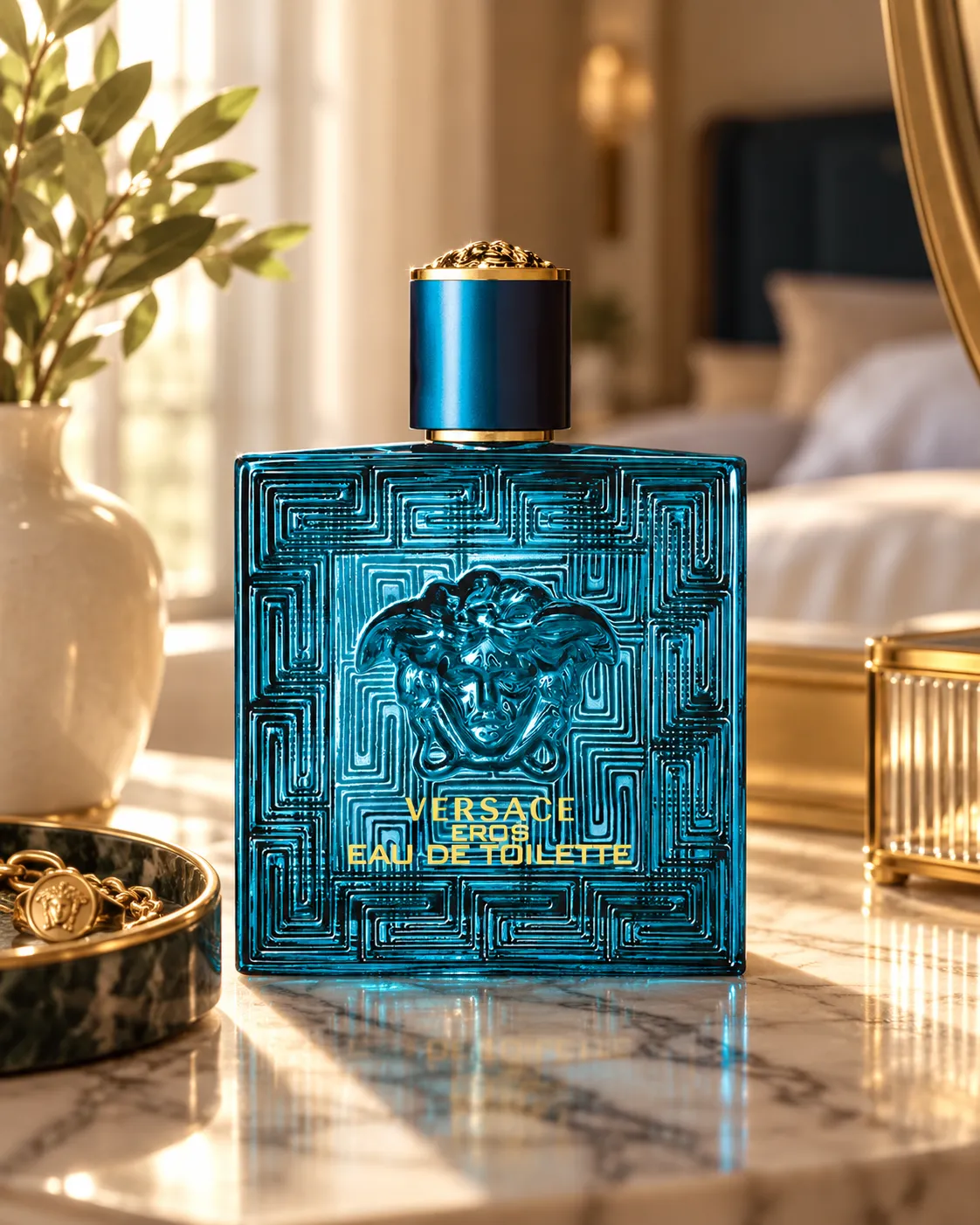
Vanity table morning light shot
For everyday, approachable positioning rather than a prestige launch.
"[YOUR PERFUME PHOTO] on a bedroom vanity table beside a jewelry tray and a small vase of flowers, soft morning window light from the side, shot on 50mm f/2.8 with the bottle sharp and the room softly blurred behind, warm intimate mood, 4:5."
Pro tip: keep the vanity props to two or three items. A cluttered vanity competes with the bottle for attention; a few deliberate props read as styled instead of busy.
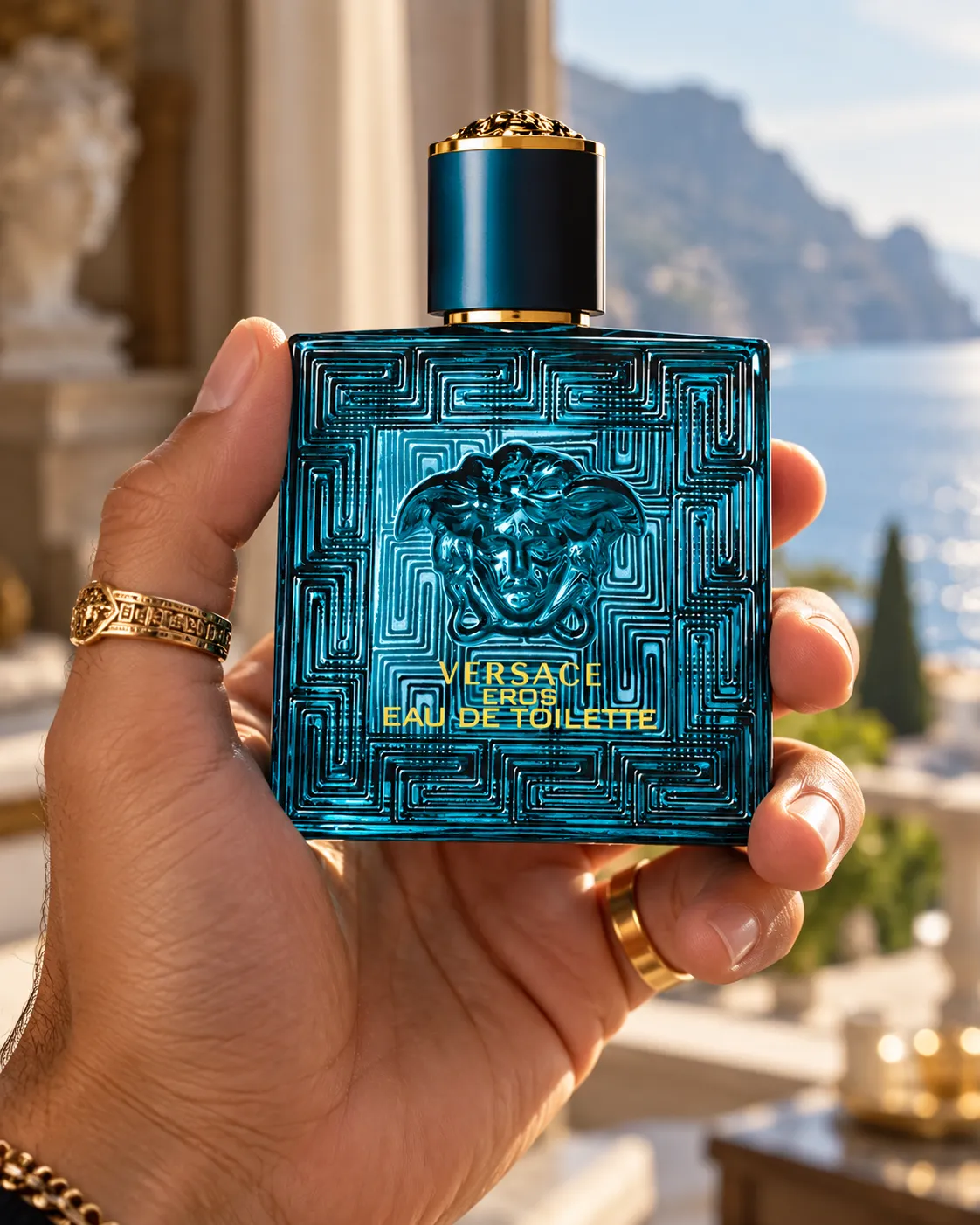
Hand holding bottle close-up
For a personal, intimate feel that a studio shot alone can't carry.
"A hand with delicate gold rings holding [YOUR PERFUME PHOTO] at eye level, soft natural light from the window, shot on 85mm f/2 with the bottle and hand sharp and the background softly blurred, elegant candid mood, 4:5."
Pro tip: specify "a hand," not "a person." Full faces are where AI-generated lifestyle shots most often go wrong; a hand reads as authentic and is far more reliable to generate.
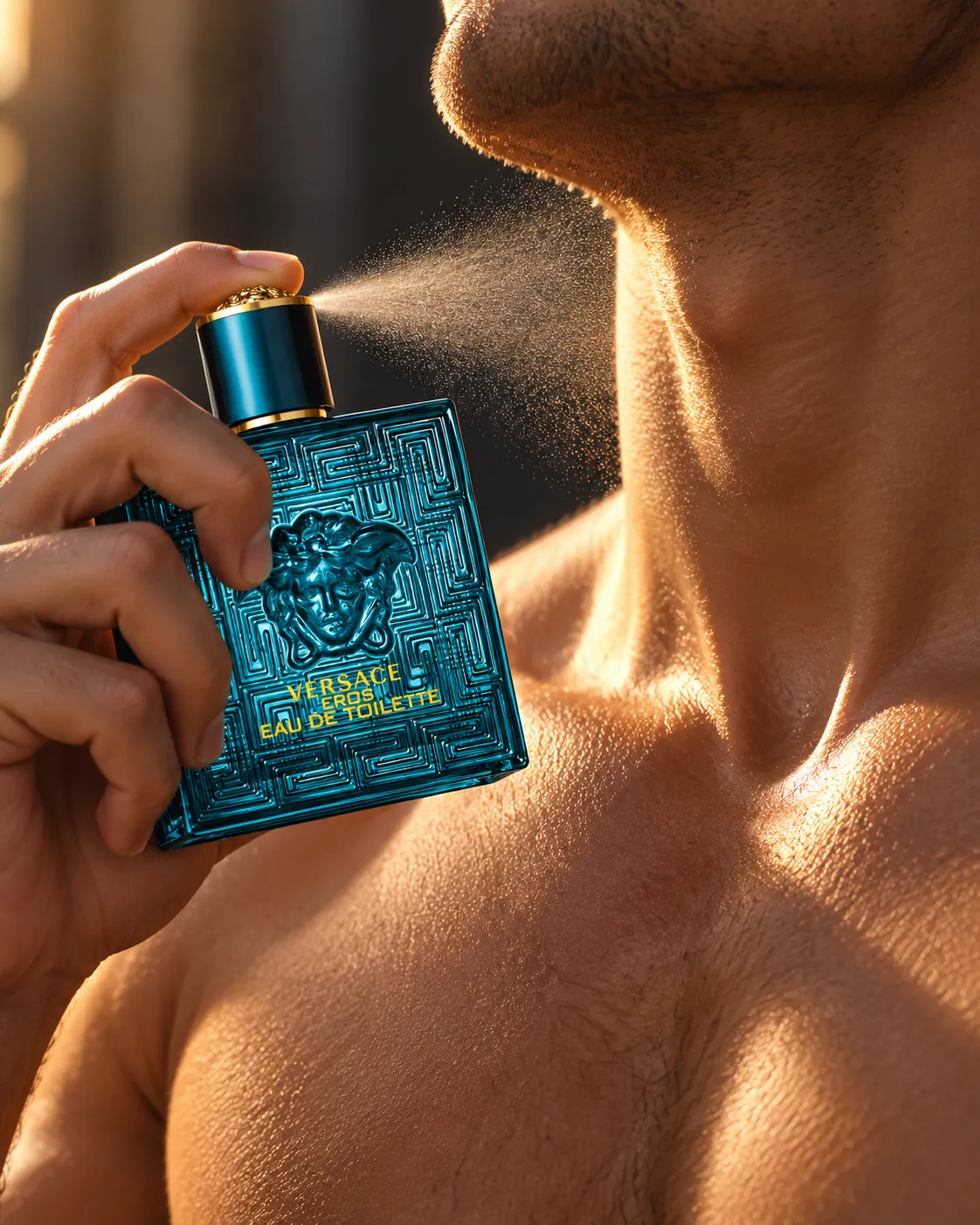
Neck spritz lifestyle shot
For showing the product in actual use, which sells the ritual more than the object.
"Close-up of a hand spraying [YOUR PERFUME PHOTO] near a bare neck and collarbone, soft fine mist visible in the air, warm natural light from the side, shot on 85mm f/2.2 with the bottle and mist sharp, intimate soft mood, 4:5."
Pro tip: crop tight on the neck and collarbone, not the full face. A visible face adds a risk of distorted features; cropping below the chin keeps the shot both safer to generate and more universal for the ad.
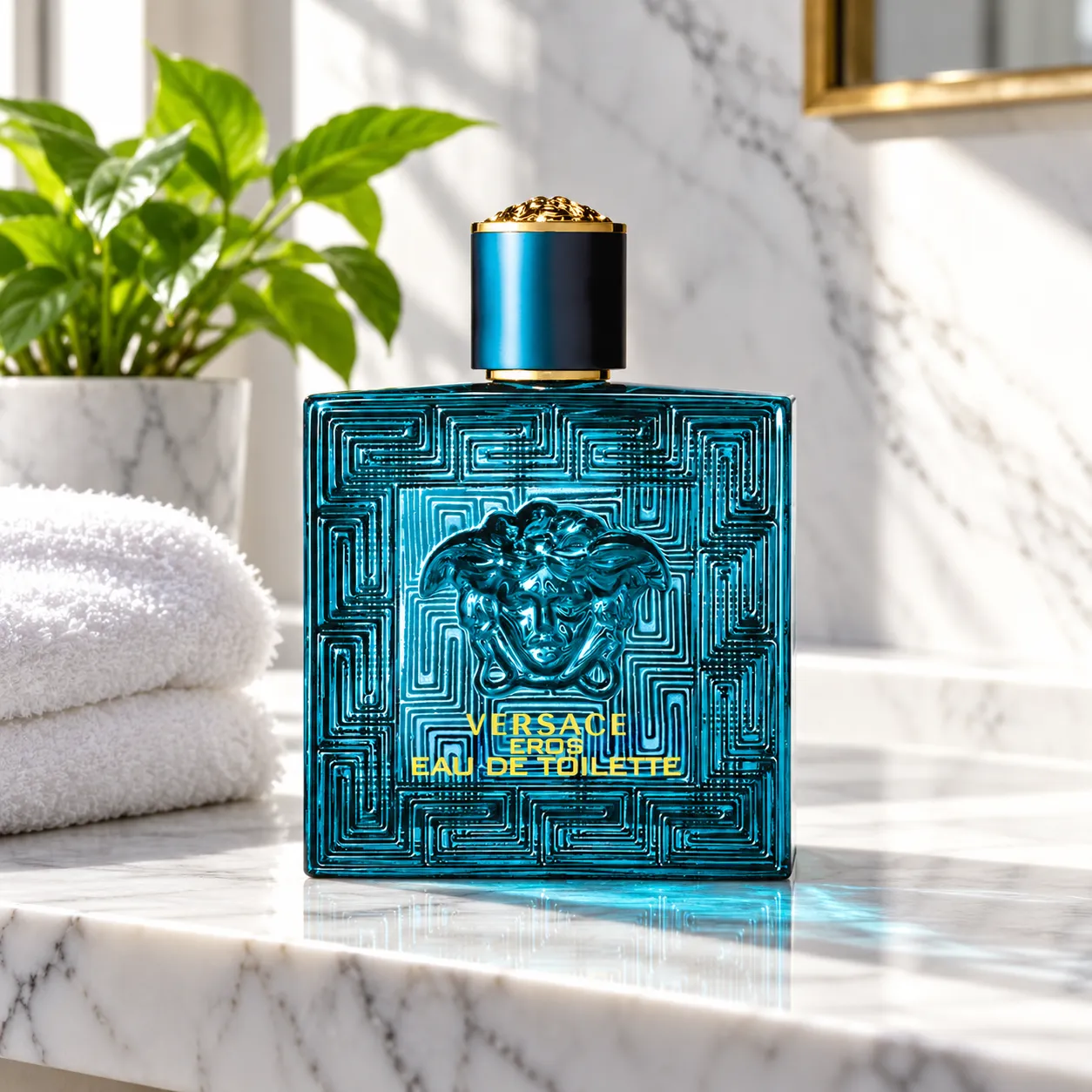
Bathroom shelf styled shot
For a clean, modern, everyday-routine angle.
"[YOUR PERFUME PHOTO] on a white marble bathroom shelf beside a folded white towel and a small green plant, soft bright daylight from a window, shot on 50mm f/4 with the bottle sharp and the shelf in full focus, clean fresh mood, 1:1."
Pro tip: "white marble" and "white towel" together need a light source strong enough to separate them, or the shot reads as one flat white mass. Specify the daylight direction so the shelf has visible shadow depth.
Material and liquid detail shots
These close-ups matter for a fragrance where the bottle design, the cap, or the liquid color itself is part of the pitch, not just the overall silhouette.
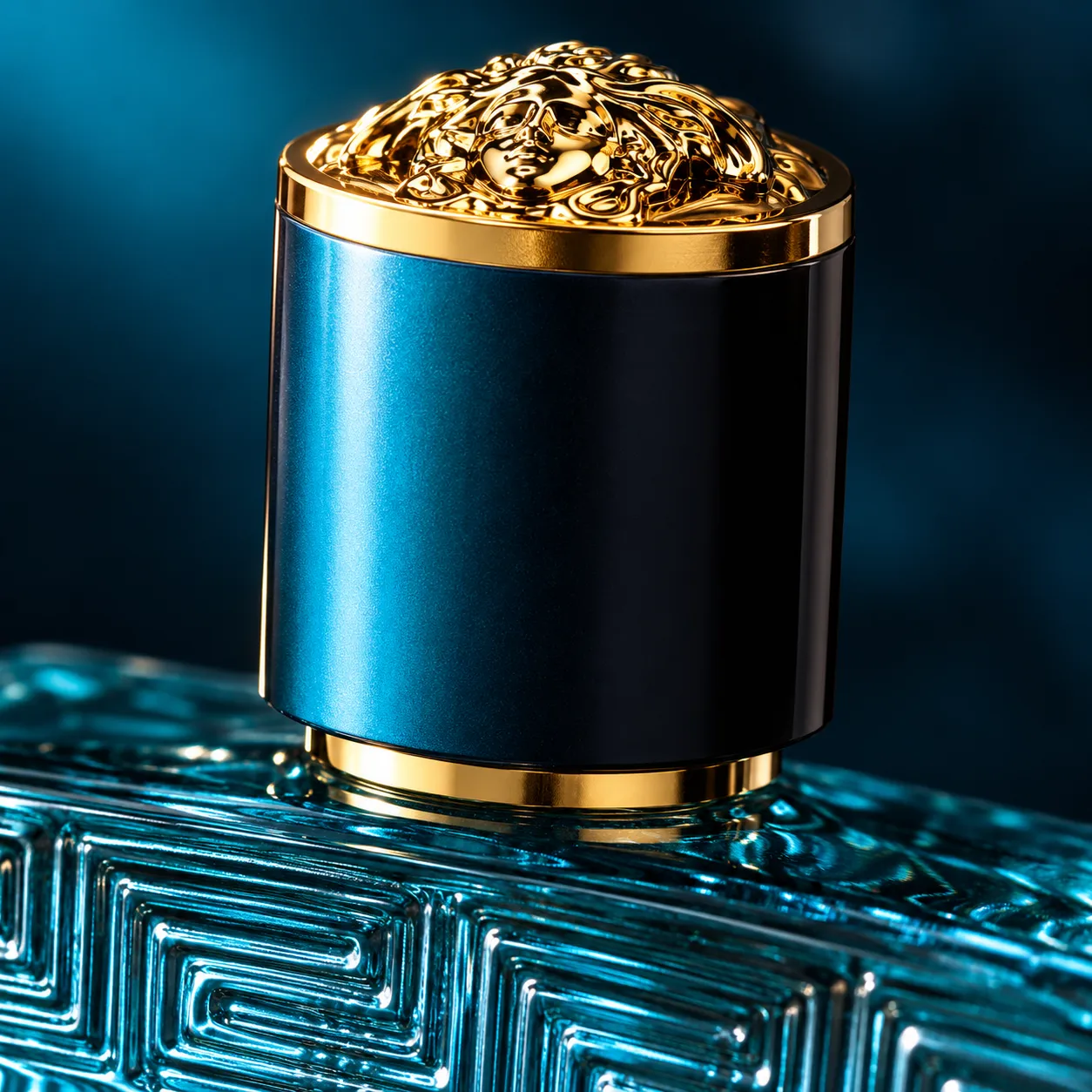
Cap and collar macro shot
For a bottle where the cap design or engraving is a genuine craftsmanship detail.
"Extreme close-up of the cap and collar of [YOUR PERFUME PHOTO], raking side light revealing every engraved detail and metallic finish, shot on 100mm macro f/5.6 with the surface in full sharp focus, rich refined mood, 1:1."
Pro tip: "raking side light," not overhead, is what reveals engraved detail. Light from directly above flattens the exact texture this shot exists to show.
Liquid color refraction shot
For a fragrance where the liquid's own color is distinctive and worth showing on its own.
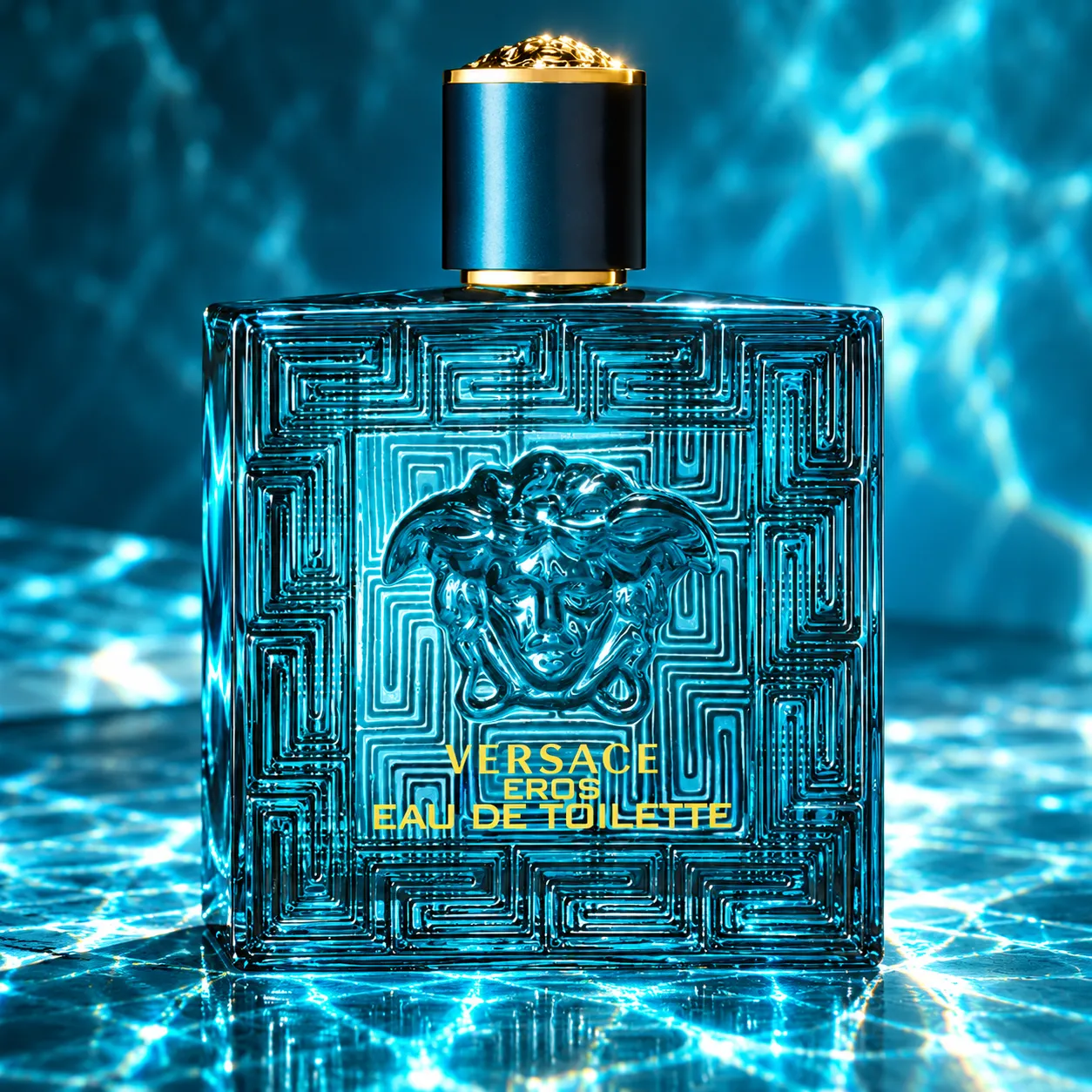
"Macro close-up through the glass of [YOUR PERFUME PHOTO], light passing through the liquid and casting a colored refraction onto the surface below, shot on 90mm macro f/4 with the liquid's color sharp and saturated, rich jewel-toned mood, 1:1."
Pro tip: name the liquid's actual color, such as "amber liquid" or "pale gold liquid." An unnamed liquid tends to render as a generic clear or yellow tint regardless of your real product.
Box and bottle flat lay shot
For showing the full unboxing moment, useful for a gifting or launch-day ad.
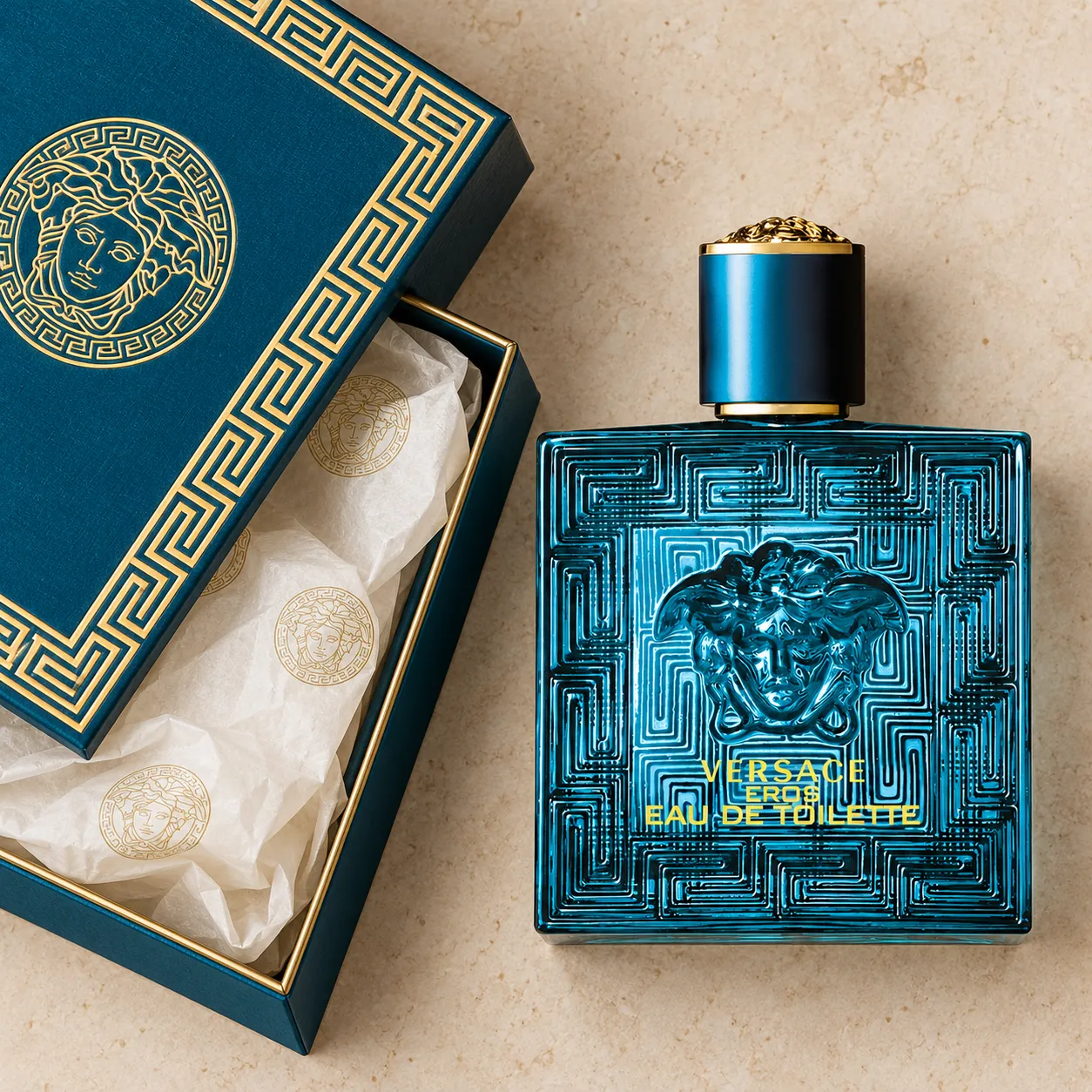
"Overhead flat-lay of [YOUR PERFUME PHOTO] beside its open packaging box and tissue paper, soft even studio lighting from directly above, shot on 50mm f/8 on a neutral beige surface with both the box and bottle in sharp focus, clean editorial mood, 1:1."
Pro tip: "tissue paper," not "crumpled paper." The word choice signals a deliberate unboxing styling rather than a messy pile, which is the difference between this looking gifted versus discarded.
Ingredient botanical pairing shot
For visualizing a specific scent note, such as rose, citrus, or sandalwood, next to the bottle that contains it.
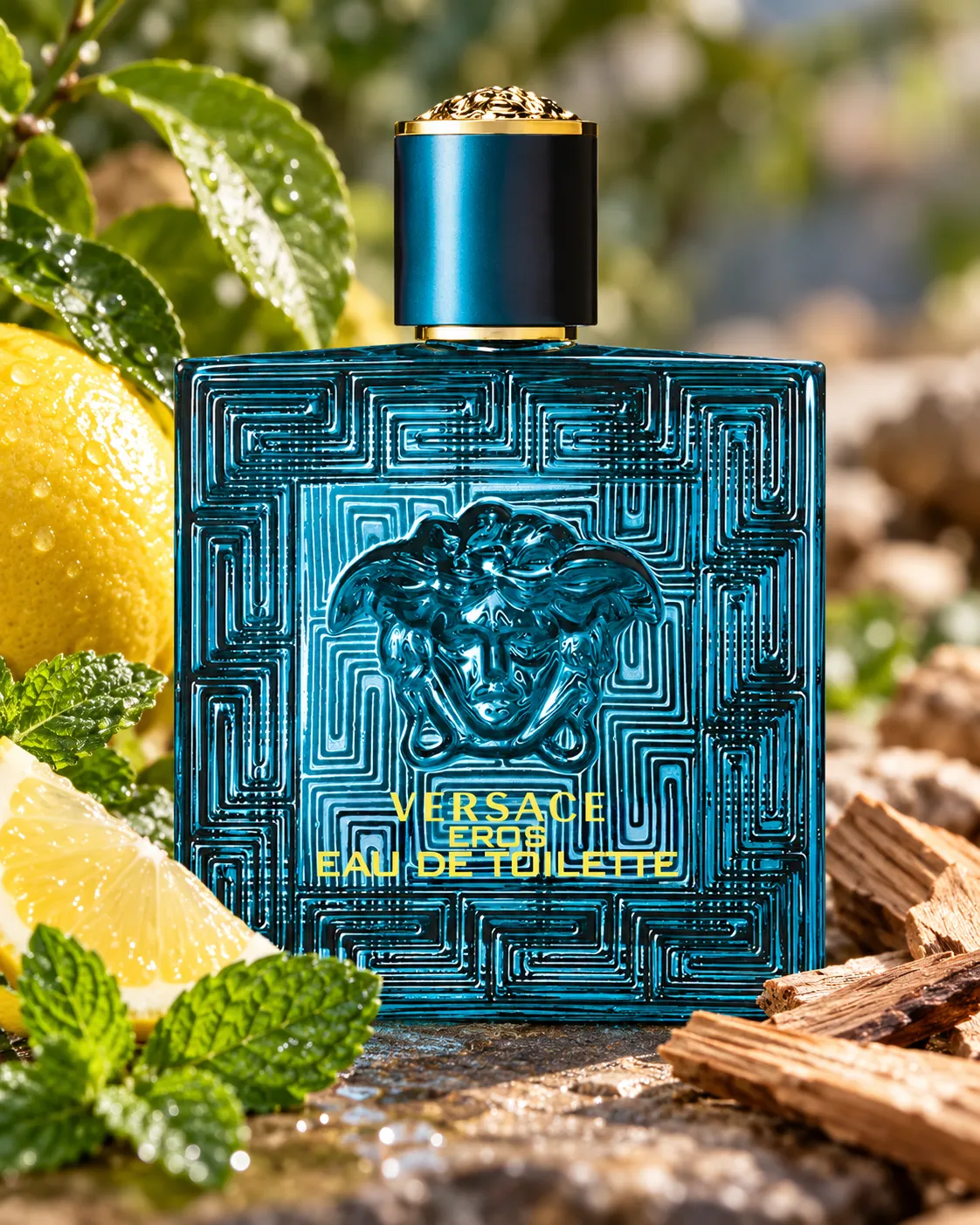
"[YOUR PERFUME PHOTO] placed beside fresh rose petals and a single stem, soft natural light from the side, shot on 85mm f/2.8 with the bottle and nearest petals sharp and the rest softly blurred, romantic natural mood, 4:5."
Pro tip: match the botanical to your actual top or heart note, not a generic flower. A rose beside a citrus-forward fragrance reads as a mismatch to anyone who already knows the scent.
Turning these prompts into finished perfume ads
A single generated image is a photo, not an ad. Running one of the prompts above in AI Ad Prompt gets you the shot and a finished creative with overlay text in the same pass, attach your bottle photo and the prompt text loads straight in.
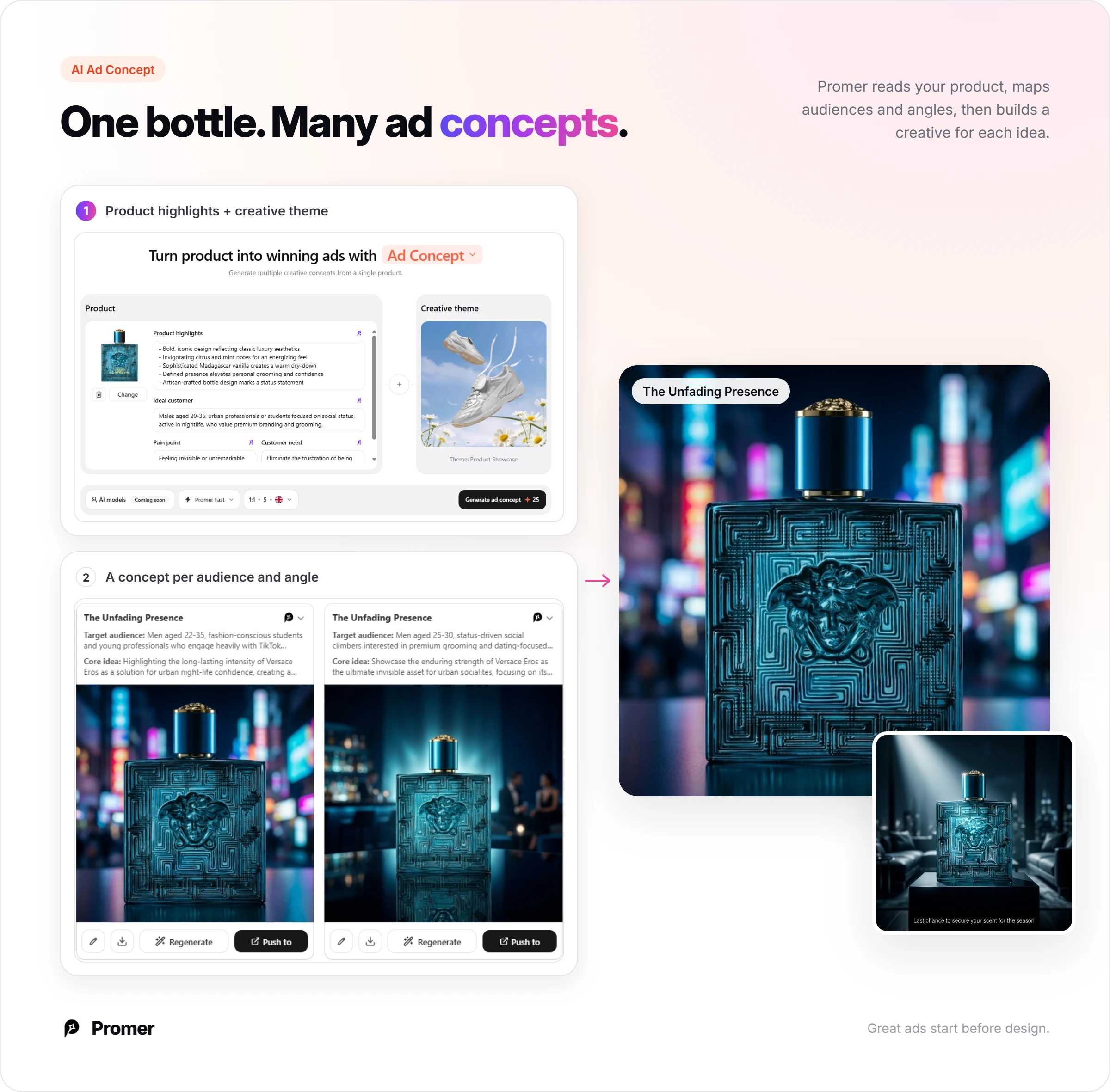
If you'd rather skip prompts entirely, Promer AI's AI Ad Concept reads your bottle and returns several ad concepts built around different audiences and angles in one pass, each with its own creative already generated.
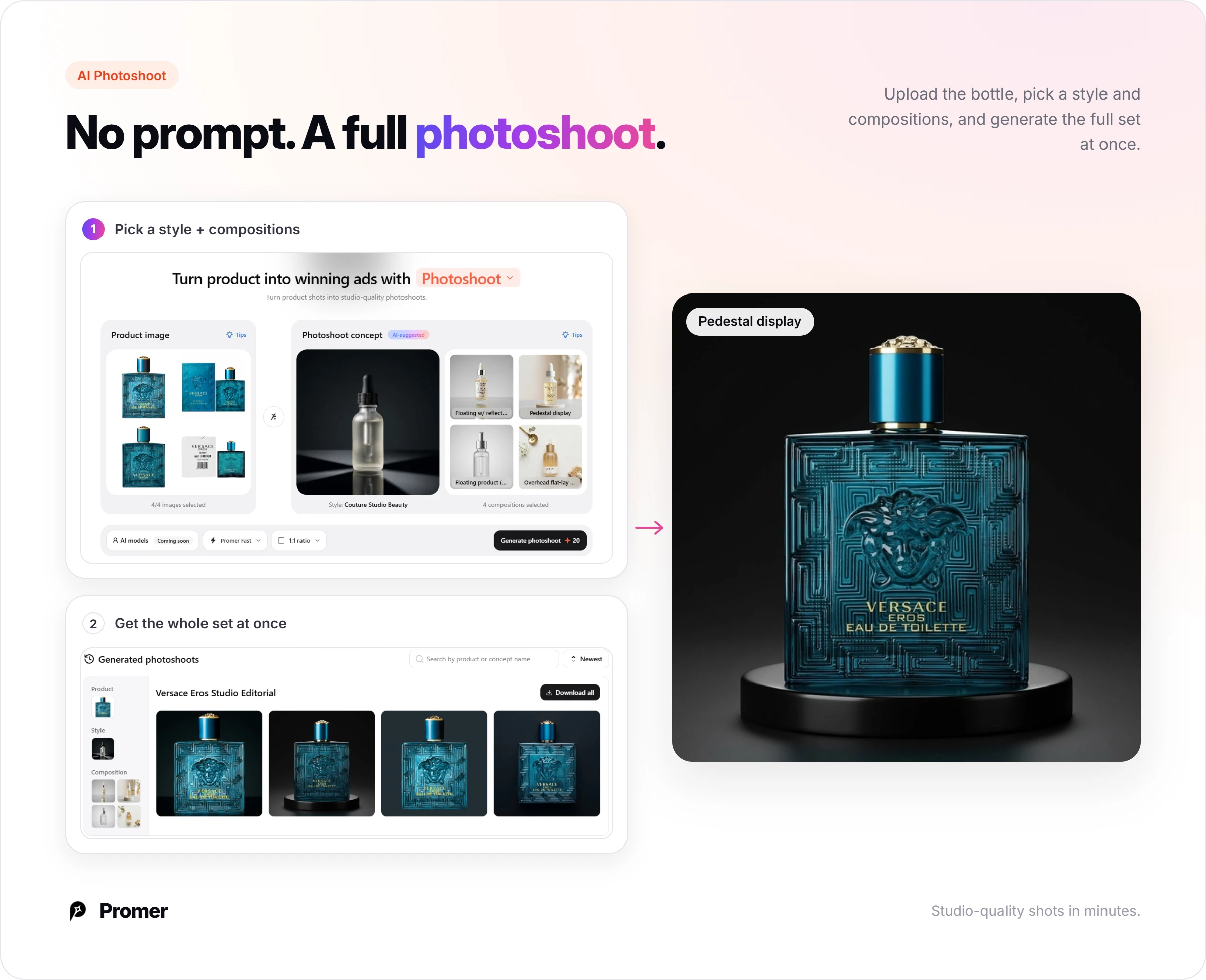
And if you'd rather not write a prompt at all, Promer AI's AI Photoshoot covers the studio and lifestyle shots above without a prompt: upload the bottle, pick a style and composition, and generate the full set at once.
For prompt technique on other product categories, AI product photography prompts covers the same six-part formula applied more broadly.
Once a shot works, Promer AI's AI ad maker can take the same product and turn it into variations without rewriting every prompt by hand.
FAQ
What should a good perfume ad prompt include?
A good perfume ad prompt names your actual bottle photo, a surface or setting, how light hits the glass and liquid, lighting, a mood element, and an aspect ratio. Skipping the glass and liquid behavior is the most common mistake, since an unprompted reflection or an unnamed liquid color is where the model is most likely to drift from your real bottle.
How do I keep the bottle looking like my real product?
Reference your actual bottle photo instead of describing it in words. A text description like "tall glass bottle with a gold cap" leaves the model to invent its own silhouette, cap shape, and label placement. Anchoring to the real image is what keeps the glass shape, cap, and label consistent across every generated shot.
How do I show a scent in an image if you can't see smell?
Use a mood element that stands in for the scent: floating particles, mist, a matching botanical, or styled fabric. An amber or vanilla fragrance pairs with warm golden particles; a citrus or aquatic one pairs with water droplets or cool light; a floral one pairs with the actual flower behind its scent note.
Can I use these prompts for video ads too?
These are written for still images, but the same six-part structure (bottle anchor, surface, glass and liquid behavior, lighting, mood, format) carries over to a video prompt. For motion, add a camera move and a named action, such as a slow push-in or a droplet falling in real time, on top of the same base description.
What aspect ratio should I use for a perfume Facebook or Instagram ad?
Use 1:1 or 4:5 for a Meta feed ad, and 9:16 for Stories or Reels. Match the ratio to the placement before you generate, since cropping a square image into a vertical Reels slot after the fact usually cuts off part of the bottle or cap.