How to Source UGC for Paid Social Ads?
UGC for paid social ads is sourced from three main places: real customers who already created content, paid creators hired specifically to produce customer-style videos, and AI-generated video built to match the same format. Each source trades off differently on cost, control, and legal risk, and most teams that scale UGC production end up combining more than one rather than relying on a single source.
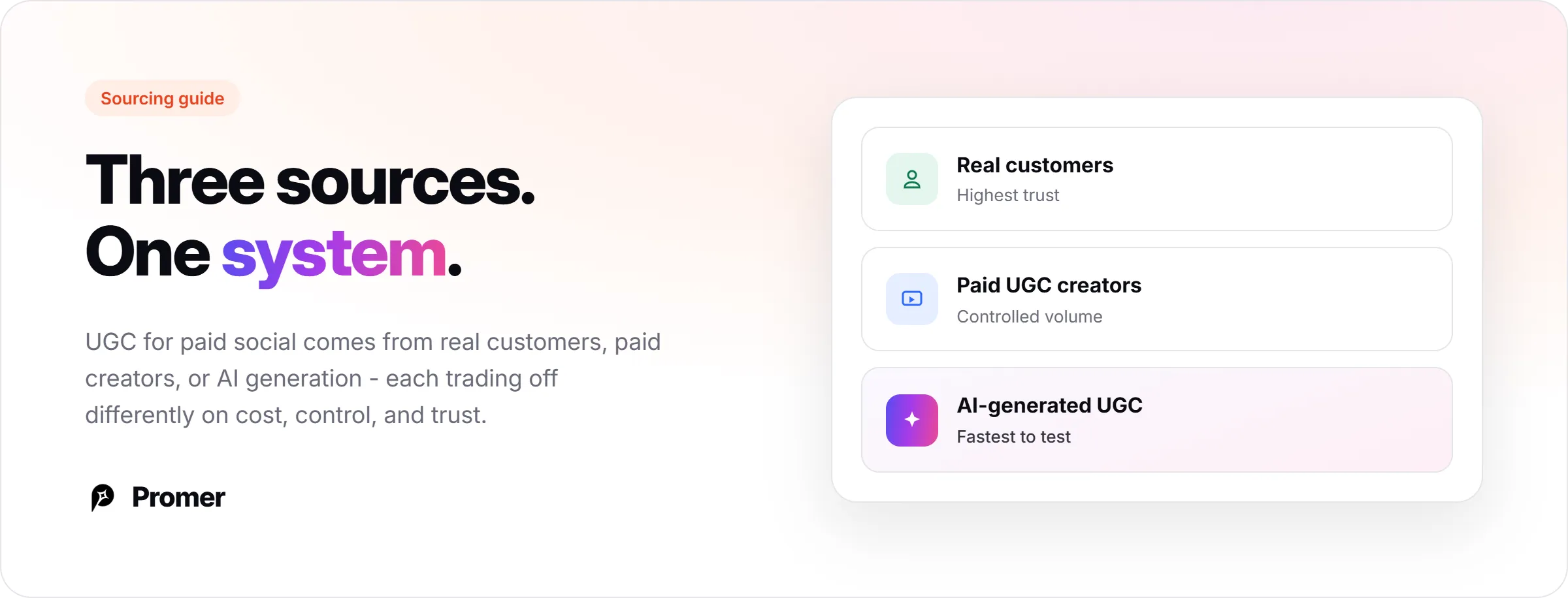
The sourcing decision matters more than it looks like it should, because the source determines what you can control. Real customer content is the highest-trust source but the hardest to brief or direct. Paid creators give structure and consistency but cost more per asset. AI-generated video removes the booking dependency entirely but can't substitute for genuine customer proof when that's specifically what the ad needs to prove.
This article covers each sourcing method, what usage rights actually require before content can run as a paid ad, and how to combine sources into a working system rather than a one-off scramble.
Key Takeaways
- The three main UGC sources for paid ads are real customer content, paid UGC creators, and AI-generated video - each with different cost, control, and trust trade-offs
- Real customer content needs explicit usage rights before it can run as a paid ad, not just permission to repost organically
- Paid usage rights and whitelisting are legally distinct - whitelisting runs ads from the creator's own account, paid usage runs the content from your ad account
- A creator brief that names the hook, the customer situation, and the CTA produces more usable footage than an open-ended request
- Testing multiple sourced hooks at the ad-set level, holding other variables fixed, is what turns sourced UGC into a repeatable system instead of a guess
Source 1: Real Customer Content
Real customer content - reviews, unboxing clips, testimonials someone posted organically - carries the highest inherent trust of any UGC source, since it genuinely is what it appears to be. It's also the hardest source to direct: you can't brief a customer on hook, angle, or structure the way you can a paid creator, and the footage you get is whatever they happened to film.
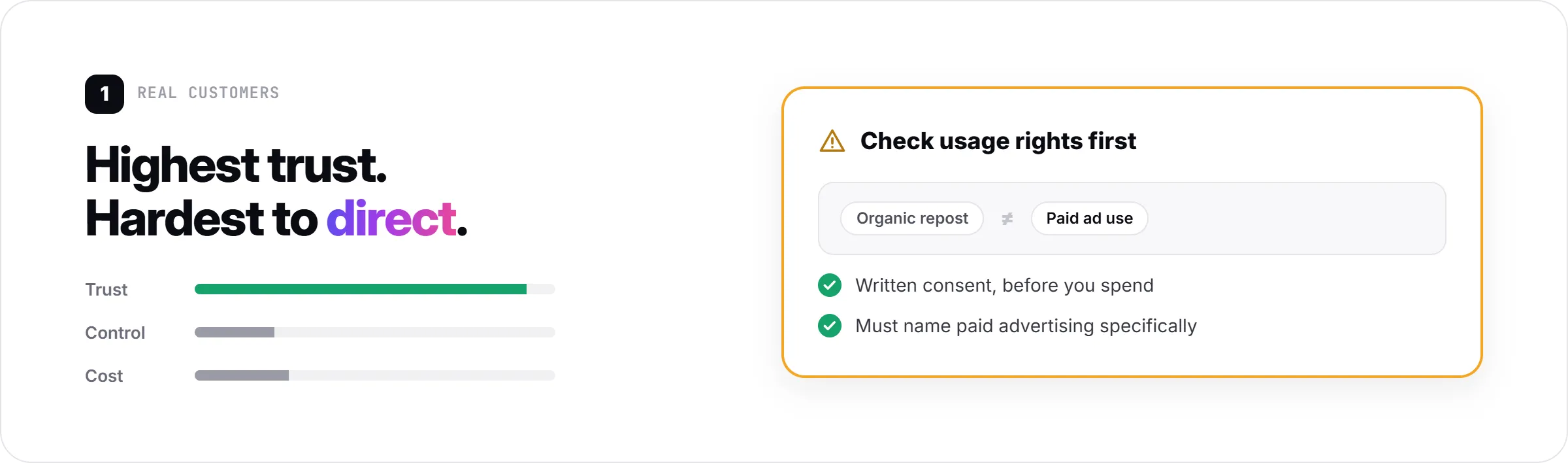
Usage rights are the first thing to check before running customer content as a paid ad. Permission to repost organically on your own social channels is a different, lower tier of right than paid advertising use. Running someone's content as a paid ad without explicit paid-usage permission is a real legal exposure, not a formality - always get direct, written consent that specifically names paid advertising use before spending against a customer's content.
Quality is the other constraint. Customer-shot footage varies wildly in lighting, audio, and framing, and very little of it arrives ready to run as-is. Real customer content tends to work best for organic social proof, website testimonial sections, and occasional paid spots where the "this is genuinely unscripted" quality is the entire point - not as the primary volume source for ongoing paid testing.
Source 2: Paid UGC Creators
Paid UGC creators are people hired specifically to produce customer-style content on commission. They're not influencers with a large following - they're hired for their ability to deliver an authentic-feeling video on a brief, which gives far more control over structure while keeping the UGC aesthetic intact.
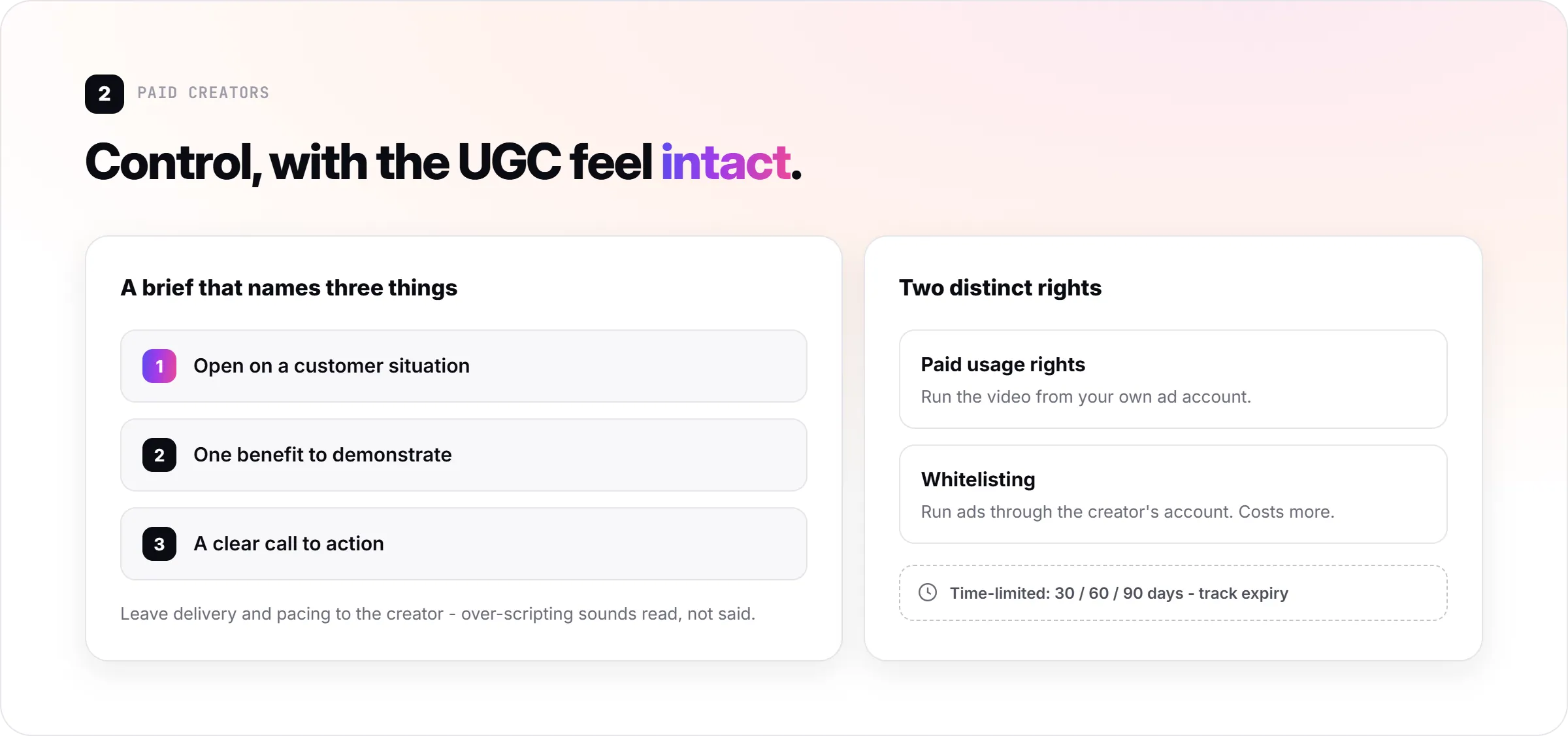
A useful brief for a paid creator names three things: the specific customer situation or problem the video should open with, the single benefit or transformation the product should demonstrate, and the call to action. Leaving room for the creator's natural delivery and pacing matters as much as the brief itself - over-scripting a creator so tightly that it sounds read rather than said undermines the exact quality that makes UGC work.
Vetting matters more than follower count. What separates a creator worth rebooking from one worth cutting is product-category fluency (does this person look like they'd actually use this product), natural on-camera pacing, and the ability to follow a brief without sounding robotic. Testing a new creator on a small budget before committing to a larger booking is the standard way to find out.
Whitelisting and paid usage rights are legally distinct arrangements, and mixing them up in a contract causes real problems later. Paid usage rights let you run the creator's video as an ad from your own ad account. Whitelisting (sometimes called Spark Ads access on TikTok) lets you run ads through the creator's account directly, which requires separate platform-level access and typically costs more. Both are usually time-limited - 30, 60, or 90-day windows are standard - so track expiration dates against your campaign flight dates, since a license that lapses mid-flight can pull a live ad without warning.
Source 3: AI-Generated UGC
AI-generated UGC removes the sourcing dependency entirely: instead of finding, briefing, and waiting on a person, an AI model (avatar) and AI voice generate the video directly from a product input. What is AI UGC covers how this production method actually works in more depth.
This source solves a different problem than the first two. Real customer content and paid creators both depend on finding the right person and waiting for delivery, which caps how many variations you can realistically test in a given cycle. AI generation skips that step, so testing five hooks doesn't mean five separate bookings - it means five generation runs in the same session.
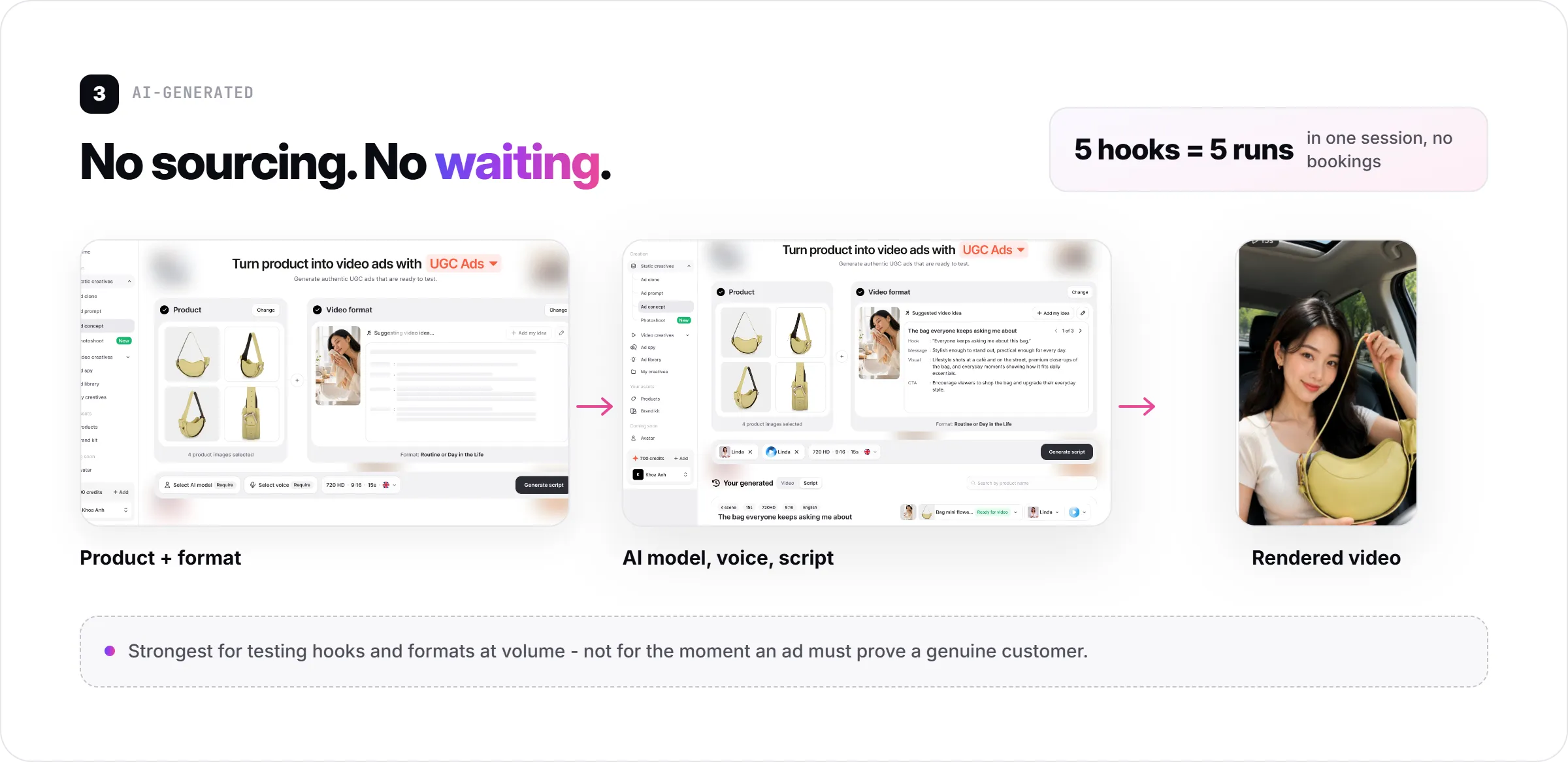
Promer AI's UGC Ads flow works this way: select a product, choose a format such as Direct Testimonial or Problem and Solution, and the AI suggests a hook and script to generate a video from, complete with an AI model and voice, without sourcing or briefing a real person. How to make AI UGC videos walks through this process step by step.
The trade-off is the same one AI UGC always carries: it doesn't replace the specific trust signal of a genuine customer, so it's a stronger fit for testing hooks and formats at volume than for the moments where the entire point of the ad is proving real customer experience.
Building a Sourcing Mix Instead of Picking One Source
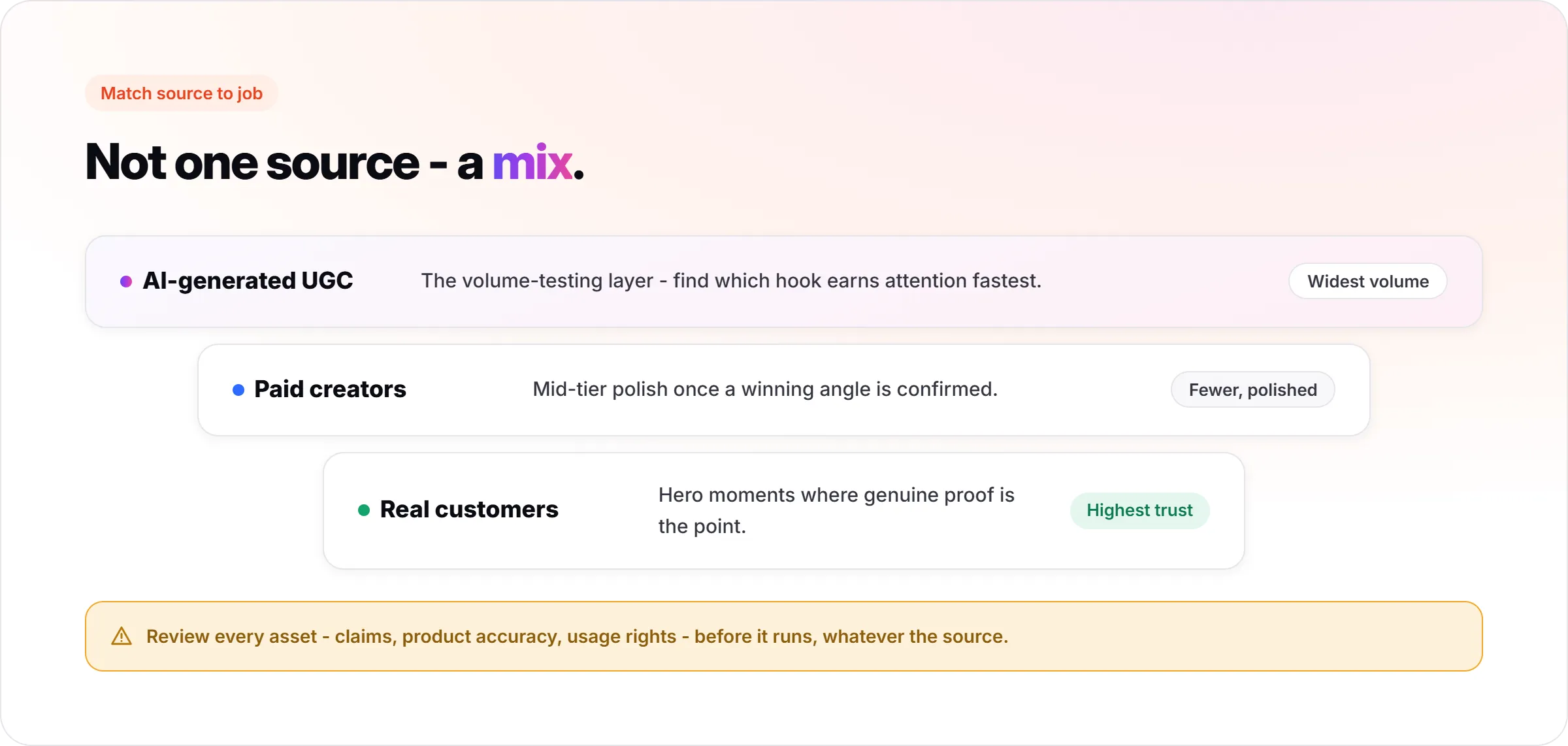
Most teams that scale UGC production successfully don't rely on a single source - they match the source to the job. AI-generated video handles the volume-testing layer, where the goal is finding which hook or angle earns attention fastest.
Paid creators handle the mid-tier production once a winning angle is confirmed, giving it more polish and a consistent presenter.
Real customer content gets reserved for the specific moments - a hero testimonial, a launch campaign - where genuine, verifiable customer experience is the actual selling point.
Testing sourced UGC works the same way regardless of where it came from: launch new material at the ad-set level so performance reads cleanly, and test multiple hooks from the same source before judging whether that source is working, since the hook usually drives more performance variance than the source itself. Ad creative testing covers the testing discipline that applies once content is sourced and ready to run.
Whichever mix you land on, review every asset - claims, product accuracy, usage rights - before it runs as a live ad. This matters across all three sources, not just AI-generated content: a customer's offhand claim, a creator's paraphrased benefit, or an AI-generated line can all misstate something about the product if nobody checks before it goes live.
An AI ad generator that handles the volume-testing layer directly can free up creator budget for the fewer, higher-stakes assets that need a real person's trust signal.
FAQs about Sourcing UGC for Paid Ads
Where do most brands actually get UGC for paid ads?
Most brands combine sources rather than relying on one. Real customer content, paid UGC creators found through marketplaces or direct outreach, and increasingly AI-generated video each fill a different role - real customer content for authenticity-driven moments, paid creators for controlled volume, and AI generation for fast hook and format testing.
Relying on a single source usually means either paying too much for volume (creators alone) or lacking the trust signal certain campaigns need (AI alone).
Do I need permission to use a customer's content in a paid ad?
Yes, and it needs to specifically cover paid advertising use, not just organic reposting. A customer tagging your brand or leaving a review doesn't automatically grant paid usage rights - get explicit, written consent that names paid ads specifically before spending budget against their content.
This is a common and expensive mistake: assuming permission to repost organically extends to running the same content as a paid ad. It doesn't, and platforms and legal teams treat the two very differently.
What's the difference between whitelisting and paid usage rights?
Paid usage rights let you run a creator's content as an ad from your own account. Whitelisting lets you run ads through the creator's account directly, which requires platform-level access the creator grants separately and typically costs more than standard paid usage rights.
Both are usually time-limited, so track expiration dates against your campaign schedule - a lapsed license can pull a live, spending ad with no warning.
How much does UGC content cost to source?
Cost varies widely by creator experience, video length, and whether paid usage rights or whitelisting are included, so there's no single number that applies across the board. Paid usage rights typically add a percentage on top of the base creation fee, commonly cited in the 20-50% range, while whitelisting costs more again since it grants account-level access.
AI-generated UGC shifts this cost structure - instead of paying per creator booking, cost is tied to tool access, which usually makes testing several variations cheaper than booking several creators for the same test.
How do I brief a UGC creator so the footage is usable?
A workable brief names the specific customer situation or problem to open with, the single benefit the video needs to demonstrate, and the call to action - then leaves the delivery and pacing to the creator rather than scripting every line. Over-scripting is one of the most common reasons creator footage ends up sounding like an ad instead of a customer.
Reviewing a creator's past work for natural pacing and product-category fit before booking is more predictive of usable footage than follower count or portfolio polish alone.
Should I use AI-generated UGC instead of real creators?
Not instead of - alongside, depending on what the specific ad needs to do. AI-generated UGC is strongest for testing multiple hooks and formats quickly, since it removes the booking and filming dependency. Real creators and customer content still carry more weight when the ad's entire job is proving genuine customer trust.
Many teams use AI generation to find a winning hook cheaply, then reserve a real creator booking for the format that's already shown it works, rather than treating the choice as either-or.