UGC for Instagram Ads: Placements, Specs & Best Practices
Category
Blogs
Date
Authored by
Promer Team
Summary
UGC for Instagram Ads turns testimonials, demos, unboxings, and product shots into authentic paid creative that captures attention and drives results.
UGC for Instagram Ads: Placements, Specs & Best Practices
UGC for Instagram ads means running customer-style content - testimonials, demos, unboxings, in-context product shots - as paid creative on a visually driven platform where produced brand ads compete directly against organic-feeling posts for the same attention.
Instagram's entire feed, Explore grid, and Reels tab reward content that looks native to what's already there, which makes the gap between a ad and a polished commercial more visible than on almost any other platform.
The mechanics of running the ad don't change - it's still targeting, bidding, and placement through Meta's ad system. What changes is which creative format earns attention inside that system, and Instagram's specific mix of placements (Feed, Stories, Reels, Carousel, Explore) each reward a slightly different cut of the same underlying content.
This article covers why UGC performs well on Instagram specifically, the placement specs that matter, where the content comes from, and how to produce it without treating every placement as an afterthought of one master asset.
Key Takeaways
Instagram's visual-first, feed-native format makes the contrast between UGC-style ads and produced commercials more pronounced than on other platforms
Instagram has placements relevant to UGC ads across Feed, Stories, Reels, and Carousel, each with its own aspect ratio and pacing expectations - Explore's standalone feed was retired in early 2026, with that traffic folded into Reels
Carousel ads are a bigger part of Instagram's UGC playbook than on most platforms, since they let multiple product angles or a short sequence run as one ad unit
UGC content for Instagram ads comes from real customers, paid creators, or AI-generated video, the same three sources used across any platform
Matching format to placement, not exporting one asset everywhere, is what prevents cropping and letterboxing that quietly hurts delivery
Why UGC Performs Well on Instagram?
Instagram was built as a visual-first platform from the start, which means its users have a more developed sense of what "native" content looks like than users on platforms that grew out of text or link-sharing.
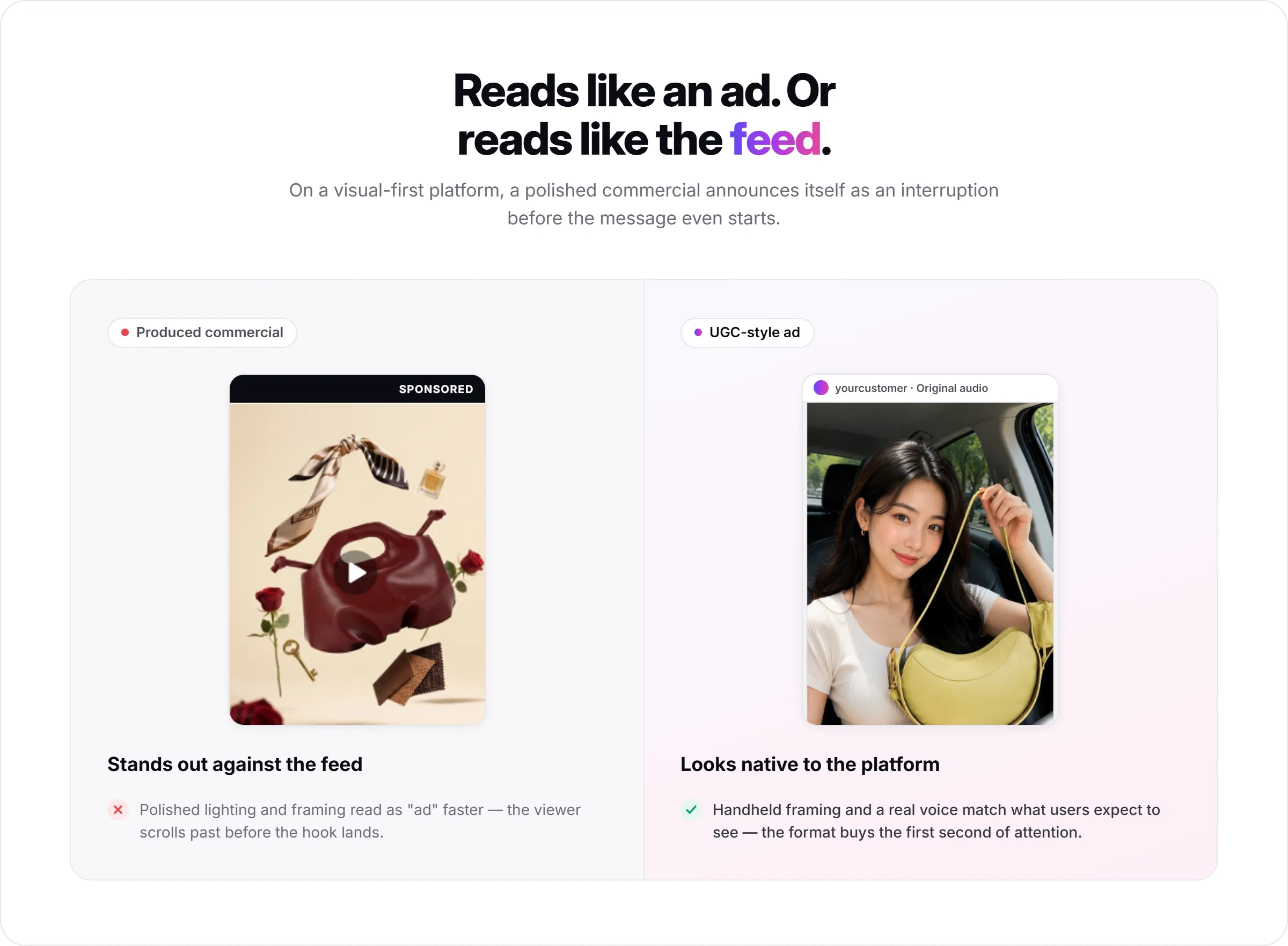
A produced commercial stands out immediately against a feed of phone-shot photos and casual video, and that contrast reads as "ad" faster than it would elsewhere.
The same underlying logic applies to UGC Facebook ads, though Instagram's more visual-first user base tends to make the contrast even sharper.
This works in UGC's favor specifically because the format - handheld framing, natural lighting, a real voice talking directly to camera - already matches what the platform's users expect to see. The ad doesn't have to work as hard to earn the first second of attention, since it isn't visually announcing itself as an interruption before the message even starts.
The tradeoff is that Instagram's audience has also gotten better at recognizing UGC-style ads as ads over time, simply from repeated exposure to the format. This doesn't erase the advantage, but it raises the bar on what makes a UGC ad actually work: the hook and the specific claim still have to earn attention, since the format alone no longer guarantees it did in the format's earlier years.
Instagram UGC Ad Placements and Specs
Getting the right cut for each placement matters more on Instagram than it might seem, since a mismatched aspect ratio gets cropped or letterboxed in ways that can cut off a face, a product, or on-screen text.
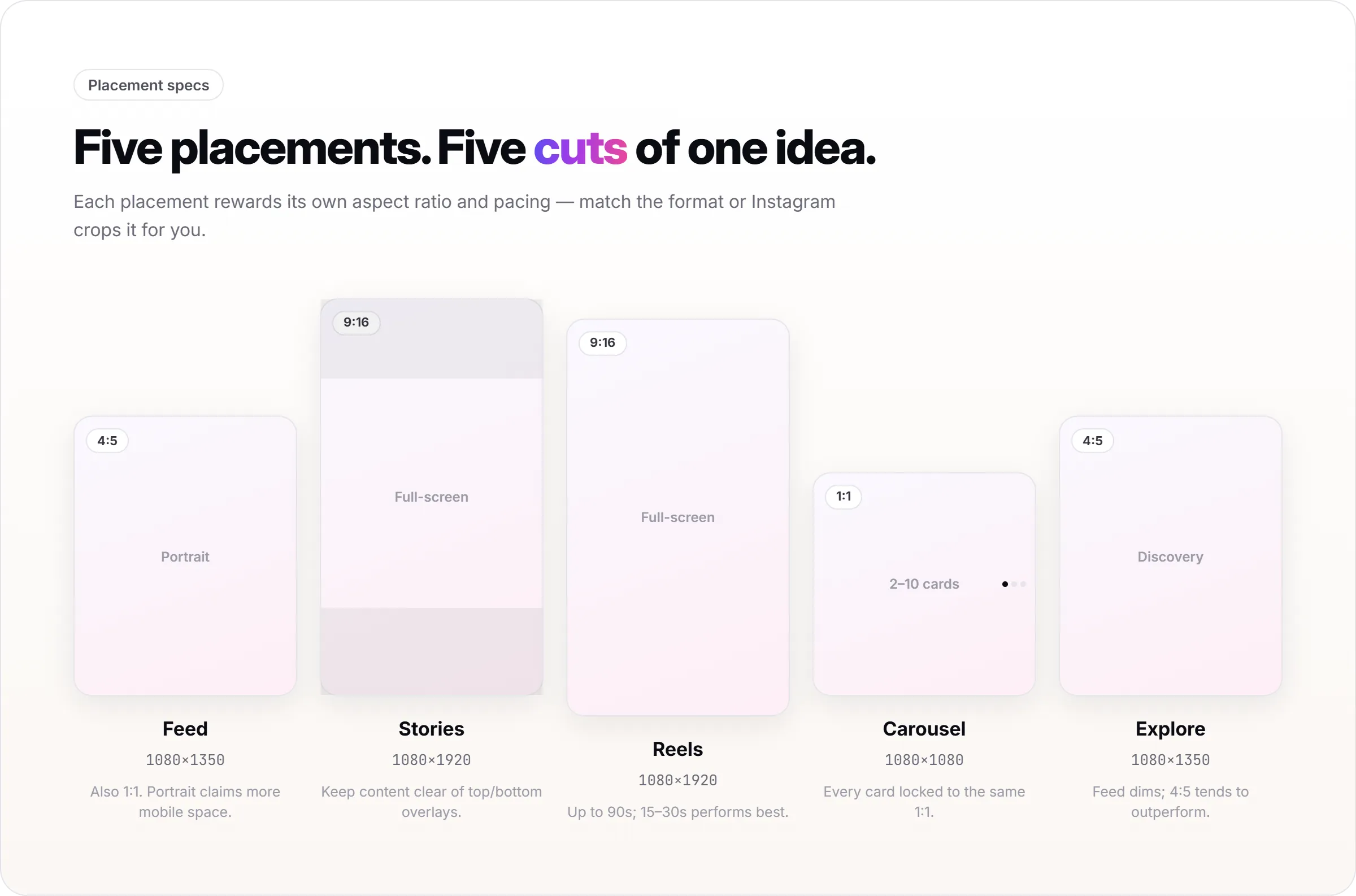
Feed. Supports 1:1 (1080x1080px) and 4:5 (1080x1350px). The 4:5 portrait ratio is generally the stronger default, since it claims more vertical screen space on mobile, where most Instagram impressions happen.
Stories. Full-screen vertical only - 9:16 at 1080x1920px. Keep key content out of the top ~250px and bottom ~340px, since profile info and the CTA button overlay those zones. Stories reward a fast hook and a short runtime, since the format is built for quick swipe-through browsing.
Reels. Also 9:16 at 1080x1920px, with more room to run - up to 90 seconds, though 15-30 seconds tends to be the stronger-performing range. Reels viewers are in a more sustained-watching mindset than Stories viewers, so a slightly slower build can work here where it wouldn't in Stories.
Carousel. Locked to 1:1 (1080x1080px) per card, 2 to 10 cards, all sharing the same aspect ratio. This placement is a bigger part of the UGC playbook on Instagram than on most platforms, since it lets a brand show multiple product angles, a short before-and-after sequence, or a step-by-step demo as one scrollable ad unit rather than a single clip.
Explore. As of early 2026, the standalone scrollable Explore feed was retired, with that traffic now folded into Reels. Explore Home - the grid-tile layout reached from the Explore tab - is still live and uses Feed dimensions (1:1, 1080x1080px). Check current placement options before planning a dedicated Explore asset, since Meta continues to consolidate surfaces.
Repurposing one Feed-cut asset across every placement is one of the more common ways a solid UGC ad underperforms for reasons that have nothing to do with the creative itself. A carousel card built at 4:5 gets cropped to 1:1 automatically, cutting real estate from the top and bottom of the frame. Building the core script once, then producing a dedicated cut per placement, avoids this without requiring a full separate shoot for each one.
Where UGC Content for Instagram Ads Comes From?
The sourcing question is the same across any platform running UGC-style ads - Instagram doesn't change where the content originates, only how it needs to be formatted once it's ready.
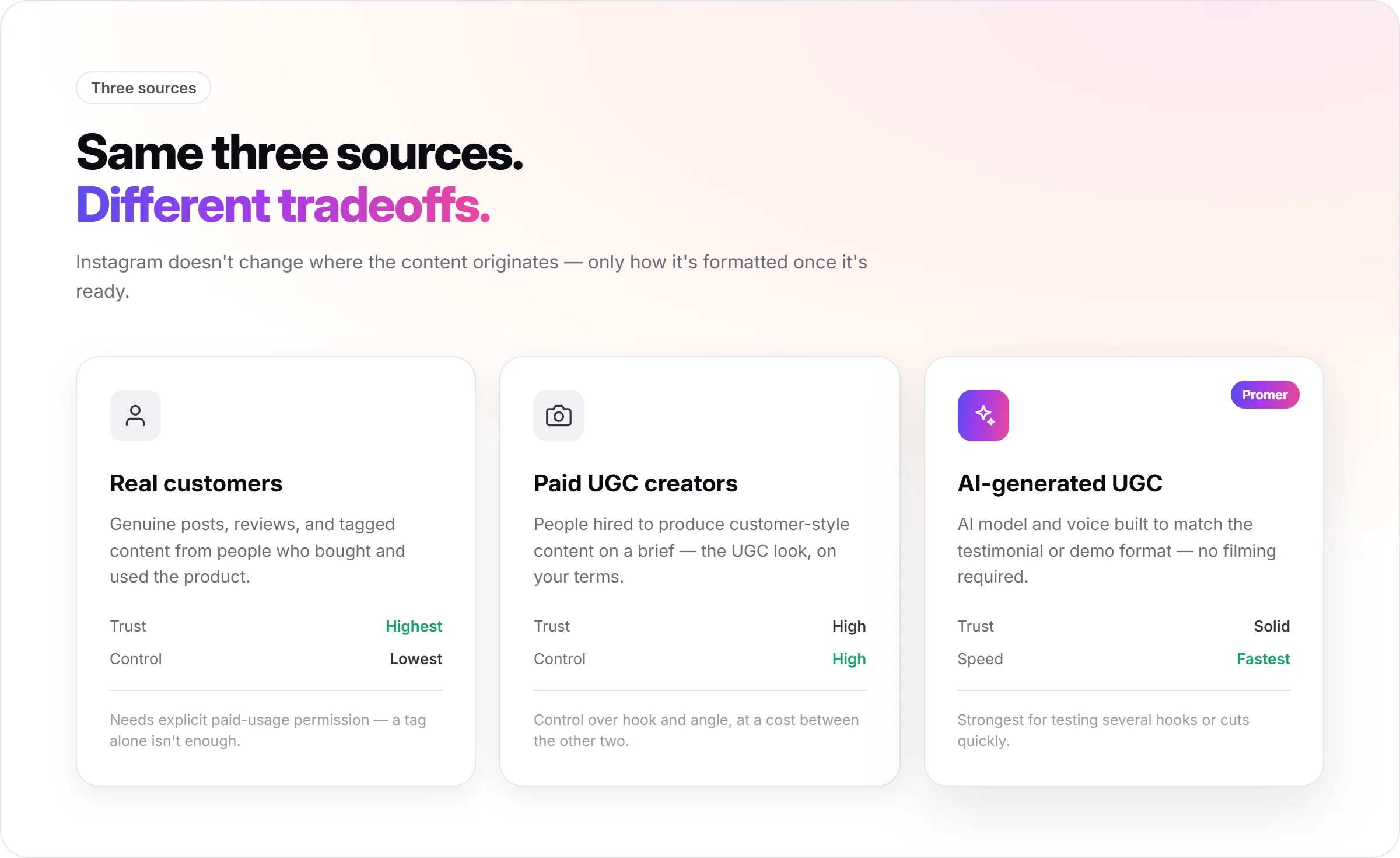
Real customers. Genuine posts, reviews, or tagged content from people who bought and used the product. Highest trust, least controllable - you can't brief a real customer on hook or structure, and using their content as a paid ad requires explicit paid-usage permission, not just the fact that they tagged your brand.
Paid UGC creators. People hired specifically to produce customer-style content on a brief. This gives control over hook, angle, and structure while keeping the UGC aesthetic, at a cost between sourcing from real customers and a full studio production.
AI-generated UGC. Video generated by an AI model (avatar) and AI voice, built to match the same testimonial or demo format without filming a real person. What is AI UGC covers how this production method works and where it fits best relative to the other two sources.
None of these sources is the automatic right answer for Instagram specifically. Real customer and paid creator content still carry more inherent trust for hero campaigns or high-consideration products. AI-generated UGC is strongest when the goal is testing several hooks or carousel sequences quickly, since generating a new variation doesn't require a new booking.
Producing and Formatting UGC for Instagram at Scale
The bottleneck in scaling UGC for Instagram is the same one that shows up on any platform: real creator content depends on booking, briefing, and waiting, which caps how many hook or placement variations a team can realistically test in a given cycle. How to scale UGC ad creative production covers this production math in more depth.
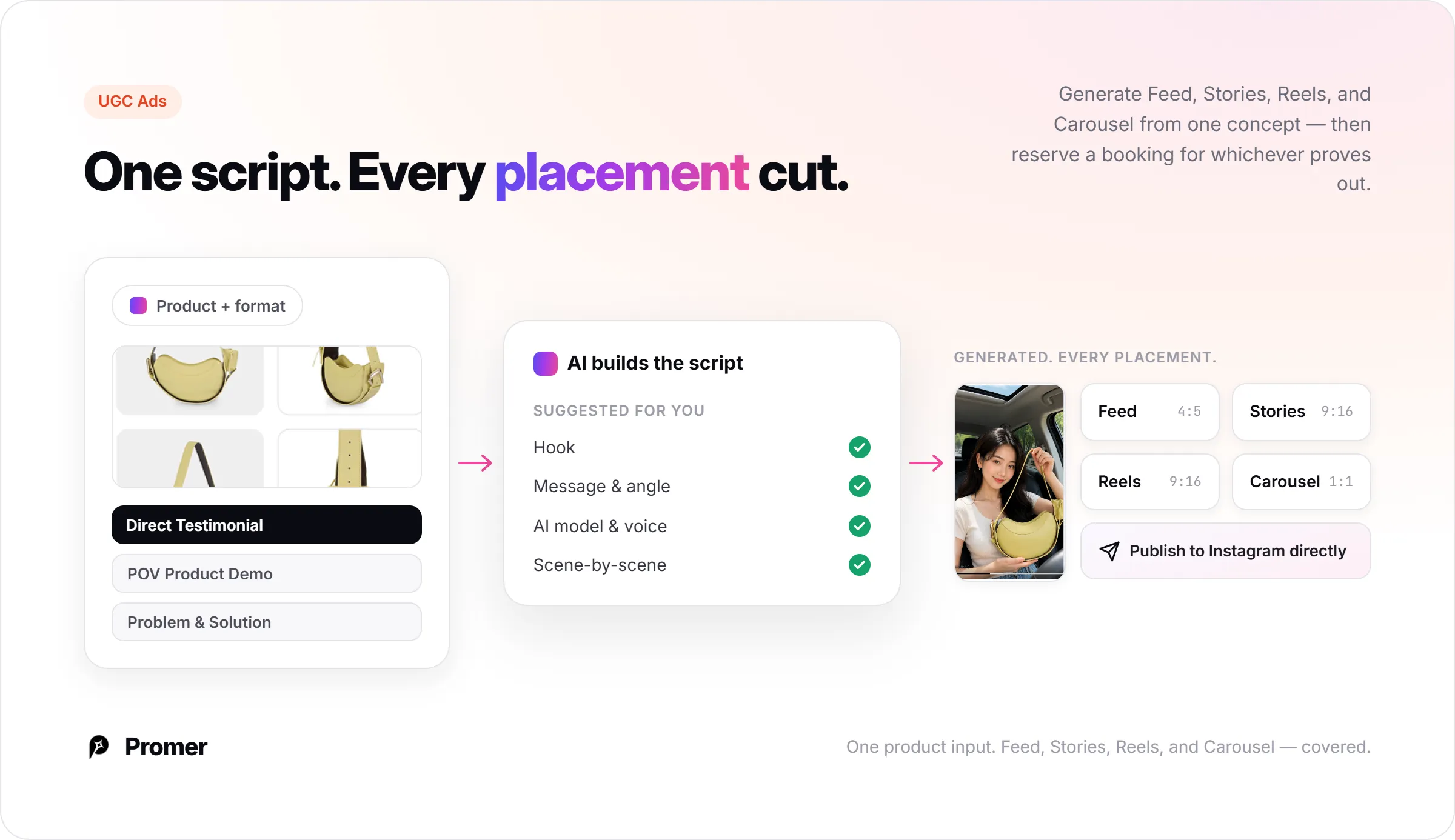
Promer AI's UGC Ads flow addresses the AI-generated side directly. Select a product, choose a format (Direct Testimonial, Voiceover Product Review, POV Product Demo, Problem and Solution, or Routine or Day in the Life), and the AI suggests a hook, message, and visual direction to build a scene-by-scene script from, complete with an AI model and voice.
Generated videos can be pushed directly to a connected Instagram account for publishing with Promer's AI Instagram ad generator, without a manual export-and-reupload step.
This is most useful as a testing layer for Instagram specifically because of how many placement variants a single concept needs - a Feed cut, a Stories cut, a Reels cut, and potentially a Carousel sequence, all from one underlying script. Generating that range quickly, then reserving a real creator booking for whichever format proves out, is a faster path than producing every placement variant by hand from the start.
Whichever source produces the content, check it against the specific placement it's headed for before it runs. A script paced for a 25-second Reels ad needs real re-editing, not just a crop, to work as a 10-second Stories placement - the hook and pacing don't compress automatically just because the format got shorter.
An AI ad generator that produces multiple formats from one product input makes covering Feed, Stories, Reels, and Carousel from a single concept faster than building each cut by hand.
FAQs about UGC for Instagram Ads
Why does UGC work better than produced ads on Instagram specifically?
Instagram's visually driven, feed-native format makes the contrast between a UGC-style ad and a polished commercial more visible than on platforms with a less developed visual culture. A produced ad reads as an interruption faster, since it visually stands out against a feed of phone-shot, casual content.
This advantage has narrowed somewhat as Instagram users have gotten more accustomed to UGC-style ads over time, which is why the hook and specific claim still matter as much as the format itself.
What size should my UGC ad be for Instagram?
Use 4:5 (1080x1350px) for Feed and Explore, since it claims more mobile screen space than square. Use 9:16 (1080x1920px) for Stories and Reels - this is the only accepted ratio for those placements. Carousel cards are locked to 1:1 (1080x1080px), regardless of what ratio the rest of the campaign uses.
Avoid designing one asset and letting Instagram crop it into every placement automatically. A 4:5 card forced into a Carousel slot loses real estate from the top and bottom of the frame.
Should I use Feed, Stories, Reels, or Carousel for UGC ads?
Most UGC campaigns benefit from running more than one placement rather than picking a single one, since each rewards a slightly different pacing and content style. Reels suits a slightly longer, more developed structure; Stories rewards a fast hook and short runtime; Carousel suits sequential or multi-angle content that doesn't fit naturally into a single clip.
Testing the same underlying concept across two or three placements, rather than committing an entire budget to one, is a more reliable way to find which placement actually performs for a specific product.
Can I use AI-generated UGC for Instagram ads?
Yes. AI-generated UGC can run as an Instagram ad the same way creator-filmed content can, provided the ad doesn't misrepresent itself as coming from a real customer when it doesn't. Check current Meta policy on AI-content disclosure before launching, since these rules have continued to evolve.
AI-generated UGC tends to be strongest for testing multiple hooks or placement cuts quickly, while real creator or customer content still carries more weight for campaigns built specifically around proving genuine customer experience.
How long should a UGC ad be on Instagram?
Length depends on placement. Stories generally perform best under 15 seconds given the fast swipe-through behavior of that format, while Reels can support a longer, 15-30 second range since viewers there are more likely to watch through a developed structure.
Regardless of placement, the opening one to two seconds carry more weight than total runtime. A strong hook in a short Stories ad typically outperforms a weak hook stretched across a longer Reels cut.
Are carousel ads a good format for UGC on Instagram?
Yes, and they're used more heavily for UGC on Instagram than on most other platforms. Carousel lets a brand sequence multiple product angles, a short before-and-after, or a step-by-step demo across cards, which suits certain UGC formats - unboxings, comparisons, transformations - better than a single clip can.
Keep every card at the same 1:1 aspect ratio and make sure the sequence still makes sense if someone only swipes through the first few cards, since not every viewer completes a full carousel.
Sources
Meta. (2026). Design requirements for Instagram Stories ads. Meta Business Help Center.
Meta. (2026). Awareness image ad specs on Instagram Reels. Facebook Ads Guide.