UGC Facebook Ads: Examples, Benefits & Best Practices
UGC Facebook ads are paid ads built from customer-style content - testimonials, product demos, unboxings, and casual reviews - rather than polished brand creative. They work on Facebook specifically because the feed is built around real people sharing real moments, and a produced commercial interrupts that pattern in a way a UGC-style ad doesn't. The ad still runs through the same auction, targeting, and placement system as any other Facebook ad - what changes is the creative itself, not the mechanics of running it.
This matters for Facebook specifically because the platform's placements (Feed, Stories, Reels) each reward slightly different pacing and framing, and getting the format wrong for the placement is one of the more common reasons a UGC ad underperforms despite a solid hook.
This article covers why UGC ads work on Facebook, the format and spec requirements for each placement, where the content actually comes from, and how to produce it without booking a new creator for every variation.
Key Takeaways
- UGC Facebook ads use customer-style creative - testimonials, demos, reviews - instead of produced brand ads, and run through the same ad system as any other Facebook ad
- Facebook has three main video placements that matter for UGC: Feed, Stories, and Reels, each with different aspect ratios and pacing expectations
- UGC content for Facebook ads can come from real customers, paid UGC creators, or AI-generated video built to match the same format
- Matching the video format to the placement (not just uploading one asset everywhere) affects delivery and watch-through more than most advertisers expect
- AI-generated UGC and real creator UGC can run side by side - the choice depends on whether the ad needs genuine social proof or just needs to test a hook fast
Why Do UGC Ads Work on Facebook Specifically?
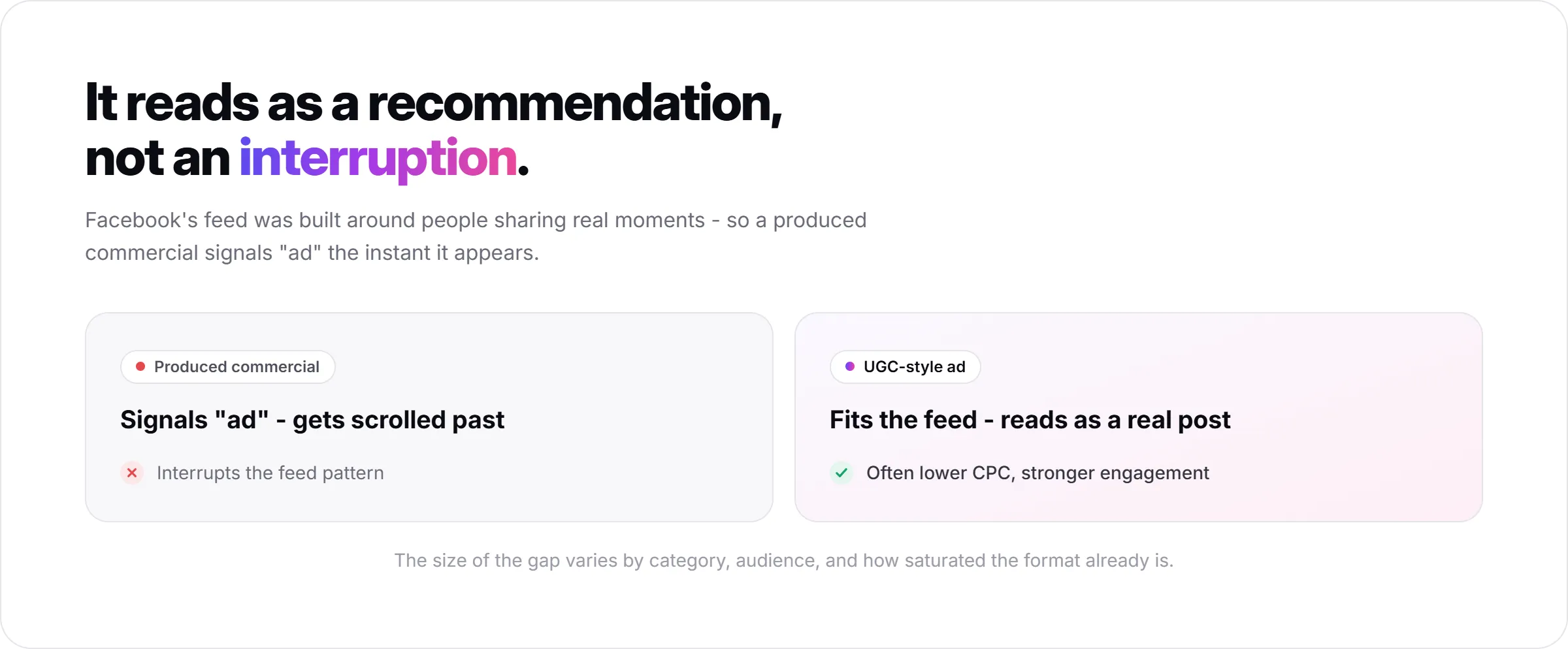
Facebook's feed algorithm and user expectations were both built around a platform that started as people sharing updates with people they know. A UGC-style ad fits that context - it reads as a recommendation, not an interruption - while a highly produced commercial signals "ad" the moment it appears, which is exactly the cue that makes people scroll past.
This isn't unique to Facebook, but it's more pronounced there than on platforms built natively for produced content.
The same casual-format logic applies to UGC Instagram Ads and TikTok, but Facebook's older, more relationship-based feed context is part of why the contrast between "ad" and "post" still matters so much to delivery and engagement.
The practical result is that UGC-style ads on Facebook often see lower cost per click and stronger engagement than produced brand ads for the same product, though the size of that gap varies by category, audience, and how saturated a specific format has already become in a given feed. This is the same reason UGC ads outperform produced creative across social platforms generally, not just on Facebook.
What Are the Facebook UGC Ad Placements and Specs?
Getting the format right for each placement matters more than most advertisers assume, since Facebook crops or letterboxes creative that doesn't match a placement's expected ratio, which can visibly cut off text, faces, or product shots.
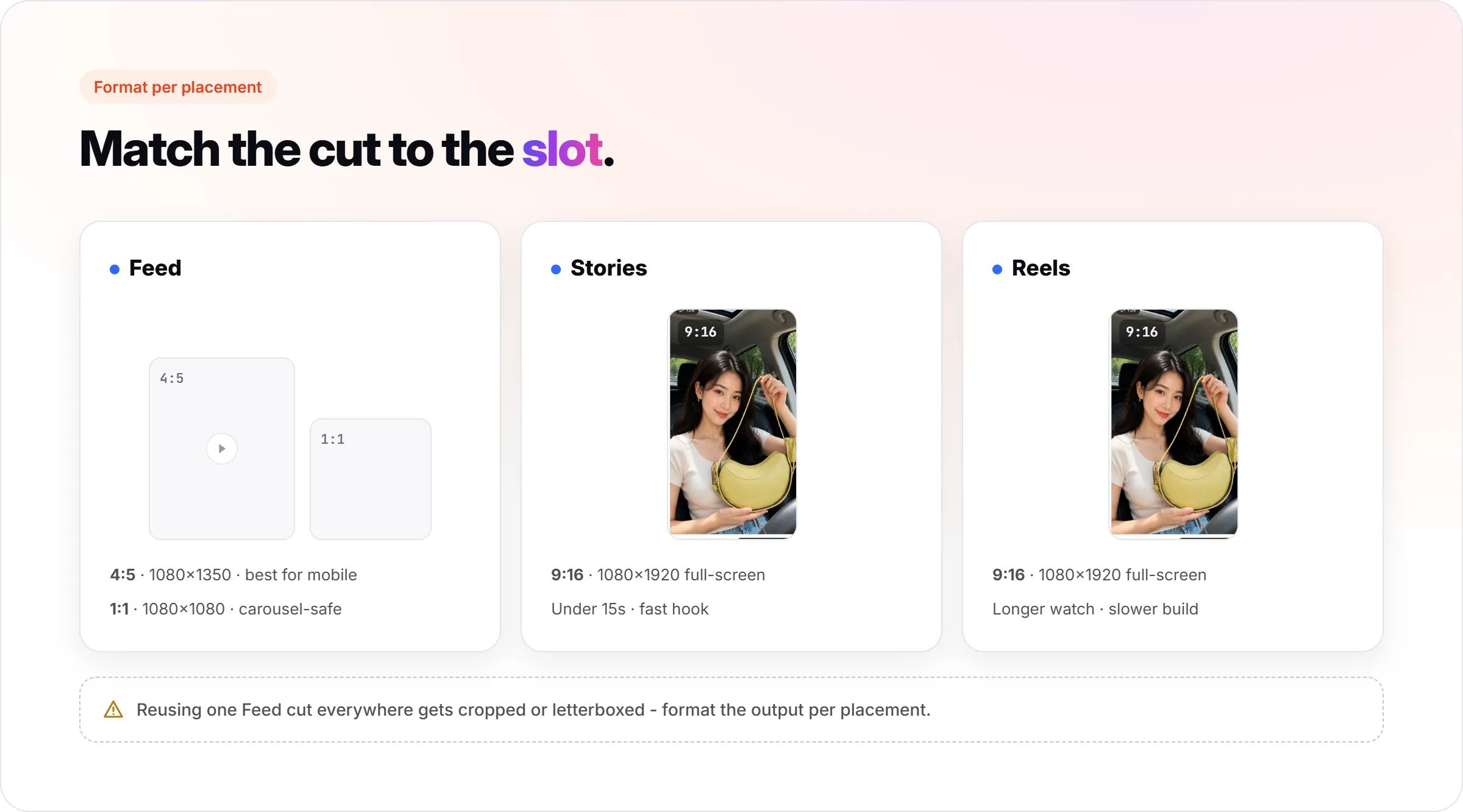
- Feed. The most common placement, supporting both square (1:1, 1080x1080px) and vertical (4:5, 1080x1350px) formats. 4:5 typically takes up more screen space on mobile, which is where most Facebook impressions happen, so it's usually the stronger default for Feed video.
- Stories. Full-screen vertical only - 9:16 at 1080x1920px. Stories reward a fast hook and a short runtime, generally under 15 seconds, since the format is built for quick swipe-through browsing rather than sustained watching.
- Reels. Also 9:16 at 1080x1920px, but with more room to run - Reels can support longer watch time and reward a slightly slower build than Stories, since viewers on Reels are already in a longer-session, sustained-watching mindset.
Trying to repurpose one Feed-cut asset across all three placements usually costs more than it saves. A vertical asset built for Stories often gets awkwardly cropped in Feed, and a square Feed asset stretched into 9:16 leaves visible letterboxing in Stories and Reels. Producing the core script once but formatting the output per placement is the more reliable approach.
Where Does UGC Content for Facebook Ads Actually Come From?
UGC-style content for Facebook ads comes from three main sources, and most advertisers end up using more than one depending on the campaign.
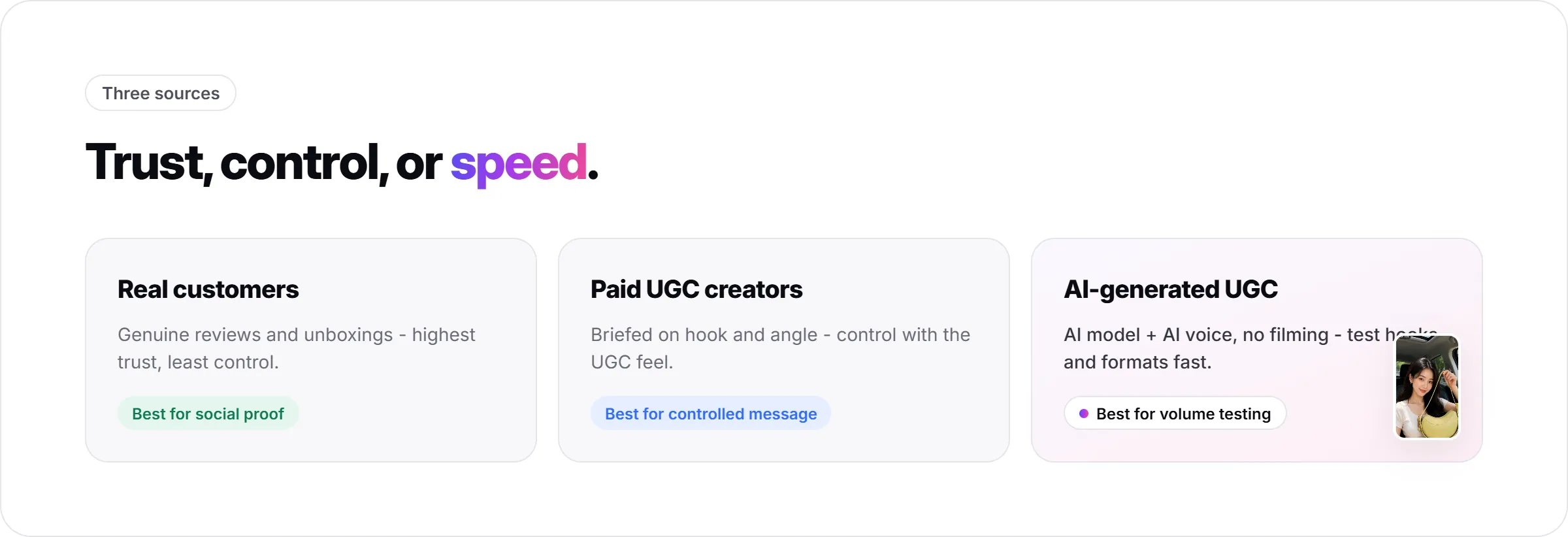
- Real customers. Genuine reviews, unboxing clips, or testimonials from people who actually bought and used the product. This is the highest-trust source, since the content genuinely is what it claims to be, but it's also the least controllable - you can't brief a real customer on hook, angle, or structure the way you can a paid creator.
- Paid UGC creators. People hired specifically to produce customer-style content on commission. This gives more control over structure and message while keeping the UGC aesthetic, since the creator can be briefed on angle, hook, and what to demonstrate. It costs more than sourcing from real customers but less than a full studio production.
- AI-generated UGC. Video generated by an AI model (avatar) and AI voice, built to match the same testimonial, demo, or review format without filming a real person. This removes the booking and filming step entirely, which matters most when a team needs to test several hooks or formats quickly rather than produce one polished hero asset.
None of these sources is universally correct. Real customer content and paid creator content carry more inherent trust, which matters most for hero campaigns or high-consideration categories. AI-generated UGC is strongest for volume testing - trying several hooks or formats fast to see which structure earns attention before committing to a bigger production.
How Do You Produce AI UGC Ads for Facebook?
AI-generated UGC removes the same bottleneck for Facebook ads that it removes everywhere else: real creator content depends on booking, briefing, and waiting, and that dependency caps how many variations a team can realistically test in a given cycle. What is AI UGC covers the production method in more depth, and the same production math applies to scaling UGC ad creative production specifically for Facebook.
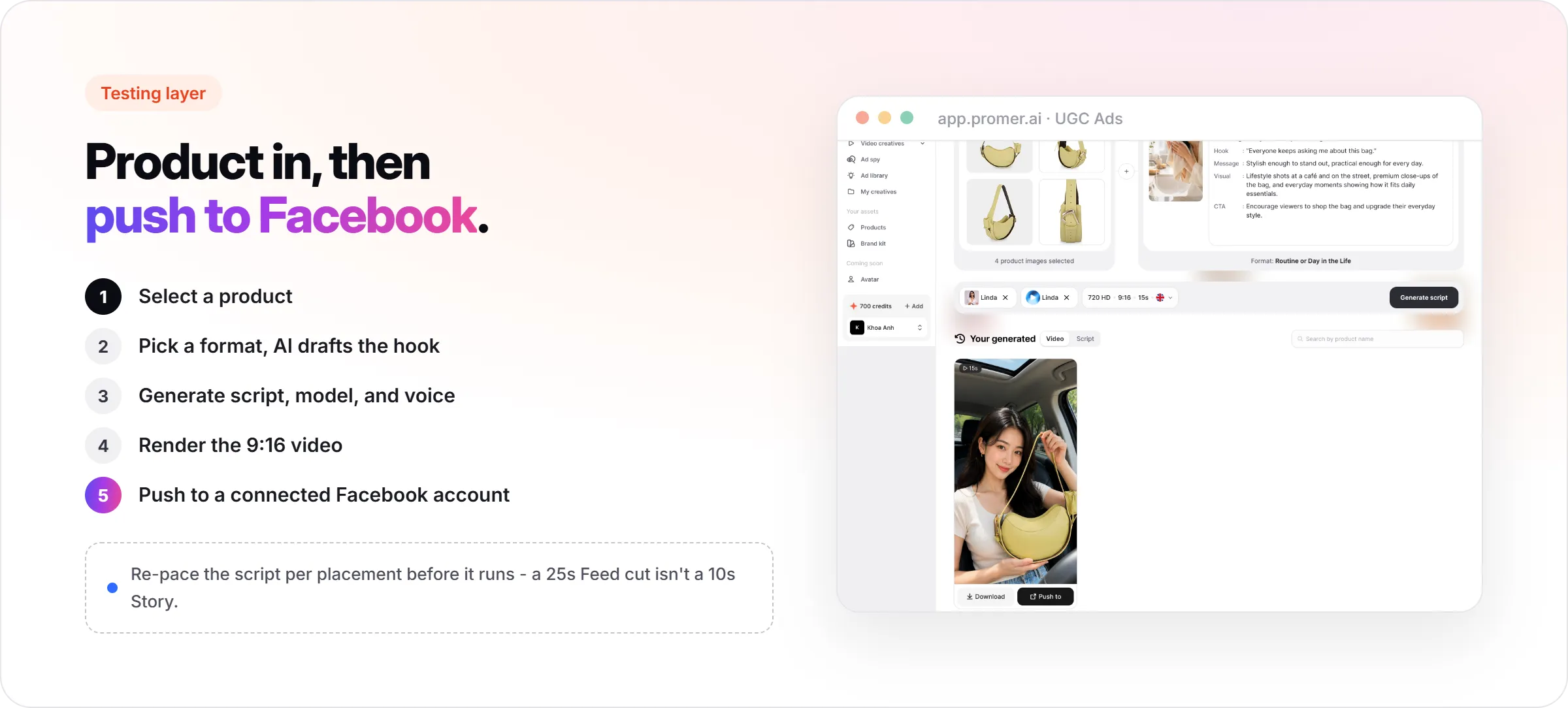
Promer AI's UGC Ads flow is built for this - and if Instagram is the priority channel, the AI Instagram ads generator inside that same flow handles it directly.
Select a product, choose a format (Direct Testimonial, Voiceover Product Review, POV Product Demo, Problem and Solution, or Routine or Day in the Life), and the AI suggests a hook, message, and visual direction to build a scene-by-scene script from, complete with an AI model and voice.
Once a video is generated, it can be pushed directly to a connected Facebook account for publishing, without exporting and re-uploading manually.
This approach works best as a testing layer ahead of bigger production decisions. Generate several hook variations quickly, see which one earns attention in the first few seconds, and reserve real creator bookings for the format and angle that's already shown it works.
Whichever source produces the content, review it against the Facebook placement it's headed for before it runs. A script written for a 25-second Feed video needs trimming and re-pacing for a 10-second Stories placement - the message and hook don't automatically compress just because the format got shorter. An AI ad generator that produces multiple formats from one product input makes this per-placement adjustment faster than starting each cut from scratch.
FAQs about UGC Facebook Ads
What makes a Facebook ad a "UGC ad" specifically?
A UGC Facebook ad uses customer-style content - a testimonial, demo, unboxing, or casual review - instead of a produced brand commercial. The defining trait is the format and tone, not necessarily who made it; the content can come from a real customer, a paid UGC creator, or AI generation, as long as it reads as personal rather than polished.
The ad still runs through Facebook's standard ad system - same targeting, same auction, same placements - so "UGC ad" describes the creative style, not a different kind of campaign.
Do UGC Facebook ads actually perform better than produced ads?
Many advertisers see lower cost per click and higher engagement with UGC-style creative, largely because it fits the native feel of the Facebook feed better than an obviously produced commercial. The size of that advantage varies by product category, audience, and how much UGC-style content that specific audience has already seen.
Testing UGC against your existing produced creative on the same audience and offer is the only reliable way to know the actual gap for your product, since published benchmarks vary widely across studies.
What size should my UGC Facebook ad be?
For Feed, use 4:5 (1080x1350px) for the best mobile screen coverage, or 1:1 (1080x1080px) if the same asset also needs to run on Marketplace or carousel placements. For Stories and Reels, use 9:16 (1080x1920px) full-screen vertical - this is the only accepted ratio for those placements.
Avoid stretching or cropping one asset across all placements. A dedicated cut per placement, even from the same underlying script, avoids the visible letterboxing or cropping that comes from forcing one ratio into a different slot.
Can I use AI-generated UGC for Facebook ads?
Yes. AI-generated UGC videos can run as Facebook ads the same way creator-filmed UGC can, provided the ad doesn't misrepresent the content as coming from a real customer when it doesn't. Check current Meta policy on AI-content disclosure before launching, since platform rules on this have been evolving.
AI-generated UGC is generally strongest for testing multiple hooks or formats quickly, while real creator or customer content tends to carry more weight for campaigns where the entire point is proving genuine customer experience.
How long should a UGC Facebook ad be?
Length depends on placement. Stories generally perform best under 15 seconds given the fast swipe-through browsing behavior, while Feed and Reels can support longer runtimes, often in the 15-30 second range, since viewers there are more likely to watch through a full scene.
Regardless of placement, the hook - the first one to two seconds - matters more than total length. A strong hook in a 10-second Stories ad usually outperforms a weak hook stretched across 30 seconds of Feed video.
Where do I actually get UGC content to use in Facebook ads?
Three main sources cover most cases: real customers who've already posted organic content (with permission to use it as an ad), UGC creators hired specifically to produce customer-style content on brief, or AI-generated video built to match the same format without filming anyone. Most advertisers end up mixing sources depending on the campaign's goal.
Use real customer or paid creator content when the campaign needs genuine social proof, and AI-generated UGC when the priority is testing multiple hooks or formats fast before committing to a bigger production.