The UGC ad examples that convert share one trait: each one proves something specific to the viewer, not just "this looks like a real person." A testimonial proves a result happened. An unboxing proves the product exists and looks the way it's described. A problem-solution ad proves a specific frustration has a specific fix. The format earns attention; the proof is what earns the click.
This list covers 12 UGC ad examples organized by what each one is built to prove, with the hook pattern, why it works, and what product types it fits best. Different styles of UGC ads covers the broader framework for choosing a style - this list is the applied version, with a concrete example for each entry.
Key Takeaways
- The strongest UGC ad examples are built around a specific proof point - a result, a first reaction, a routine - not just a casual tone
- Testimonial, unboxing, before-and-after, and problem-solution remain the four most reliable formats across ecommerce categories
- Newer formats like the UGC-style photo carousel and review-to-static screenshot ads are gaining ground because they're faster and cheaper to produce than video
- Matching the example to your product's actual proof point matters more than copying a specific brand's exact format
- Testing several of these examples against your own audience is the only way to know which one earns attention for your specific product
1. The Direct Testimonial
Hook pattern: "I've been using this for [timeframe] and here's what actually happened."
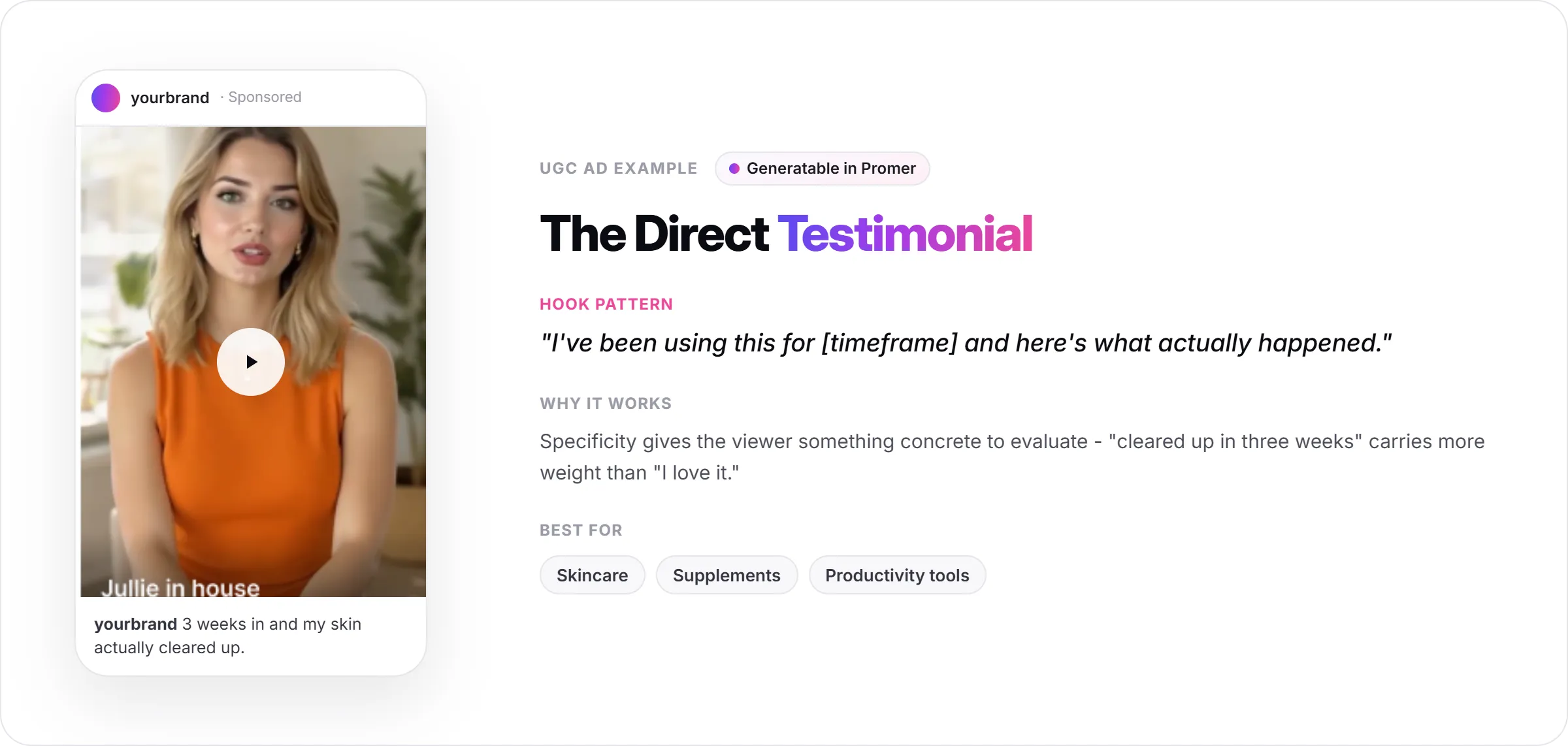
A creator or customer speaks straight to camera, names a specific result, and explains what changed. The strongest versions name a number, a timeframe, or a before-state rather than a vague endorsement - "my skin cleared up in three weeks" carries more weight than "I love this product."
This format works because specificity gives the viewer something concrete to evaluate. It fits products with a measurable or describable outcome: skincare, supplements, productivity tools, anything where "it worked" can be made concrete rather than left as an opinion.
2. The Unboxing Reaction
Hook pattern: No spoken hook at all - the reaction on the creator's face in the first two seconds is the hook.
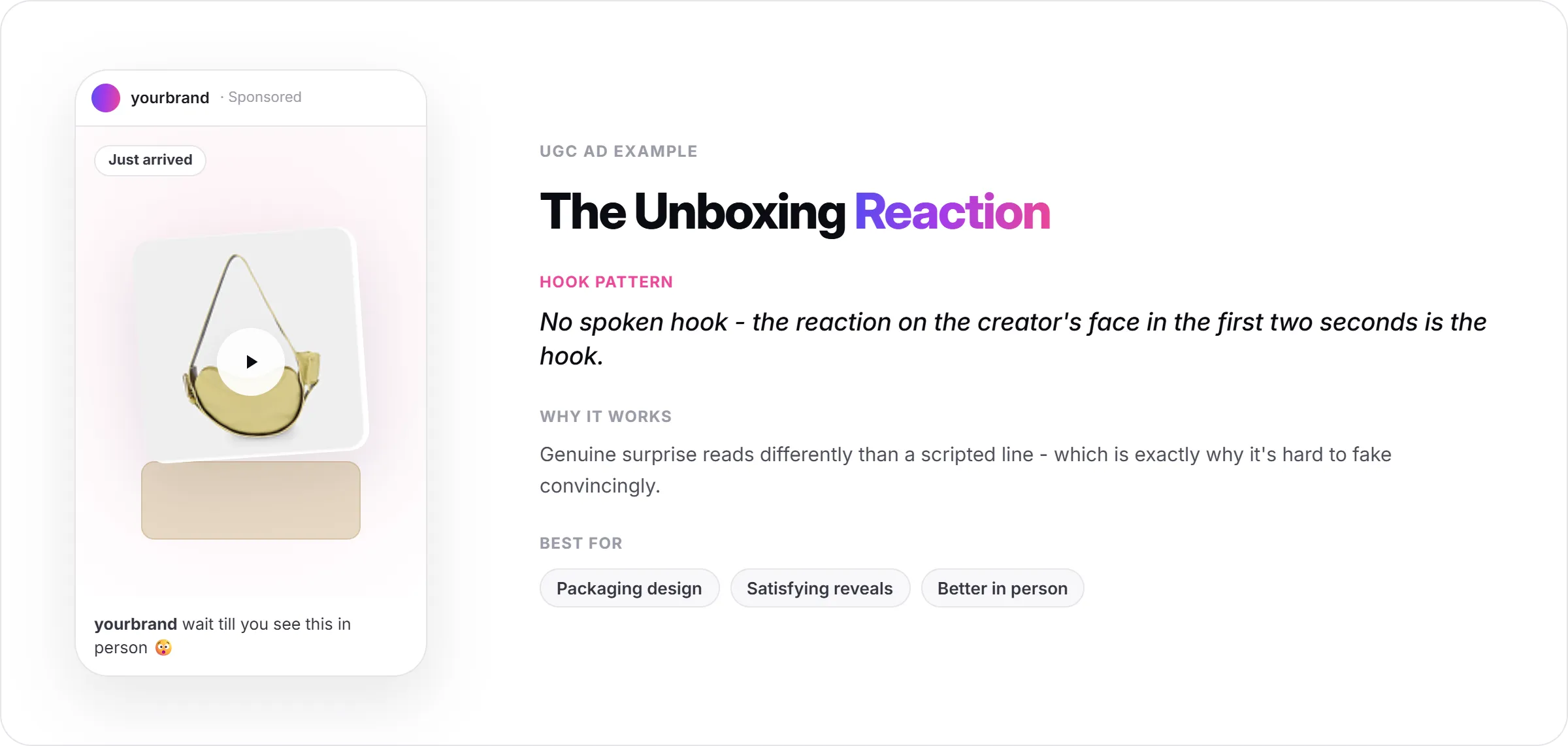
The creator opens the package on camera and reacts in real time, with minimal narration beyond first impressions. What makes this format hard to fake is the reaction itself - genuine surprise or delight reads differently than a scripted line, which is exactly why it's difficult to script convincingly.
Unboxing works best for products with a strong physical or visual reveal moment: packaging design, a satisfying mechanism, a product that looks better in person than in a photo. It works less well for digital products or services with no physical unwrapping moment.
3. The Before-and-After Transformation
Hook pattern: "Day 1 vs. Day 30" or a split-screen visual with minimal spoken setup.
A visible transformation - skin, a room, a fitness result - carries its own proof without needing much narration. The strongest versions show the same angle, lighting, and framing in both states, since inconsistency between the before and after shots undermines the exact credibility the format depends on.
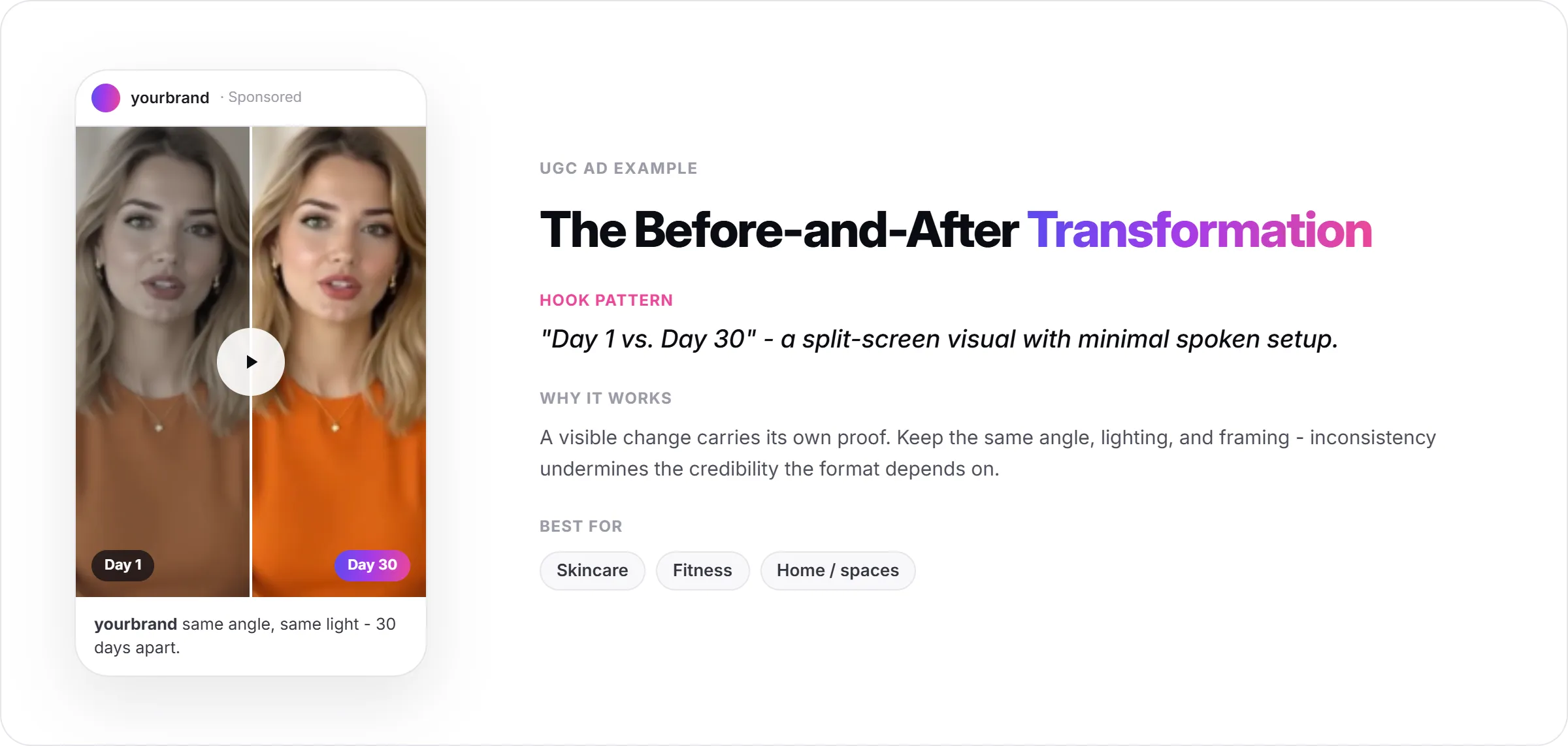
This format is category-specific by nature: it only works when the product produces something genuinely visible. Forcing a before-and-after structure onto a product without a visible result is one of the more common ways this format falls flat.
4. The Problem-and-Solution Demo
Hook pattern: "I used to [specific frustration] until I found this."
The ad opens with a relatable problem stated specifically enough that the target viewer recognizes themselves in it, then introduces the product as the resolution. The specificity of the problem statement matters more than the polish of the solution reveal - a vague problem ("I wanted better sleep") earns less recognition than a specific one ("I was waking up at 3am every night for months").
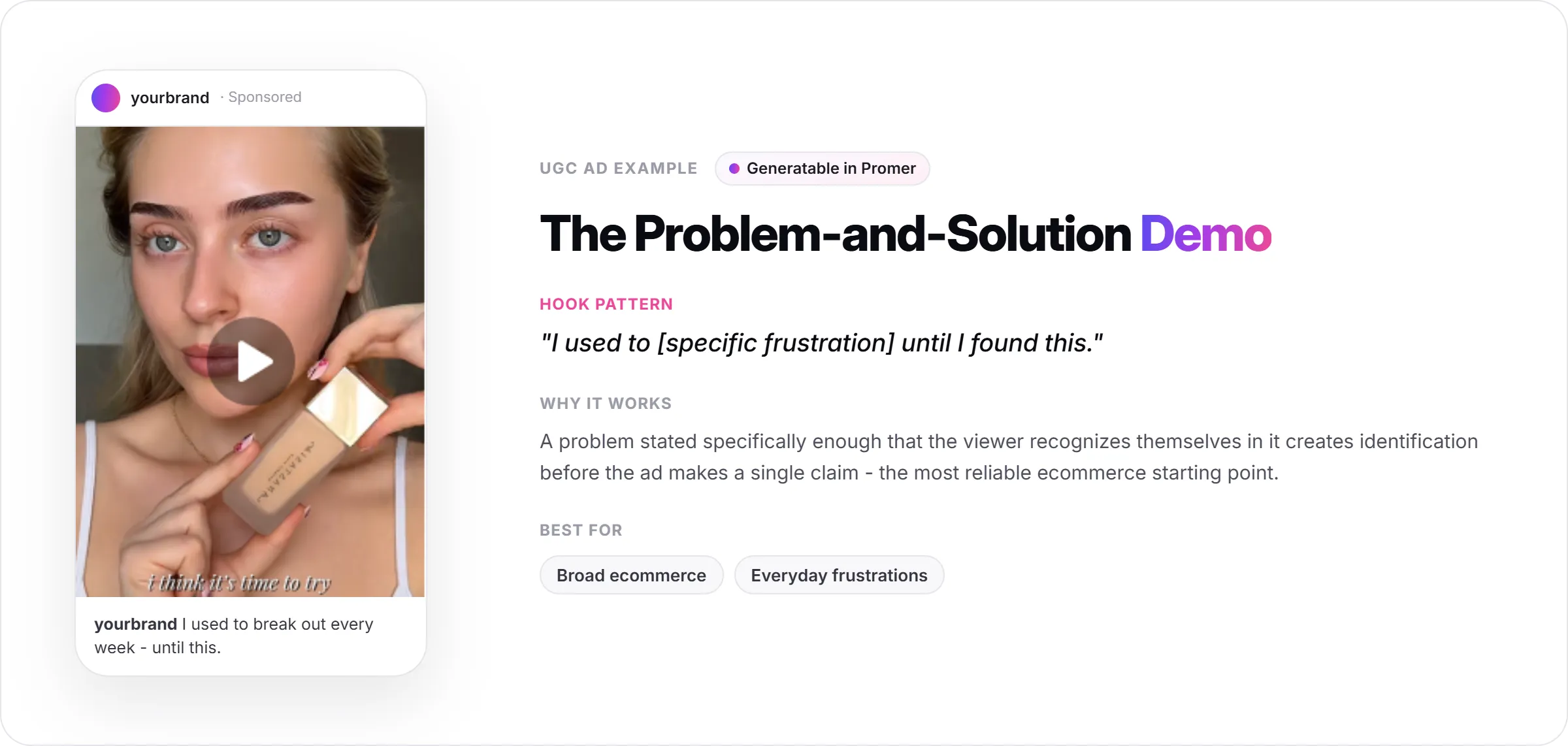
This format is often cited as the most reliable starting point for ecommerce UGC, since naming a real frustration creates identification before the ad has made a single claim about the product.
5. The Day-in-the-Life Integration
Hook pattern: No direct hook - the product simply appears inside an already-in-progress routine.
Rather than a direct pitch, the product shows up naturally in a morning routine, a workout, or a commute, with minimal explicit selling. The "this is just part of my day" framing works because it implies the product has already earned a permanent place in someone's life, rather than asking the viewer to imagine that future.
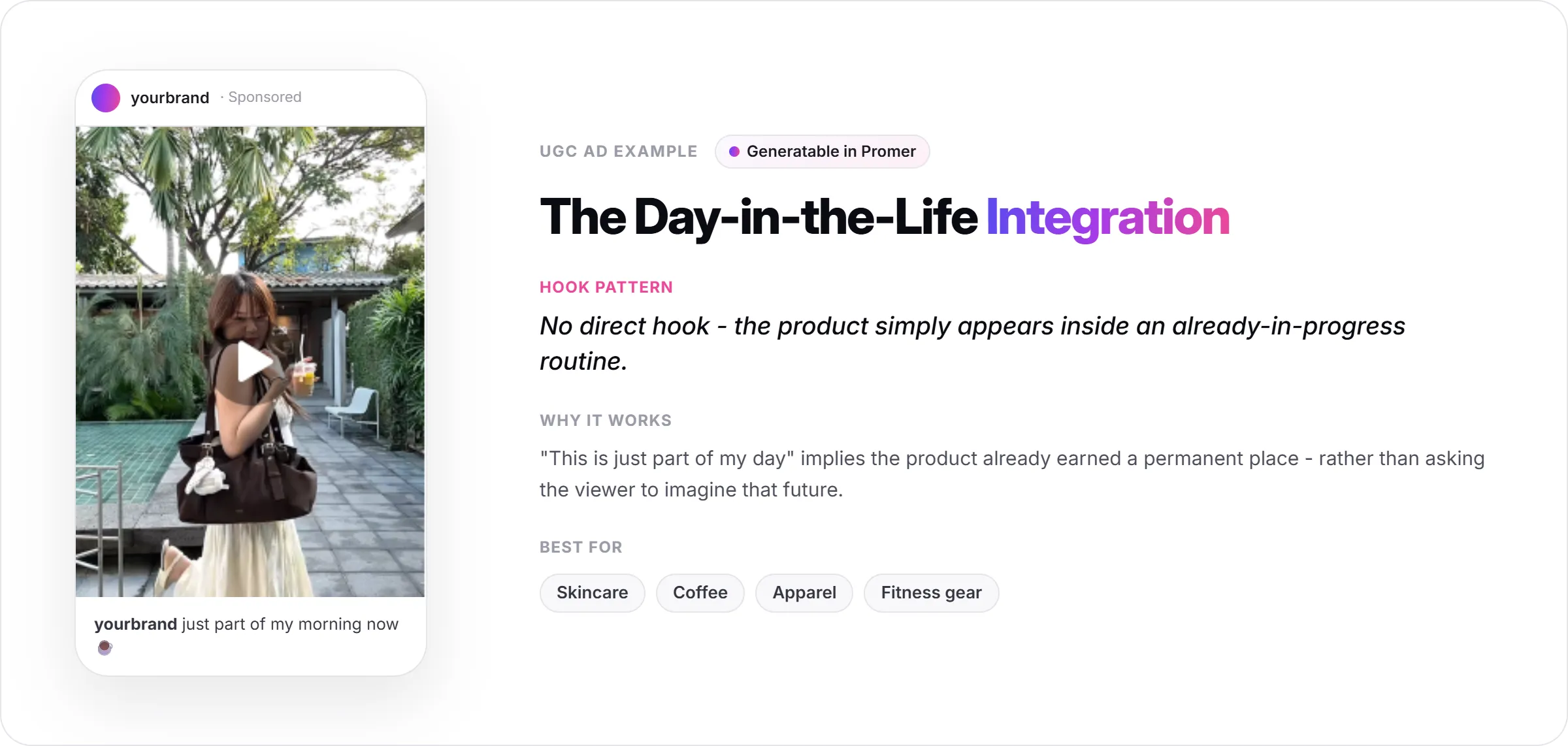
This format fits products that are genuinely part of a visible daily routine - skincare, coffee, apparel, fitness gear - and works less well for one-time-purchase or occasion-specific products that don't have a natural routine to sit inside.
6. The Tutorial or How-To
Hook pattern: "Here's exactly how I use this" followed by a step-by-step walkthrough.
The creator demonstrates the product in use, explaining each step as they go, positioning the product as part of a process rather than the entire message. This format doubles as genuine utility - a viewer who wasn't ready to buy can still get value from the tutorial itself, which extends watch time and shareability beyond a pure sales pitch.
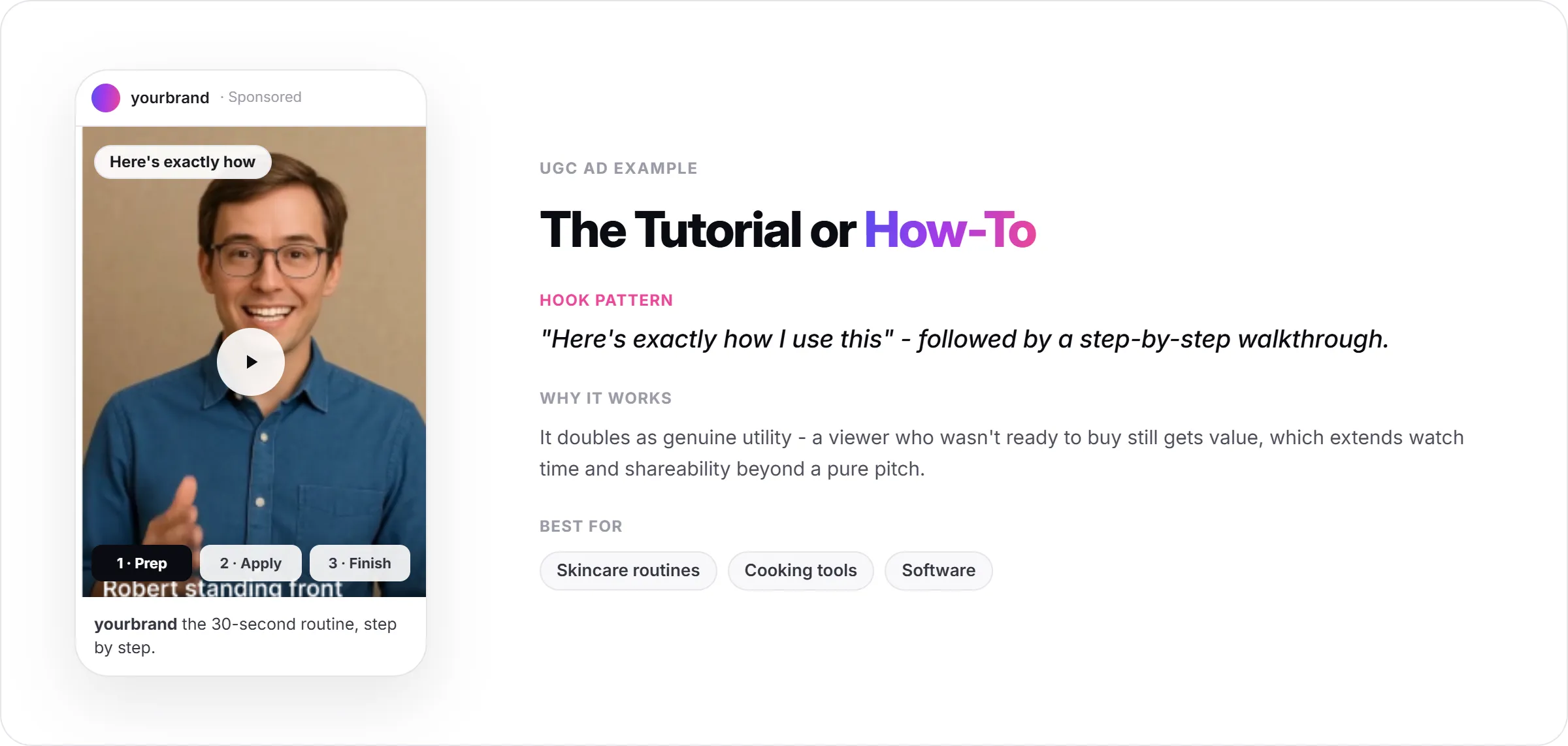
Works well for products with a real technique or method to demonstrate: skincare routines, cooking tools, software, anything where "how do I actually use this" is a real question the buyer has.
7. The Review-to-Static Screenshot
Hook pattern: A pulled quote or star rating overlaid directly on a product image, no video at all.
Real review text, a comment thread, or a star rating is layered as a static image, converting genuine written feedback into ad creative without any filming. This format is faster and cheaper to produce than any video format on this list, since it requires no camera, no creator, and no editing beyond overlay design.
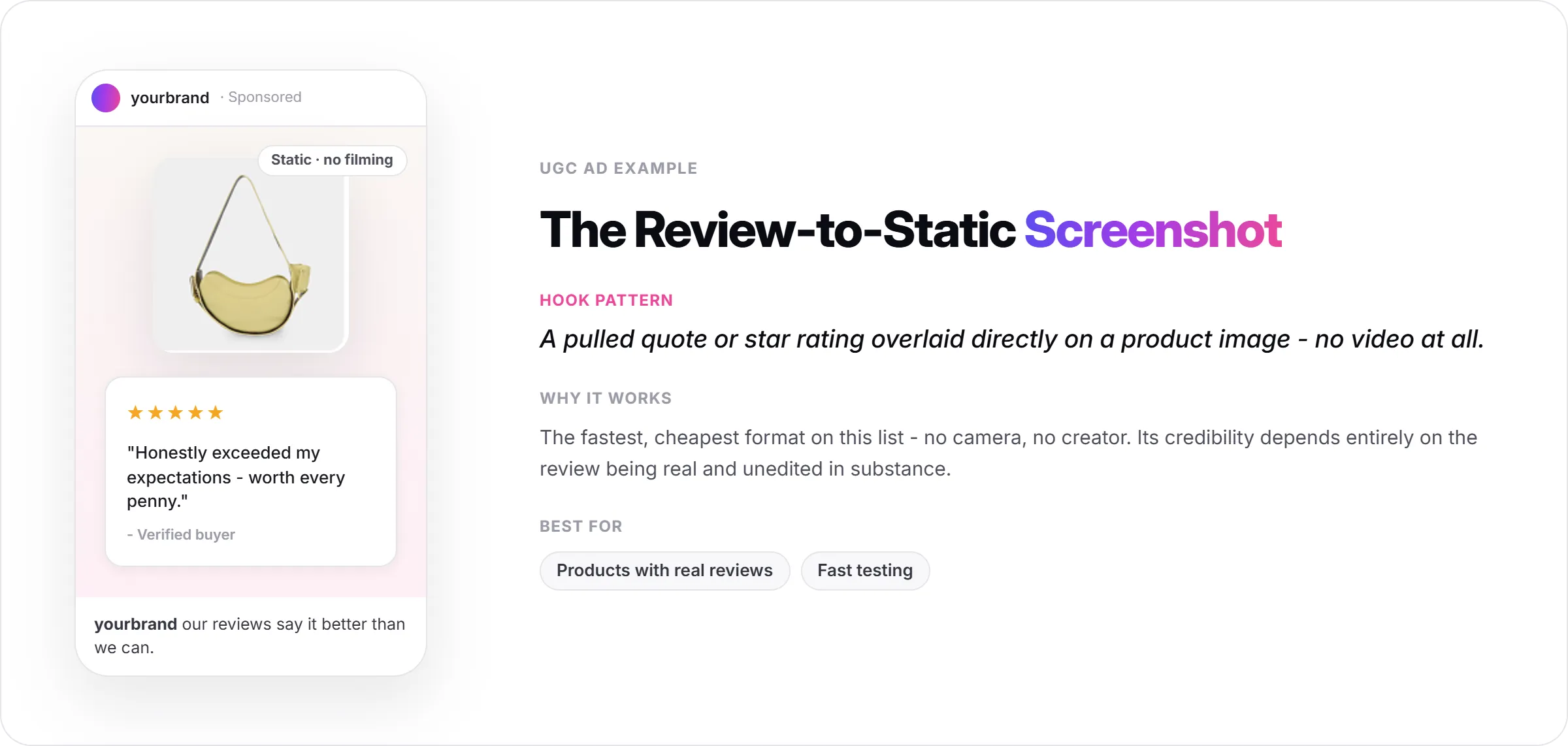
The credibility of this format depends entirely on the review being real and unedited in substance - fabricating or heavily paraphrasing a review to fit the ad undermines the exact trust signal the format is built on.
8. The UGC-Style Photo Carousel
Hook pattern: A native-feeling caption over the first photo, styled like an organic post rather than an ad.
A sequence of photos - rather than video - styled with casual captions, swiped through like a real post. This format has been gaining ground because it's markedly cheaper to produce than video (no filming, no editing, no creator booking) while still letting viewers control their own pace through the content, lingering on a specific detail or comparison.
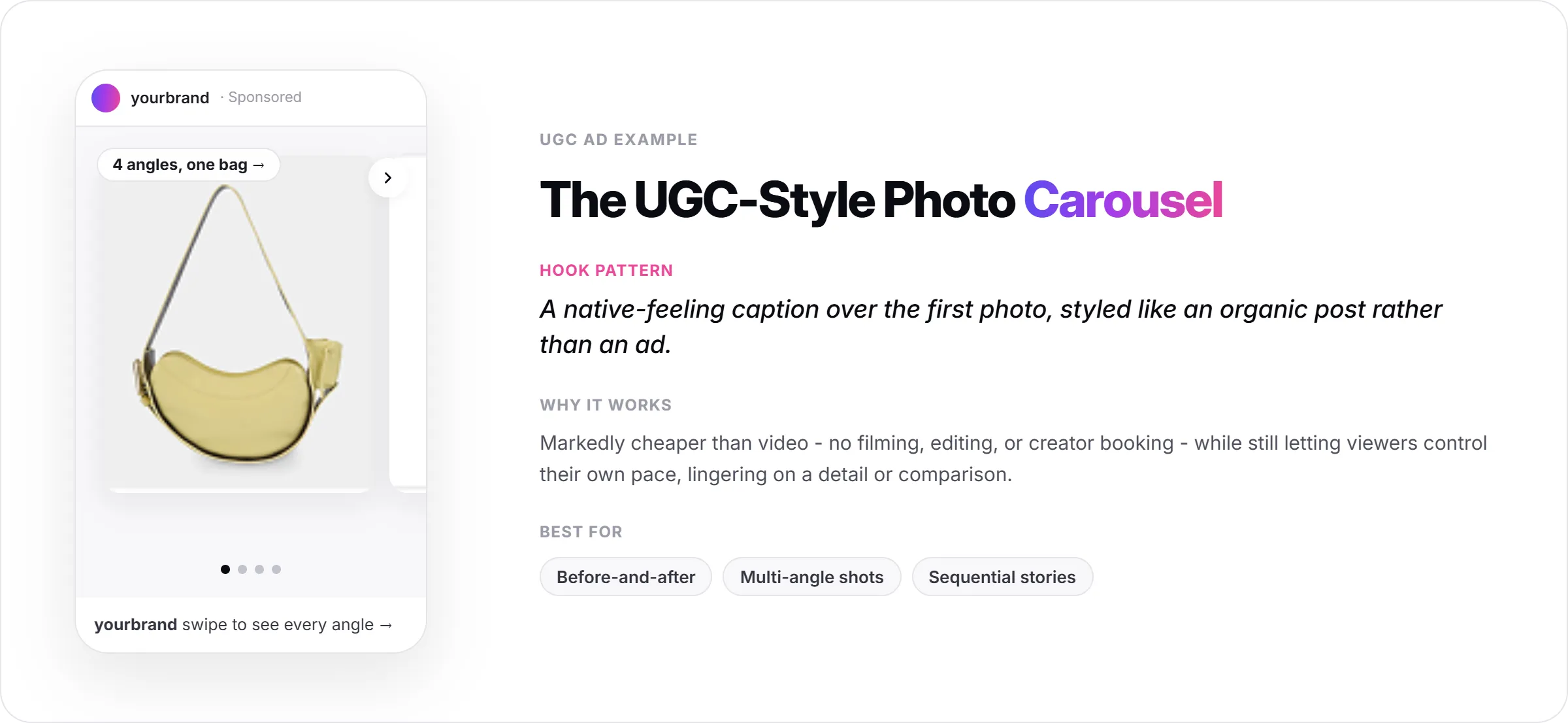
This works particularly well for before-and-after content, multi-angle product shots, or a short sequential story - a use case, an unboxing broken into stills, a comparison against an alternative.
9. The POV Product Demo
Hook pattern: First-person hands-on interaction, often with no face on screen at all.
The camera shows the product being used from the user's own point of view - opening it, applying it, wearing it - rather than a creator narrating to camera. This format works because it puts the viewer directly into the experience rather than watching someone else have it, which can feel more immediate for hands-on or tactile products.
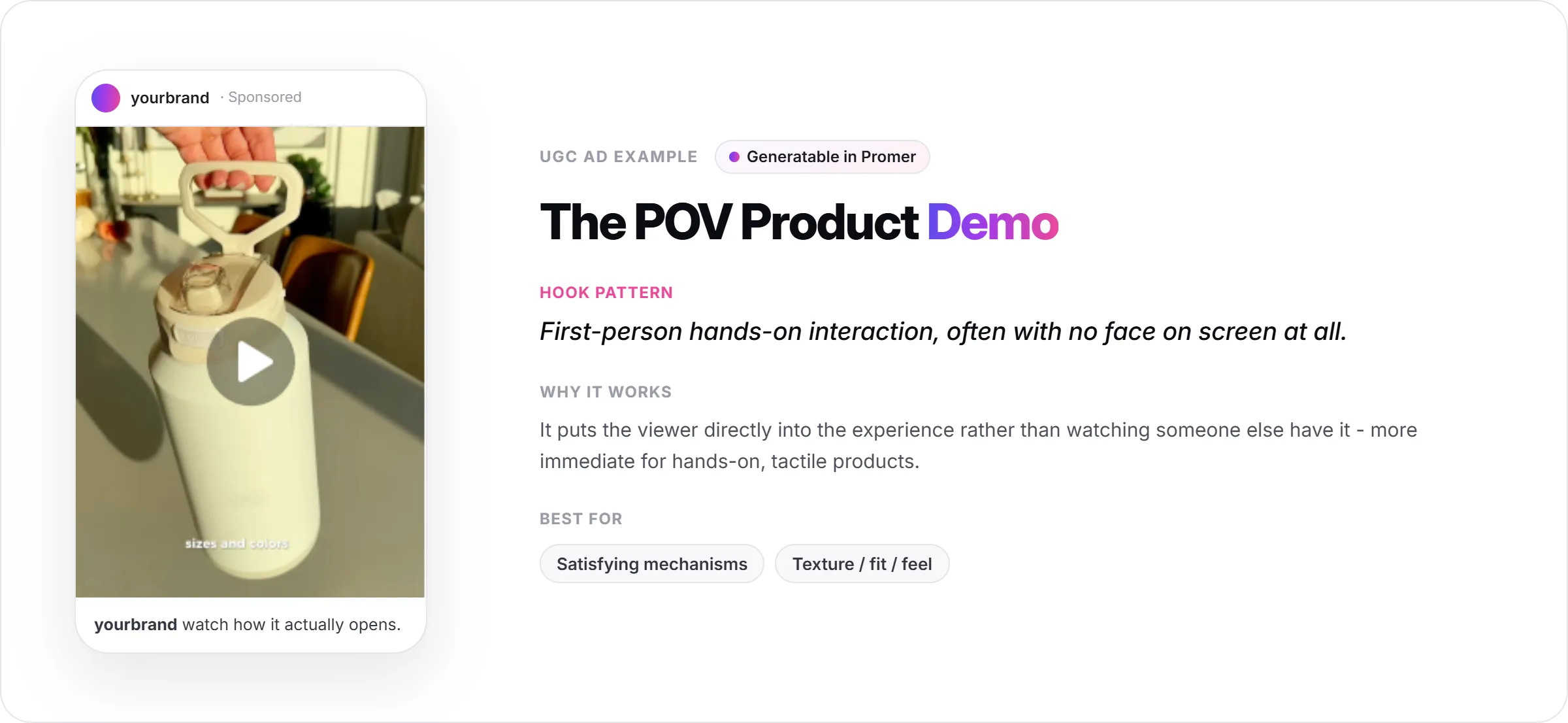
Fits products where the physical interaction itself is part of the sell: a satisfying mechanism, a texture, an unboxing motion, a fit or feel that's hard to describe in words alone.
10. The Voiceover Product Review
Hook pattern: The product is shown on screen while a voiceover narrates the benefits, without the presenter's face necessarily visible throughout.
This format separates the visual demonstration from the spoken narration, which gives more control over pacing and message than a straight talking-head video while keeping the casual, review-style tone intact. It's also one of the more practical formats for AI-generated UGC, since script and visual can be structured independently.
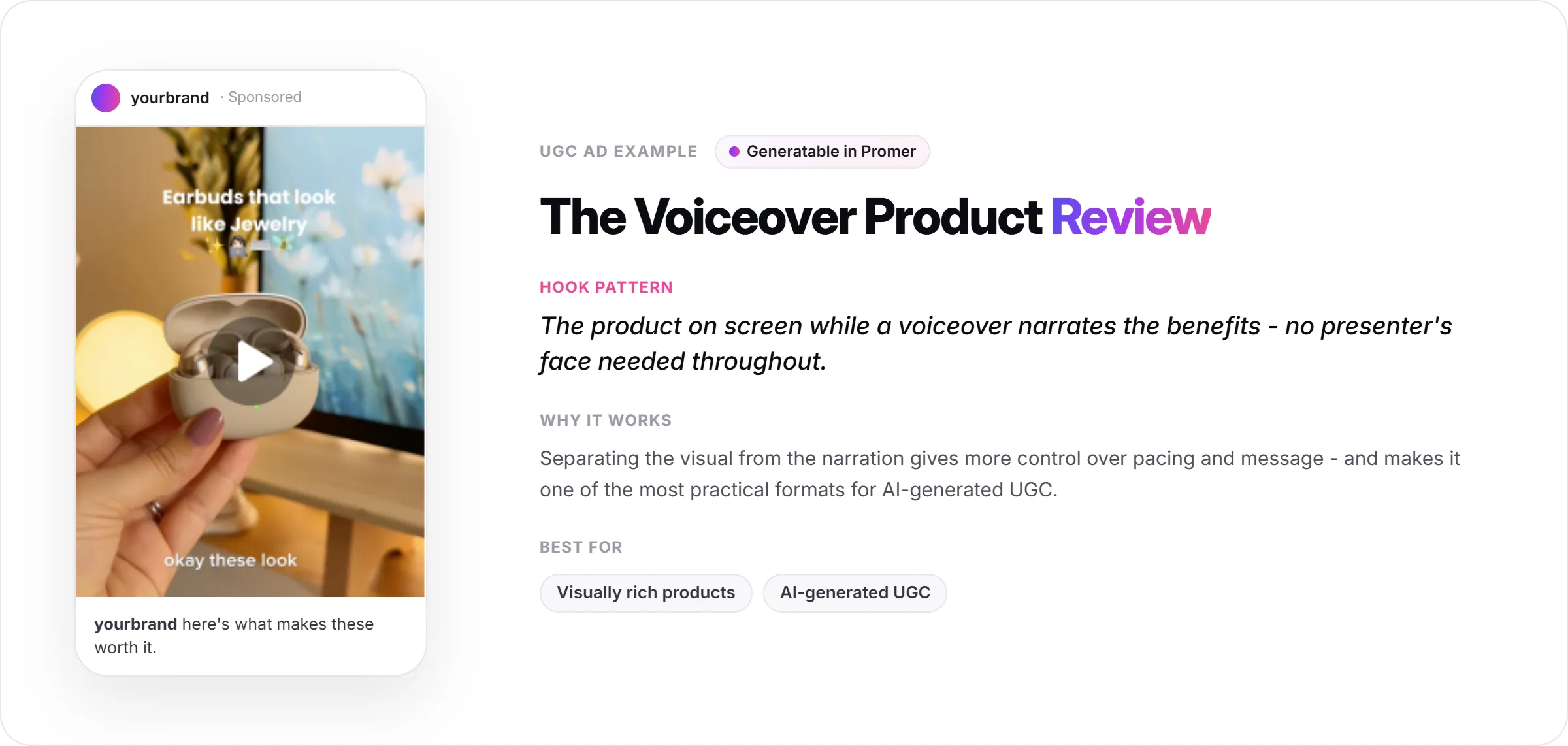
Works well when the product itself is visually interesting enough to carry the screen time without needing a face to hold attention throughout.
11. The Comparison or "I Tried Both" Format
Hook pattern: "I tested [your product] against [an alternative] so you don't have to."
The creator directly compares the product against a competitor or a previous solution, walking through the differences and landing on a verdict. This format works because it does research the viewer would otherwise have to do themselves, and a specific, even-handed comparison (naming a real tradeoff, not just declaring one product better) reads as more credible than a one-sided pitch.
Fits categories where buyers are already comparison-shopping - skincare, supplements, tech accessories, subscription services - and works less well for products without an obvious point of comparison.
12. The Green-Screen Reaction or Commentary
Hook pattern: The creator's face and voice react to or explain content shown behind them, often reacting to a stat, a screenshot, or the product itself.
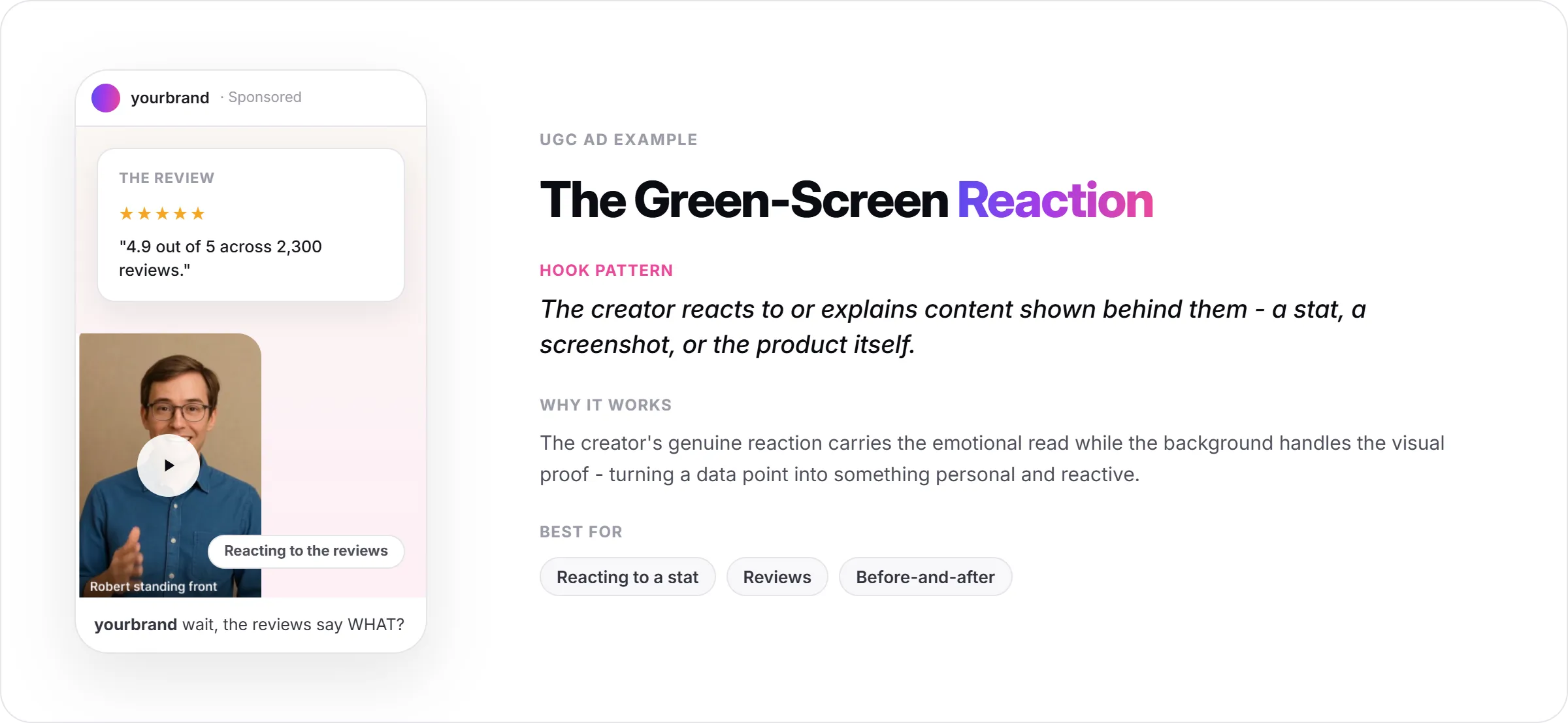
This format blends commentary with product demonstration, letting the creator's genuine reaction carry the emotional read while the background handles the visual proof. It works well for translating a data point, a review, or a before-and-after into something that still feels personal and reactive rather than presented.
Choosing Which Example Fits Your Product
None of these twelve formats is universally the strongest - the right choice depends on what your product actually has to prove. A visible transformation calls for before-and-after. A frustrating, specific problem calls for problem-solution. A product with a satisfying physical interaction calls for a POV demo or unboxing.
Matching the format to a real, existing proof point in your product is what separates an example that converts from one that just looks like the others on this list.
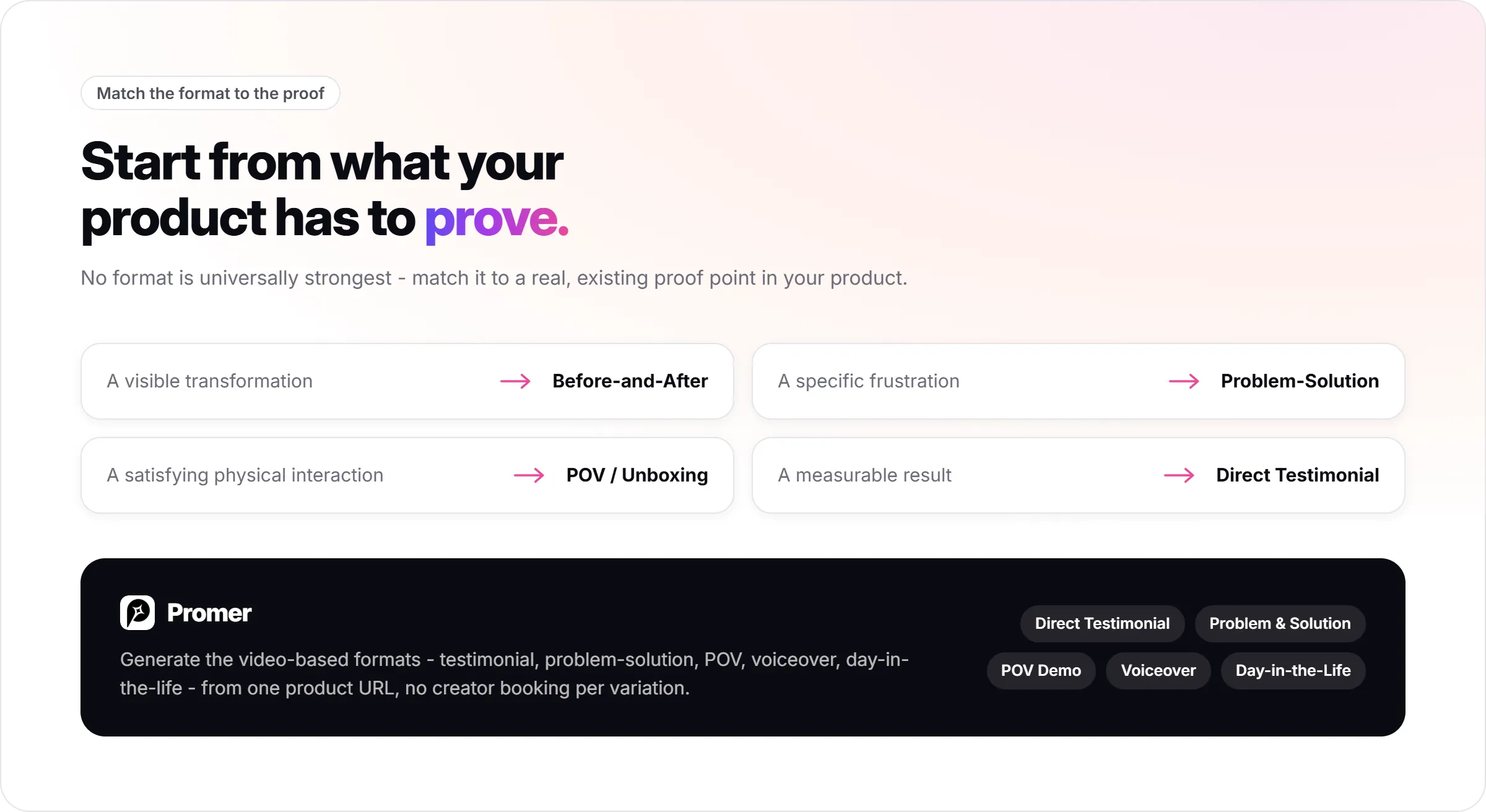
Producing several of these formats to test against your own audience is where the real bottleneck usually shows up - booking a creator for every format on this list means a dozen separate production cycles. How to make AI UGC videos covers a faster path for the video-based formats on this list, generating a script, AI model, and voice directly from a product without booking a creator for each variation.
An AI ad generator built for ecommerce products can produce a first version of most of these examples directly from a product page.
FAQs about UGC Ad Examples
What's the most effective UGC ad format?
There's no single most effective format - it depends on what your product needs to prove. Testimonial and problem-solution are commonly cited as the most reliable starting points across ecommerce categories generally, but a product with a strong visual transformation often performs better with before-and-after, and a product with a satisfying physical interaction often performs better with a POV demo or unboxing.
Testing two or three formats against your own audience is more reliable than assuming one format from a general ranking will work for your specific product.
Are photo-based UGC ads as effective as video?
For certain use cases, yes. UGC-style photo carousels and review-to-static screenshot ads have grown in use because they're faster and cheaper to produce than video, and they let viewers control their own pace through the content. They tend to work particularly well for before-and-after content and multi-angle product shots.
Video still tends to carry more weight for formats that depend on a genuine reaction or spoken demonstration, like unboxing or testimonial, where the motion and voice are part of the proof.
Can AI-generated UGC replicate these examples?
Yes, for most of the video-based formats on this list. Testimonial, problem-solution, POV demo, voiceover review, and day-in-the-life can all be generated from an AI model, voice, and script rather than filmed with a real creator, following the same structural logic as the human-filmed version.
Formats built specifically around a genuine, unscripted reaction - like unboxing - are a harder fit for AI generation, since the format's credibility depends partly on the reaction being real and unplanned.
How many UGC ad examples should I test before picking one?
There's no fixed number, but testing three to five formats that plausibly fit your product's actual proof point is a reasonable starting range, rather than testing every format on this list at once. Isolating the format as the one changing variable, while keeping the offer and targeting fixed, makes it possible to tell which format actually drove a performance difference.
Do these UGC ad examples work on every platform?
The formats themselves translate across TikTok, Instagram, and Facebook, since the underlying proof logic doesn't change by platform. What changes is pacing and length - a format built for a 30-second TikTok watch-through often needs trimming for a Stories placement, where a faster hook matters more than a fully developed narrative.
Do I need a professional creator to produce these examples?
No - several of these formats, particularly review-to-static and the photo carousel, require no filming or creator at all. Others, like testimonial and problem-solution, can be produced with a paid UGC creator, sourced from real customers, or generated with AI, depending on your budget and how much control you need over the script.
The format itself doesn't dictate the source - the same testimonial structure can come from a genuine customer, a hired creator, or an AI-generated video, each with different tradeoffs in cost, control, and trust.