Meta Andromeda is the AI system that decides which ads Meta even considers showing each person, and it changed who wins on Facebook and Instagram.
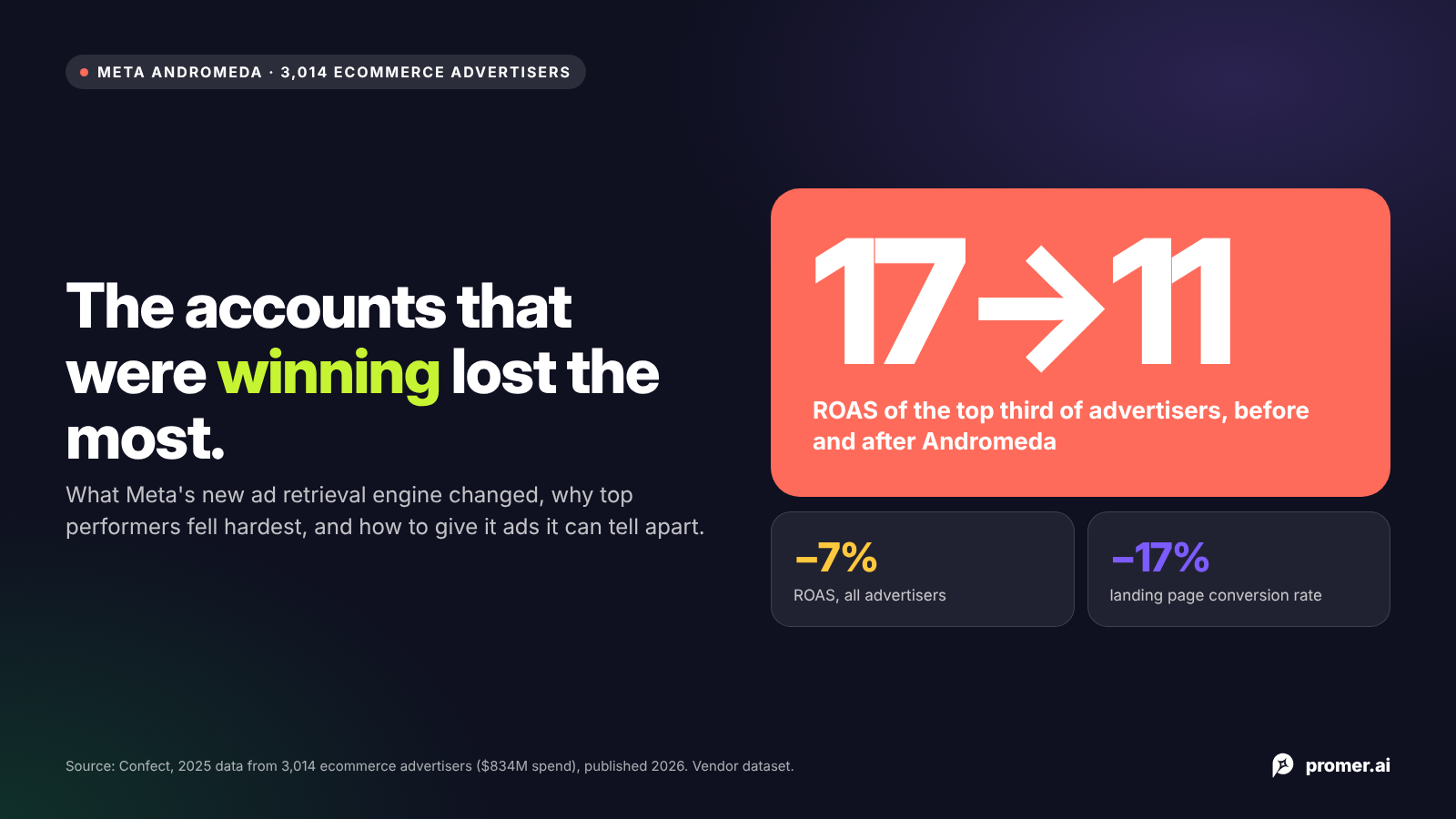
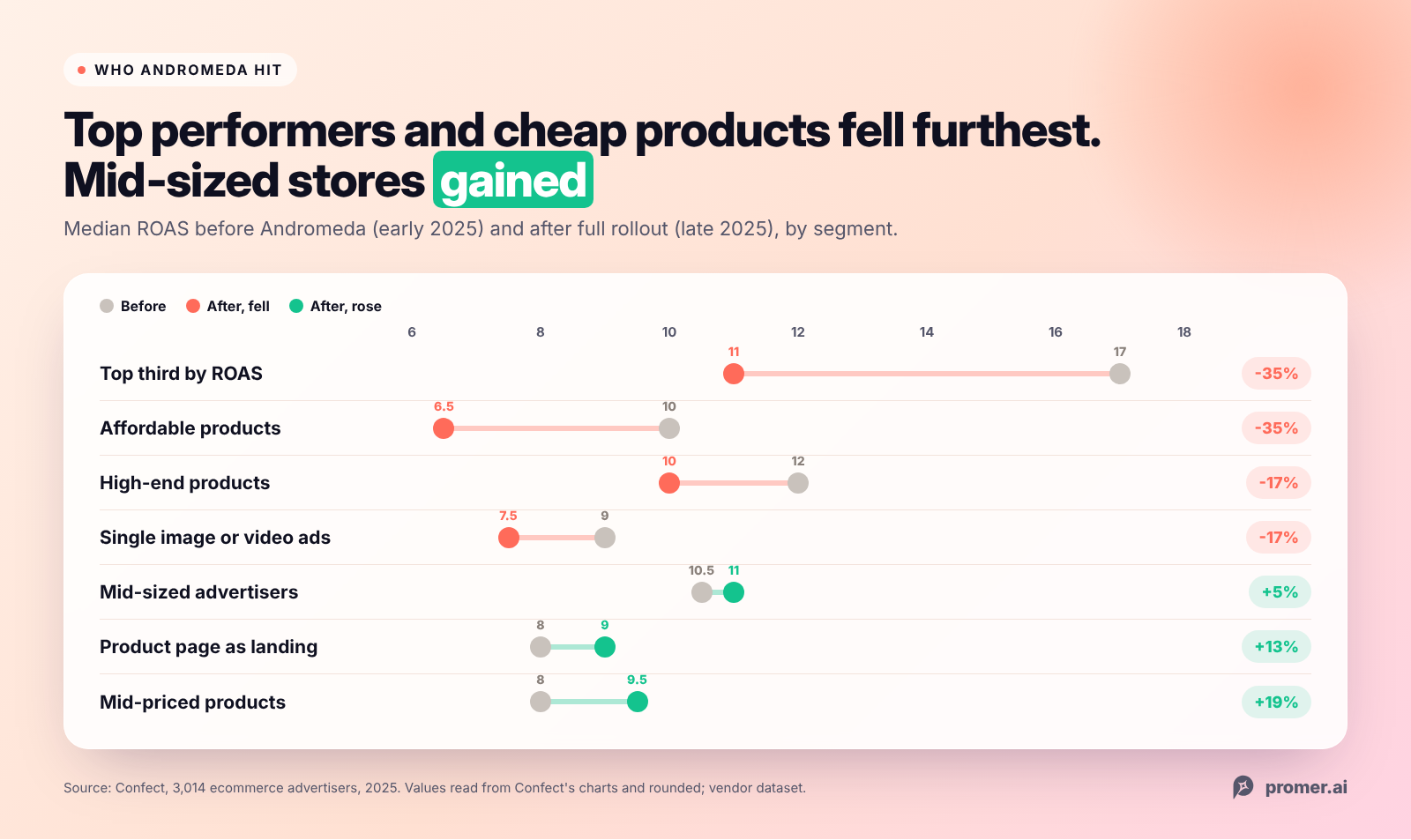
When a vendor study tracked 3,014 ecommerce advertisers through the 2025 rollout, the average store lost 7% of its ROAS. The top third lost far more: Their median ROAS fell from about 17 to about 11.
That's the uncomfortable part. The accounts that had the platform figured out, with a few proven ads and tight targeting, were exactly the ones the new system punished. Mid-sized advertisers with more varied ads came out slightly ahead.
This guide explains what Andromeda actually does (from Meta's own engineering posts), why the best accounts fell hardest (including the part that's just statistics), and how to audit your ads so the system has real options to work with, whether you shoot them yourself or build them with an AI ad generator.
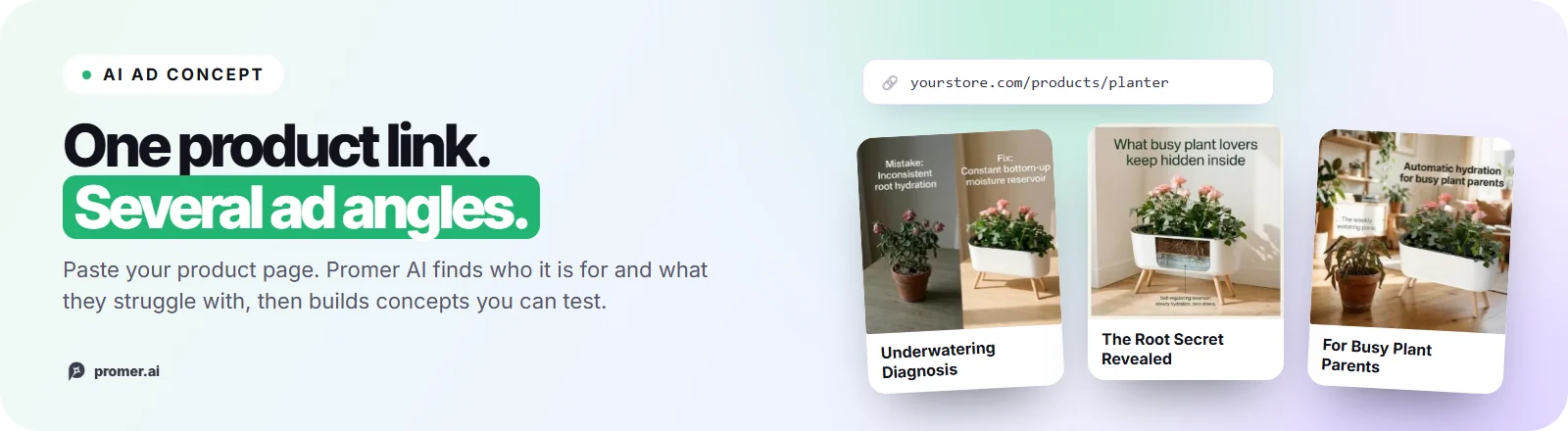
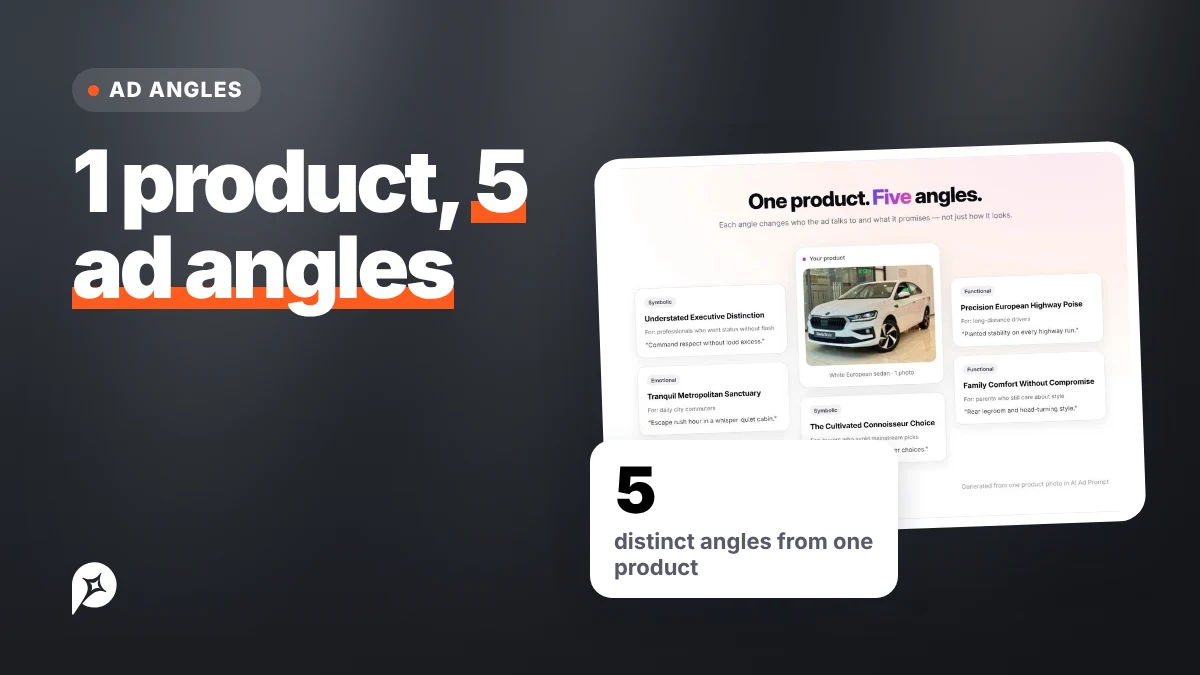
Short on distinct concepts? Promer AI's AI Ad Concept reads one product link and returns several angles built for different buyers, ready to test as separate ads.
Andromeda is a retrieval system: It shortlists the few thousand ads worth ranking for each person. Meta says it runs 10,000x more model capacity than the system it replaced.
In the 3,014-advertiser study, ROAS fell 7% on average and landing page conversion rate fell 17%. The top third of advertisers dropped about 35%.
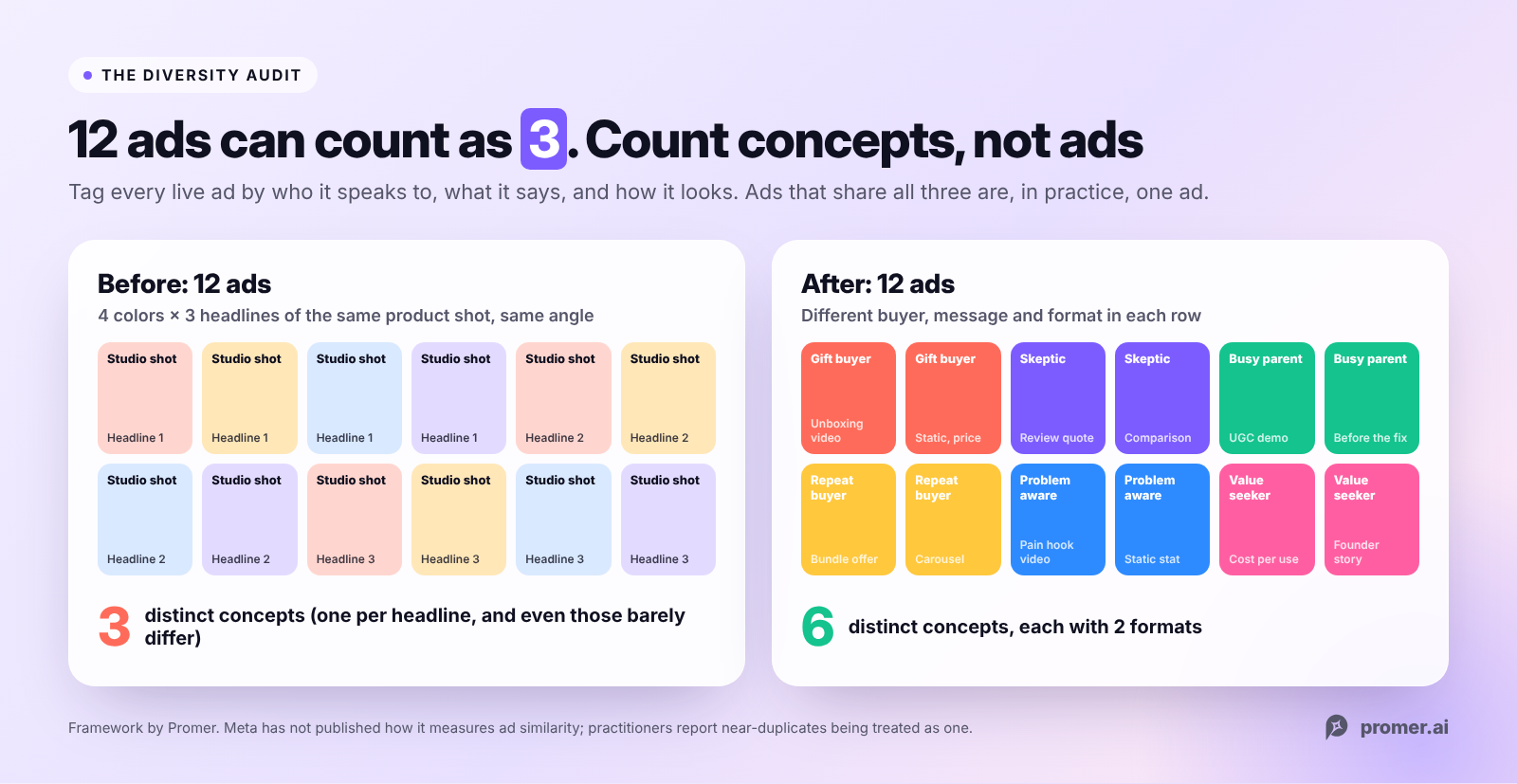
Ads that look alike compete for the same slots. Twelve variations of one product shot can behave like one ad.
Count concepts, not ads: Who the ad speaks to, what it says, and what format it uses.
Meta reports Andromeda lifted Facebook conversions 2.4% since 2025. Platform-wide gains and your account's ROAS are different things.
How does Meta Andromeda work?
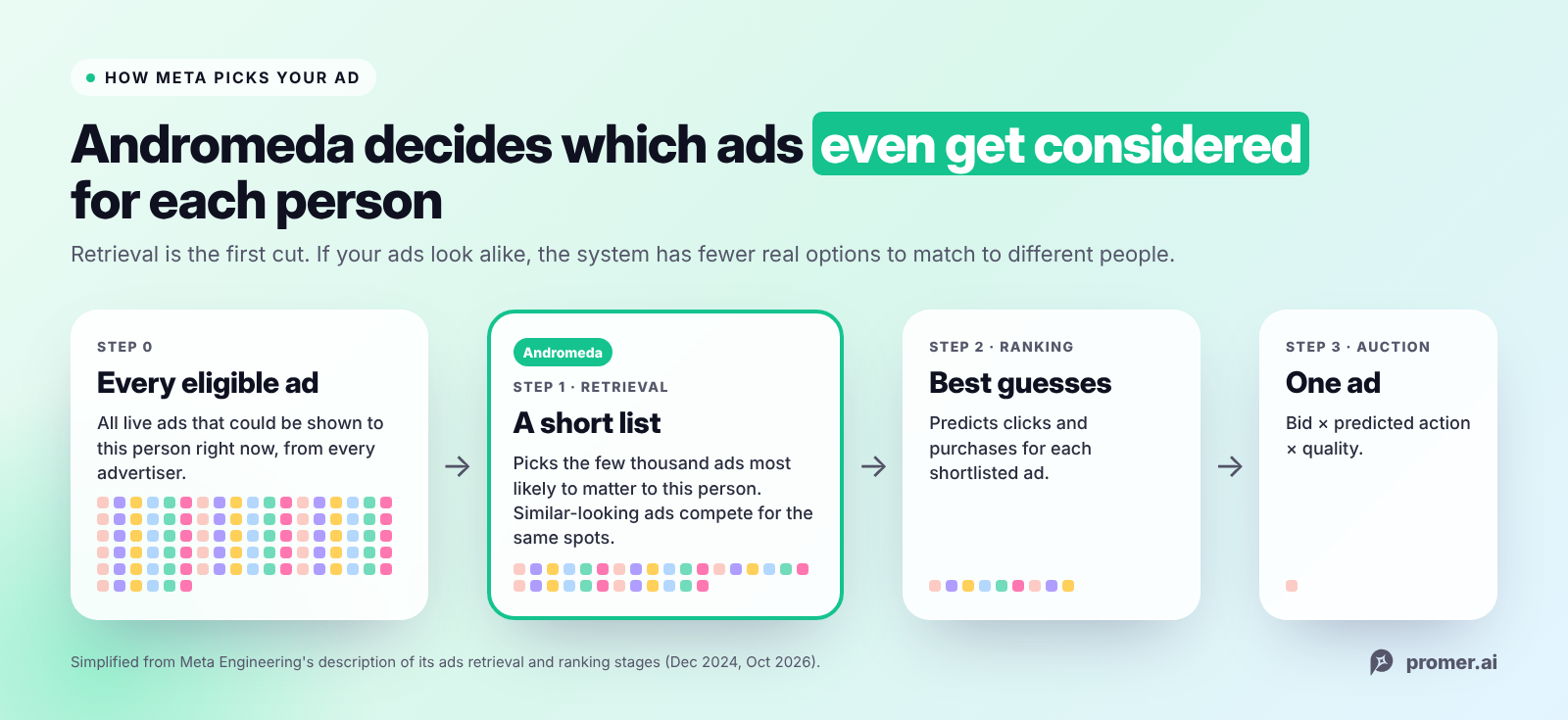
Every time someone opens Facebook or Instagram, Meta has to pick one ad from millions that could be shown. It can't run its expensive prediction models on all of them, so it works in stages.
First a retrieval step shortlists a few thousand candidates. Then ranking models predict who will click and buy. Then the auction picks the winner.
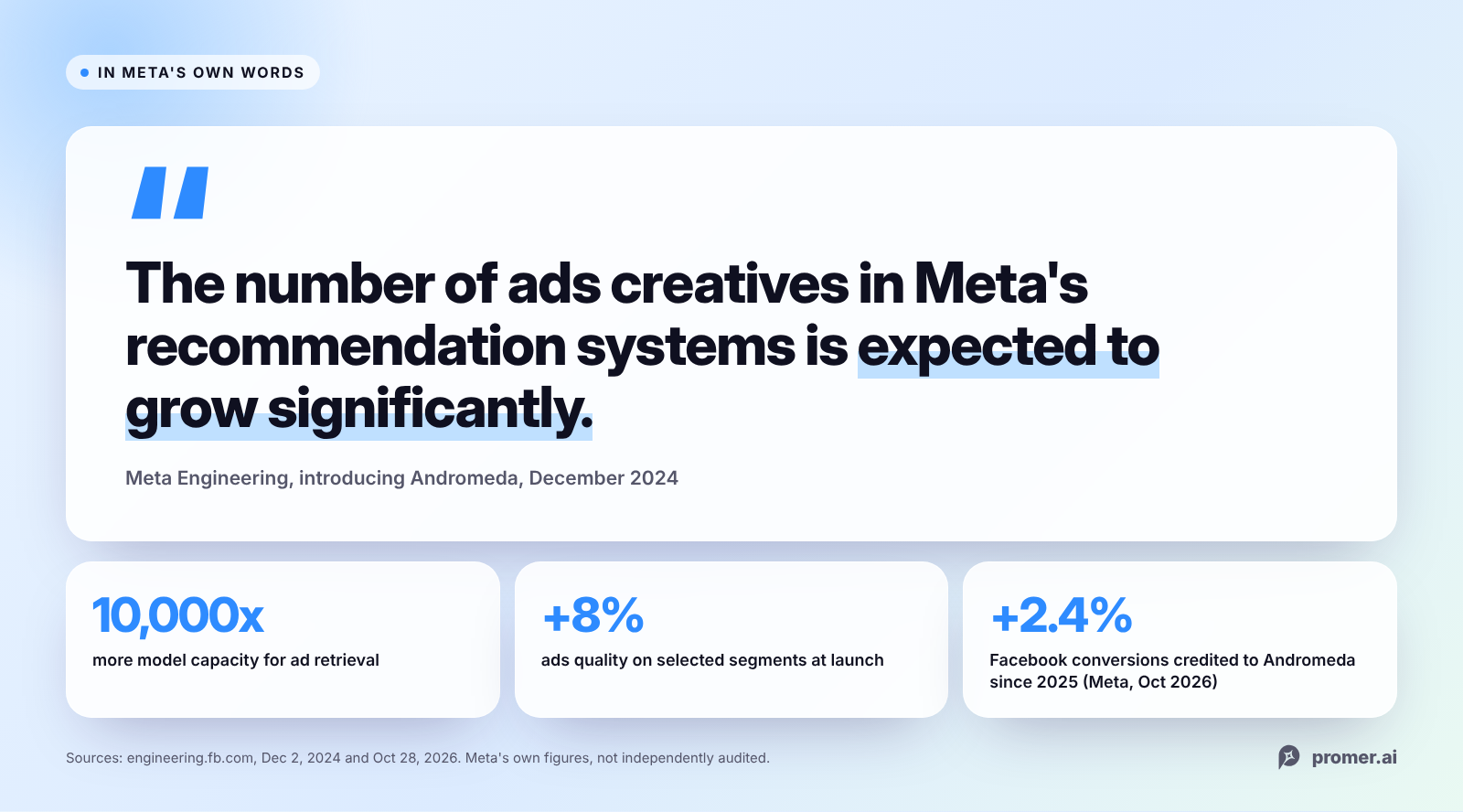
Andromeda is the retrieval step. Meta introduced it in an engineering post in December 2024, describing a 10,000x increase in model capacity, a 6% improvement in recall and an 8% improvement in ads quality on selected segments. It was rolled out to accounts in waves through 2025 and was fully live by October 2025.
The reason Meta built it is in that same post. Generative AI tools were about to flood the system with ads, and the old retrieval step couldn't keep up. Whether those AI-generated ads actually work is a separate question, but their volume is why Andromeda exists.
In October 2026, Meta's engineers reported that Andromeda has delivered a 2.4% increase in Facebook conversions since 2025, and the Q3 2026 earnings call credited it with a 1.4% lift that quarter.
Those are platform-wide numbers. A system that produces more conversions overall can still spread them differently across advertisers, and that's what the advertiser data shows.
For a store owner, the practical change is this: Targeting settings matter less, and your ads do more of the targeting. Retrieval looks at the ad itself (the image, the words, the format) to decide who it might fit. If all your ads say the same thing to the same person, you've given it one option, however many ads you upload.
To see what real variety looks like in your category, the winning ad library shows long-running ads from top stores side by side.
Who got hit, and why did the best accounts fall hardest?
The largest public dataset on Andromeda comes from a catalog-ad software vendor. It tracked 3,014 ecommerce advertisers in 73 countries through 2025: $834 million in spend, about a million ads and 44.3 million purchases. It's a vendor's own customer base, so read it as strong evidence about ecommerce stores, not a census of Meta.
Across the whole group, ROAS fell 7%, from about 9 to about 8.4, and the landing page conversion rate fell 17%, from roughly 3.5% to 2.9%. Prospecting took most of the damage (down 13%), while retargeting barely moved. The drop came mostly in the first wave of the rollout.
Which segments lost and which gained?
The split by segment is where it gets interesting:
Top performers fell the most: The top third by ROAS went from about 17 to about 11.
Cheap products were hit as hard: Stores in the affordable price band fell about 35%, likely because a low order value can't absorb a higher cost per sale.
Single-asset ads lost ground: Ads with one image or one video fell about 17%, while formats with more variety held up better.
Mid-sized advertisers gained: Stores spending roughly $34,000 to $172,000 a year edged up, as did mid-priced products and ads that sent people straight to a product page.
Why would the best accounts do worst?
The study's explanation is that top performers relied on a handful of proven ads and precise targeting, and Andromeda deprioritizes both. That fits the mechanism: If retrieval matches ads to people by what the ad shows, an account with three near-identical winners has very few ways to reach someone new.
There's a second explanation, and it's worth being honest about. When you pick the top third of anything in one period and measure them again later, they usually fall, algorithm change or not.
Part of every unusually high ROAS is luck, and luck doesn't repeat. Statisticians call it regression to the mean. The study doesn't say whether its numbers correct for this, so some of that 35% drop would have happened anyway.
The practical lesson survives either way. Accounts that depended on one angle and one audience had the most to lose, and the stores that held up were running more varied ads to broader audiences. Even turning one concept into Feed, Reels and Story versions with an AI Instagram ad generator adds a little of that variety.
Creative diversity: What counts as "different" to Meta?
Meta's advice since Andromeda boils down to two words: Creative diversification. The hard part is knowing what counts as different.
Meta hasn't published how it measures similarity between ads, but practitioners consistently report the same thing. According to Common Thread Collective, near-duplicates are treated as one ad. Ten crops of the same studio shot may get one ad's worth of delivery.
A useful test: If you covered the logo, would a shopper think these were two different ads? Changing the background color or swapping the headline font fails. Changing who the ad speaks to passes.
The creative diversification guidance Jon Loomer summarizes from Meta points to four axes:
Persona: Who is this for? A gift buyer, a skeptic, a busy parent and a repeat customer need different ads.
Message: What's the reason to buy? Result, problem, price, proof, or story.
Format: Static image, video, carousel, UGC-style talking head, catalog ad. An AI UGC video generator can add the talking-head format without a creator.
Visual: A noticeably different scene, person or composition, not a recolor.
How do you run a 15-minute diversity audit?
Export your live ads from Ads Manager and add three columns: Persona, message, format. Fill them in honestly. Then count unique combinations. That number, not the number of ads, is how many real options you're giving Andromeda.
If the count comes back at three or four concepts spread across a dozen ads, that's not a reason to make 50 more. It's a reason to make the next five ads different on purpose: One new buyer, one new reason to buy, one new format each time. An AI Facebook ad generator can build those five from one product URL.
How many distinct concepts are enough?
The advice varies a lot. The 3,014-advertiser study recommends 20 to 30 genuinely different creatives per ad set. Common Thread Collective suggests 8 to 12 new distinct creatives a month for accounts spending under $10,000 a month. Jon Loomer warns that 50 ads in an ad set guarantee nothing.
For a small store, a realistic target is 6 to 10 distinct concepts live, with two or three new ones each week. If you need a starting list, these approaches to generating multiple ad angles from one product are a fast way to fill the persona and message columns.
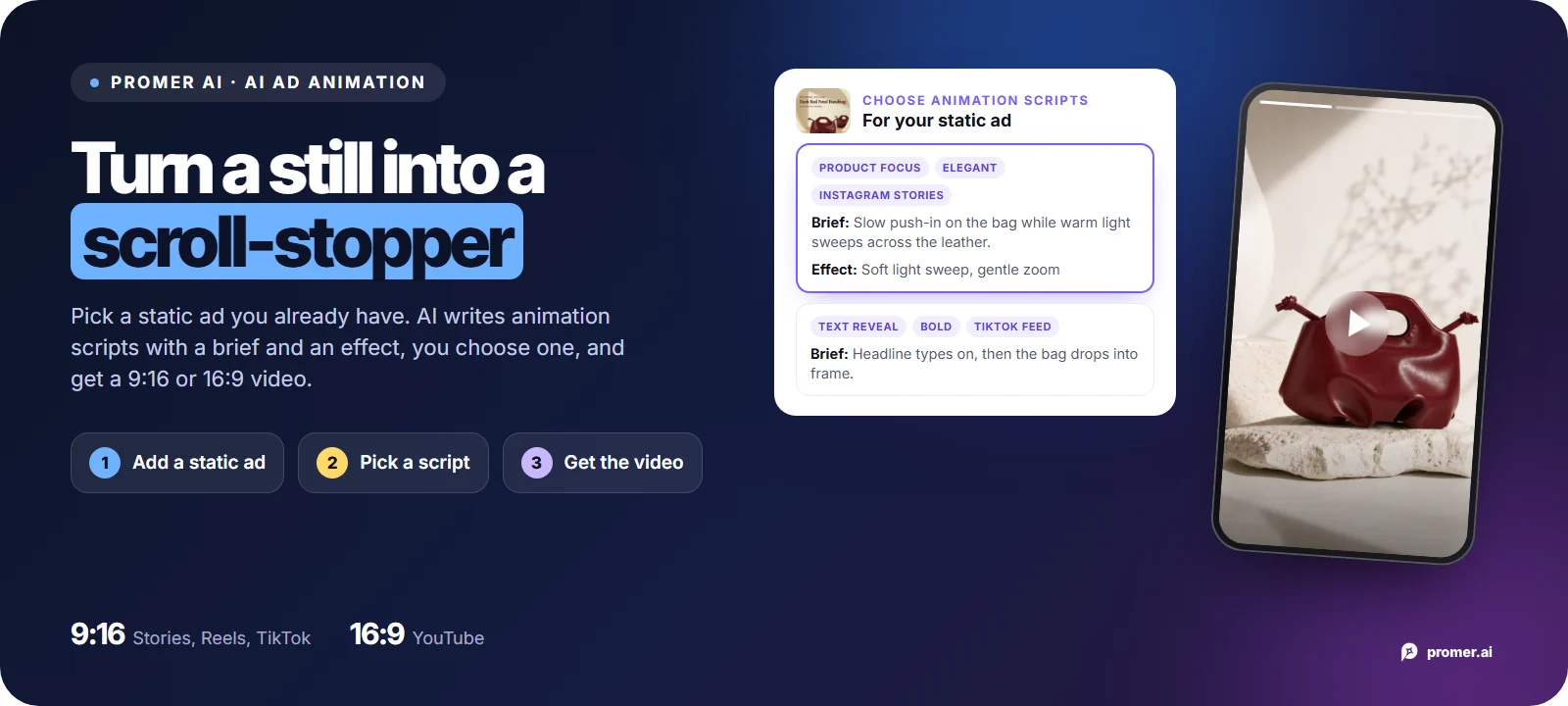
Every concept stuck in one format? Promer AI's AI Ad Animation turns a static concept into a short 9:16 video, so one angle can fill a second row of your audit.
How should you structure and test ads after Andromeda?
If the ads do the targeting, the account structure should get out of their way. The changes most practitioners agree on:
Fewer, broader ad sets: The same study cites a test where one ad set with 25 diverse creatives produced 17% more conversions at 16% lower cost than the same budget split across five narrow ad sets. It's a single test without a disclosed sample, so treat it as a direction, not a law.
Broad targeting over stacked interests: Lebesgue data cited in the study found broad targeting delivered 49% higher ROAS than lookalikes.
Send people to the product page: Product page landings gained in the study's data while category pages fell 24%. Too many choices on arrival costs sales.
Refresh faster: The study estimates creative lifespan has shortened from 6 to 8 weeks to 2 to 4 weeks. Plan for a steady trickle of new concepts rather than a big refresh every quarter.
How should small budgets test new concepts?
Testing changes too. Splitting each new ad into its own ad set to "isolate" it fights the system.
A simpler approach for small budgets: Keep one evergreen ad set with your proven concepts, add new concepts to it every week, and judge each concept on spend share and cost per purchase after it has had a fair amount of delivery. Our guide to ad creative testing for ecommerce covers how to read those results without over-reacting.
When a concept wins, make new versions that change the format or the visual but keep the angle. When it fades, don't tweak the color. Replace it with a different idea.
How does Promer AI add concepts without more shoots?
The audit usually exposes the same bottleneck. Small stores don't lack ads, they lack different ideas, and every new concept used to mean a new brief, a new shoot or a new creator.
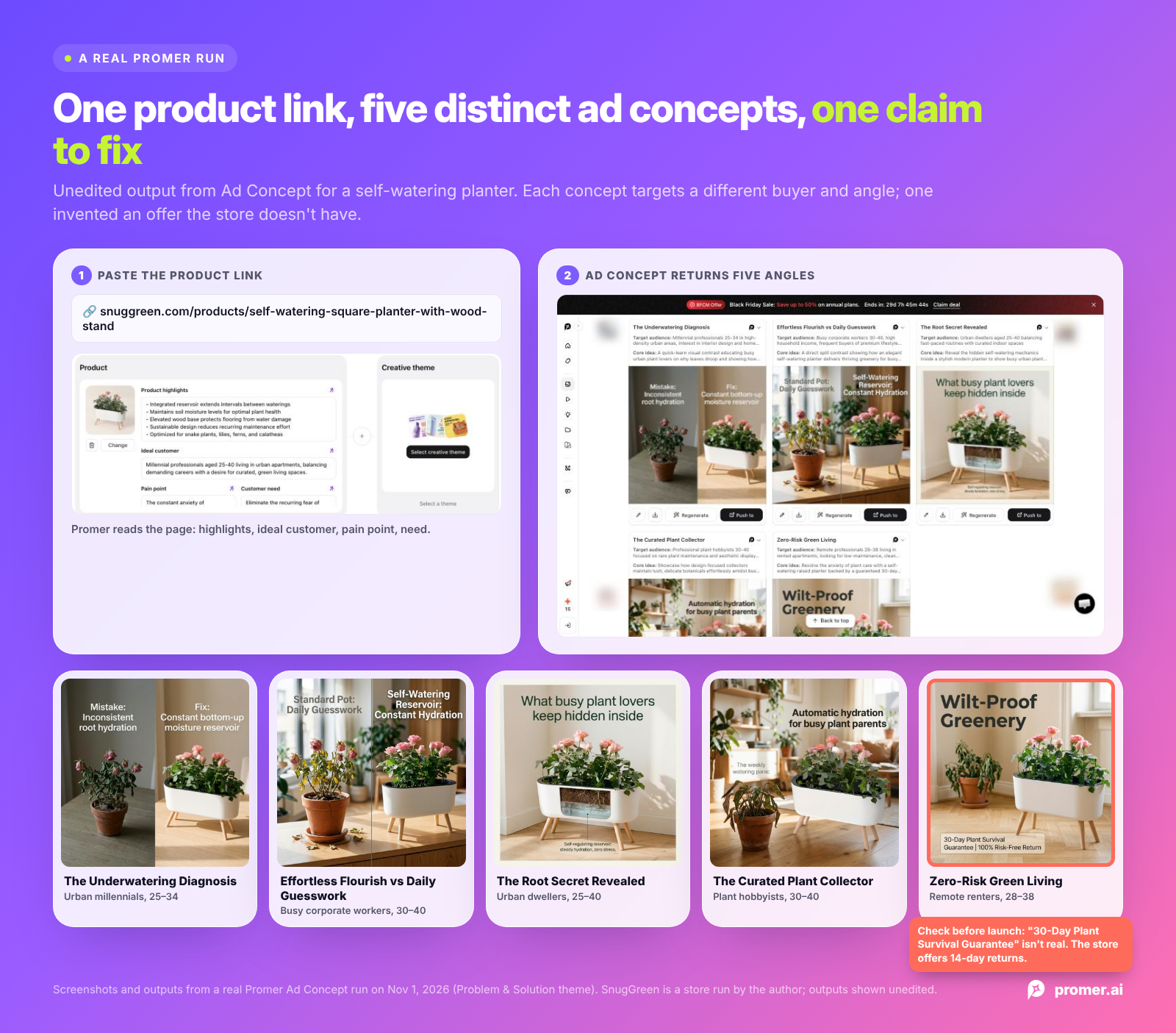
Promer AI is built for that gap. Paste a product link into AI Ad Concept and it reads the product, the likely buyers and their objections, then returns several angles aimed at different people: A gift angle, a problem angle, a proof angle and so on. Each one is a separate concept, which is exactly what fills the persona and message columns in your audit.
In this real run for a self-watering planter, the five concepts targeted five different buyers with five different angles: A mistake-and-fix diagnosis, a side-by-side comparison, a cutaway of the hidden reservoir, a collector's lifestyle shot and a risk-reversal offer. In audit terms, that's five rows filled from one link.
One caveat from the same run: The risk-reversal concept invented a 30-day guarantee the store doesn't offer, so the offer line had to be rewritten before use.
To cover the format axis, AI Ad Animation turns a static concept into a short 9:16 video, and AI UGC Ads gives you a talking-head version without booking a creator.
The usual rule still applies: Check every generated ad for product accuracy before it goes live, and treat a new concept as a test, not a guaranteed winner.
FAQ
What is Meta Andromeda?
Andromeda is Meta's ad retrieval system: The first stage that shortlists which ads are worth considering for each person before ranking and the auction. Meta introduced it in December 2024 with a 10,000x increase in model capacity, rolled it out through 2025, and reports it has lifted Facebook conversions 2.4% since 2025.
When did the Andromeda update roll out?
Meta announced it in December 2024. Advertisers were moved over in waves during 2025, with roughly 18% to 42% of accounts enrolled early in the year and 58% to 82% by mid-year, according to the 3,014-advertiser study. It was fully deployed by October 2025.
Why did my Facebook ads get worse after Andromeda?
In the 3,014-advertiser study, average ROAS fell 7% and landing page conversion rate fell 17%, with prospecting hit hardest. Accounts that relied on a few similar ads and narrow targeting dropped the most. Audit how many truly different concepts you run, broaden targeting and send traffic to product pages.
How many creatives should I have per ad set after Andromeda?
There's no official number. Recommendations range from 8 to 12 new distinct creatives a month for small accounts (Common Thread Collective) to 20 to 30 per ad set (the 3,014-advertiser study). For a small store, 6 to 10 distinct concepts live with two or three new ones a week is a realistic start. Variety matters more than count.
Does Andromeda make audience targeting useless?
Not useless, but less important. Retrieval leans on the ad itself to find the right people, so broad targeting usually works better than stacked interests. Lebesgue data cited in the 3,014-advertiser study showed broad targeting beating lookalikes by 49% on ROAS. Exclusions and location settings still matter.
Do Advantage+ campaigns work better with Andromeda?
Andromeda was designed to power Advantage+ automation, and it works best when the system has many distinct ads to choose from. Advantage+ with three similar ads gives it little to work with. Feed it varied concepts and formats, and judge results on cost per purchase over a few weeks.
The short version
Andromeda didn't make ads matter less. It made them matter more, because the ad is now how Meta decides who sees it. The accounts that fell hardest had polished a few winners for a narrow audience. The ones that held up gave the system real variety.
Run the 15-minute audit, count your concepts, and make the next ones different on purpose.
Sources
Meta Engineering: Meta Andromeda: Supercharging Advantage+ automation with the next-gen personalized ads retrieval engine - https://engineering.fb.com/2024/12/02/production-engineering/meta-andromeda-advantage-automation-next-gen-personalized-ads-retrieval-engine/ - accessed 2026-11-02
PPC Land: Meta says Andromeda lifted Facebook conversions 2.4% since 2025 - https://ppc.land/meta-says-andromeda-lifted-facebook-conversions-2-4-since-2025/ - accessed 2026-11-02
Common Thread Collective: Meta Andromeda, ROAS and creative strategy in 2026 - https://commonthreadco.com/blogs/coachs-corner/meta-andromeda-roas-creative-strategy-2026 - accessed 2026-11-02
Jon Loomer: Meta Andromeda and creative diversification - https://www.jonloomer.com/meta-andromeda-creative-diversification/ - accessed 2026-11-02
Confect: Meta Andromeda in 2026, data from 3,014 ecommerce advertisers - https://confect.io/tactics/meta-andromeda-2026 - accessed 2026-11-02
Nana Phan has 16 years of experience across marketing, ecommerce, and SaaS, including running her own dropshipping business and nearly 8 years at FireGroup working on products for online merchants. Her experience spans both selling online and building software for the people behind those businesses.
As Head of Growth at Promer AI, she works across customer research, product, and marketing. She writes about ecommerce growth, ad creative, and practical applications of AI, informed by firsthand experience and conversations with merchants about the challenges they face.
You may also like
Meta Andromeda: Why Top Advertisers Lost Most?
Top advertisers' ROAS fell from 17 to 11 after Meta Andromeda. What changed, who lost, and a 15-minute audit to check how many real ads you're running.