The Reels Flood: How Small Stores Get Millions of Views With One Product?
Open the reels tab of some fast-growing stores and you'll notice something odd. It's the same product, again and again.
A plush gift on an office desk. Then in a police car. Then in a classroom, then in grandma's living room. A zip hoodie in front of a cathedral, then on a snowy mountain, then on a store rack.
No celebrity. No studio. Just dozens of short videos of one product, posted week after week. And a few of them pull 2 million views. One pulled 5.3 million.
It looks like luck. It isn't. It's a system, and once you see the parts, you can run it for your own store. This guide breaks down two stores doing it, the math behind it, the hooks they reuse, and a 30-day ecommerce Reels strategy you can start this week, even without a content team.
Key takeaways
- Most reels flop. In the two grids we studied, 7 of 38 reels pulled 85% of all the views.
- You can't predict the winner, so you plan for volume: one product, many hooks, many scenes.
- The hook speaks to a person ("Don't show this to a Christmas fan"), not a feature.
- The hard part is keeping up. A good workflow turns one product into a month of reels in an afternoon.
- Views aren't sales. Track saves, shares, link clicks and orders, then turn organic winners into ads.
What the reels flood looks like in practice?
Here are two stores in completely different niches. Neither is a household name. Both run the same play.
Store #1: A novelty plush gift
The product is a holiday plush with a tissue holder built in. It's a gag gift, the kind you buy for a coworker or your dad.
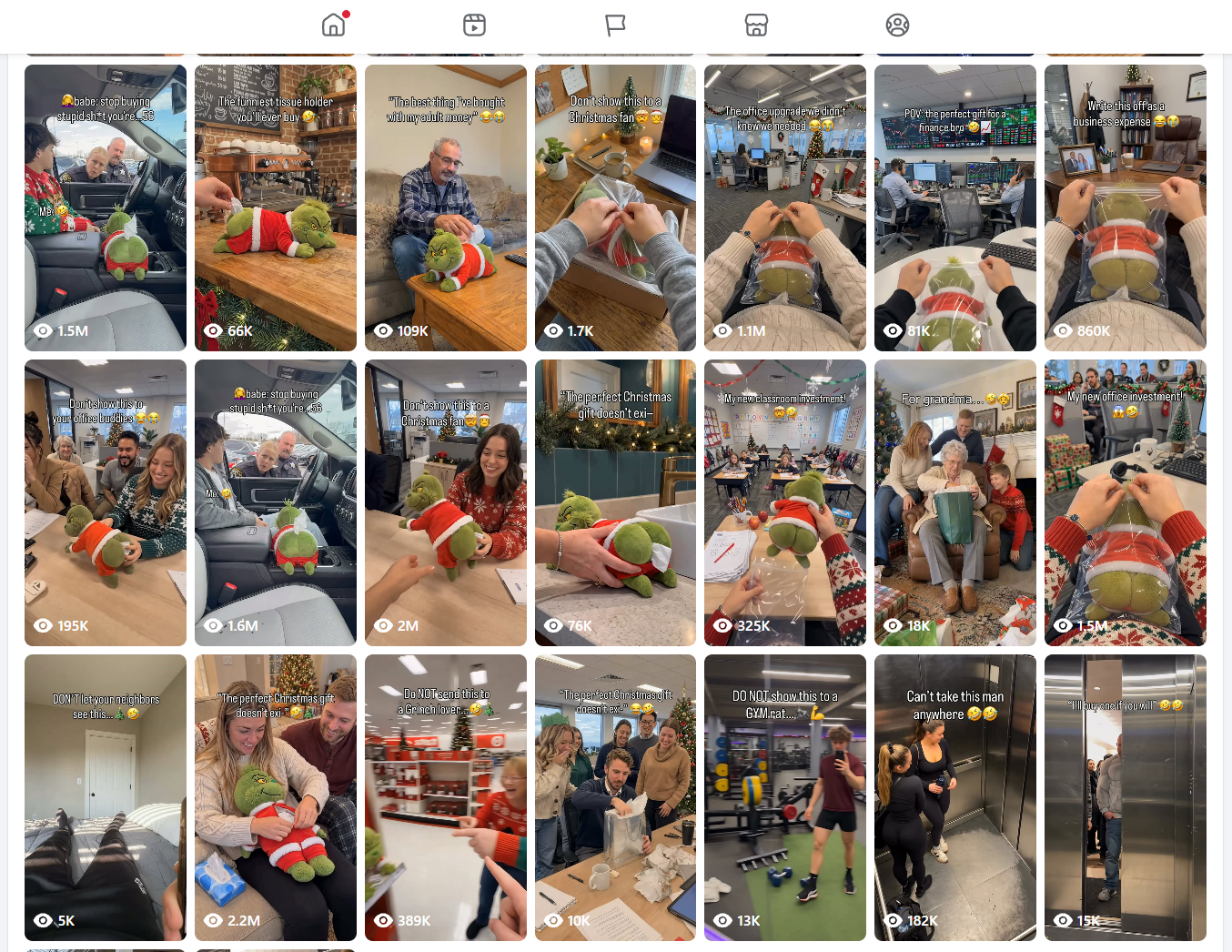
The store puts it in every setting a buyer might recognize: an office, a library, a bathroom, a car at a traffic stop, a trading floor, a classroom, a family living room. Some videos are just two hands opening it from a plastic bag.
The on-screen text does most of the selling:
- "Don't show this to a Christmas fan"
- "Babe: stop buying stupid stuff. Me:"
- "Write this off as a business expense"
- "POV: the perfect gift for a finance bro"
- "The perfect Christmas gift doesn't exi—"
Store #2: A faith-inspired zip hoodie
The product is a full-zip hoodie with a cross on the hood and gold thorn embroidery. Same play, different buyer.
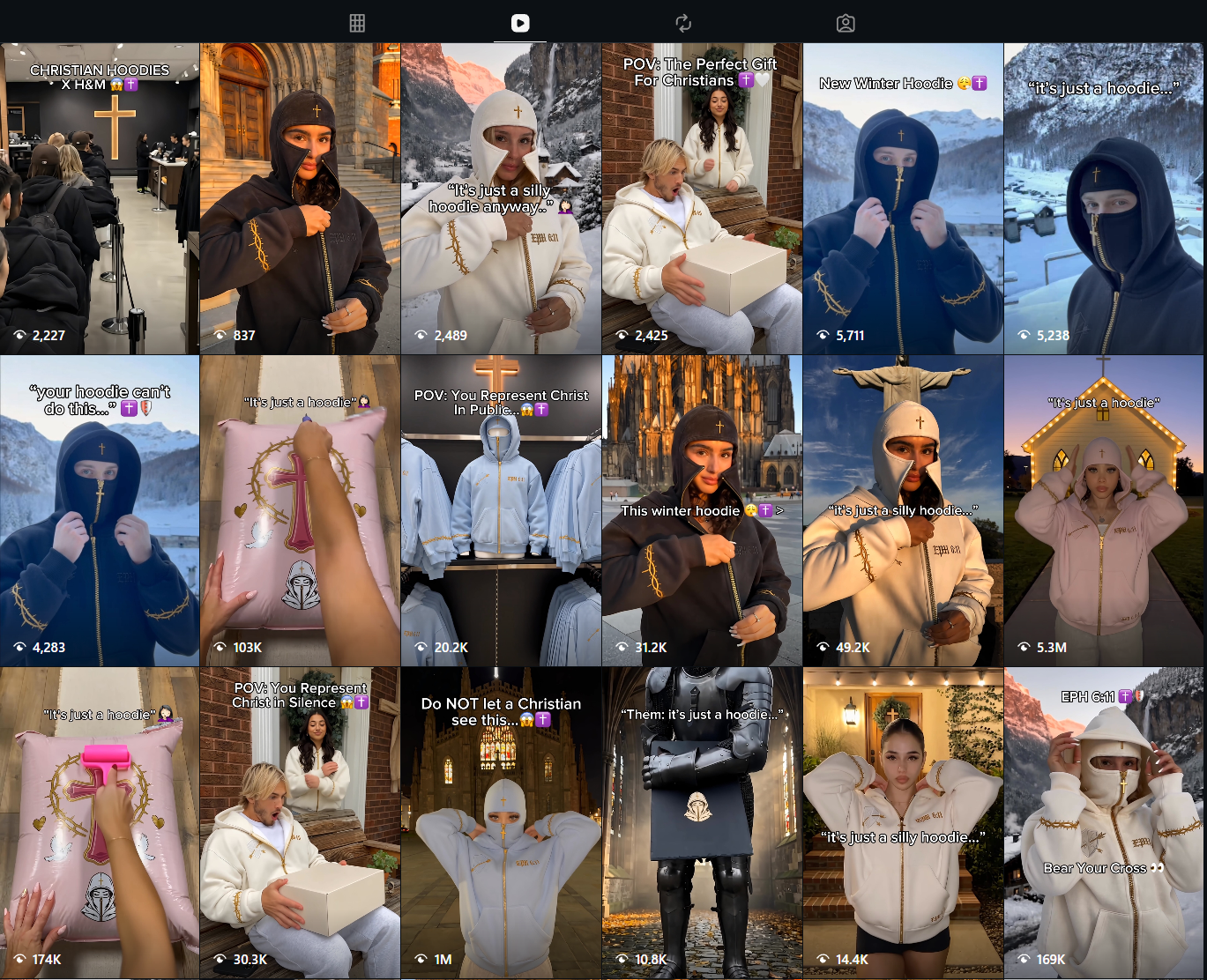
The backdrop keeps changing: a gothic cathedral, a giant statue of Christ, a snowy mountain, a small chapel, a store rack. One video puts the hoodie on a knight in armor. Others are pure unboxing, with the hoodie vacuum-packed in an oversized printed pouch.
And a handful of hooks repeat across almost every video:
- "It's just a hoodie..."
- "POV: You represent Christ in public"
- "Do NOT let a Christian see this"
- "Them: it's just a silly hoodie"
Two stores, two audiences, one pattern: keep the product the same, keep changing the reason to watch.
The numbers: Most reels flop, a few carry everything
Here's every visible reel from both grids, sorted by views.
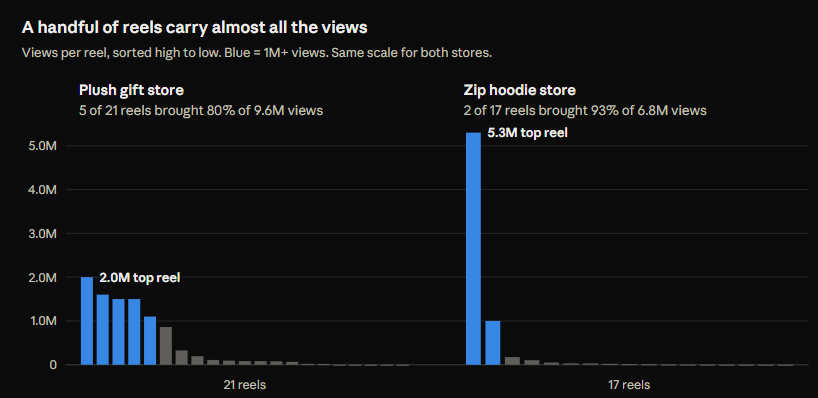
Read that twice. For the hoodie store, 2 of 17 reels brought in 93% of the views, while 7 of its reels didn't reach 6,000. For the plush store, 5 of 21 reels drove 80%. Across both grids, 7 of 38 reels pulled 85% of all the views.
That's the whole strategy in one picture: you don't know which bar will shoot up, so you need a lot of bars.
Why do some reels go viral? You can't pick the winner, so you buy more tickets
Some reels go viral because the first small group of people who see them watch to the end, rewatch, and send them to friends, so the platform keeps showing them to bigger groups. Nobody can predict which reel that will be, which is why the stores above post so many.
Most merchants treat social like a photoshoot. Plan one great video, polish it for a week, post it, hope. The stores above work differently, because of how the feed hands out reach.
How a reel gets picked up?
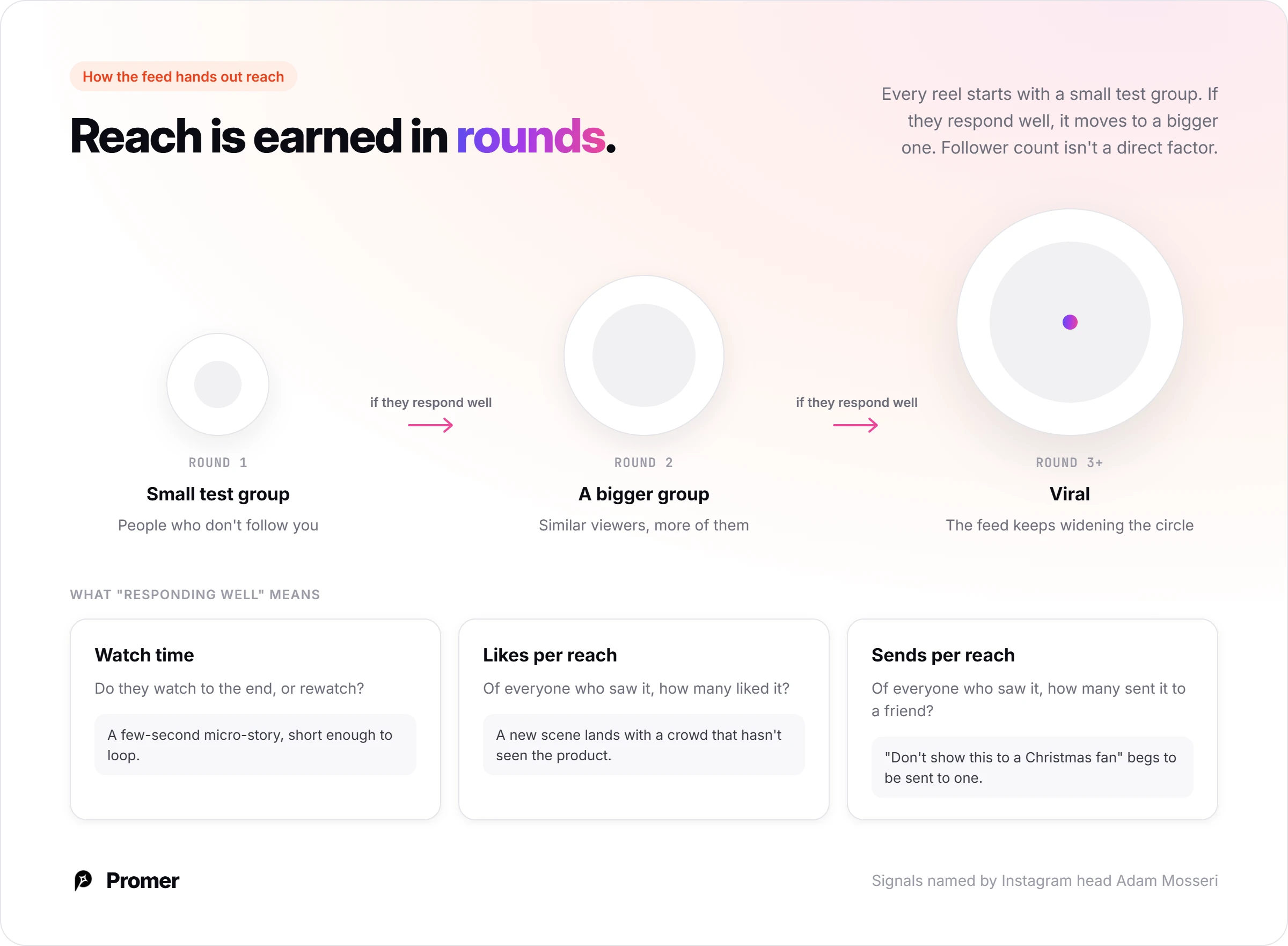
According to Instagram, a reel is first shown to a small group of people who don't follow you. If they respond well, it reaches more people, based on engagement rather than follower count.
TikTok says the same: follower count and past hit videos aren't direct factors in what it recommends.
So what counts as responding well? Instagram's head, Adam Mosseri, has named the 3 signals that matter most: watch time, likes per reach, and sends per reach. Look at the two stores again with that in mind:
- Watch time: Each reel is a few-second micro-story, short enough to rewatch.
- Sends: "Don't show this to a Christmas fan" is an invitation to send it to one.
- Likes per reach: The scene changes, so each video lands with a new crowd that hasn't seen the product yet.
Every reel is a lottery ticket
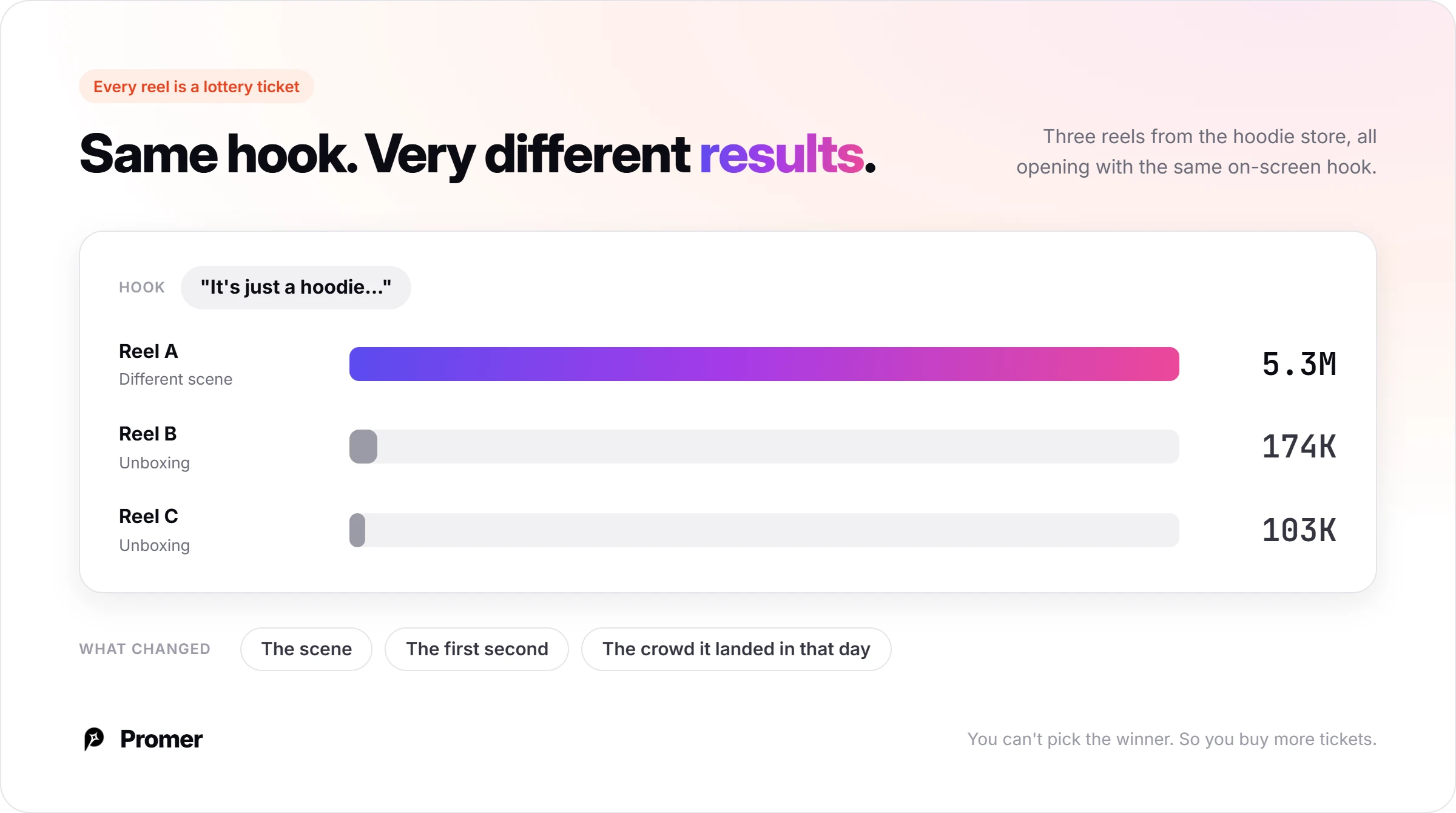
Every reel is a separate lottery ticket, and nobody knows in advance which one wins. The hoodie video that hit 5.3M used the same "It's just a hoodie" hook as two unboxing videos that stopped at 103K and 174K. What changed was the scene, the first second, or the crowd it landed in that day.
That changes the goal. You're not trying to make one perfect video. You're trying to make it cheap to post a lot of good ones, then double down on whatever takes off. Three things follow:
- Low-view videos stop hurting. A reel with 231 views cost you an hour. The 2M-view reel pays for all of them.
- Repetition builds recognition. See the same hoodie in five scenes over one week and it stops being an ad. It becomes that hoodie. That's branding, and you didn't pay for it.
- Winners become your ads. A reel that already pulled a million organic views is a tested creative. Put budget behind it and skip most of the guesswork.
Why your reels aren't going viral (yet)?
If your reels stall at a few hundred views, the cause is usually one of these:
- Too few tickets. 5 reels a month gives the feed 5 chances. The stores above posted dozens.
- A slow first second. If the hook isn't on screen right away, sound-off scrollers swipe before they see it.
- A feature hook. "Soft polyester blend" doesn't get sent to anyone. A hook that names a person does.
- Watermarks and reposts. Instagram says it shows fewer watermarked, low-resolution, or already-posted reels. Export clean files, and don't re-upload clips from other accounts.
- Judging too early. Most early reels land under 10K views. That's the base rate, not a verdict on your product.
The 6 mistakes below cover the rest.
Why now: Platforms are rewarding original content
There's a timing argument too. In March 2026, Meta said views and watch time for original Reels on Facebook roughly doubled in the second half of 2025 compared with the same period a year earlier. Content a Page films or produces itself counts as original. Reposted or lightly edited clips from other accounts get pushed down.
For a store, that's good news. Videos you make about your own product are exactly the kind of content the feed is trying to show more of.
What views don't prove?
One honest caveat before we go further. A view count tells you a video was played, not that anyone bought. From a public grid, you can't see how much reach was paid, how many orders came in, or how the videos were made. Treat millions of views as proof that attention is available, then measure what turns it into sales (we'll cover that below).
Before you post: Set your brand frame
Volume without direction just makes noise. A feed full of random scenes gets views but leaves shoppers unsure what you actually sell.
So before you make a single reel, write down 3 things:
| Decide | Question | Example: a soy candle brand |
|---|---|---|
| The buyer | Who should feel this product is for them? | Renters trying to make a small apartment feel cozy |
| The feeling | What should they remember it for? | The Sunday reset: clean room, candle lit, phone down |
| The signature |
Now every reel has a job: show the signature, speak to the buyer, leave the feeling. A close-up, a room scene and a gift unboxing can all look different and still build the same brand.
Selling many unrelated products? Start with one hero product or one collection. It's far easier to build a series when every post clearly belongs on the same account.
The anatomy of a product reel that travels
Volume gets you tickets. These five ingredients make each ticket worth more. You'll find all five in almost every reel from both stores.
1. One hero product, not a catalog
In both grids, nearly every reel features the same product. Seen three times, a product gets recognized. Recognized products get searched, and searched products get bought.
2. The hook lives on screen
Many people scroll with the sound off, so the hook sits on screen in the first second, in big readable type. It isn't a caption. It's the headline of the video.
3. The hook names a person, not a feature
Nobody in these grids says "soft polyester blend" or "holds 100 tissues." They call out a person: a Christmas fan, a finance bro, a gym rat, your office buddies, a Christian. People share videos that say something about who they are, or about a friend. "Don't show this to a Christmas fan" is really an invitation to tag one.
4. Same product, new scene
The scene is the variable they test. Office, car, classroom, cathedral, mountain. Each new setting can reach a new buyer (teachers, office workers, gift shoppers) without changing the product or the hook. Several scenes are clearly staged, and it doesn't seem to hold them back. Viewers react to the joke or the feeling more than to the production.
5. One job, one tiny story
Each reel does one thing: get noticed, explain one feature, or give a reason to buy now. The best ones fit a micro-story into a few seconds: setup ("Babe, stop buying stupid stuff"), reveal (the plush on the passenger seat), payoff (a laugh, a reaction, an unboxing). Short enough to rewatch, which is exactly what the feed rewards.
One rule runs under all five: the product has to look like the real thing. Staged scenes are fine. A jacket shown as waterproof when it isn't, or a lamp with brightness settings it doesn't have, will cost you in refunds and reviews what it earned in views. When a claim depends on physical performance, show real footage.
How to turn one product into 30 reels?
This is the part most merchants get wrong. They think they need 30 ideas. They need 10 hooks and 3 scenes.
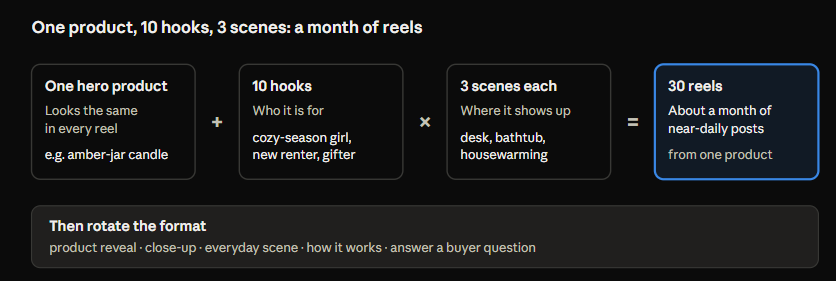
Keep the product fixed, change who it's for and where it shows up, and rotate the format so the feed never feels repetitive.
Here's that grid filled in for the candle brand: three buyer angles across five formats gives you 15 concepts before you've written a single hook.
Make a small batch first. Then let the results tell you which row and column deserve 10 more variations.
8 hook templates you can steal today
The hooks in these grids are templates. Swap in your buyer and your product, and you have weeks of on-screen text. Here they are, applied to our candle brand:
Drop these into the formula above: write 10 hooks, film each in 3 scenes, and you have 30 reels from one product. That's a month of near-daily posts.
The catch: Most stores can't keep up
On paper this sounds easy. In practice, it's where most small brands quit.
One reel means an idea, a hook, a location, props, filming, editing, text overlays, a caption, hashtags, and posting at the right time. Now do that 30 times a month, across Instagram, Facebook and TikTok, while you're also packing orders and answering support emails.
That's the real advantage these stores have. Not a secret hook, not a bigger budget. A production system that ships a new video most days without burning anyone out.
Most merchants hit one of three walls:
- The idea wall. After the first five videos, you run out of angles.
- The production wall. Filming one product in 15 locations isn't realistic for a two-person team.
- The consistency wall. You post daily for two weeks, life happens, and the account goes quiet for a month.
If you've hit any of these, the problem isn't your product or your creativity. You're running a volume strategy on a one-video-at-a-time workflow.
How to run the reels flood with Promer AI?
Promer AI is an AI ad maker built for exactly this kind of volume. You give it one product, and it handles the angles, the creatives, the captions and the posting calendar. Here's how each step knocks down one of the three walls, using one black hoodie as the example.
Step 1–2: Start from your product, not a blank page (the idea wall)
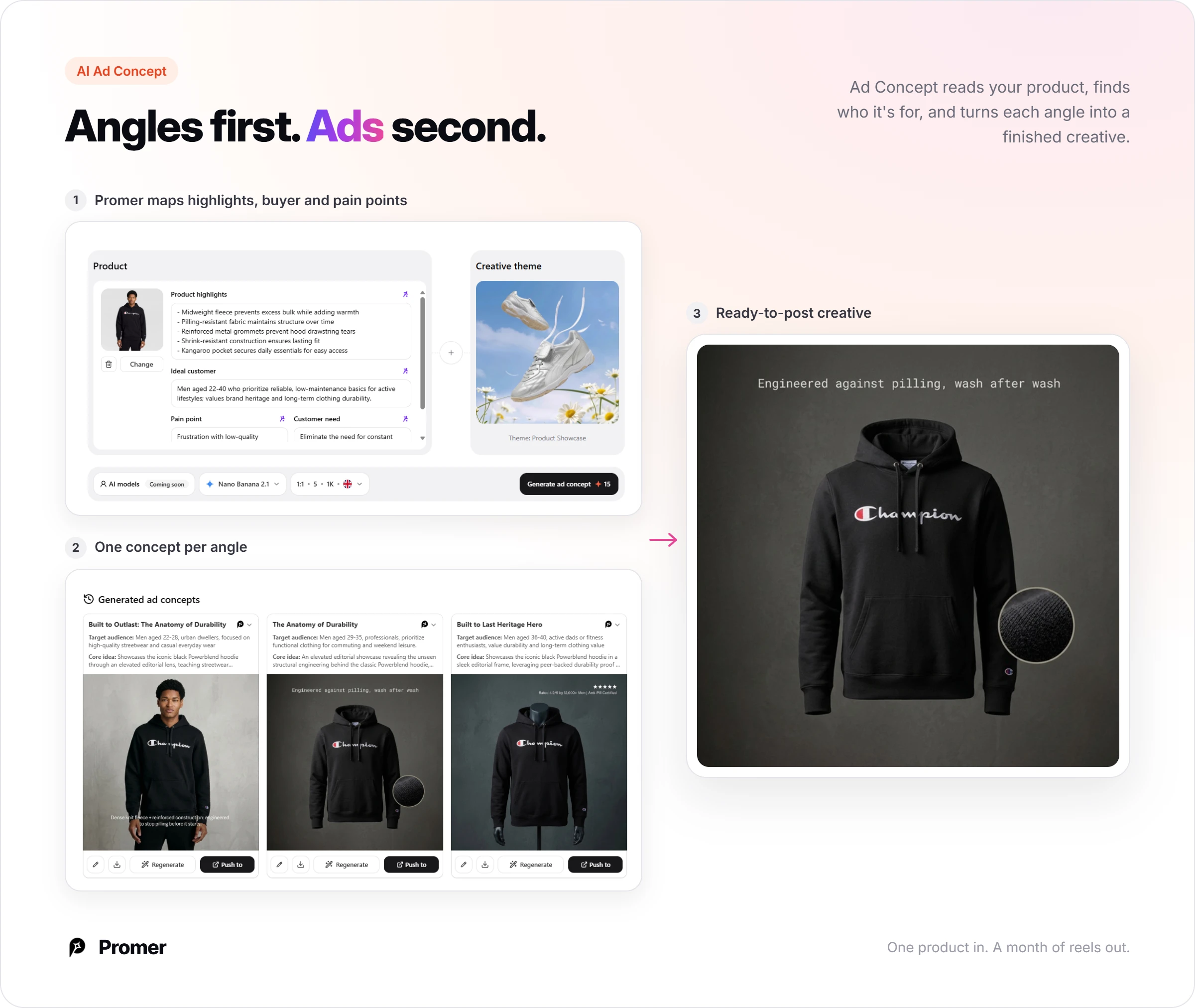
Paste a product URL, upload product photos, or pick a product synced from Shopify. When you want the Reel itself made for you, you can turn a product link into a Reel-ready video with an AI creator. Promer AI studies the product, who's likely to buy it and the market around it, then suggests angles. You don't need to know what's trending or have a brief ready. Promer AI's AI Ad Concept generates several angles on its own, so "Don't show this to a [your buyer]" ideas come built in.
It maps the product's highlights, ideal customer, pain point and need first. Each concept then comes back with its own target audience, core idea and finished creative, so you can see why an angle should work before you post anything.
No brief and no angle in mind? Start from AI Ad Prompt instead. Add a product photo, click Get ad ideas, and it suggests creative ideas, each with a message, a visual description and a tag (functional, emotional or symbolic). Pick one, it writes the prompt for you, and you get several variations to choose from.
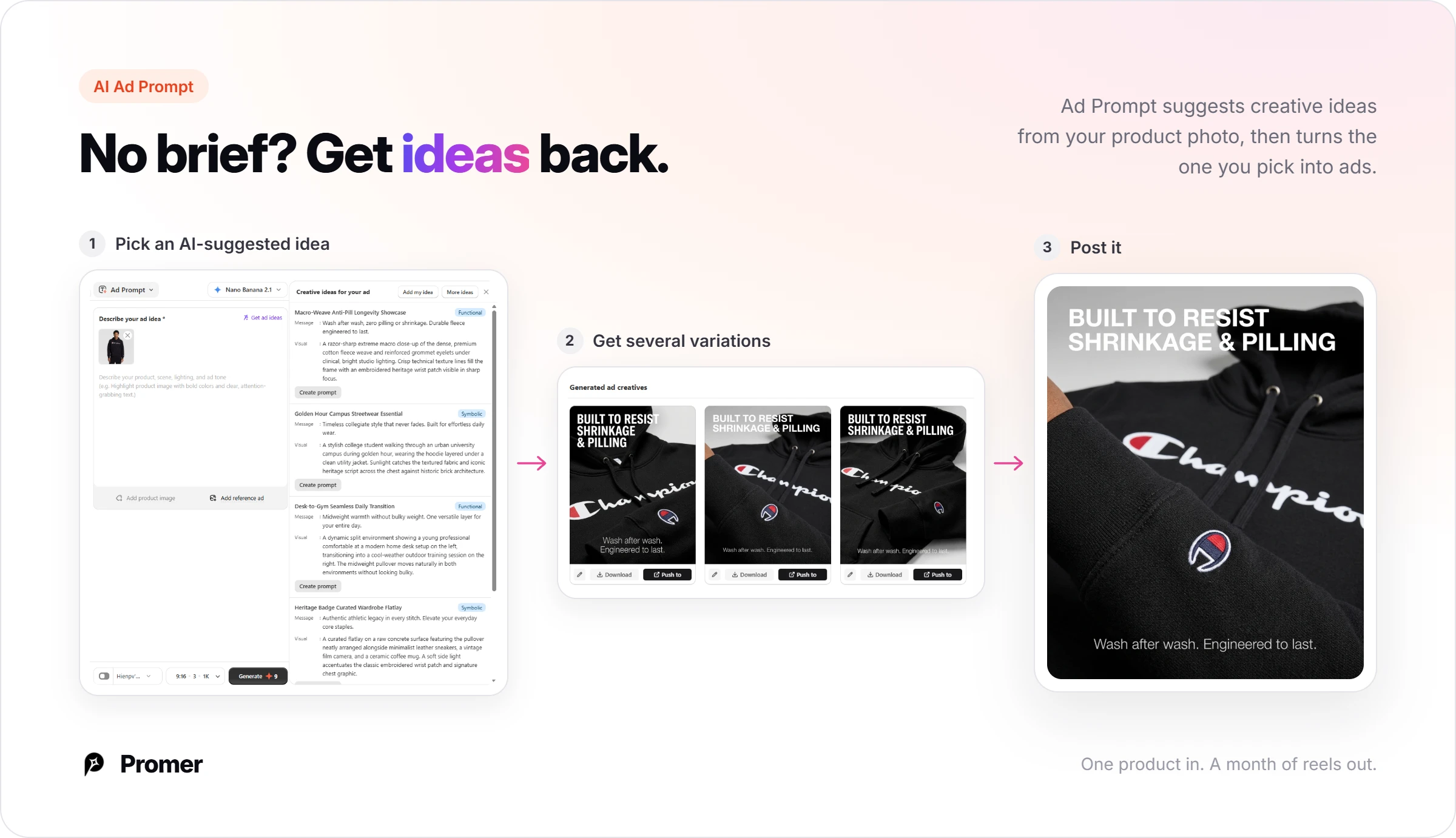
Want more control? Add a short brief. For the candle brand, it might read:
Content for renters making a small apartment feel cozy. Focus on the Sunday reset. Keep the amber jar, wooden wick and label exactly as they are. Don't invent burn times or scent claims.
Step 3: Create a month of scenes in one sitting (the production wall)
This is where "same product, new scene" gets easy. Here's the same hoodie run through each tool.
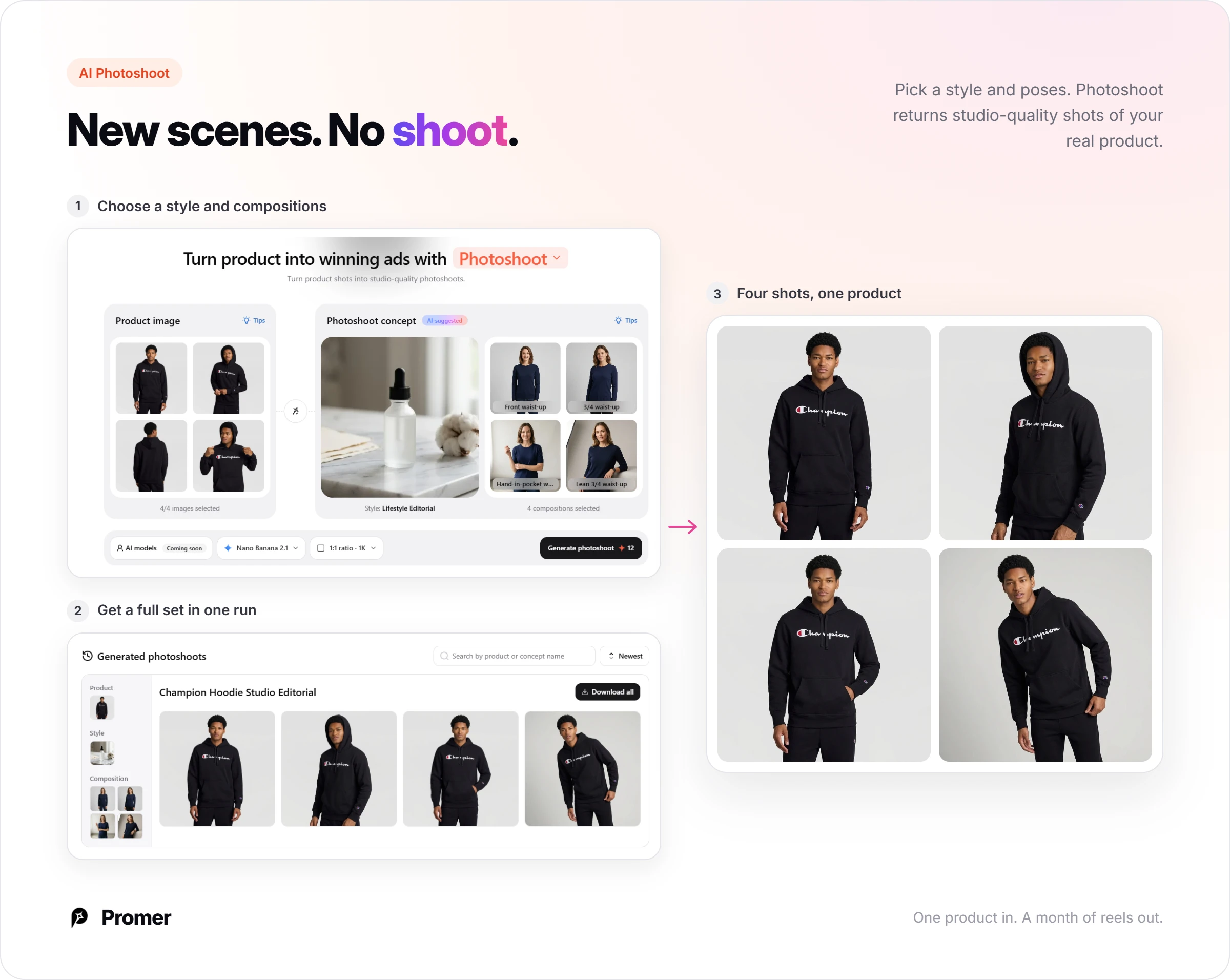
New scenes, no shoot. Promer AI's AI Photoshoot puts your product into new settings (a desk, a bathtub ledge, a housewarming table) without a real shoot. Add up to 4 angles of the product, pick a style and a few compositions, and you get a full set of studio-quality shots in one run.
Motion from a still. Promer AI's AI Ad Animation turns a still image into a short motion clip. It writes animation scripts for your photo, like a fabric close-up, a moody backdrop or a 2.5D depth push. Pick one, and it comes back as a 9:16 clip sized for Reels, TikTok and Stories.
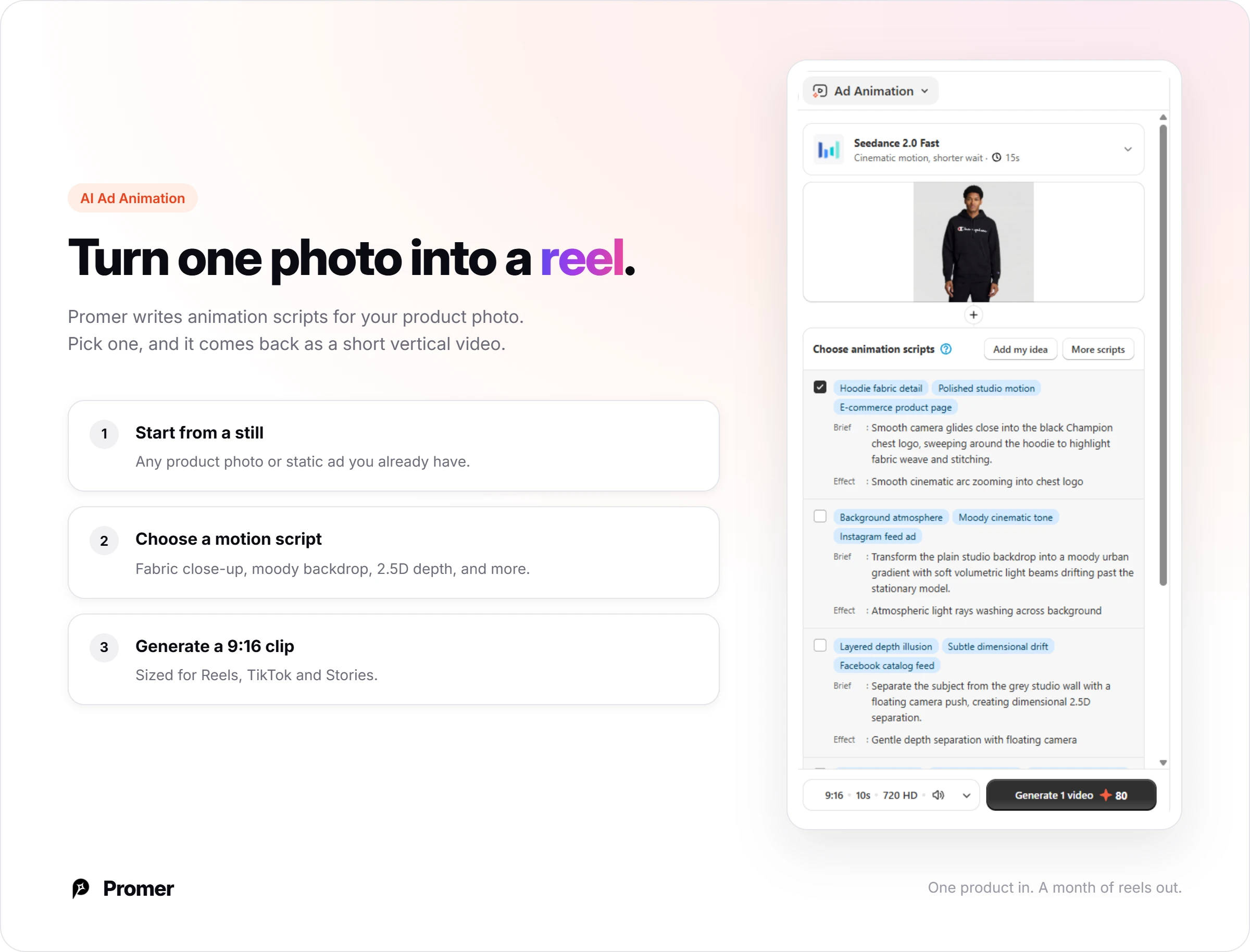
Here's the clip it made from that hoodie photo:
Creator-style video, no creator. Promer AI's AI UGC Ads makes creator-style videos that feel native to the feed. Let it suggest UGC ideas, pick an angle, hook and format, and it writes a timed script, scene by scene, with a voiceover. An AI avatar and AI voice present the product.
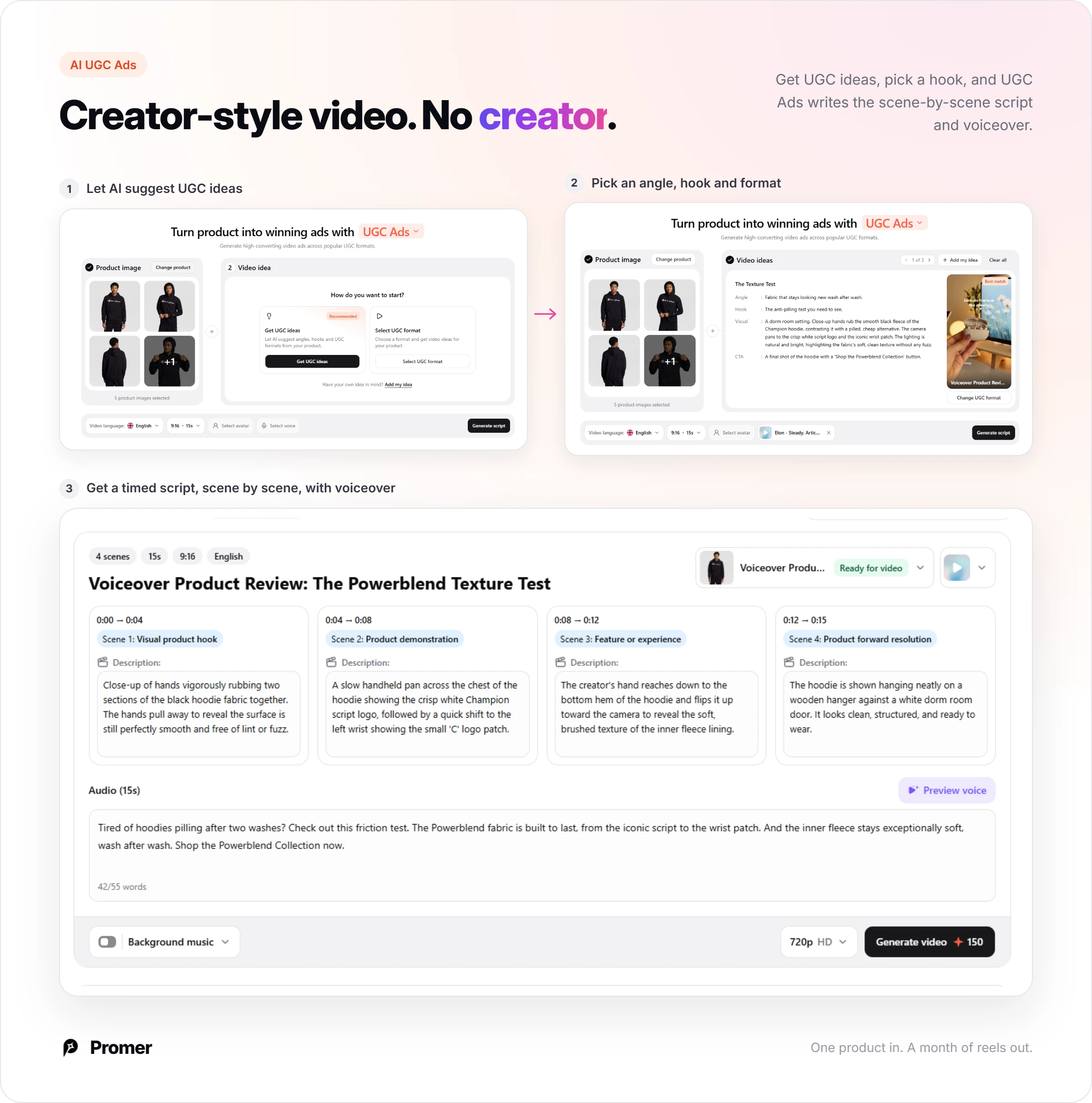
And the finished video from that script:
A proven layout, rebuilt for your product. AI Ad Clone takes a static ad you've seen work and rebuilds it around your product. Pick a reference ad, swap in your own headline and body text, and you get the same winning layout with your product in it.
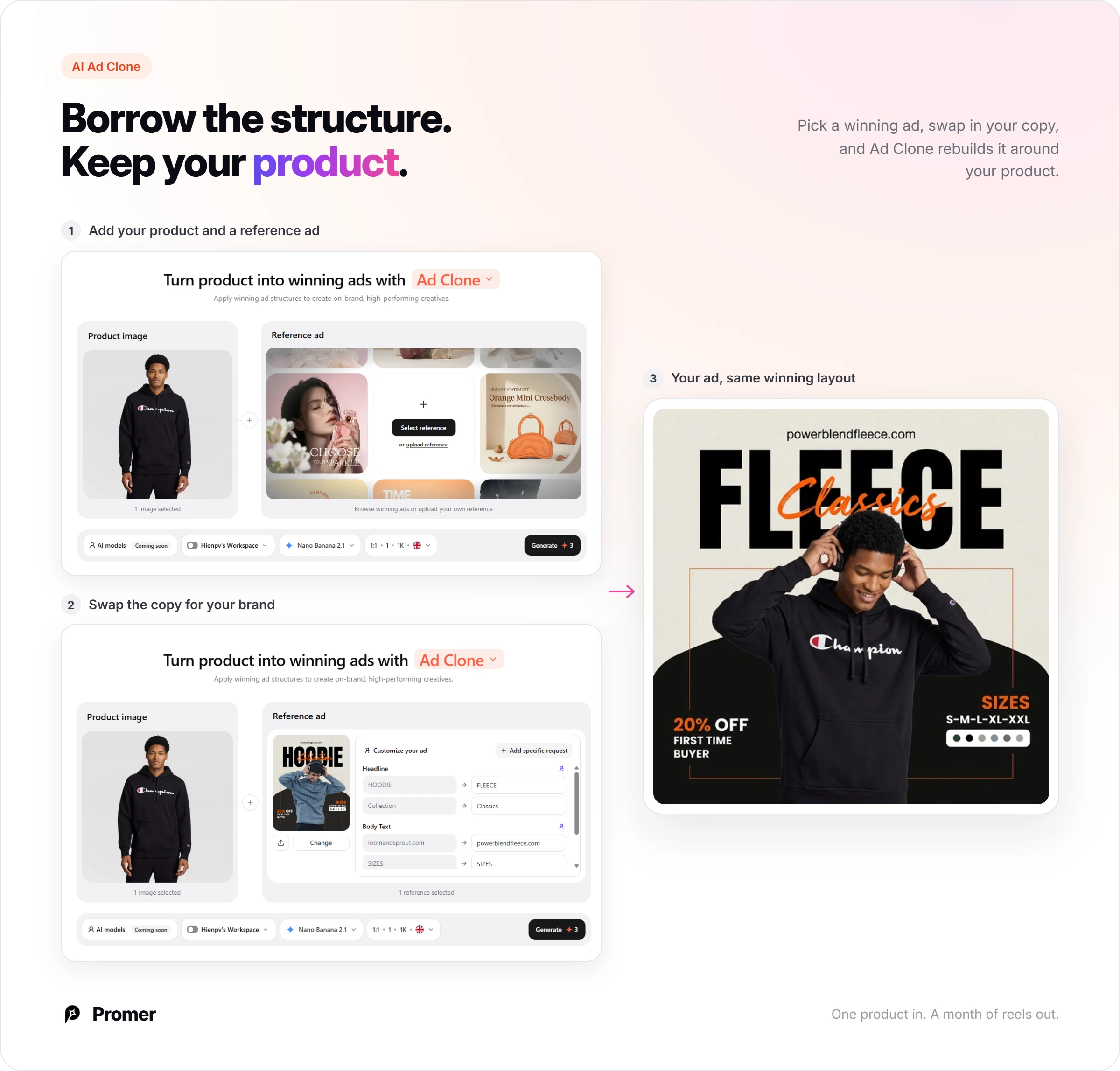
AI Video Ad Clone does the same for video: it takes a video format you've seen work and rebuilds it around your product. Between your videos, AI Ad Concept, AI Ad Clone and AI Ad Prompt cover the static posts and carousels.
One product in, dozens of scene and hook variations out.
Step 4: Review, then caption (keep the brand honest)
AI can drift on small details, so check every output: shape, color, packaging, text on the label. If an AI presenter explains the product, don't pass it off as a real customer review.
Captions start from a goal (awareness, education and so on) and come back as several angle options you can regenerate one at a time. Hashtags can auto-apply to future posts, and product links shorten automatically when you publish. Edit for your voice, and add something the video doesn't show: dimensions, a use case, or the answer to a common question.
Step 5: Fill your Content Plan (the consistency wall)
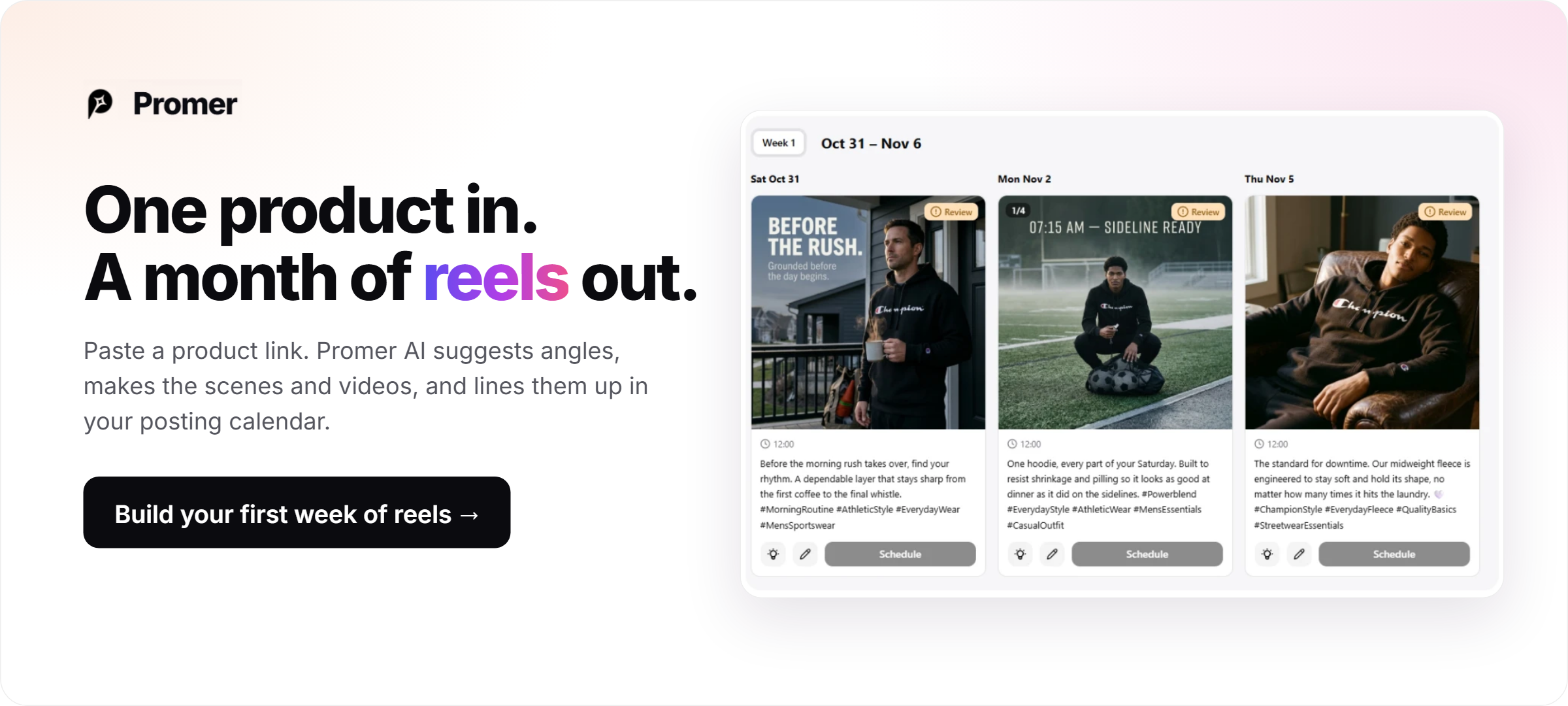
Drop approved posts into the Content Plan and schedule them to your connected Facebook, Instagram and TikTok accounts. Plan a month in one afternoon, and the account keeps posting even in the weeks you're buried in orders.
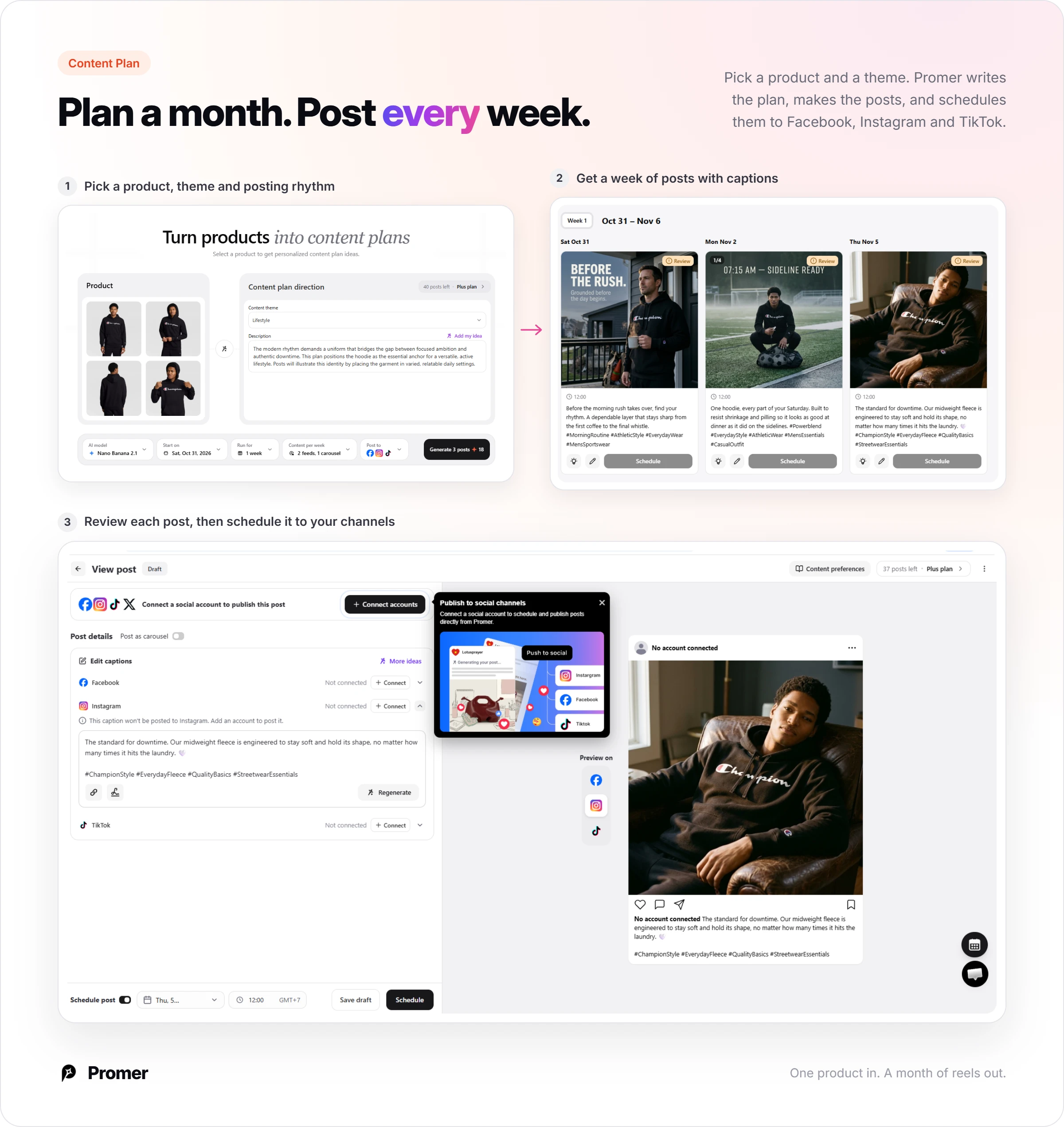
Step 6: Learn, repeat, and turn winners into ads
Each week, check what worked (next section shows what to measure) and make more versions of the winners. When a reel clearly takes off, push it to Meta Ads straight from Promer AI with Launch Ads and put budget behind a creative your audience has already picked.
Try it with one product from your store → Plans start at $9/month.
Your 30-day reels flood plan
You don't need a strategy deck. You need four weeks of steady posting and the discipline to read the results.
By day 30 you'll have about 25 reels live and real data on what your buyers respond to. That's more than most brands learn from a year of one-off posts.
Starting from zero? Three reels a week you can sustain beats seven you'll abandon. Add more once you have the ideas and the time to review each one.
What to measure besides views?
Views tell you a video was played. They don't tell you whether anyone wanted the product. Read your reels in this order, from attention to money:
| Question | Signal to check |
|---|---|
| Did the opening hold attention? | Average watch time, retention past 3 seconds |
| Did people care enough to keep or pass it on? |
Three habits keep the data honest:
- Compare like with like. Same platform, same format, same number of days since posting.
- Look at the typical reel, not just the best one. A rising average matters more than one spike.
- Tag your links. Use a different UTM link per channel in your bio, so you can see whether TikTok or Instagram actually sends shoppers.
If a funny reel gets huge views but no product questions or clicks, don't just copy it. Make a version where the product's role is clearer.
6 mistakes that kill a reels strategy
- Deleting low-view reels. A reel with 300 views isn't a failure, it's a data point. Reels can also pick up reach weeks later, so leave it up.
- Changing everything at once. New product, new hook and new scene in one video means you'll never know what worked. Change one thing at a time.
- Leading with features. "Made with organic cotton" doesn't stop a thumb. "POV: you're the only one at the party with taste" does. Lead with the person, prove it with the product.
- Reposting other brands' videos. Borrow the structure, never the footage. Meta says re-uploads and minor edits of someone else's post get pushed down in Feed and Reels.
- Quitting in week two. The hoodie brand's 5.3M-view reel sits in a grid where 7 other reels didn't reach 6,000 views. The flops come with the territory.
- Sending viral traffic nowhere. A million views won't help if your bio link is broken or the product page loads slowly. Fix the landing page before you scale.
FAQ: Ecommerce reels strategy
How many reels should an ecommerce store post per week?
Start with what you can keep up: 3–5 a week for a small team. Move toward daily once you have enough distinct ideas and time to review each one. Consistency over a month matters more than any single video.
Why are my reels not going viral?
Usually it's volume and the first second, not your product. Most reels from small accounts stay under 10K views. Post more variations, put the hook on screen immediately, and give it 30 days before you judge.
Can I keep posting the same product?
Yes, that's the whole strategy. Change the scene, the hook, the buyer or the format each time, and keep the product recognizable. Reposting an identical clip with a new caption teaches you far less than testing a genuinely new idea.
Do product reels need a face or a creator?
No. Many high-view reels are just hands, a product and a text hook. Faces can help with some audiences, so test both and let the numbers decide.
Will AI-made product videos hurt my reach?
What drives reach is whether people watch, rewatch and share. Several scenes in the examples above are clearly staged and still pulled six and seven figures. Just keep the product accurate, label AI content where a platform requires it, and use real footage when you need to prove performance.
Can I post the same video on Instagram, Facebook and TikTok?
Yes, as long as you own the footage. Upload clean files without another app's watermark and adjust the caption and hashtags for each channel.
How long until I see results?
Give it 30 days of steady posting before you judge. Expect most early reels to land under 10K views; it's the few outliers that build the brand.
Does this only work for gifts and fashion?
It works best for products with a strong look or a clear identity angle, but most categories can use it: home decor, beauty, pet products, accessories, gadgets. The key is finding the person your product says something about.
Do I need design or editing skills to run this?
No. With a tool like Promer AI, you start from a product link or photo and review what it creates. Your job is choosing the angles and checking that the product looks right.
The brands winning on social aren't more creative. They just ship more.
The stores pulling millions of views aren't hiding a secret. They picked one product, found a few hooks that speak to a specific person, and kept posting until the feed picked a winner. Then they did it again.
You don't need a new product for every post. You need more ways to show why someone would want the one you already sell, and a way to produce them without losing your week.
That's the part Promer AI takes off your plate: product analysis, angles, scenes, videos, captions and scheduling, in one place.
Turn one product into a month of reels with Promer AI →
Paste a product link, pick your angles, and fill your first week of posts today. Plans start at $9/month.