Last updated 29 September 2026. Prices, model rates, and policies were checked against Hedra's public pages on this date. This analysis is based on desk research, terms of service, and independent directories. No account was used; no videos were generated. Not sponsored.
Hedra review: What you are really hiring it for, and what it costs when the product has to show up?
If you evaluate Hedra purely by its pricing page, you see a floor of 2.5 cents per second of output for its in-house lip-sync model, Character-3. At that rate, a 15-second talking-character ad costs just 38 cents to render.
But the unit economics change the moment you define the actual "Job to Be Done" (JTBD). If you are hiring Hedra to animate a static face to a pre-recorded audio track, it hits that 38-cent floor. If you are hiring Hedra to actually show your physical product on screen, it becomes a two-model workflow. Generating a scene that holds a product in frame requires reference-driven video models, which cost three to six times more per second than Character-3.
Below is a breakdown of both routes based on Hedra's published rates, an analysis of the platform's 2026 architecture, and a look at the compliance bottleneck most buyers miss: Hedra’s Acceptable Use Policy regarding human likeness.
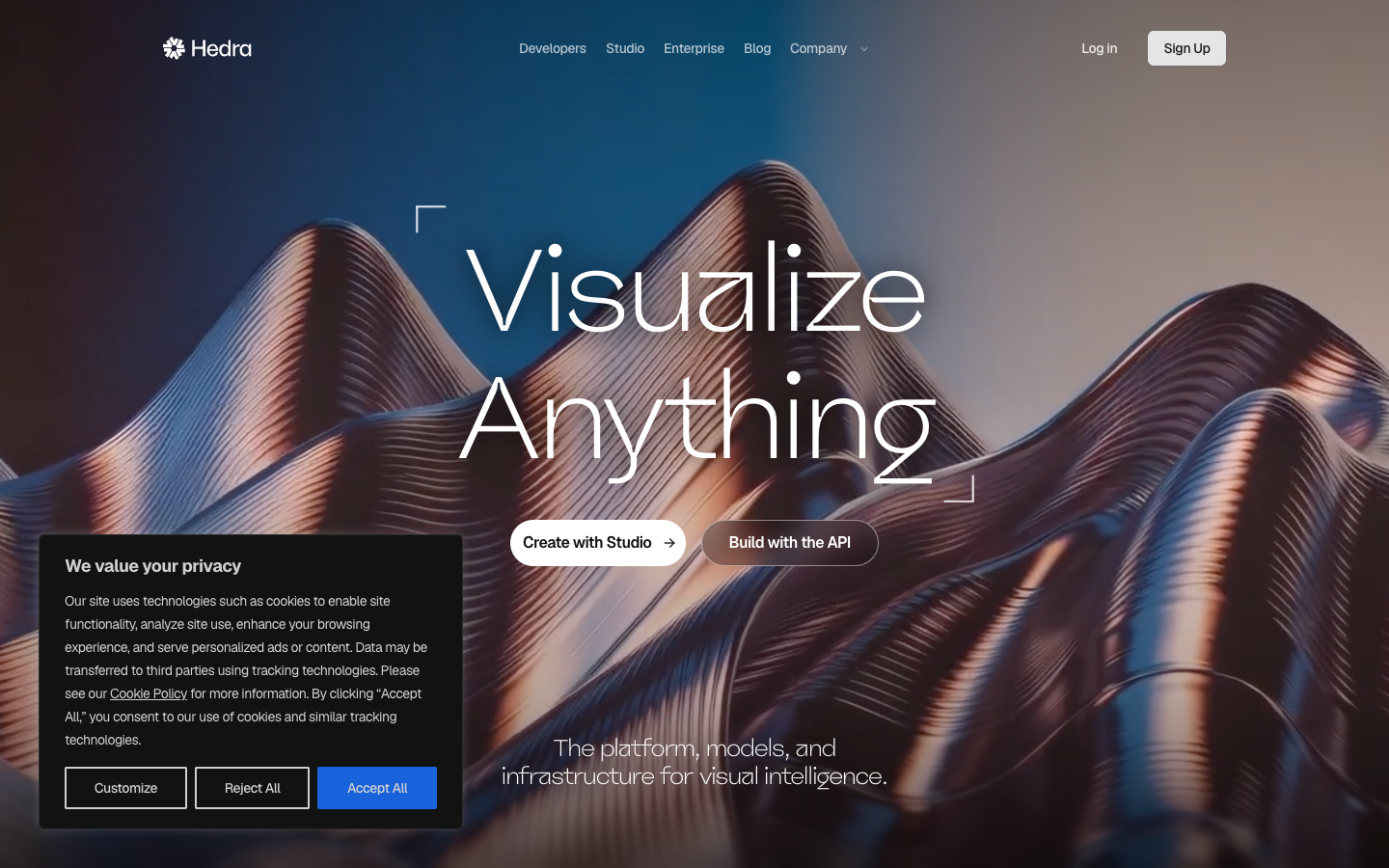
Hedra's homepage, captured 29 September 2026.
The tl;dr
- Hedra is a model platform, not a single tool.
- Its models page listed 104 models on 29 September 2026 (53 video, 39 image, 12 audio). Two are trained in house, Hedra Character 3 and Hedra Avatar, both from 2.5 cents per second.
- Character-3 animates a face to a recording. It takes any face (photo, illustration, mascot, painting) plus an audio file, and runs as long as the audio, up to ten minutes per generation. The language comes from the recording.
- The product appears only if it is already in the still, or if you render it with a reference-driven model such as Kling V3 (from 8.4 cents per second), Veo 3.1 (from 11.43) or Seedance 2.5 (from 14.85). Hedra's own UGC page says how strictly those models hold the reference "varies".
- Monthly plans: Basic $20 for 2,000 credits, Pro $50 for 7,200, Ultra $100 for 18,000, Teams $75 for 14,400. Every paid plan lists commercial use. How credits convert into seconds of video was not readable on the pricing page.
- Policy conflict: Hedra's Acceptable Use Policy bars uploads of media "containing individuals other than yourself". Its UGC and lip sync pages only ask that you hold the rights. Get this clarified in writing before casting a real creator.
- No quality verdict. G2, Trustpilot and Capterra could not be read, so this review does not rate Hedra's lip sync output.
The job: what you would hire Hedra to do
Framing a tool by its features gets you a spec sheet. Framing it by the job gets you a buying decision. Hedra's pages support two jobs cleanly and one job poorly.
- Job 1 (strong fit): "When I have a script that already works, I want a face to say it in every market I sell into, so I can test hooks and languages without a shoot." Hedra hires out for this at 2.5 cents per second. It replaces a filmed spokesperson, a voice actor per language, and the reshoot when the script changes.
- Job 2 (strong fit): "When my brand has a mascot or illustrated character, I want it to speak, so the character becomes the ad without anyone filming." Character-3 accepts illustrations, cartoons, 3D characters and stop-motion puppets. This is the least crowded use of the tool.
- Job 3 (weak fit): "When I sell a physical product, I want a person holding it and talking about it, generated from my product page." Hedra does this in two steps on two models. None of the Hedra pages read describe importing a product URL.
What Hedra competes with depends on the job. For Jobs 1 and 2, the alternatives are a paid creator, a voice actor and an editor. For Job 3, the alternatives are tools that start from the product page, covered near the end.
What Hedra is in 2026: a model platform with two in-house avatar models
Hedra in 2026 is a visual AI company that runs a no-code studio, a creative agent and a developer API on inference infrastructure it operates, with 104 in-house and third-party models behind one account. For product ads, the relevant parts are its two avatar models and the reference-driven video models hosted beside them.
Hedra's homepage says it builds models "that generate, perceive, and predict the visual world". It splits into three entry points:
- Creative Studio: an agent with reusable skills and an MCP connection.
- Developer API: sold as "one key, every model".
- Sovereign inference: for companies that want diffusion models on their own clusters.
Half the homepage is robotics research: World Action Models and publications from 2020 to 2025, including the BEHAVIOR-1K embodied AI benchmark. For an ad buyer this signals priorities. Talking characters are one product line inside an infrastructure company, and the ad pages sit in a "Use Cases" menu next to pitch decks and slides.
Why older Hedra listings describe a different product
Directory listings still describe the Hedra of 2024. There's An AI For That dates Hedra's initial release to 18 April 2024 and, on 29 September 2026, still described a beta with a waitlist and paid options from $8 a month. Hedra's Terms of Use, last updated 25 October 2024, define the service as "a video content generation platform and social media platform".
The 2026 site matches neither. The pricing page starts at $20 a month, and the models page lists Kling, Veo, Seedance, MiniMax and Wan models next to Hedra's own. Hedra's enterprise page reports 20 million users, 125,000 businesses and 45 million content generations. Those are Hedra's figures and could not be checked here.
Studio, Creative Agent and API: three surfaces on the same models
Hedra's use-case pages say Studio "runs the same models on the same engine" as the API. The differences are in how you drive it:
- Studio and Creative Agent: the working surface for a merchant. The agent plans, generates, edits and publishes on one canvas. Multiplayer Spaces add real-time collaboration.
- API, CLI and MCP server: for teams that want one render request per SKU. Hedra's blog announced the MCP server and CLI on 31 August 2026.
Hedra Character-3 lip sync: one face plus one recording
Hedra Character-3 takes a still image of a face and an audio file, then rebuilds the mouth, jaw and expression to match the recording. The take runs as long as the audio, up to ten minutes in a single generation, in whatever language the recording is in.
Hedra writes the name as both "Character 3" and "Character-3"; this review uses Character-3. Accepted image formats are PNG, JPEG and WebP. Hedra asks for a face that is "clear, legible" and pointed roughly at the viewer.
What counts as a face is broad. Hedra's talking photo page shows photographs, illustrations, cartoons, 3D characters, stop-motion puppets and an oil painting, all driven by the same eight-second recording. For an ecommerce brand, this is image to talking video in its plainest form: a mascot speaks your script and nobody is filmed.
Hedra clip length, voices and languages
- Length follows the audio. Leave the duration blank and the take matches the audio, up to ten minutes for Character-3. Hedra Avatar also runs to ten minutes. The clip-oriented video models cap far shorter, and each model page states its own video length limit.
- Export goes up to 4K with upscaling through Topaz models such as Starlight Precise (1080p to 4K).
- Voice comes from four places: a script read by one of Hedra's "4,000+ voices", a clone of your own voice, a recording made in the platform, or an uploaded file. ElevenLabs V3 text to speech is listed at 10 cents per 1,000 characters.
- Language is a property of the audio, not a setting. Hedra's lip sync page shows one still performing the same line in English, Japanese and German. Its talking avatar page says to lock the portrait once and it holds through rewritten scripts and new markets.
- Two speakers can share a frame. Pass one audio track per speaker and mark where each person sits. That allows a two-person exchange, such as a skeptic and a convert, from one generated image. (Which other avatar tools support this was not checked.)
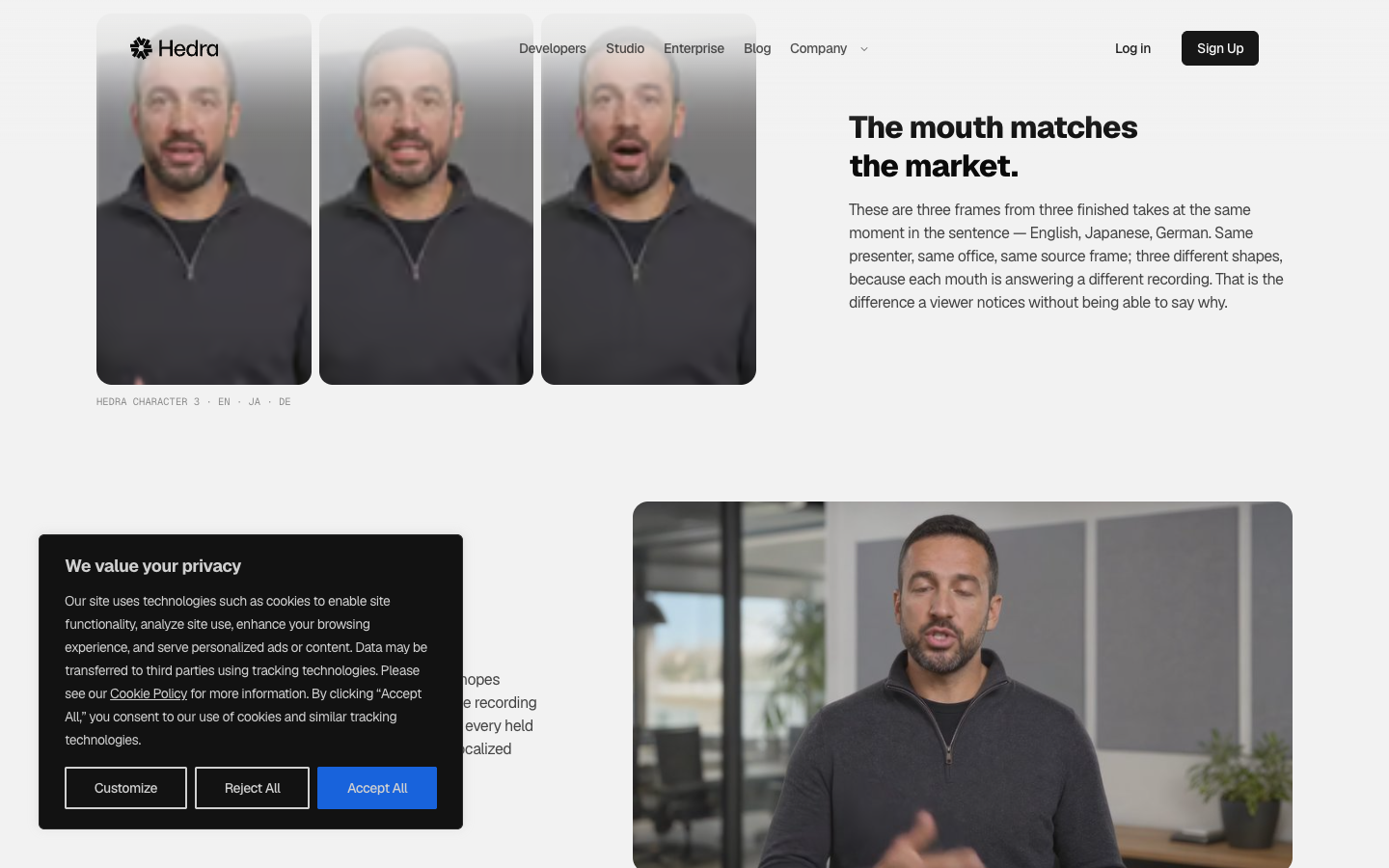
Hedra's lip sync page, section "The mouth matches the market", captured 29 September 2026.
Facial expressiveness: Hedra's claim, and what this review could not measure
Hedra pitches Character-3 as a performance model. Its talking photo page says the model reads where the stress lands and where the breath goes, and the face answers. That is a claim about facial expressiveness, and it is the one thing a desk review cannot score.
No independent Hedra lip sync review could be read for this article. So this review does not rate lip sync quality, drift or artefacts. Treat Hedra's demos as the best case, and run one of your own scripts before planning a batch.
Evaluating the Avatar Marketplace
Hedra hosts competitor avatar models directly alongside its own. Think of this as an inference marketplace. Here is the unit economics breakdown (based on listed rates as of 29 September 2026):
Takeaway: Hedra prices its own models to win volume. The HeyGen model runs inside Hedra at four times the floor rate of Character-3. Hedra Avatar is positioned for long-form content and training, while the clip-oriented models are built for short, high-fidelity social cuts.
When the product has to enter the frame: Hedra's reference-driven UGC models
Character-3 knows nothing about your product. It animates whatever is in the still. Hedra's AI UGC video generator page names the risk itself: the failure mode of synthetic UGC is a product that is "almost right", with examples like a label off by a word or a cap the wrong shape. Its fix is to anchor every scene to the real product photo.
The same page is candid about the limit. Asked whether the actual product will show up correctly, Hedra answers that how strictly the model holds to it "varies, which is why the choice matters". It points you to reference-driven models when the label and shape have to be exact.
Hedra's leading product-in-hand sample, a person talking to camera about a product, is labelled "VEO 3.1 · 0:08 · SPOKEN". So the clip Hedra leads with is a Veo 3.1 render, not a Character-3 render. Character-3's own samples show a presenter in an office and drawn or painted characters.
Route 1: put the product in the still, then let Character-3 perform
Hedra's FAQ names Nano Banana Pro, Seedream 4.5 and Flux.2 Max as image models you can use inside Hedra and then animate without downloading. On the models page, Nano Banana Pro starts at 15 cents per generation and GPT Image 2 at 1.43 cents.
- Cost: one generated image of a character holding the product, then a Character-3 take at 2.5 cents per second. The cheapest product route on the platform.
- Unknown: none of the pages read say how well Character-3 keeps a label legible while the head and shoulders move. Treat this route as a test before committing a batch.
Route 2: a reference-driven video model holds the product and speaks the line
Hedra's product video FAQ says Veo, Kling, Seedance, MiniMax, LTX and Wan all start from a frame. Its video ads FAQ adds that several models generate their own dialogue natively. Send the packshot as a reference, describe the person and the room, and the model renders both, in the language you write the line in.
- Cost: Kling V3 from 8.4 cents per second, Veo 3.1 from 11.43, Seedance 2.5 from 14.85 (listed as reference-driven video up to 30 seconds at 1080p with native audio).
- Check the length: the Veo 3.1 samples on Hedra's pages each run 8 seconds. Confirm the model page's maximum before planning a single 15-second take.
Route 3: no product in frame at all
This is the route Character-3 is priced for. A 15-second take at the floor rate is about 38 cents, with no product seconds to buy.
- Fits: an app, a subscription, a service, a warranty, a digital product, a brand whose mascot is the recognisable asset, or a spokesperson ad that works in one market and needs the same read in another language.
- Does not fit: any purchase that depends on seeing the thing, such as fit, texture, size, colour or what comes in the box. A talking face can promise a bottle keeps water cold for 24 hours. It cannot show the ice.
A two-job brief for a Hedra product ad
The brief splits a 15-second product ad into the two jobs Hedra's pages imply. "Name what must not change" comes from Hedra's product video FAQ, and regenerating each aspect ratio rather than cropping comes from its video ads page. Copy it and fill the brackets.
``` JOB 1: CHARACTER TAKE (Model: Hedra Character-3 or Hedra Avatar)
Face: [Portrait you hold written rights to, or a generated character]
Framing: Chest up, face toward camera, product omitted.
Audio: [Uploaded recording or cloned voice]
Duration: Null (matches audio length; aim for 8-10s)
Script: Hook and CTA.
Aspect ratio: 9:16
JOB 2: PRODUCT INSERT (Model: Kling V3 or Veo 3.1)
Reference: Clean packshot, high-res PNG/WebP.
Constraints: [Label text, cap shape, brand colors MUST NOT CHANGE]
Camera: Single slow push-in, product holds still.
Duration: 5s
Aspect ratio: 9:16 (regenerate at 1:1 or 16:9 for other placements)
ASSEMBLY
Order: Job 1 (Hook) -> Job 2 (Product Insert) -> Job 1 (CTA).
QA Check: Verify label legibility frame-by-frame before allocating ad spend.```
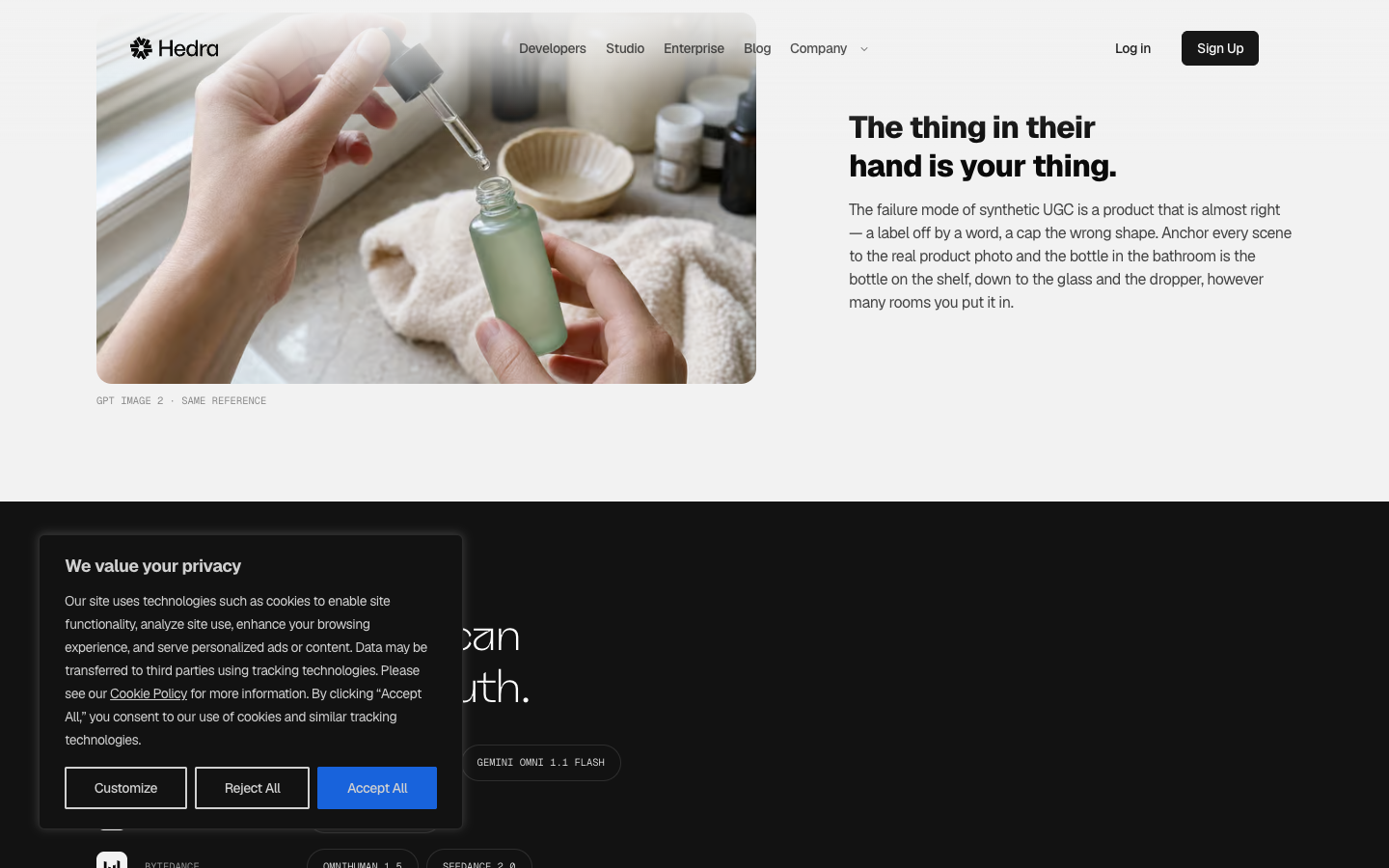
Hedra's UGC generator page on product reference images, captured 29 September 2026.
Hedra pricing: two price lists, plan credits and per-second rates
Hedra shows prices in two units. The pricing page sells credit-based plans by the month. The models page lists every model in cents per second of output. On 29 September 2026, the pricing FAQ answers that would connect the two ("What costs credits on Hedra?", "How are credits deducted for video generation?") did not load in the reader used for this review, so the conversion stays open.
What $20, $50, $75 and $100 buy in Hedra credits
Ultra and Teams both carry a "Best value" badge, yet Teams is cheaper per credit ($75 for 14,400 against $100 for 18,000). The Teams card does not say whether $75 is per seat, so confirm that before choosing it for one person. Every card read showed "Billed monthly"; annual prices, if any, were not visible.
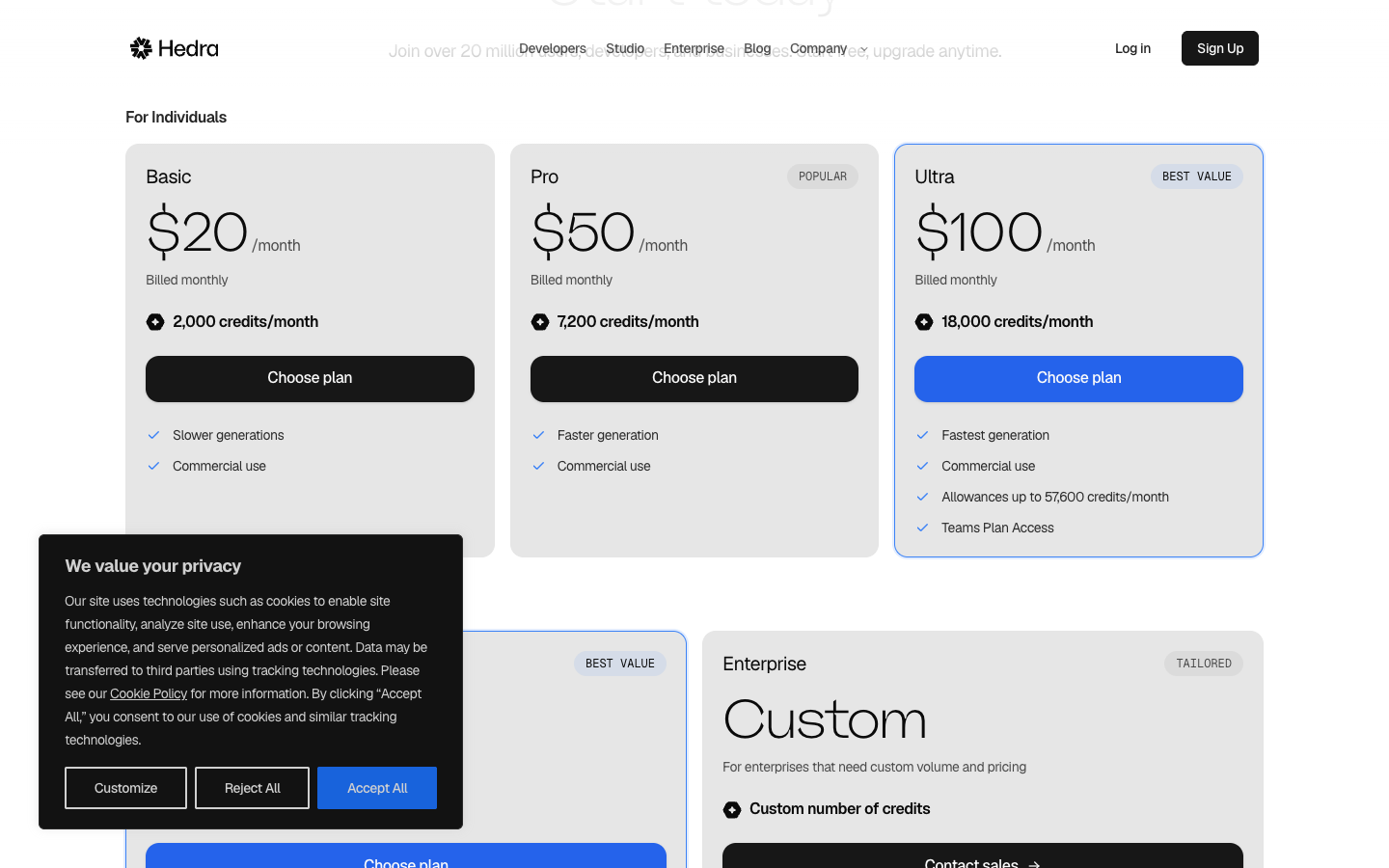
Hedra's individual plans on monthly billing, captured 29 September 2026.
Cost per ad creative: a 15-second Hedra ad at published per-second rates
The table multiplies Hedra's listed "from" rates by 15 seconds to give a floor. Higher resolutions and tiers cost more. Whether Studio credits bill at the same rate could not be confirmed.
Note: Rates represent lowest-tier resolutions; rendering in 1080p or 4K via Topaz upscaling models increases inference costs.
Ad creative testing is where the gap shows. Ten 5-second product openings on Kling V3 are 50 seconds of output, about $4.20 at the floor rate. A 10-second Character-3 read to follow them is about 25 cents. Hedra's video ads page makes the same case for per-second billing: a losing variant costs the seconds it rendered. It advises finding the hook on a fast tier, then re-rendering the winner on a flagship.
Hedra's blog published a post on 25 September 2026 on what 10 seconds of Seedance, Kling, Veo and MiniMax video costs. It could not be opened for this review, so the credit side of this arithmetic is unchecked. Budget from the cents on the model page and check the credit counter after your first render.
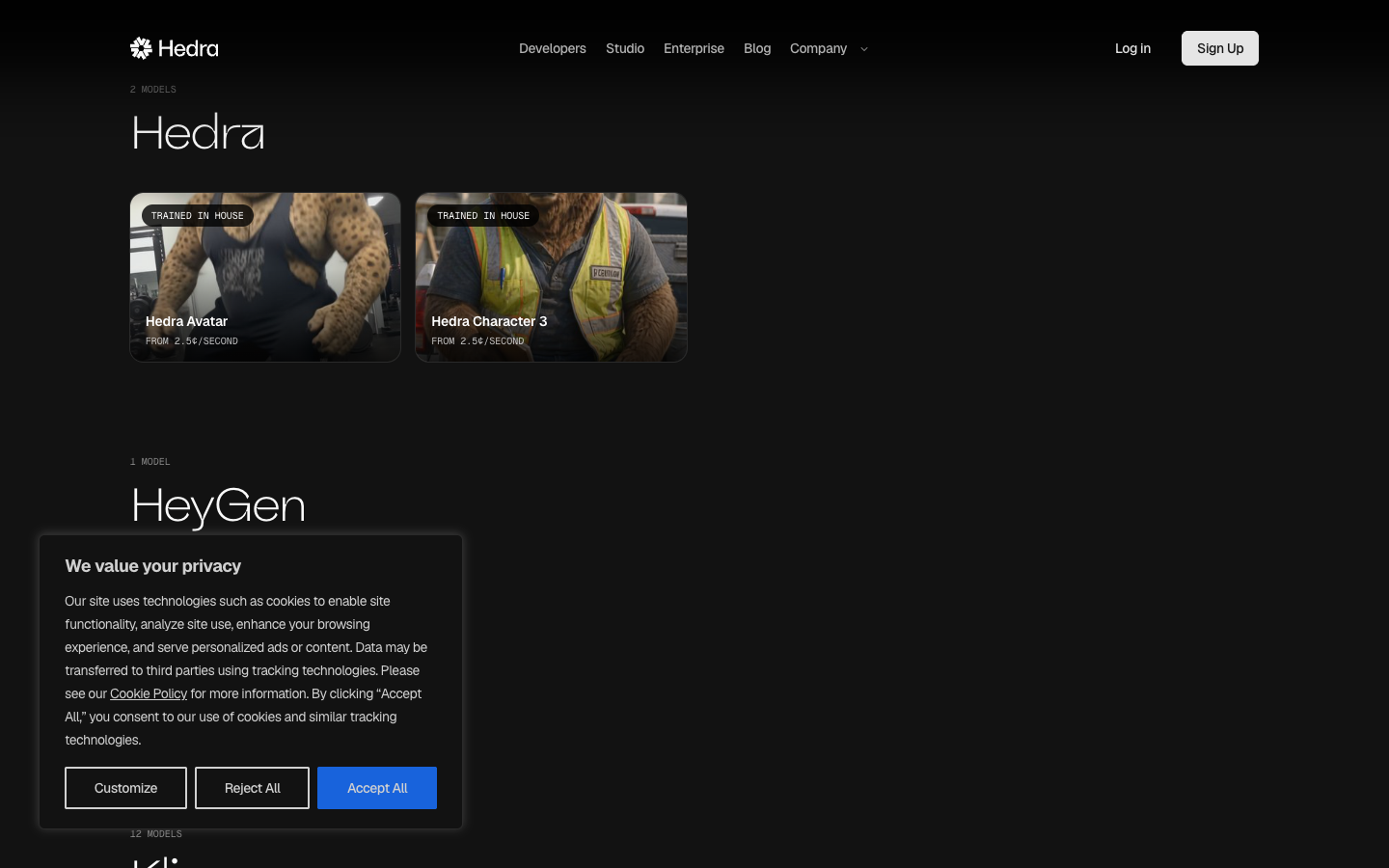
Hedra's in-house models on its video models page, captured 29 September 2026.
Terms, Watermarks, and Operational Policies
- Free Plan & Watermarks: Hedra advertises a "Free Plan, No Credit Card Required" in its header, but omits specific credit allocations on the plan comparison cards. Unwatermarked assets and full commercial usage rights are strictly locked behind paid plans (starting at the $20 Basic tier).
- Auto-Renewal & Stripe Billing: Subscriptions automatically renew at Hedra's current list price until canceled via Stripe. Answers regarding unused credit rollover were unavailable in public documentation, meaning teams must budget under the assumption of a monthly "use-it-or-lose-it" credit expiration.
- Legal Protections & Liability Caps: Disputes are subject to binding arbitration with a standard class-action waiver (with a 30-day opt-out window via written notice to their San Francisco headquarters). Most crucially for risk modeling, Hedra caps its total liability at the greater of three months of paid fees or $100.
Likeness, Consent, and the Creator Compliance Clash
If your creative strategy involves uploading assets from hired UGC creators, you face a major contractual conflict between Hedra's sales collateral and its Acceptable Use Policy (AUP).
- What the Product Pages State: The UGC and lip-sync landing pages instruct users to "only send portraits and voices you have the rights to use," adding that international localization requires the creator to have consented across all target languages.
- What the Acceptable Use Policy Enforces: The binding AUP explicitly forbids users from uploading, generating, or outputting any media "containing personal information related to any individual other than yourself, including (without limitation) any photos, audio, videos or any other media containing individuals other than yourself." The sole carveout is for individuals deceased for over a century.
The operational risk: Read literally, a standard signed talent release form does not protect you from an AUP violation.
Furthermore, the AUP forbids creating fake personas or synthetic deepfakes to "falsely attribute content or mislead others about its origin without consent or legal right." Because Hedra's own marketing features synthetic avatars delivering first-person customer reviews ("My daughter bought me this..."), growth teams walk a fine line between synthetic creative testing and FTC disclosure rules regarding deceptive testimonials. Enterprise teams should settle this ambiguity in writing before uploading creator rosters.
Data privacy: biometric retention and IP licensing
Hedra's data governance policies govern two key assets: facial vectors and source creative.
- Biometric Data Retention: Under the Biometric Data Privacy Policy (effective 23 July 2024), Hedra derives facial geometry templates and voice prints to construct avatars. This biometric data is stored for up to three years after your last interaction with the platform.
- Broad Content Licensing: While Hedra does not claim ownership of user inputs or outputs, users grant the company a "non-exclusive, transferable, perpetual, irrevocable, worldwide, fully-paid, royalty-free, sublicensable" license to process your assets for service operations. The terms remain silent on whether user inputs are used to fine-tune future generative foundation models.
Hedra for short-form ads: hooks, placements and a ten-variant test plan
Hedra's AI video ads page is written for a performance buyer. Its headings include "An ad is a test, not a take" and "The hook is the whole ad". The pitch is that one packshot fills a test plan. Three mechanics apply to TikTok ads, Instagram Reels ads and YouTube Shorts ads:
- Placement shapes are regenerated, not cropped. Most models take aspect ratio as a parameter, so a story frame, an in-feed square, a pre-roll and a CTV spot are four requests against the same asset.
- Ad variations come from changing the instruction. Hold the product in the reference and change the setting, the light or the first second.
- Localization is a performer reading a new script. The page's example is a Portuguese read on Veo 3.1 with the mouth matching the new language.
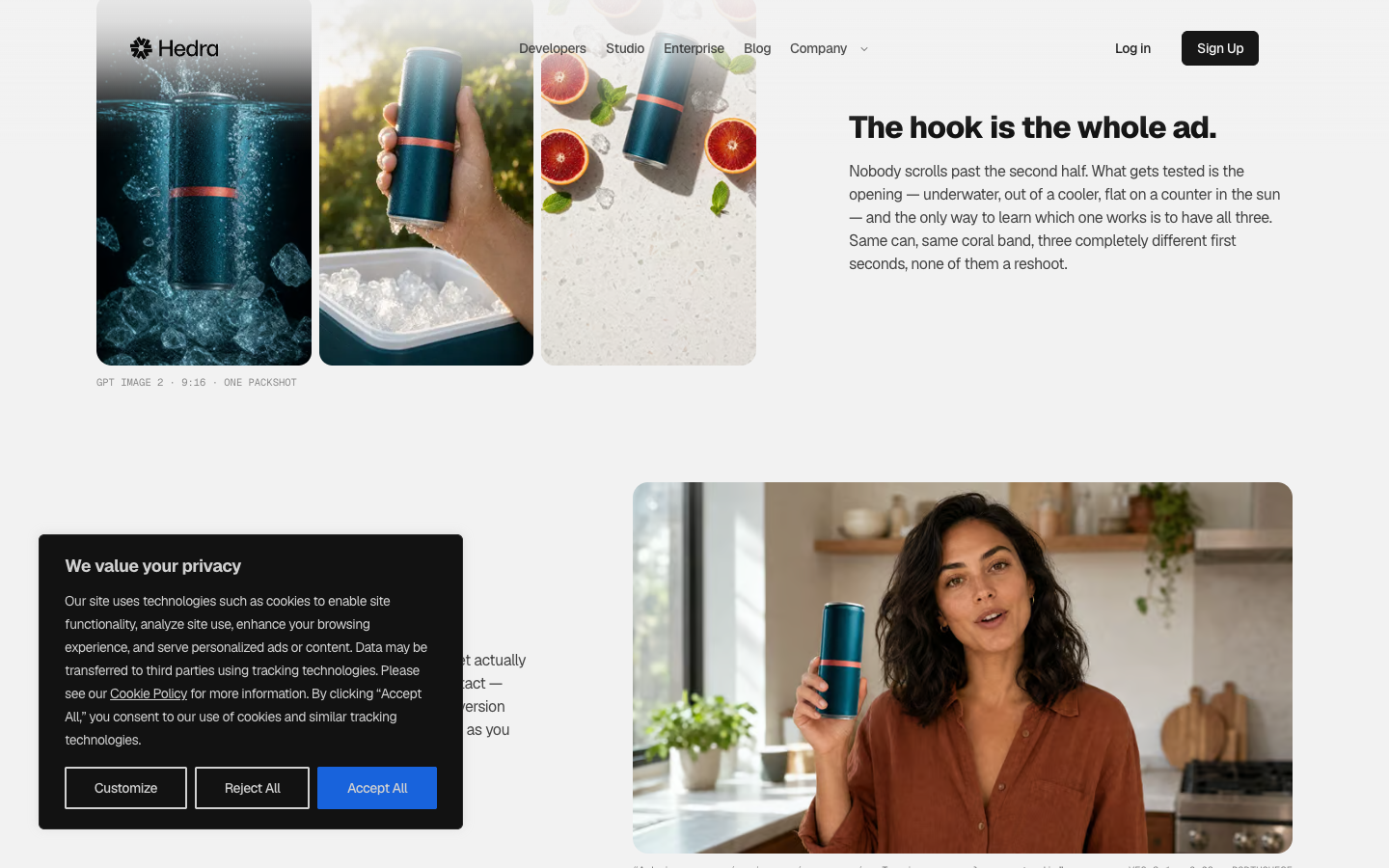
Hedra's video ads page on testing openings, captured 29 September 2026.
What the pages read do not describe: importing a product URL, browsing competitor ads, connecting a Meta or TikTok ad account, or reading campaign results back. The Creative Agent copy says "publish" without naming where. Hedra's blog lists a 29 July 2026 case study on how Finso tests ad formats with Hedra. Only the title was readable.
Hedra pros and cons, sourced to its own pages
With no readable review platform, both lists come from Hedra's pages and terms, checked 29 September 2026.
What Hedra does well
- Cheapest talking face on its own list: Character 3 and Hedra Avatar from 2.5 cents per second, against 5.62 to 16 cents for the other avatar models it hosts.
- Ten-minute takes from one still, long enough for a full script read rather than clips you stitch.
- Any face type, including illustrations, mascots and 3D characters.
- Language follows the audio, so one image carries a multilingual set.
- 53 video models behind one account, including Veo 3.1, Kling V3 and Seedance 2.5. On the API, switching model is a string.
- Commercial use from the $20 Basic plan.
- An API, a CLI and an MCP server for teams that automate renders.
Where Hedra costs you time or money
- Two price lists, credits on plans and cents on models, with the credit deduction rule unreadable on the pricing page.
- Product fidelity varies by model, in Hedra's own words.
- Policy mismatch between the Acceptable Use Policy and the product pages on uploading other people's faces.
- Stale terms. The terms dated 25 October 2024 still describe a social media platform.
- Catalog outpaces copy. Hedra's alternatives page says OpenAI retires the Sora API on 24 September 2026, yet the video models page still listed Sora 2 Pro from 30 cents per second on 29 September.
- No product URL import, ad library or ad account connection on the pages read.
- Render time. Basic is marked "Slower generations", and Hedra puts typical picture to video render time at 2 to 10 minutes.
Independent Hedra reviews: one small, dated listing
This review tried the usual sources on 29 September 2026. G2 and Trustpilot (hedra.com and www.hedra.com) returned HTTP 403. The guessed Capterra URL returned 404. Product Hunt and Reddit served bot checks, and Futurepedia and SaaSworthy returned 403.
One listing was readable. There's An AI For That showed Hedra at 3.7 out of 5 from 16 ratings. The same listing still describes a 2024 beta with paid plans from $8 a month, which no longer matches hedra.com. Sixteen ratings on a directory is too few and too old to judge a 2026 product, so this review does not use it as a verdict.
That leaves no readable complaint cluster, no praise pattern and no user-reported lip sync problems. The substitute is a test of your own: one real script, one real packshot, both routes from the brief above, on the plan you would buy.
The lesson for any AI UGC tool: the face is the cheap second, the product is the expensive one
Hedra's price list makes a point that holds across the category. A talking face is the cheapest second you can buy, from 2.5 cents. A product that keeps its label and shape while the camera moves is among the most expensive, and it is the part Hedra says can come back almost right.
That changes how to plan any AI UGC budget:
- Decide the product seconds first. Which five seconds must show the product, which reference photo locks it, and what must not change.
- Spend freely on hooks, faces and languages. They are cheap to vary and cheap to lose.
- Check inputs before models. Hedra's own FAQ says whether AI UGC is good enough for paid creative "depends almost entirely on the inputs", and that a studio-lit frame reading ad copy will not hold up in a feed however good the model is.
Alternative Solutions for Ecommerce Video Ads
If Hedra’s modular model-routing architecture does not match your creative workflow, three specialized tools solve specific adjacent jobs:
1. CapCut: The Editing Baseline for Owned Footage
- The Job: Post-production assembly, captioning, and resizing for footage you have already captured.
- The Model: Free web editor with 160 starter credits; features automated subtitles, voiceover generation, and background removal without requiring prompt orchestration.
- When to Use: Use CapCut to composite a Hedra character take alongside real, physically filmed product B-roll.
2. Creatify: The URL-to-Avatar Pipeline
- The Job: Turning a live product URL into an avatar-led social ad with zero prompt engineering.
- The Model: Freemium tier available; Starter plan begins at $39/month for 100 credits, offering 300+ stock avatars, 75+ languages, and native ad-launch integrations for Meta, TikTok, and AppLovin.
- When to Use: Choose Creatify if you want an automated, single-step pipeline from product page to finished creative, without manually directing separate background and lip-sync models.
3. Promer AI: Product-First Creative Generation
- The Job: Generating conversion-oriented UGC ads where physical product fidelity is non-negotiable.
- The Model: Specifically architected around ecommerce catalog context. You supply a product URL (Shopify, Amazon) and upload up to eight static product packshots from distinct angles.
- The Workflow:
- Extracts brand data, pricing, and product dimensions directly from the URL.
- Maps the product into one of five standard performance frameworks (Direct Testimonial, Voiceover Review, POV Demo, Problem/Solution, Daily Routine).
- Auto-scripts a scene-by-scene storyboard with timestamped audio and renders a 15-second, 9:16 video at 720p.
- Pushes finished creative directly into Meta and TikTok ad accounts.
- When to Use: If your marketing requires a turnkey, product-accurate ad generator ready for paid media deployment, Promer AI eliminates the two-model assembly required by Hedra. Choose Hedra when you need absolute control over specific model routing; choose Promer AI when your primary job is catalog-driven ad generation.
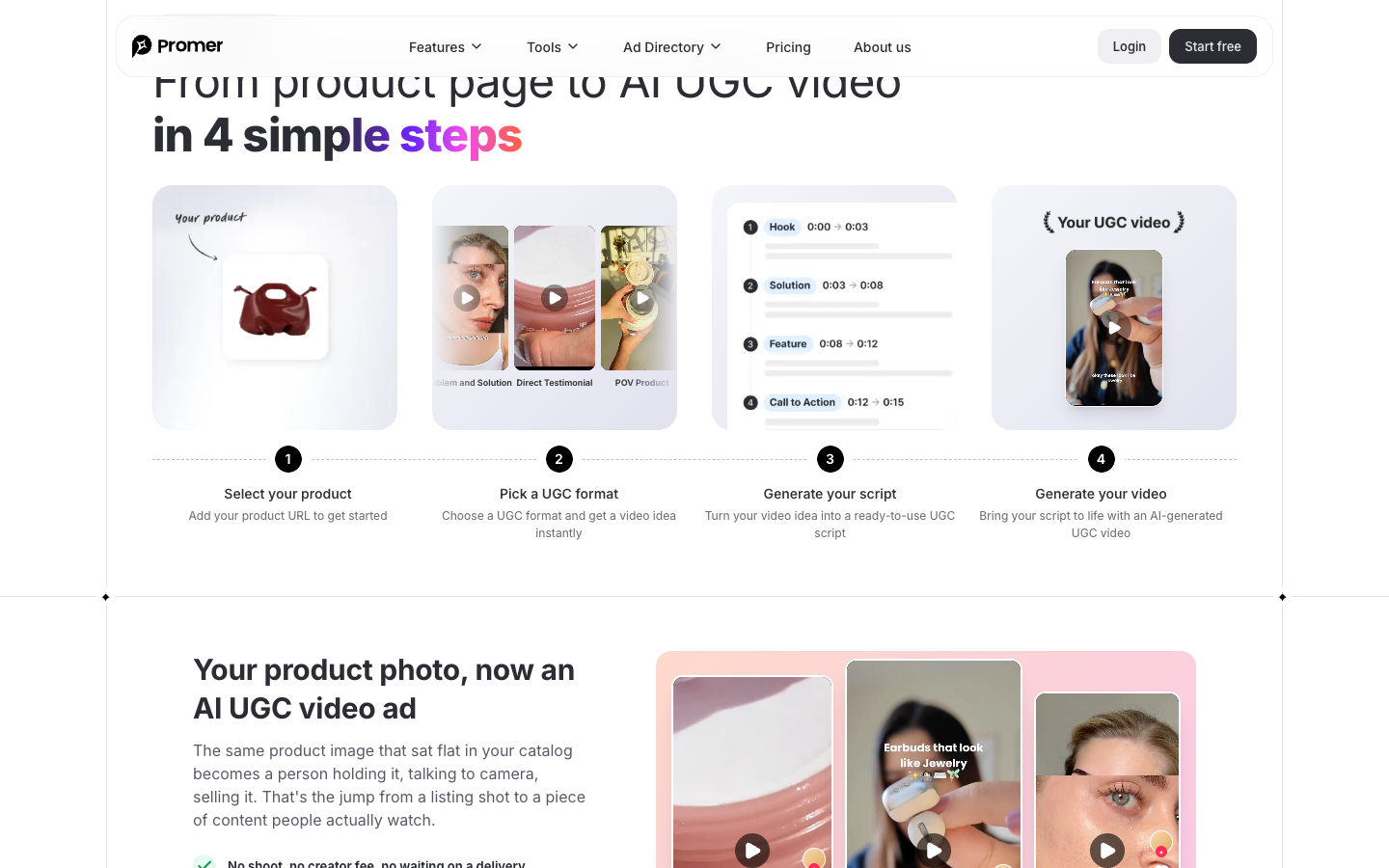
Promer AI's AI UGC Ads page, captured 29 September 2026.
The trade against Hedra is scope. Hedra does ten-minute lip sync, any face including your mascot, localization from your own audio, and a choice of 53 video models. AI UGC Ads is a fixed 15-second flow built around the product. If you already have a winning video ad, AI Video Ad Clone applies its scene structure to a new product and shows a product-fit assessment before scripting the new version. As with any AI output, review each creative before spend goes behind it.
If your ad is a character reading a script, Hedra is built for that and Promer AI is not. If the job is a steady supply of product ads to test on Meta and TikTok, an AI ad maker that starts from the product page is the closer fit, and you can create your first ad free with no credit card required.
Who Hedra is actually for, and who should skip it
Buy Hedra if:
- A face or character is the asset you scale. Your brand has a spokesperson or mascot, and the ad's job is a spoken claim Character-3 can deliver from one still.
- You have one winning ad and need it in more languages. Hedra's lip sync page shows one still performing the same line in English, Japanese and German.
- You want to test many spoken hooks before paying for product shots. A 10-second Character-3 read is about 25 cents at the floor rate.
- You have an editor, or you are fine treating the product insert as a second job on Kling V3 or Veo 3.1.
- You automate renders through the API, or through the MCP server and CLI announced on 31 August 2026.
Skip Hedra, or wait, if:
- You sell something that has to be handled, worn or demonstrated, and want it in one generation from a product page. No page read describes product URL import.
- You plan to upload real creators' faces before Hedra clarifies how its Acceptable Use Policy line on individuals "other than yourself" applies to you.
- You need the cost per ad in credits before subscribing. The credit deduction answers did not load on 29 September 2026.
- You want competitor ad research or ad account publishing in the same tool.
Hedra review verdict: buy the voice, brief the product separately
Hedra is a cheap, capable way to make a character talk, and a two-model workflow once your product has to be on screen.
Before subscribing, write the two-job brief above for one real product. Price Job 1 at 2.5 cents per second and Job 2 at the model you would use, then run both on a paid Basic month and check the credit counter after each render. If the character take works and the product insert holds its label, Hedra is worth scaling for hooks and languages. If the product keeps coming back almost right, get those seconds from a real shoot or a product-first tool, and keep Hedra for the voice.
FAQ
Is Hedra worth it for ecommerce ads?
Hedra is worth it when the ad is a spoken claim by a character, spokesperson or mascot. Hedra Character 3 starts at 2.5 cents per second and runs up to ten minutes from one audio file. Ads that must show the product need a reference-driven model at 8.4 to 14.85 cents per second, and Hedra says product fidelity varies by model, so budget those seconds separately.
How much does Hedra cost per month?
Hedra costs $20, $50 or $100 a month for Basic, Pro and Ultra, with 2,000, 7,200 and 18,000 credits. Teams lists $75 for 14,400 credits, and Enterprise is custom. Every paid plan includes commercial use. Prices were checked 29 September 2026 on monthly billing. The rule for credits per second of video was not readable, so check the counter after your first render.
How long can a Hedra Character-3 video be?
A Hedra Character-3 take can run up to ten minutes in one generation. If you leave the duration blank, the take matches the audio you upload. Hedra Avatar also runs to ten minutes. Other video models on Hedra cap much shorter, and each model page lists its own limit.
Can Hedra put my product in the video?
Yes, through a reference-driven video model or a still that already shows the product. Hedra tells you to send the product photo as a reference and keep it across generations. Its UGC page also says how strictly a model holds the reference varies, so check the label and shape frame by frame before putting spend behind the ad.
Can I use Hedra videos in paid ads?
Yes, Hedra's paid plans include commercial use and unwatermarked output. Hedra's terms say it does not claim ownership of your inputs or outputs, though you grant it a broad license to operate the service. You remain responsible for rights to any face or voice you upload, and for disclosing AI-generated content where your ad platform requires it.
Can I upload a real creator's face to Hedra?
Get written confirmation first, because Hedra's own pages disagree. Its UGC and lip sync pages say to send only portraits and voices you have the rights to use. Its Acceptable Use Policy bars inputs containing individuals other than yourself, with an exception only for people who died at least a hundred years ago. A signed creator release may not settle that alone.
What is the difference between Hedra and Promer AI for UGC ads?
Hedra animates a face you bring to audio you bring, while Promer AI starts from your product page. Hedra offers ten-minute lip sync, any face and 53 video models. Promer AI's AI UGC Ads extracts product context from a URL, then scripts and renders a 15-second, 9:16 ad with an AI avatar and voice. Choose by whether the character or the product is the asset.
How was this Hedra review researched?
This review is desk research from Hedra's public pages, terms and policies, plus one directory listing, checked 29 September 2026. No Hedra account was used and no videos were generated. Cost per ad figures are our arithmetic from Hedra's published per-second rates. G2, Trustpilot and Capterra could not be read, so the review makes no quality verdict on Hedra's output.
Related reviews and ecommerce guides
If you are comparing AI video tools for paid social, these reviews and guides on the Promer AI blog cover the neighbouring options:
- HeyGen Reviews 2026: HeyGen's studio avatars and lip sync, its Product Placement feature for physical products, and what its plans cost per ad.
- Creatify AI Reviews: a Shopify product link followed through Creatify URL to Video step by step, plus AdMax, pricing and refund terms.
- Higgsfield Reviews: a multi-model cinematic video suite, its Cinema Studio controls, and the credit math for batch generations.
- What Is AI UGC?: how AI UGC works, what it solves, and when real creators still win.
Reference Sources
CapCut. (n.d.). CapCut AI video editor: smart online video editing with advanced AI tools. https://www.capcut.com/
Creatify. (n.d.). Pricing plans. https://creatify.ai/pricing
Hedra. (n.d.). Acceptable use policy. https://www.hedra.com/acceptable-use
Hedra. (n.d.). AI content platforms compared. https://www.hedra.com/alternatives
Hedra. (n.d.). AI lip sync: one take, every language. https://www.hedra.com/uses/ai-lip-sync
Hedra. (n.d.). AI models: video, image and voice in one studio. https://www.hedra.com/models
Hedra. (n.d.). AI product video generator: one photo, every channel. https://www.hedra.com/uses/ai-product-video-generator
Hedra. (n.d.). AI talking avatar: one photo, any script, every model. https://www.hedra.com/uses/ai-talking-avatar
Hedra. (n.d.). AI UGC video generator: a different person every time. https://www.hedra.com/uses/ai-ugc-video-generator
Hedra. (n.d.). AI video ads: ten hooks, every placement. https://www.hedra.com/uses/ai-video-ads
Hedra. (n.d.). AI video models: run them in Hedra Studio. https://www.hedra.com/models/video
Hedra. (2024). Biometric data privacy policy. https://www.hedra.com/biometric-data-policy
Hedra. (2026). Hedra blog: AI video news, guides, and product updates. https://www.hedra.com/blog
Hedra. (n.d.). Hedra for enterprise: AI content creation at scale. https://www.hedra.com/enterprise
Hedra. (n.d.). Hedra: visual inference models and infrastructure. https://www.hedra.com/
Hedra. (n.d.). Pricing: free plan, no credit card. https://www.hedra.com/pricing
Hedra. (n.d.). Talking photo AI: if it has a face, it can talk. https://www.hedra.com/uses/talking-photo-ai
Hedra. (2024). Terms of use. https://www.hedra.com/terms
Hedra. (n.d.). Use cases: marketing, ads, L&D and more. https://www.hedra.com/uses
There's An AI For That. (n.d.). Hedra. https://theresanaiforthat.com/ai/hedra/