This Smartly review is for you if you run paid ads for an online store and are weighing Smartly against the automation you already use. Smartly publishes no price, and every button on its site leads to a demo request.
Buyers on Vendr report a median contract of $90,000 a year. Smartly is worth a demo if you spend $100,000 or more a month across 3 or more channels.
Below $50,000 a month, that median equals 15% or more of your ad spend. I checked Smartly's terms, docs and buyer reports between October 9 and 12, 2026. Skip to the ad-spend threshold if you only want the math.
Why you can trust this Smartly review
Smartly sells through a demo, so this review rests on public sources: its terms of use, documentation and feature pages, buyer-reported prices on Vendr, and reviews on TrustRadius. I checked each between October 9 and 12, 2026.
Where a number comes from someone else, I name the source. The break-even math is mine.
Key takeaways
- Plan on $90,000 a year, not a free trial. Smartly publishes no price and no trial. Vendr buyers report $25,500 to $171,240, with that median.
- Your fee is a share of spend plus a minimum. The terms set a percentage of ad spend and a monthly minimum, invoiced monthly.
- Spend decides the deal. At the median, the fee equals 15% of $50,000 in monthly ad spend and 3% of $250,000.
- Ask which ad accounts count. Spend covers every charge on a registered account, even campaigns you built outside Smartly.
- Exit has no refund. After the first term you can leave by written notice, but Smartly returns no paid fees.
What Smartly is in 2026: creative, media and Synapse agents
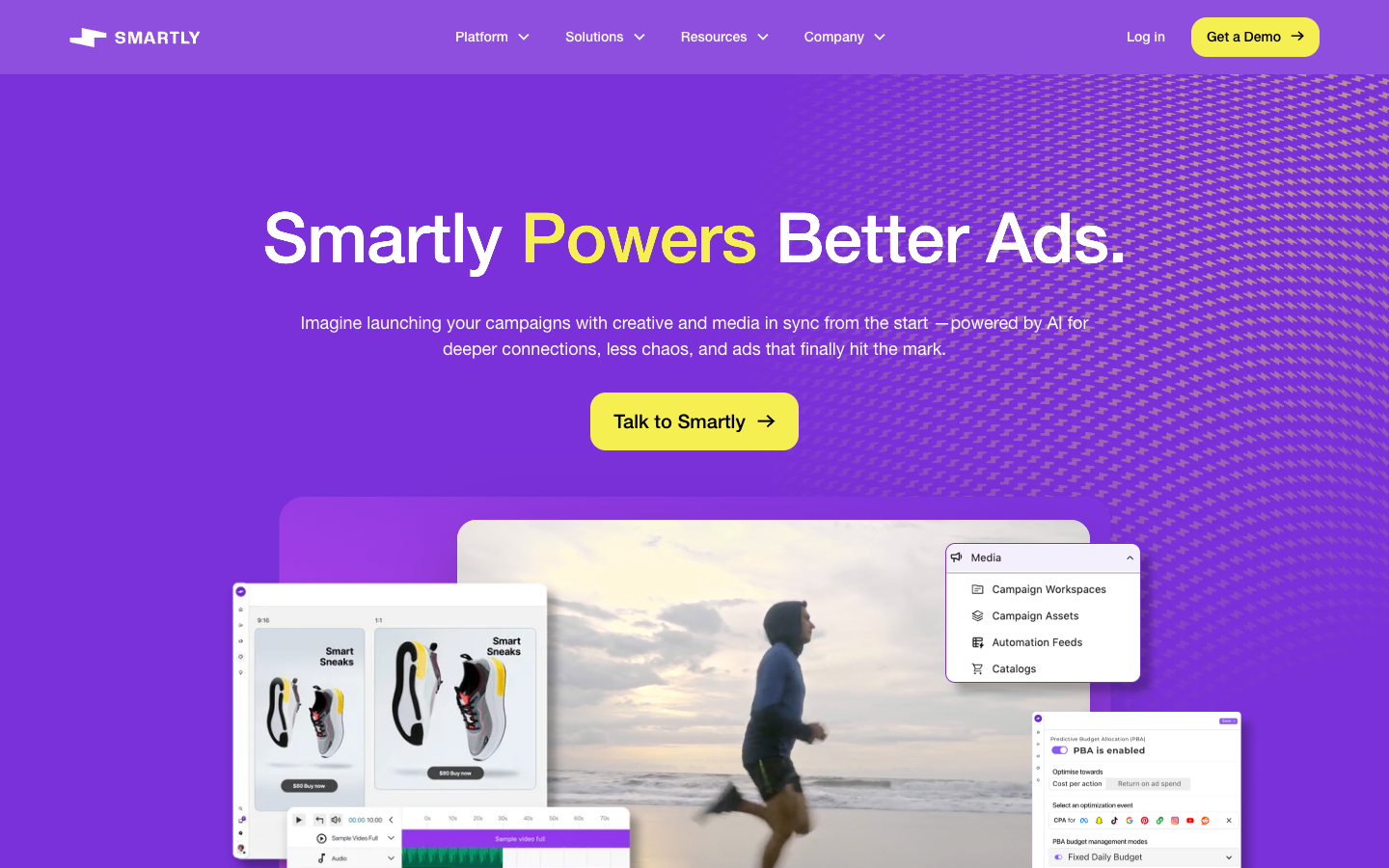
Smartly is an enterprise ad automation platform. It builds ad creative, launches campaigns and reports results across social and programmatic channels from one login.
Smartly's site lists Samsung, Spotify, Uber, Ralph Lauren, Tripadvisor, TUI, Boots and Nutrafol as customers. That is the buyer Smartly is built for: a brand running 1 media plan across several countries.
Smartly's 3 suites and the Synapse agent layer
Smartly sells 3 suites, one per job. Creative builds and approves ad variations through templates, AI Studio and Producer, the approval hub. Media launches campaigns and moves budget through Predictive Budget Allocation and Optimization Triggers.
Intelligence reports results, including Brand Pulse, which Smartly says measures deduplicated reach and frequency across channels. The all-features page also lists Automated Ads, Dynamic Product Ads and Creative Predictive Potential, which Smartly says forecasts creative effectiveness before launch.
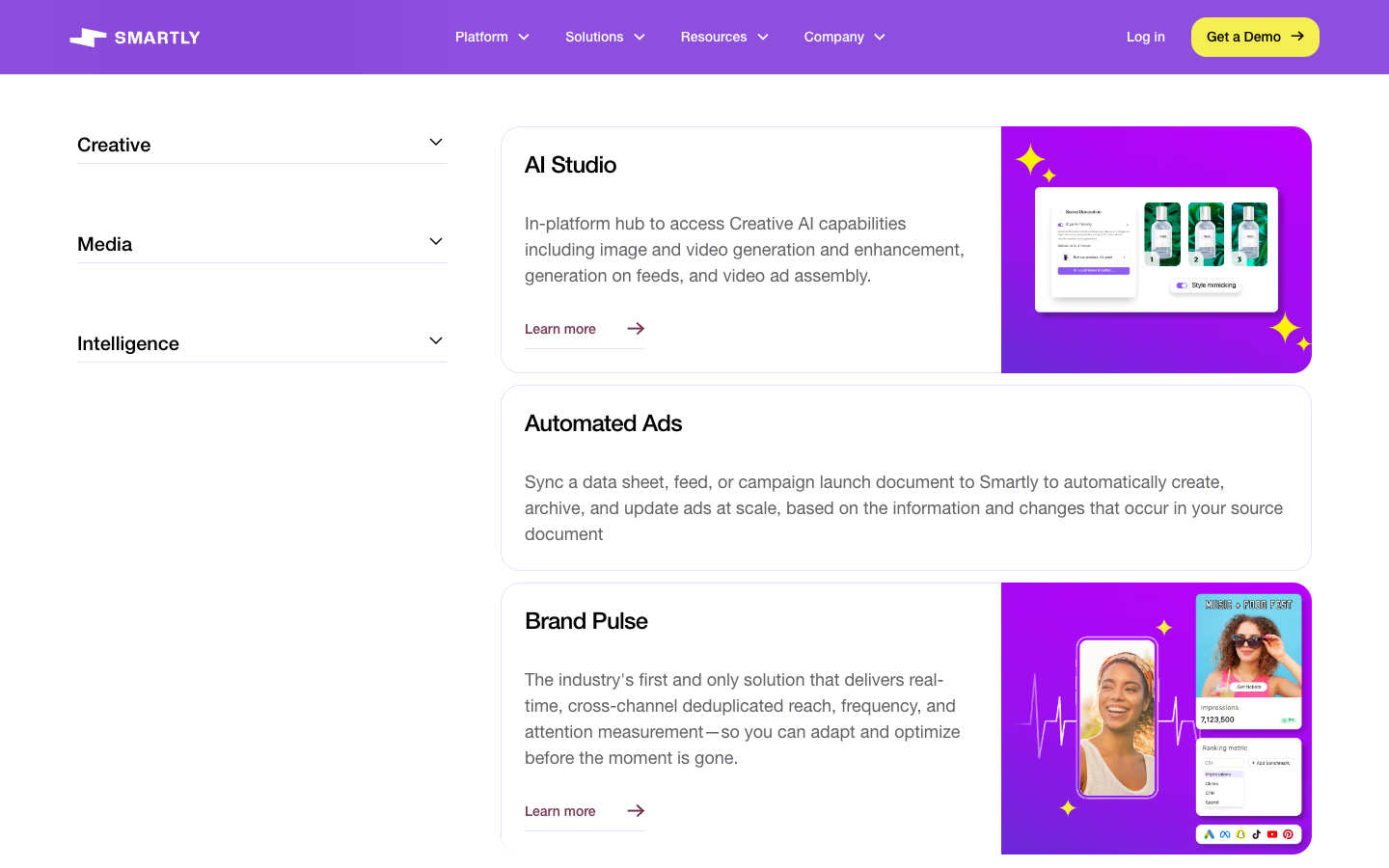
Synapse is Smartly's agent layer inside the same platform. Planning Agents handle forecasts, Execution Agents such as the Campaign Assembly Agent turn briefs into campaigns, and QA Agents and Optimization Agents check and adjust the work.
The control setting matters more than the agent names. Smartly says Optimization Agents adjust budgets and rotate creative "with or without human input," and that built-in approvals let agents act only when you choose. Your approval settings decide how much budget moves without a person signing off.
Smartly channel coverage: 10 social and 5 programmatic platforms
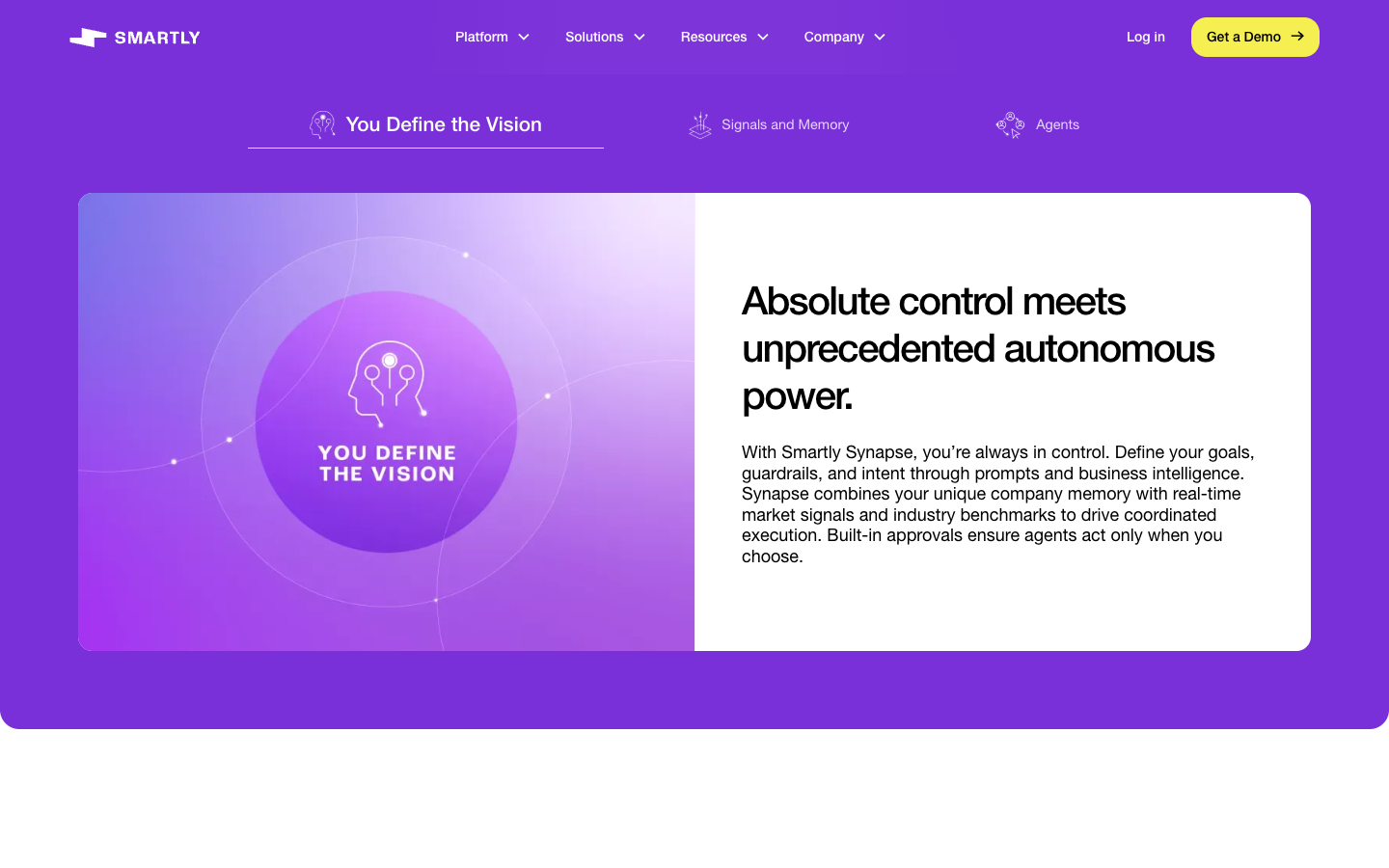
Smartly's knowledge base, updated October 8, 2026, lists 10 supported social channels, including Google Ads, Meta, Pinterest, Snapchat, TikTok, Reddit and Spotify. Programmatic support adds Amazon DSP, Google DV360, The Trade Desk and Yahoo DSP, with X in beta and Amazon DSP in alpha on the social list.
Channel reach is where Smartly separates from Shopify-sized tools. A Meta and TikTok plan leaves most of that list unused.
From catalog feed to live ads: how a Smartly campaign gets built
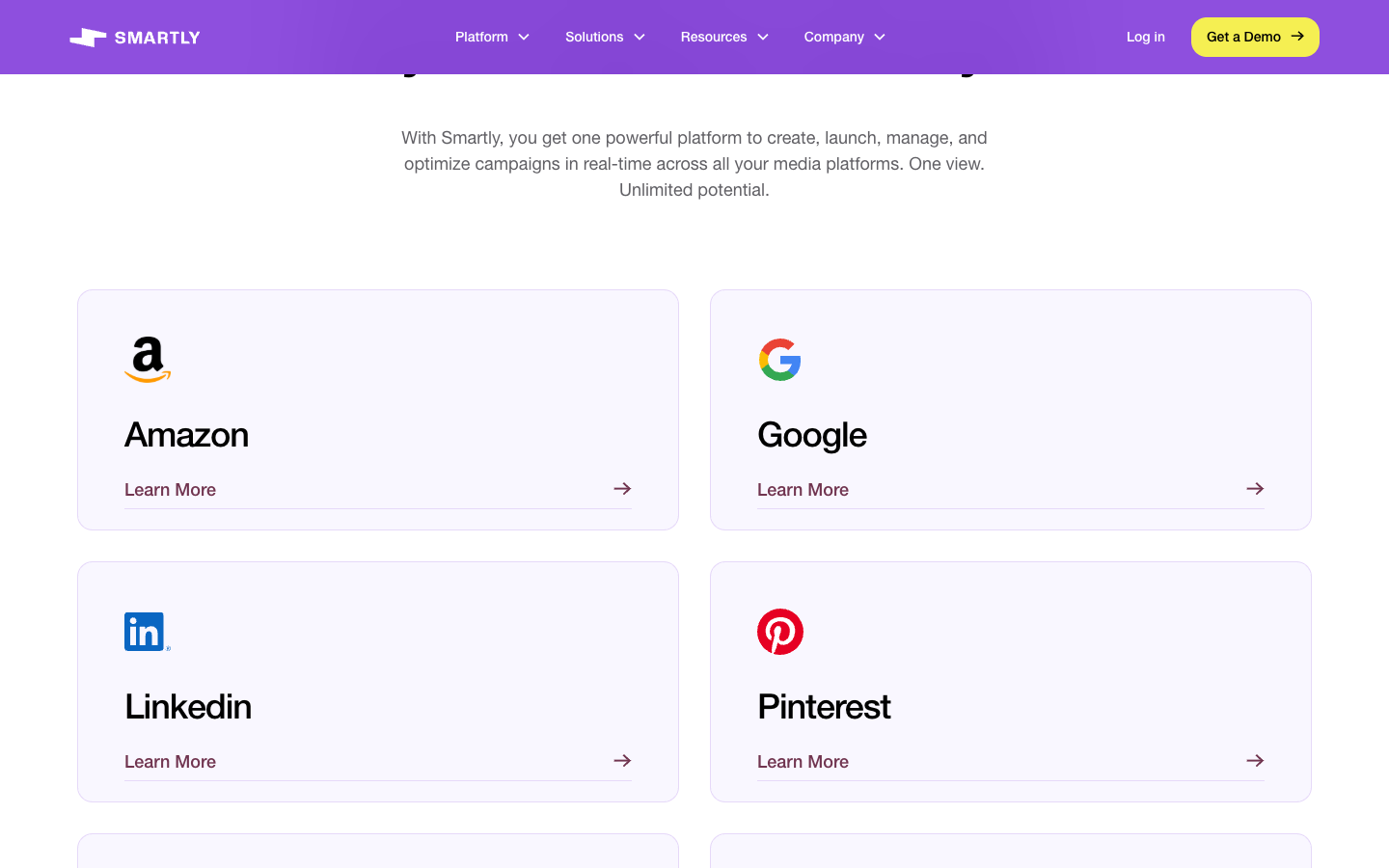
A Smartly campaign starts from data: a product feed, a sheet or a launch document. The 4 steps below follow Smartly's terms, feature pages and a shoe retailer use case in its knowledge base. They show where your team's hours go and where the platform takes over.
Step 1: Connect ad accounts and sync a feed into Automated Ads
Smartly's terms require you to register on app.smartly.io and authorize Smartly to access your ad accounts and the data in them (section 3.1). Section 2.4 lets Smartly staff view those accounts during a support case and change campaigns on your request or approval. You stay responsible for results either way.
Automated Ads then turns a spreadsheet into campaigns. You sync a data sheet, product feed or launch document, and Smartly creates, archives and updates ads as rows change.
For an ecommerce brand, a price change or out-of-stock flag in the feed reaches the ads without anyone opening Ads Manager. With 30 SKUs, one person can make the same edits by hand.
Step 2: Enrich the catalog with Smartly AI Studio
AI Studio is Smartly's hub for image and video generation, generation on feeds and video ad assembly. A Smartly knowledge base use case, dated September 24, 2025, shows a large shoe retailer running it on a plain feed of images, colors, names and prices.
The team used Text Generation to convert color names such as "cool grey" into hex codes for every row. Scene Generation handled background removal, and the Creative Editor animated the stills into video.
Scenario: a store with 600 home and kitchen SKUs is heading into Black Friday, with one feed row per product. The prompts below are adapted from the retailer's tagline prompt, so change the field names to match your feed.
| Ad job | Prompt to run on every row | What to check in the output |
|---|---|---|
| Problem-first hook | Write 1 hook for {{product_name}} aimed at a shopper who is {{pain_point}}. Open with the problem, not the product. Use only facts in {{description}}. Maximum 7 words. | Invented features, and the same opening word repeated across 600 rows. Add a pain_point column per category first. |
| Offer line | Write an offer line in the form "Now $X" using only {{sale_price}}. Never round the price and never add shipping claims. | Wrong or rounded prices that no longer match the product page. |
Each prompt sets a hard limit on length and claims. A prompt that says only "make a nice ad for this mug" gives you 600 near-identical studio shots, and output quality still needs a human check on every batch.
Step 3: Scale ad variations with Video and Image Templates
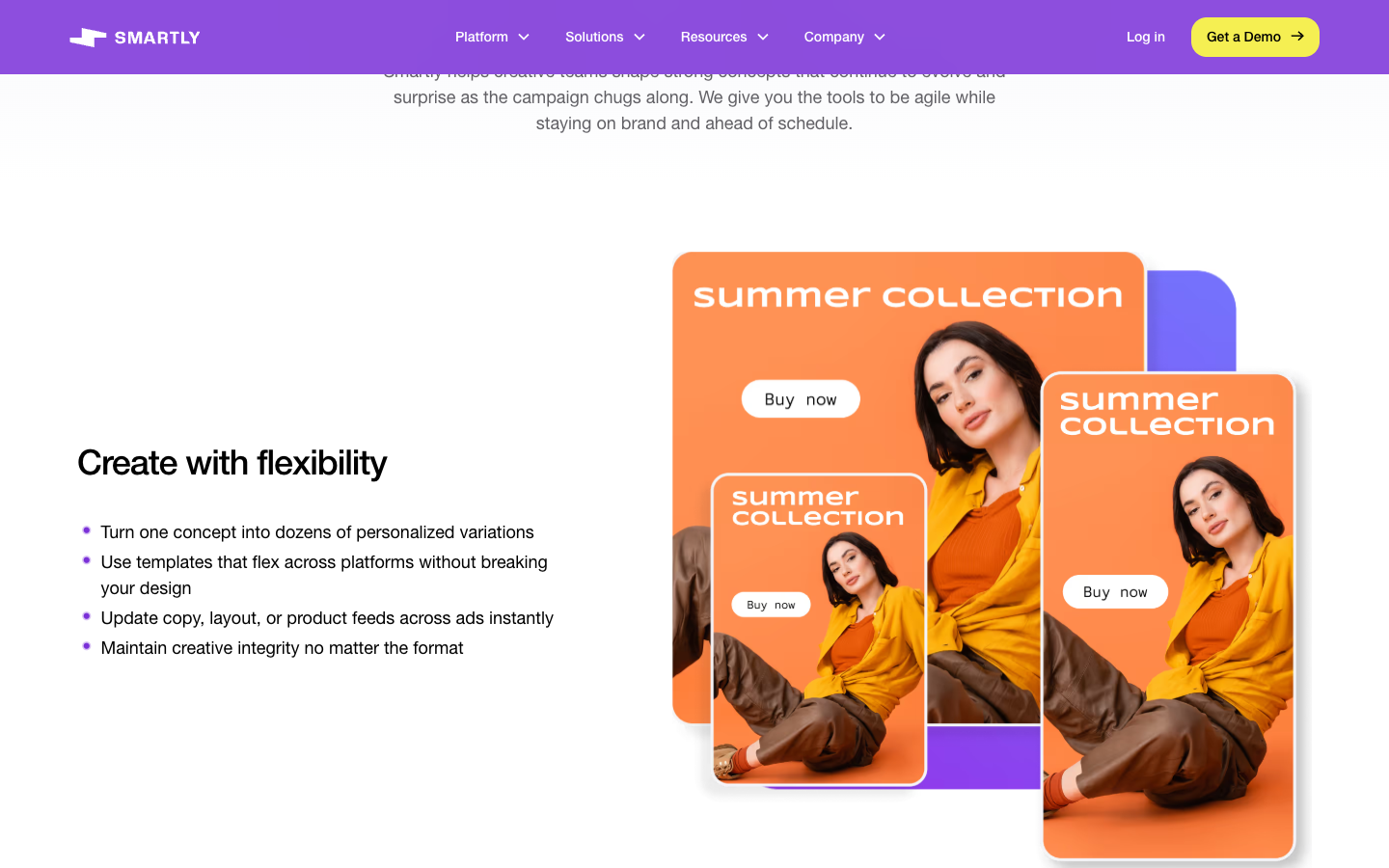
Smartly's creative teams page promises hundreds of personalized variations from one concept, built from a synced product feed or data source. Templates hold the layout, lock brand elements, and swap copy, product and language per row.
The vendor's own example is Samsung's Galaxy Note 20 launch in Spain: 400 banner versions and 5 days from brief to live campaign, per Smartly's performance teams page. A launch that needs 10 versions leaves most of that capacity idle. Templates also multiply an idea you supply without choosing the angle.
Step 4: Let budget allocation and triggers move the spend
Once ads are live, 2 Media tools take over. Optimization Triggers are automated rules, such as pausing underperforming campaigns or raising budget behind top creatives. Predictive Budget Allocation shifts budget across channels based on predicted performance.
Both buy back setup labor, multiplied by every channel you run.
Smartly pricing: no price page, a demo form and a $90,000 median
Smartly does not publish its prices. Buyers on Vendr report a $90,000 median, and the public terms set out how the fee, the exit and the refund rules work before any sales call.
What buyers report paying for Smartly
Vendr, a software buying marketplace, lists a median Smartly contract of $90,000 a year, with a low of $25,500 and a high of $171,240 (checked October 12, 2026). Per month, that is about $2,125, $7,500 and $14,270.
Treat those as buyer reports, since Smartly publishes no rate card. Vendr does not publish a sample size, and its page title still reads 2025. They are still the most complete price figures available before a demo.
Smartly's terms send you to a price list at smartly.io/pricing for the fee percentage and the monthly minimum. That page now says it is no longer available and points prospects to sales.
TrustRadius lists no pricing plans for Smartly and states "No free version or trial is available for Smartly.io" (checked October 12, 2026). An agency reviewer there reported a base minimum that rose from $1,000 to $5,000 a month as spend grew (August 2020).
How the Smartly fee follows your ad spend
Section 5.1 of Smartly's terms sets the fee as a percentage of your ad spend, calculated separately for each subscription, plus a monthly minimum fee. Smartly invoices after each calendar month.
Spend is defined broadly. Section 1.2 counts all advertising charges on a registered ad account, whether or not you ran those campaigns through Smartly. Ask sales to confirm in writing which ad accounts your fee covers, and leave accounts you won't run through Smartly unregistered.
The Smartly contract terms you can read before the demo
Smartly's public terms settle these points before any call:
- Price changes: Smartly may change pricing with 30 days written notice, and you may end the agreement on the change date (section 5.3).
- Exit: after the Initial Term, written notice ends the subscription. Managed or Creative Service needs 30 days notice (section 9.1).
- Refunds: on termination, "no paid fees will be returned" (section 9.5).
The terms leave the percentage, the minimum and the length of the Initial Term to the price list or your Order Form. With the price list page retired, get all 3 in writing before you sign.
The ad-spend threshold: when Smartly's fee pays for itself
Smartly's fee pays for itself when the efficiency it adds, on top of the automation you already use, is worth more than the contract. At Vendr's $90,000 median, that takes $75,000 a month in ad spend at a 10% gain, or $150,000 at a 5% gain.
If your spend sits below $50,000 a month, jump to the alternatives section.
The Smartly fee as a share of monthly ad spend
The table divides Vendr's 3 contract figures by 6 monthly spend levels. Find your spend row and look for the column where the fee falls under 5%.
| Monthly ad spend | Low contract ($2,125/mo) | Median contract ($7,500/mo) | High contract ($14,270/mo) |
|---|---|---|---|
| $25,000 | 8.5% | 30% | 57.1% |
| $50,000 | 4.3% | 15% | 28.5% |
| $100,000 | 2.1% | 7.5% | 14.3% |
| $250,000 | 0.9% | 3% | 5.7% |
The arithmetic is mine, from Vendr's figures checked October 12, 2026. Vendr does not tie its range to spend levels, so read the low and high columns as stress tests.
At $25,000 a month, a median contract costs 30 cents for every ad dollar. At $250,000 it costs 3 cents, and the question becomes whether automation moves your results by more than 3%.
The break-even math for Smartly automation
The break-even rule fits in one line: monthly fee divided by the efficiency gain you expect equals the monthly spend you need. At the $7,500 median monthly fee, it works out like this:
- A 5% efficiency gain needs $150,000 in monthly ad spend to cover the fee.
- A 10% gain needs $75,000.
- A 20% gain needs $37,500.
Efficiency gain means extra results per ad dollar compared with your current setup. The right baseline is free automation: Meta claims a 20% improved CPA for Advantage+ sales campaigns at no tool fee. Smartly has to beat the automation you can already switch on.
Hours saved: the other half of the Smartly case
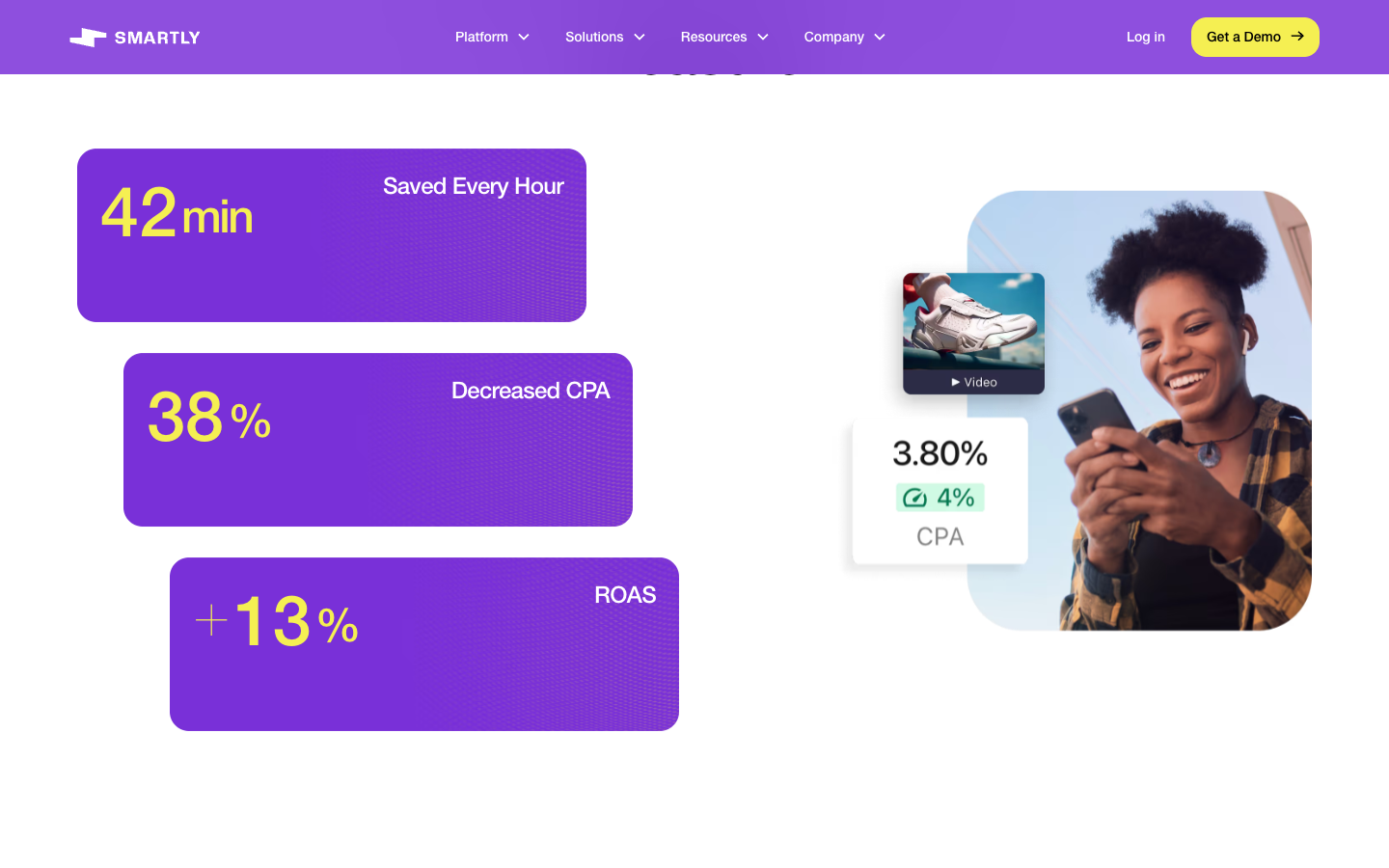
The second payback route is labor. Smartly's platform overview claims 42 minutes saved every hour with no client named, and neither page publishes a method.
Run your own version of that number. Count the monthly hours your team spends building campaigns, resizing variations and copying them across channels. Multiply by what an hour costs you, and add the result to the media gain above.
When neither the media math nor the hours math clears the fee, a demo will not change the answer.
Smartly pros and cons: channel reach, case studies and tradeoffs
Smartly publishes large results from large brands, such as a 113% revenue lift at Under Armour. These are vendor case studies chosen by Smartly, and they show who buys Smartly (a sportswear brand, a fashion marketplace, a lottery operator) more than what you would get.
| Smartly strength | The tradeoff |
|---|---|
| 10 social and 5 programmatic channels in one login (knowledge base, October 8, 2026) | No public price and no free trial (TrustRadius) |
| Automated Ads updates ads from a feed or sheet | Little time saved on a small catalog |
| Support chat 24/7/365 (knowledge base) | Support does not build your campaign strategy, and billing goes through a CSM |
| Approvals gate Synapse agents | Agents can act with or without human input if you allow it |
Who Smartly fits for ecommerce ads, and who should skip it
Smartly fits when:
- Your monthly ad spend is $100,000 or more and runs across 3 or more channels.
- Your catalog has hundreds or thousands of SKUs feeding dynamic product ads.
- You launch in several markets or languages and need approval steps in one place.
- An in-house marketing team or agency sets strategy, since Smartly's support does not build campaign strategy.
Skip Smartly, or wait, when:
- Your monthly spend is under $50,000, where a median contract equals 15% or more of spend.
- You need a free trial or month-to-month terms before committing.
- You run Meta only, where Advantage+ already automates audience, placements and budget at no tool fee.
- Your bottleneck is deciding what the ad should say, not producing 400 sizes of it.
The Smartly lesson for any ad contract: divide before you demo
Smartly's contract shows a shape that every ad automation tool billed against spend shares. The fee is fixed or tiered, and the benefit is a percentage of spend, so the fee share decides the deal before any feature does.
Divide the quoted fee by your monthly spend. If the result is larger than the efficiency gain you would bet on, no feature list fixes it. AdScale's Basic plan at $169 for up to $1,000 in ad spend is 16.9% of spend at the cap, a bigger share than Smartly's median takes at $50,000.
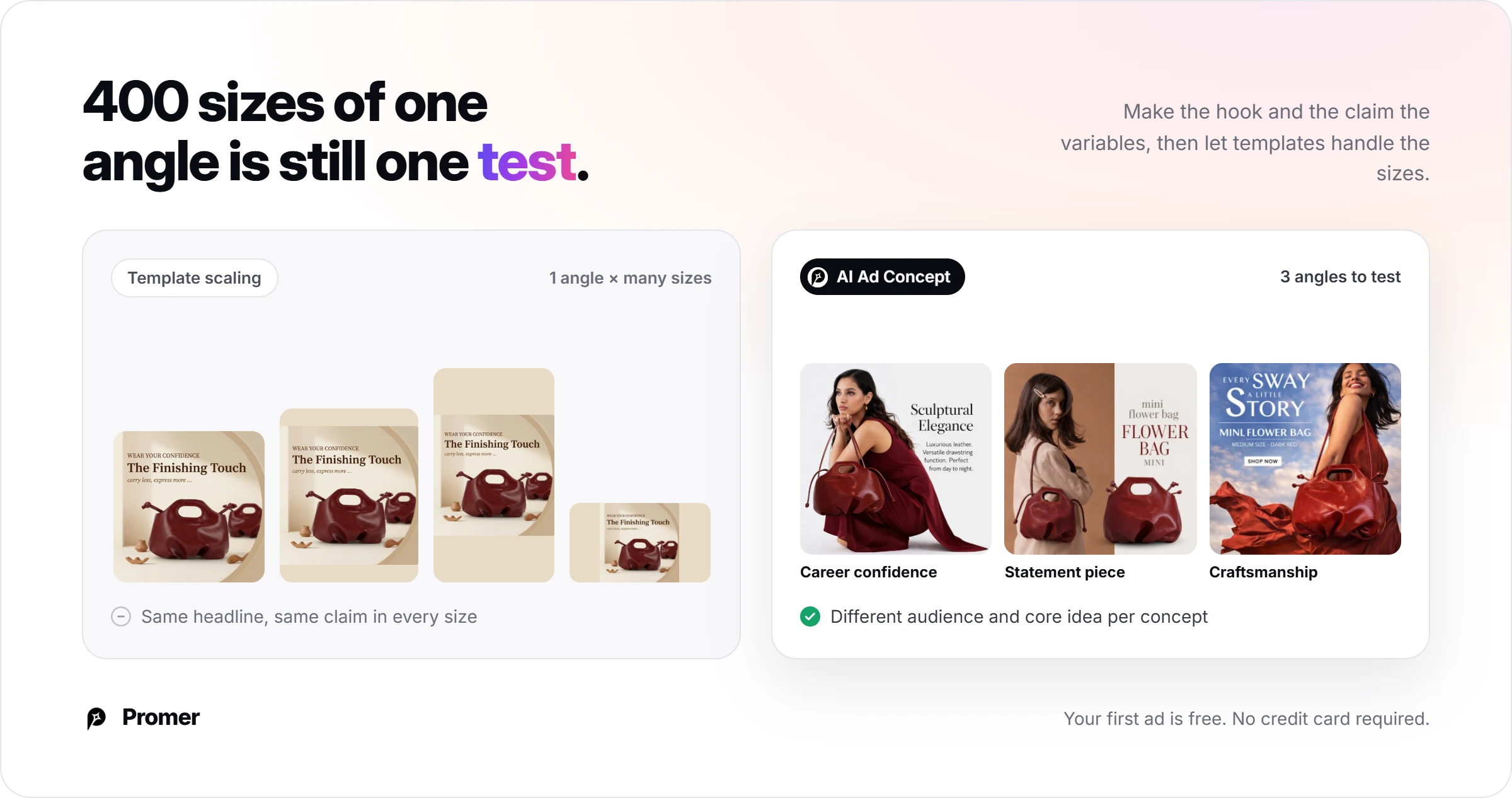
Automation multiplies whatever you feed it, and 400 versions of a weak angle are 400 weak ads. Ad creative testing works when the hook and the claim are the variables, decided before any template runs.
Smartly alternatives below the enterprise threshold
Three Smartly alternatives cost less, ordered by what they add to your monthly bill. The first 2 replace parts of Smartly's media automation, and the third replaces part of its creative side. None of them matches Smartly's 10 social and 5 programmatic channels or its approval workflows.
Read the cost column first, because the right pick rarely matches the longest feature list:
| Option | Cost | Best for | Verdict |
|---|---|---|---|
| Smartly | Median $90,000 a year (Vendr buyers) | Brands with $100,000+ monthly spend across 3+ channels | Most channels and approvals, highest fee |
| Meta Advantage+ | No tool fee | Stores that spend mostly on Facebook and Instagram | The free baseline every paid tool has to beat; Meta only |
| AdScale | $169 to $329 a month, 7-day trial | Shopify stores spending $1,000 to $3,000 a month on Google and Meta | Spend-capped automation with no TikTok or Pinterest |
| Promer AI | First ad free, no credit card | Stores that need a steady supply of ad concepts and variations | Makes the ads, does not buy media |
Meta Advantage+, the automation already in Ads Manager
Meta Advantage+ is Meta's own automation suite inside Ads Manager, with no tool fee on top of your ad spend. Meta claims a 20% improved CPA for Advantage+ sales campaigns, which is Meta's own figure and the baseline any paid tool has to beat.
Pick Advantage+ when most of your spend runs as Facebook ads and Instagram ads and you want budget and audience automation without a contract. Skip it when you need one view across TikTok, Google and Pinterest, because it covers Meta placements only.
AdScale, spend-capped automation for Shopify stores
AdScale is a Shopify app that builds and runs Google and Meta campaigns. Its listing shows Basic at $169 a month for up to $1,000 in ad spend, Growth at $249 up to $2,000, and Elite at $329 up to $3,000.
Each plan has a 7-day free trial, and the app holds 4.7 out of 5 from 373 Shopify reviews (checked October 12, 2026), which lets you test before you pay.
Pick AdScale when your Shopify store spends $1,000 to $3,000 a month on Google and Meta and you have no media buyer. Skip it when you need TikTok or Pinterest, since the listing names Google and Meta only. The AdScale review on this blog covers its trial and permissions.
Promer AI, the creative supply without a media contract
Promer AI is an AI ad creative performance platform for ecommerce advertisers, and it covers a different half of Smartly's job. It makes the ads and does not buy media, so it sits beside Advantage+ or AdScale.
Promer AI's AI Ad Concept starts one step before Smartly's templates, which multiply a concept your team already has.
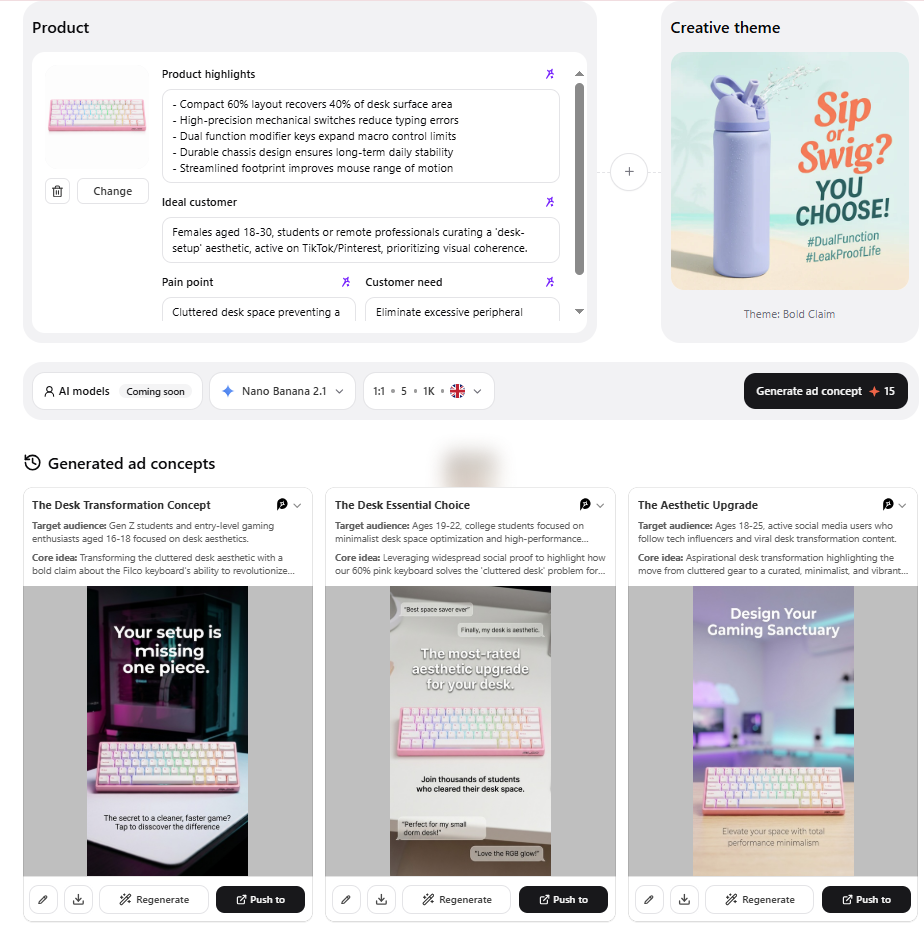
You add a product URL or image and pick a creative theme and mood. The AI reads the product for highlights, ideal customer, pain point and need, then generates several concepts, each with a name, target audience and core idea.
For variations, AI Ad Clone rebuilds the structure of a high-performing reference ad with your own product. References come from a winning-ad library, live Meta ads or your own upload. Output covers ratios such as 4:5 for Meta feed and 9:16 for Reels.
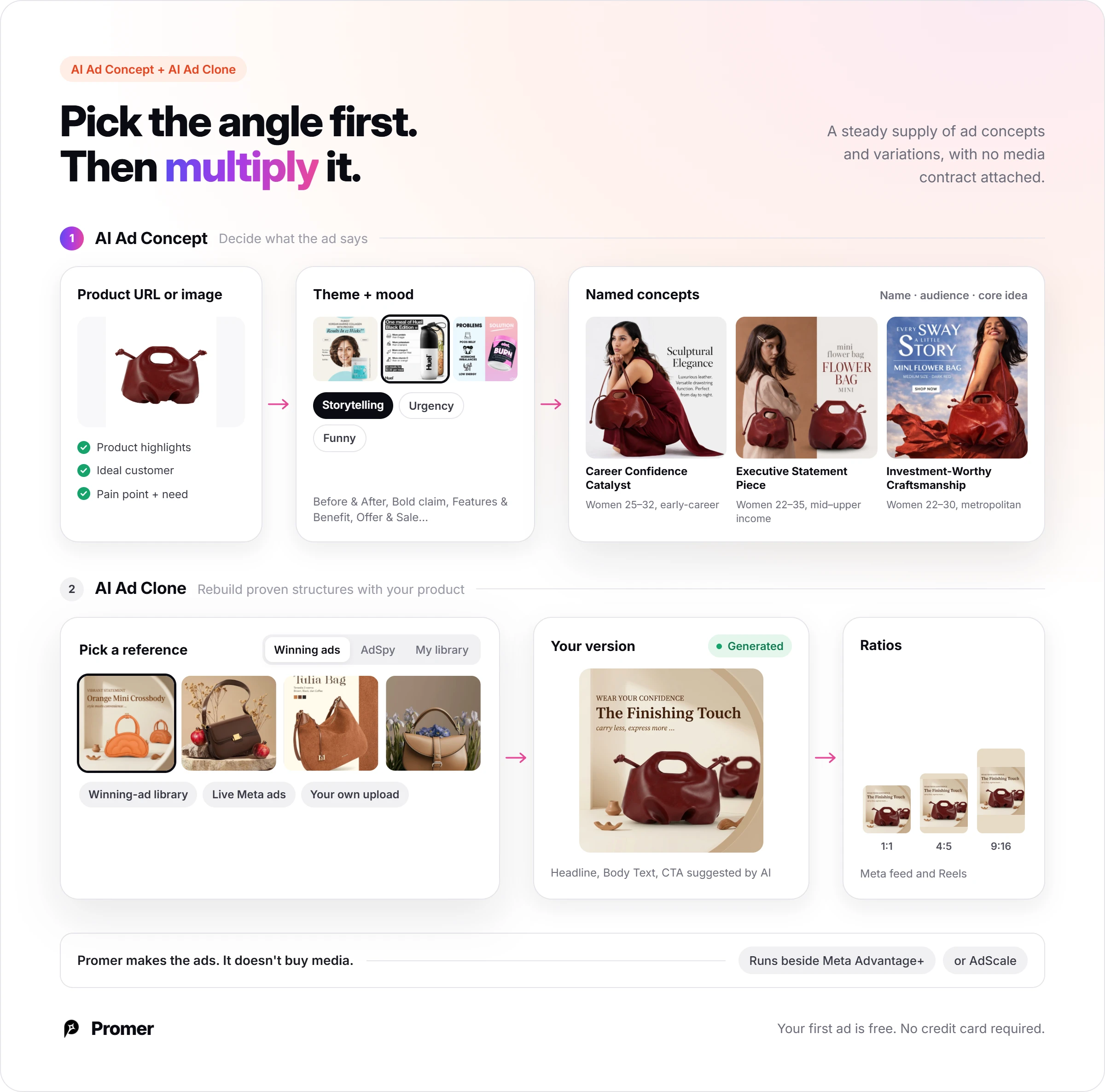
Creatives can contain mistakes, so review each one before spend goes behind it. Smartly does work Promer AI does not attempt: cross-channel media buying and approval workflows for a large team.
Below that scale, if your gap is a steady supply of angles and ad variations, an AI ad maker built on product context is the closer fit. You can create your first ad free, with no credit card required.
Smartly review verdict: worth a demo above $100,000 a month
Book the Smartly demo if your monthly ad spend clears $100,000 across 3 or more channels and your catalog runs to hundreds of SKUs. Skip it below $50,000, where a median contract equals 15% or more of spend. Between the two, the hours your team spends on builds decide it.
Before the call, spend 30 minutes on 3 numbers: monthly spend per channel, monthly hours on builds and resizing, and the gain you would bet on over Advantage+. Divide any quoted fee by your spend and compare.
Then get the fee percentage, minimum, Initial Term and covered ad accounts on the Order Form in writing. Those 4 items set the real price, and the public terms do not state them.
FAQ
How much does Smartly cost?
Smartly does not publish prices; Vendr reports a median contract of $90,000 a year, ranging from $25,500 to $171,240.
Smartly's old pricing page now says it is no longer available and points prospects to sales. Smartly's terms set the fee as a percentage of ad spend plus a monthly minimum. Your quote will likely depend on spend, channels and services, so use the Vendr range when you negotiate.
Does Smartly have a free trial?
No, Smartly does not offer a free trial or a free plan.
TrustRadius states that no free version or trial is available for Smartly, and Smartly's own site offers only demo requests (both checked October 12, 2026). Access starts with an Order Form and registration on app.smartly.io. To test automation before signing, Meta Advantage+ runs inside Ads Manager at no tool fee.
Is Smartly worth it for a small ecommerce store?
For a store spending under $50,000 a month, Smartly is hard to justify on cost.
At Vendr's $90,000 median, the fee equals 15% of $50,000 in monthly spend and 30% of $25,000.
Smartly's value comes from multi-channel reach, large catalogs and approval workflows, which a small team may not need. If creative supply is your gap instead of media automation, Promer AI generates ad concepts and variations from a product URL without a media contract.
How is Smartly different from Meta Advantage+?
Meta Advantage+ automates Meta campaigns at no tool fee; Smartly automates creative, media and reporting across 10 or more channels for a contract fee.
Meta claims a 20% improved CPA for Advantage+ sales campaigns. Smartly's Meta documentation lists Advantage+ among supported ad formats, so both can run together. Smartly earns its fee when cross-channel budget moves, catalog templates and approvals matter more than Meta alone.
Can you cancel Smartly or get a refund?
You can end a subscription by written notice after the Initial Term, but Smartly returns no paid fees.
Section 9.1 of the terms allows written notice, with 30 days for Managed Service or Creative Service, and the monthly minimum still applies to the month you leave. Section 9.5 says paid fees are not returned. Ask for the Initial Term length before you sign.
Reference Sources
- Smartly. (n.d.). About us. https://www.smartly.io/about-us
- Vendr. (n.d.). Smartly.io software pricing and plans. https://www.vendr.com/marketplace/smartly-io