Direct Answer: Independent Higgsfield reviews position the platform as a leading generative video suite that brings more than 50 AI models, including Kling 3.0, Seedance 2.5, Sora 2, and Google Veo 3.1, under one monthly credit subscription.
Its Cinema Studio 4.0 provides detailed control over virtual cameras, lenses, and lighting, making it possible to create cinematic product footage without traditional production crews. However, ecommerce advertisers still need to develop the marketing angle, write conversion-focused hooks, and turn individual clips into complete multi-scene ads.
For paid social teams, this addresses one part of the creative fatigue problem: producing visually distinctive footage is expensive and time-consuming. Traditional cinematic product shoots can require specialized crews, cinema equipment, and weeks of planning. Higgsfield brings much of that visual production process into a laptop, letting advertisers experiment with camera movements, lighting, and motion across multiple generative video models.
I spent 14 days testing Higgsfield with physical product assets, focusing on its camera controls, motion templates, and real credit consumption to assess how practical its cinematic AI video capabilities are for ecommerce advertising.
The result is a powerful visual production tool, but not a complete ad-creation workflow. Higgsfield can help produce polished cinematic footage; turning that footage into a high-converting ad still requires a separate creative and marketing strategy.
Key takeaways for ecommerce advertisers
- Aggregated model bench in one place: Instead of paying for separate subscriptions to Sora, Kling, Veo, Hailuo, and Seedance, Higgsfield unifies them behind a single credit pool, alongside its native Soul image model and Director of Photography tools.
- Cinematic camera controls: Cinema Studio 4.0 features real camera controls, with 30+ camera motion presets (dolly, crane, 360 orbit) and lens emulations (35mm film, vintage anamorphic, deep aperture) that reduce the need for trial-and-error prompting.
- Batch rendering economics: Cinema Studio’s default generations produce four variations at once, consuming 60 to 80 credits per generation run rather than single-digit credit increments.
- The ad conversion reality: High-end cinematic B-roll looks stunning, but out of 12 test generations, only 3 functioned as workable ad components. Video ads still need hooks, problem-solving demonstrations, and clear calls to action - elements the platform leaves you to build manually.
- Low-cost synthetic photography: Higgsfield Soul 2.0 generates static lifestyle images at just 0.12 credits per generation (under half a cent), making synthetic catalog photoshoots remarkably cost-effective.
- Subscription entry points: Individual plans start at $15 per month for Starter (200 credits), followed by Plus at $39 per month on annual billing ($49 monthly for 1,000 credits) and Ultra at $99 per month on annual billing ($129 monthly for 3,000 credits).
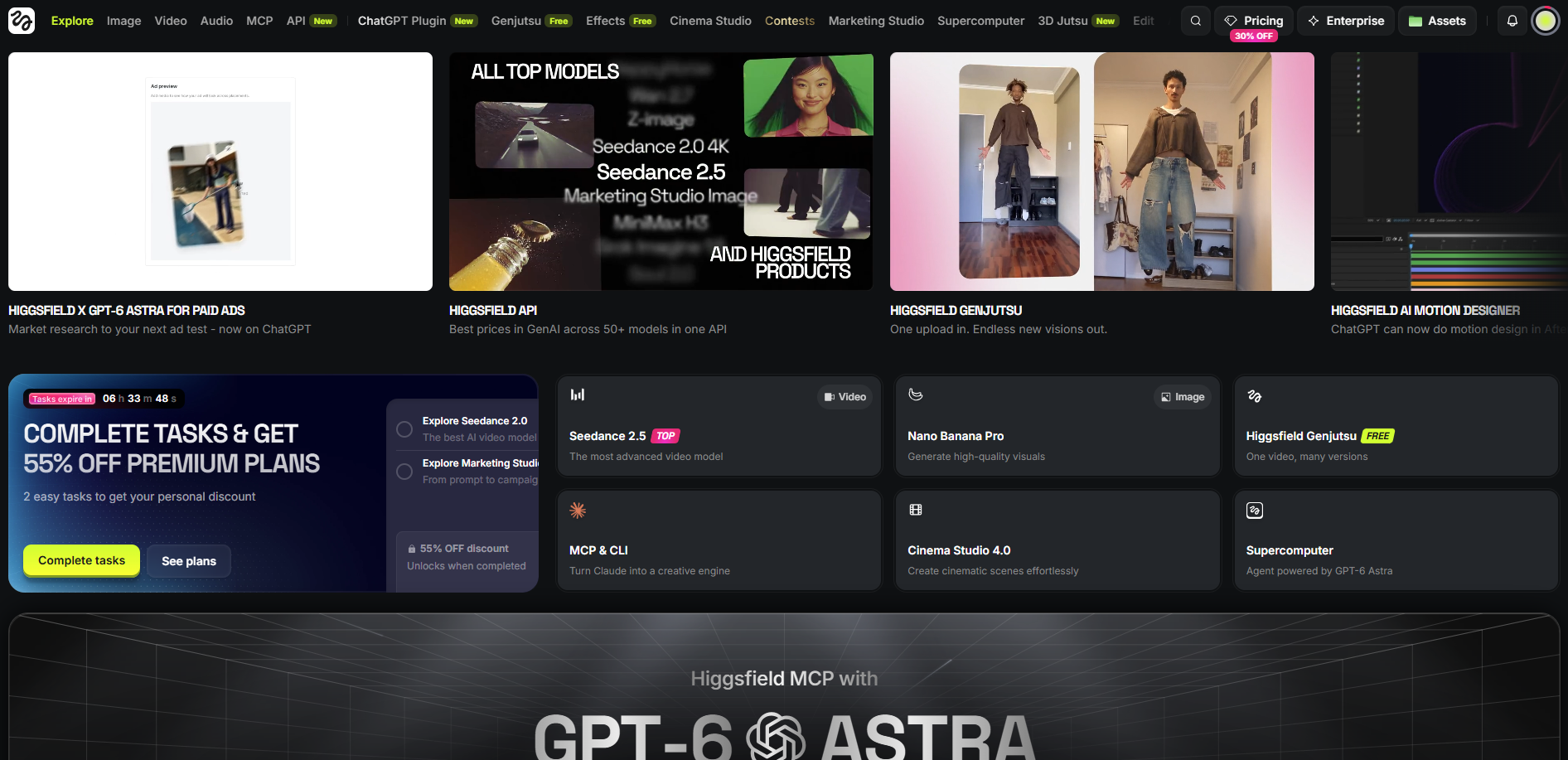
The Higgsfield Explore workspace showing unified access to Cinema Studio, Marketing Studio, and model benches, captured September 2026.
What is Higgsfield AI, and how does its 50-model suite work?
Higgsfield AI operates as an AI-native creative suite and model aggregator. Founded in 2025 and based in San Francisco, the company recognized an early truth in generative video: no single foundation model excels at every scene. One engine might excel at realistic human skin, another handles fluid physics, while a third specializes in smooth drone pans.
Instead of forcing creators to maintain half a dozen individual logins, Higgsfield packages a roster of over 50 leading models behind one unified credit subscription. For video generation, the bench includes:
- Kling Series: Kling 3.0, 2.6, and 2.5 Turbo for snappy physical interactions and consistent object motion.
- Seedance Suite: Seedance 2.5, 2.0, and Pro for ultra-crisp 4K rendering and natural environmental textures.
- OpenAI Sora 2 and Sora 2 Pro: High-coherence scenes and complex narrative camera transitions.
- Google Veo 3.1: Commercial-grade studio lighting and photorealistic surface reflections.
- Minimax Hailuo 2.3 and Wan 3.0: Rapid iteration renders and expressive physical action.
On the static imagery side, Higgsfield includes its proprietary Soul 2.0 model alongside Nano Banana Pro, GPT Image 2, Seedream, and Flux.2. Marketers navigate these engines through dedicated workspaces: Cinema Studio for shot-level cinematography, Marketing Studio for product staging, UGC Factory for avatar speech, and Canvas for visual storyboarding.
In this Higgsfield ai review, the aggregator design represents an immense productivity upgrade for creative directors and video editors. You no longer need separate tabs or multiple enterprise credit cards to test whether Kling or Veo renders a product surface better. However, model discipline is essential. Choosing high-end 4K models over standard HD engines burns through monthly credit pools rapidly, making it vital to match the right model to each production stage.
Inside Higgsfield Cinema Studio 4.0: granular camera and lighting dials
Cinema Studio 4.0 sets Higgsfield apart from basic text-to-video generators by treating filmmaking variables as distinct operational dials. Instead of relying on prompt phrasing alone, creators can configure camera movements, lens characteristics, color grading palettes, and lighting schemes through dedicated controls. This provides more precise visual direction, though users still need to assemble finished video ads across external editing timelines.
Most generative video tools behave like slot machines: you enter a descriptive prompt, hit generate, and hope the virtual camera captures the right framing. Cinema Studio 4.0 replaces that trial-and-error process with a structured virtual set. Above the main prompt field, the interface separates visual direction into independent controls for Camera, Color palette, and Lighting, alongside a reference panel that accepts up to 50 source images.
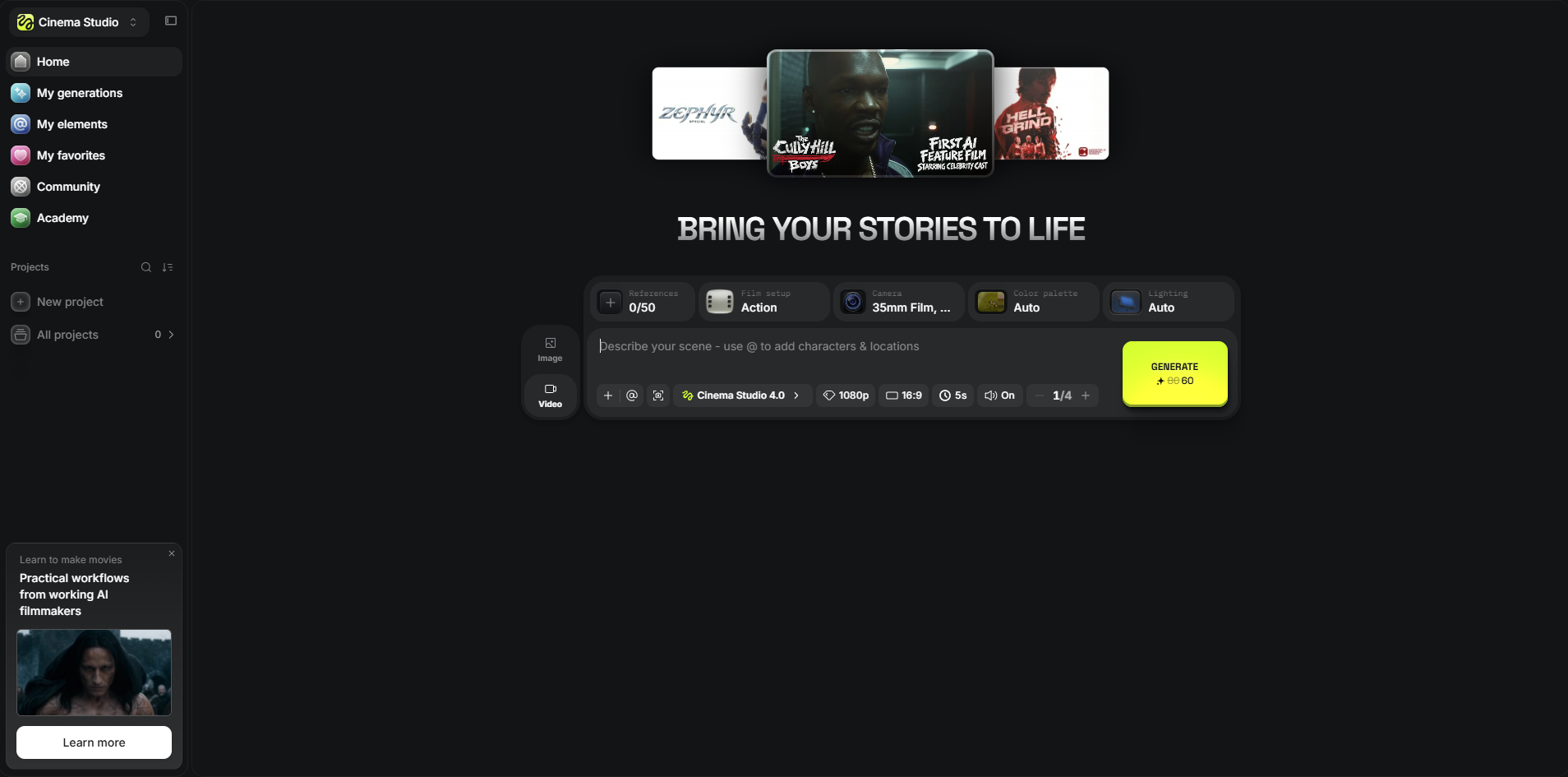
Testing the Cinema Studio 4.0 workspace, showing the prompt field, reference panel, and shot controls, captured September 2026.
Clicking into the Camera deck reveals an impressive level of hardware simulation. Rather than typing cinematic look, you assemble a virtual camera package directly:
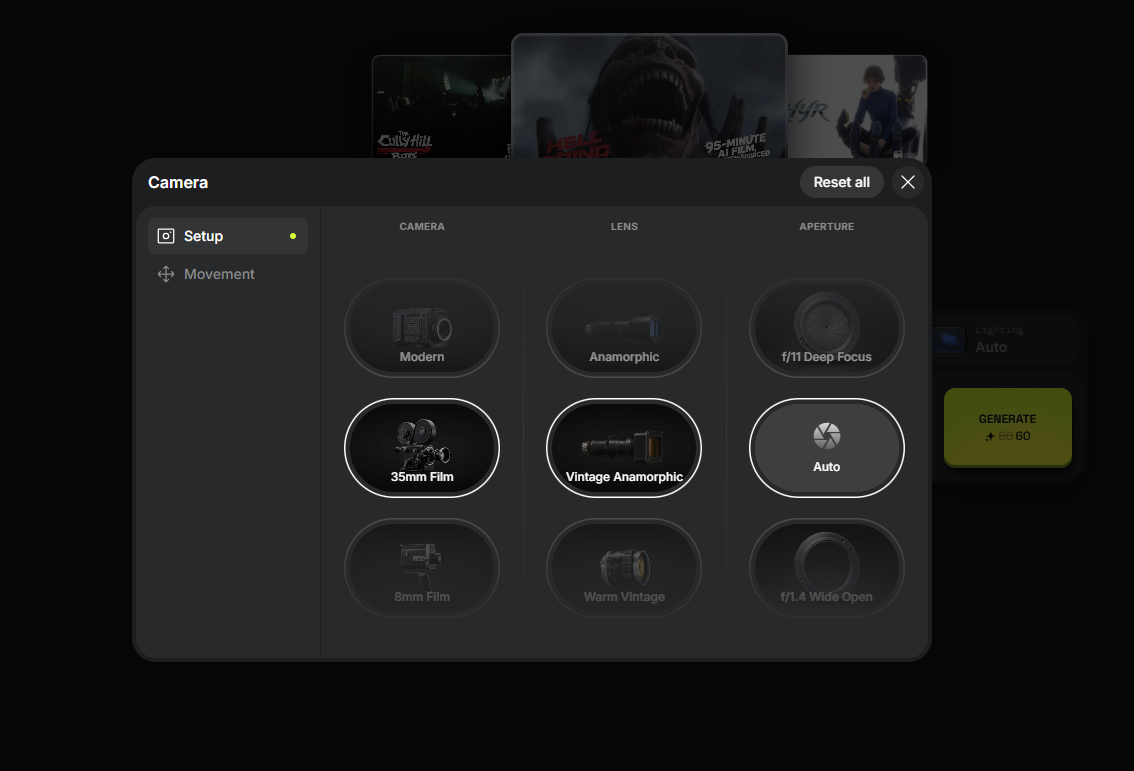
Dialing in optical specifics with a 35mm film body and vintage anamorphic lens emulation inside Cinema Studio, captured September 2026.
- Camera bodies and lenses: You can select between modern digital sensors, classic 35mm film stock, or 8mm film, paired with anamorphic lens emulations and aperture controls ranging from f/1.4 wide open for shallow depth of field to f/11 deep focus. Over 30 mechanical movements are available, including dolly in, crane up, 360 orbital tracking, and handheld shake.
- Color grading: Provides over 50 cinematic grading presets such as Film colors, Soft palette, and Nostalgic blue, with options to import custom brand color swatches.
- Lighting schemes: Replaces vague prompt words with practical studio lighting setups, including Silhouette backlighting, Practicals, and directional Window light.
For pre-production, luxury brand reveals, and visual B-roll, Cinema Studio delivers strong creative control. But for performance advertisers, two practical constraints remain: generations default to 16:9 widescreen rather than 9:16 vertical video, and clips render in 5-second increments. More importantly, while these dials determine how cinematic a shot looks, they do not identify customer pain points, write a hook, or structure a converting direct-response ad.
Marketing Studio, UGC Factory, and Soul ID: Can it handle product ads?
Marketing Studio is Higgsfield's surface built specifically for brands and online store owners. Its stated promise is turning any physical product into ready-to-post social content through AVATAR and PRODUCT staging modes.
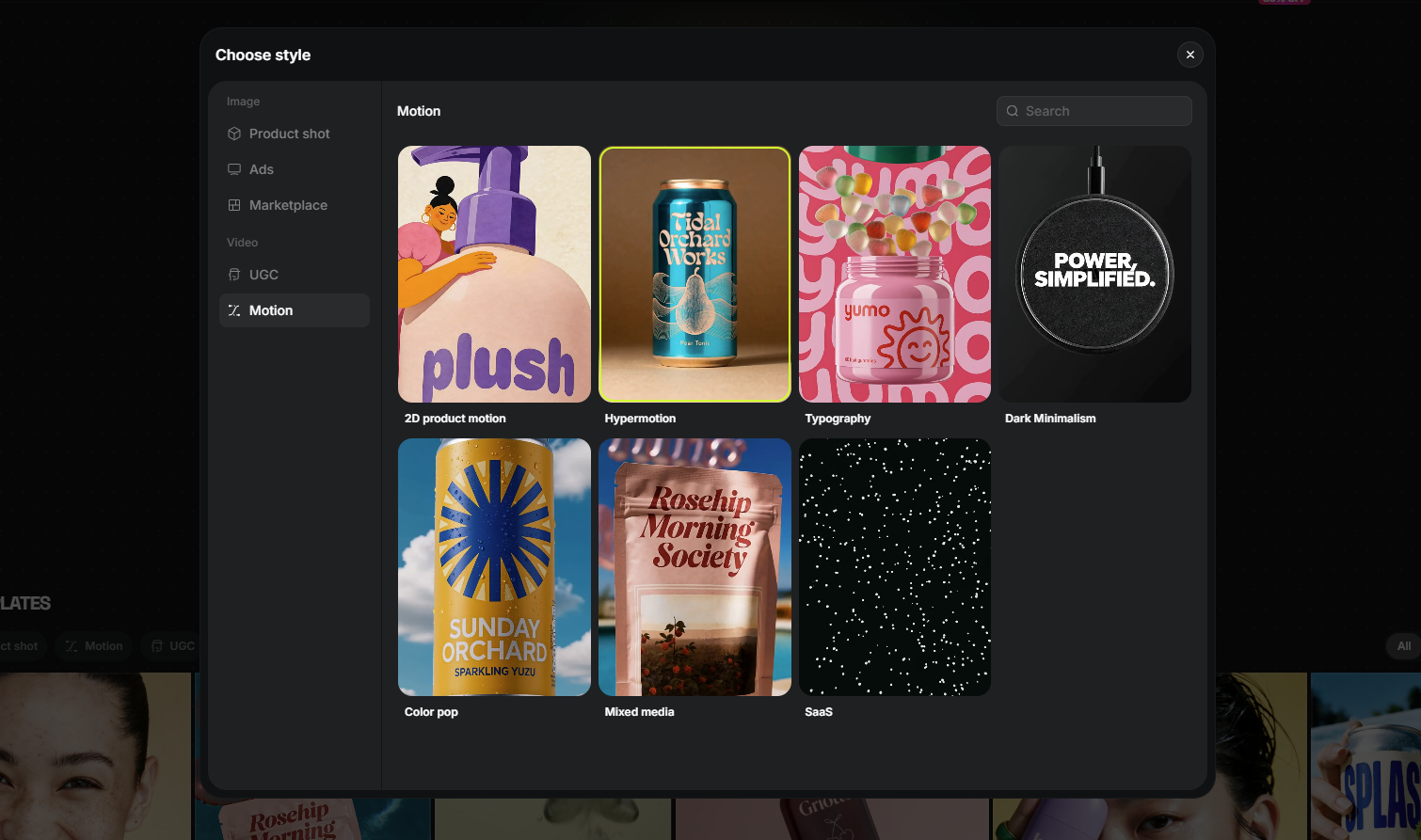
Browsing product motion templates inside Marketing Studio to stage physical ecommerce products, captured September 2026.
The template library divides into six practical categories: Product Shot, Motion, UGC, Ads, Posters, and Marketplace. Individual templates feature descriptive setups such as Linen Lid Lift, Ice Cube Hover, and Acrylic Shelf Grab. In practice, these templates function primarily as high-end visual product staging rather than comprehensive marketing ad generators. They give your product a stylish, tactile motion, but they do not write a hook or identify why a customer should buy.
UGC Factory sits inside Lipsync Studio and follows a three-step production flow: upload an image or video clip as the base, generate voiceover audio from typed text or an uploaded audio file, and select a lipsync model like Infiniti Talk, Higgsfield Speak, or Google VEO3. The motion template picker lets you dictate how the character moves and interacts with the camera, including styles like Selling, Podcast, Handheld Selfie, ASMR, and Steadicam.
To keep character faces consistent across different clips, Higgsfield provides Soul ID. You can train a specific character identity once and reuse that face across multiple scenes and outfits. For lifestyle photography, Higgsfield Soul 2.0 is remarkably fast and costs only 0.12 credits per image (under half a cent), making high-volume lifestyle catalog generation one of the platform's most cost-effective workflows.=
The ad test: Higgsfield scored on six things a paid social video needs
A good-looking clip and a testable ad are different objects. The table below takes six things a video ad needs before it can go into a Meta or TikTok test, and sets them against what Higgsfield documents today. The right-hand column isn't a list of flaws. It's the work that stays on your desk.
Five of the six rows are mostly covered by the tool. The one that isn't is the one that decides whether a test wins. Higgsfield's own July 2026 guide puts it plainly: the tool writes the copy "once you've decided what the angle is."
Higgsfield pricing and credit math: the reality of batch generations
Higgsfield pricing is structured around a monthly credit pool. Subscriptions are available on monthly or annual billing across three individual tiers, checked directly on the official pricing page in September 2026:
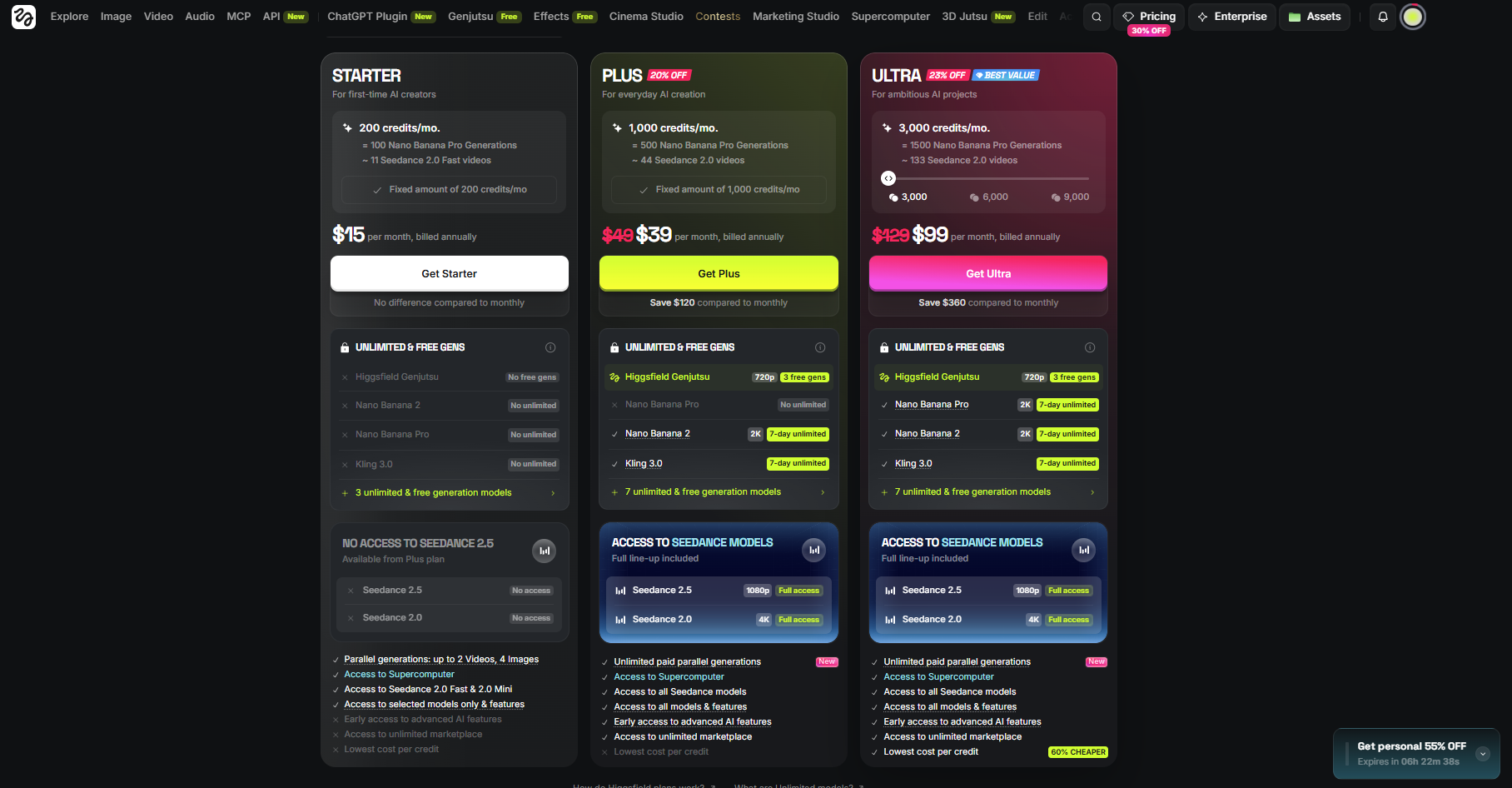
Verifying Higgsfield subscription tiers and monthly credit allowances inside the billing dashboard, captured September 2026.
The most important insight for anyone budgeting video production is understanding how credits are deducted in practice. Theoretical marketing pages often cite low per-second costs, but inside the working Cinema Studio interface, generations run in batches. A single click of the generate button defaults to producing four variations at 1080p, deducting 60 to 80 credits per run to cover the multi-shot processing and optical dials.
When translated into real production capacity, the monthly allowances look very specific:
- Starter ($15 / mo, 200 credits): At roughly 60 to 80 credits per Cinema Studio run, this plan covers only 2 to 3 generation attempts per month. It functions as a lightweight trial tier rather than a working ad production tool.
- Plus ($39 / mo on annual billing, 1,000 credits): Provides enough capacity for roughly 12 to 16 batch generations. This tier is practical for creating visual assets for two or three focused ad campaigns.
- Ultra ($99 / mo on annual billing, 3,000 credits): Offers room for approximately 37 to 50 batch generations, making it the viable entry point for creative agencies or active store teams testing new visual variations weekly.
Furthermore, in generative AI video, not every take is usable. Common visual glitches, such as warped product geometry, irregular hand movements, or erratic camera paths, mean that roughly 1 in 3 or 1 in 4 generated clips meets commercial advertising standards. Factoring in this keeper rate means that completing one polished 15-second product ad (which requires three distinct 5-second scenes) can easily consume 500 to 700 credits. Budgeting for batch attempts rather than single seconds prevents running out of credits mid-project.
What Higgsfield AI reviews on Trustpilot say?
Higgsfield holds 4.0 out of 5 on Trustpilot across 4,504 reviews, checked 21 September 2026. The distribution is split: 62% five star, 12% four star, 4% three star, 3% two star, and 19% one star. Trustpilot shows the company replied to 95% of negative reviews.
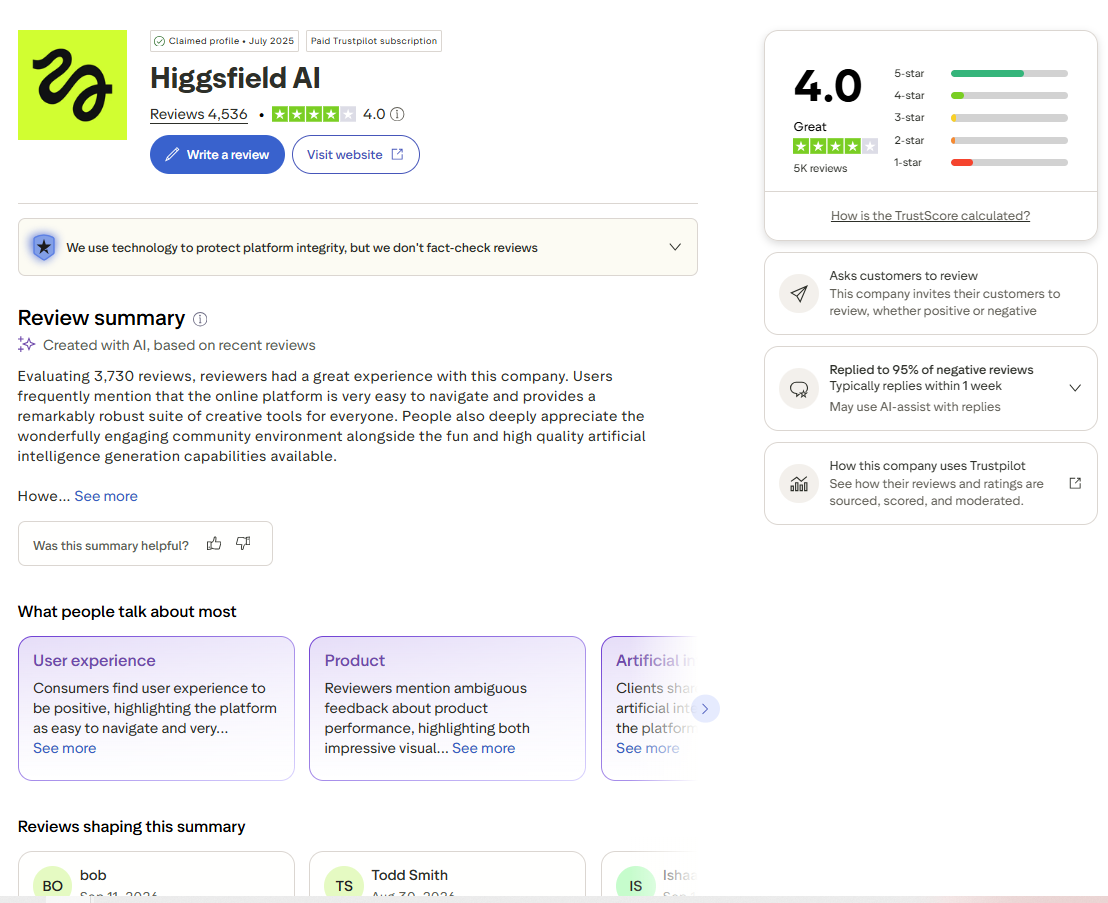
Higgsfield AI Trustpilot rating breakdown and AI review summary, captured September 2026.
The praise is consistent. Reviewers describe the platform as easy to navigate once you're in, the creative toolset as broad, and switching between video models inside one account as the reason they stay. A 2 September 2026 reviewer names that model switching as the favorite feature, and several short-film makers in mid-September describe it as part of their regular workflow.
The complaints cluster on billing and friction, not on output. Trustpilot's own summary of recent reviews lists confusing subscription terms, unexpected charges, monthly credits expiring unspent, long waits on complex video jobs, and slow support on account problems. One reviewer called the interface "busy, overwhelming and disorienting" at first (30 August 2026). Others mention generations blocked by content filters they felt were too strict, and a 10 September 2026 reviewer asked for tooltips because of the worry about spending credits on a tool they didn't fully understand.
Read together, these Higgsfield AI reviews describe a product people like using and a pricing model people have to learn. For an ad team, that means the learning curve is mostly financial: know what a take costs and when credits reset before you plan a testing month around it.
Is Higgsfield worth it for ecommerce ads? Who it fits, and who should wait?
Higgsfield is a strong fit if:
- You already know your winning angle and need more production value on it, for example turning a proven UGC script into a 1080p spokesperson ad plus a cinematic product reveal.
- You want one AI avatar across a month of ads. Soul ID is built for exactly that, and character consistency is where many single-model tools drift.
- You run many SKUs. Paste-a-URL generation, a Brand Kit pulled from your store, and Canvas pipelines are designed for catalog work.
- Brand look matters to your ads. Retargeting and launch ads can carry more polish than cold-traffic UGC, and Cinema Studio is the most controllable way to get it.
Higgsfield may not fit yet if:
- You don't know which claim converts. The platform will make your current idea look better. It won't tell you whether the idea is right.
- You need a fixed monthly cost per ad. Credit burn changes with model, length, resolution, and retakes.
- You want finished ads with no editing pass. Plan time for trimming to each placement and adding any text or end cards your test needs.
Five checks before you pay for Higgsfield
- Price your ad, not your plan. Pick the model, length, and resolution you'd really use, then read the credit cost on the Generate button.
- Test your hardest product first. Reflective packaging or a small printed label will tell you more about product fidelity than a plain bottle.
- Count takes to a keeper. Run five generations of one ad and note how many you'd put spend behind. Multiply your per-take cost by that ratio.
- Know when "unlimited" ends. Check Manage Subscription for the access window before you plan volume around it.
- Find the cancel path in week one. Higgsfield's support says it lives under Manage Account, then Subscription, then Manage Subscription.
Higgsfield alternatives: matching the right AI tool to your growth bottleneck
No single creative platform handles every stage of advertising equally well. If you love Higgsfield for its virtual camera movements and multi-model bench, it is an outstanding asset in your production workflow. However, if your primary constraint is scriptwriting, fast-turnaround UGC avatars, high-volume static banner production, or conversion-focused angle testing, other specialized tools may fit your workflow better.
Here is how the leading alternatives compare across primary use cases, pricing structures, and creative workflows:
1. Creatify: Best for quick URL-to-Video avatar ads
If your primary ad format is TikTok-style UGC where an on-camera creator pitches a problem and reviews your product, Creatify takes a far more automated approach than Higgsfield. Instead of manually configuring virtual camera rigs and lighting setups, you paste a product link from your store. The software pulls product photography, drafts a short direct-response script, and assigns an AI talking avatar to present the offer.
The trade-off lies in visual artistry. Creatify produces standardized short-form reels that look like social UGC, but it cannot match Cinema Studio 4.0 for sweeping crane movements, anamorphic lens flares, or moody cinematic lighting. If your creative bottleneck is generating 20 variations of a creator speaking to the camera, Creatify delivers speed; if you need cinematic B-roll, Higgsfield remains far superior.
2. AdCreative.ai: Best for high-volume static feed and display banners
While Higgsfield concentrates heavily on generative video, many performance marketing budgets still depend heavily on static imagery. AdCreative.ai focuses specifically on static graphics, carousel cards, and banner ads. You upload your brand logo, set your brand colors, and the system automatically generates dozens of graphic variations formatted for 1:1 feeds, 9:16 stories, and Google Display sizes.
Each design receives a proprietary conversion score based on historical ad spend data. Where AdCreative.ai falls short is video depth, its video tools remain relatively rigid compared to the multi-model freedom of Higgsfield. If your team needs endless static variations to feed automated catalog ads, AdCreative.ai is a dedicated fit.
3. Subscribing to video engines directly: best for single-model loyalty
Because Higgsfield functions as a creative aggregator, you are paying for the convenience of accessing Kling 3.0, Seedance, Sora 2, and Veo under one unified credit balance. If your production routine settles on one specific engine, such as exclusively using Kling for realistic product physics or Runway Gen-3 for stylized motion, subscribing directly to those providers often yields a lower cost per second of raw footage.
The disadvantage of going direct is losing Higgsfield's unified interface, Soul ID character memory, and Cinema Studio camera presets. For creators who switch between models frequently, the aggregator premium is well worth the operational efficiency.
4. Promer AI: the performance ad engine built to solve creative fatigue
While tools like Higgsfield give you breathtaking shots, growing ecommerce brands often hit a different wall: creative fatigue. Even the most stunning 5-second cinematic clip stops converting once your target audience has seen it several times. Scaling return on ad spend requires continuously testing new hooks, emotional pain points, and distinct marketing angles.
This is where an AI ad generator like Promer AI bridges the gap between visual production and marketing strategy. Instead of starting with an empty prompt box and a camera dial, you paste a product URL from Amazon, Shopify, or your custom store.
The AI Ad Concept engine scans your landing page and extracts four strategic pillars before generating any visual asset: Product highlights, Ideal customer persona, Customer pain points, and Core buying needs.
From that conversion foundation, Promer AI provides an end-to-end ecommerce ad production suite:
- AI UGC Ads: Generates authentic creator-led video ads featuring natural AI avatars and synchronized voiceovers across five proven frameworks, including Direct Testimonial, Voiceover Review, POV Demo, Problem and Solution, and Routine or Day in the Life.
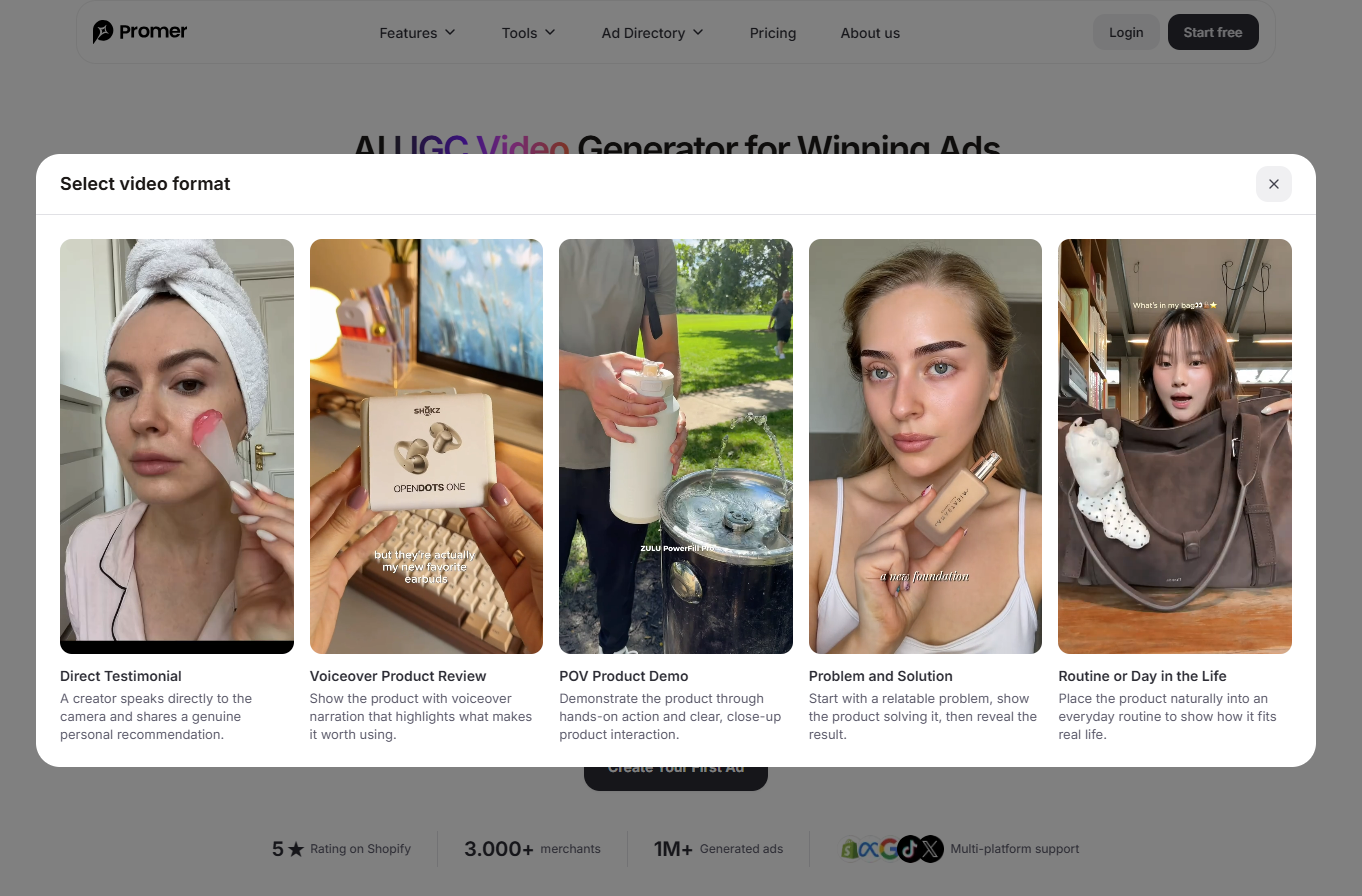
Selecting from five conversion-focused UGC video frameworks inside Promer AI, captured September 2026
- AI Ad Animation: Transforms winning static product photos into feed-stopping AI Ad Animation 8-second video ads optimized for social feeds.
- AI Ad Library and AI Ad Spy: Grants access to over 60,000+ proven static and video templates, and real-time Meta ad searches by brand or keyword.
- Launch ads: Deploys finished static creatives directly into your connected Meta Ads Manager with recommended budget and targeting settings.
If you already have a reference ad that works, Promer's AI Video Ad Clone analyzes it, breaks down its scene sequence, and shows a product-fit assessment before it scripts the version for your product. That fit check is the part that stops you cloning a structure that suited someone else's product and not yours.
Higgsfield acts as your high-end virtual camera crew, while Promer acts as your ecommerce performance strategist. If your objective is cinematic storytelling, Higgsfield is best in class. If your objective is testing ten unique marketing angles this week to lower your cost per acquisition, Promer delivers the conversion-first framework you need. You can generate your first ad with Promer for free, with no credit card required.
Verdict: is a cinematic suite worth it for ecommerce ads?
Higgsfield is undeniably worth its $39 monthly Plus plan if you need an all-in-one cinematic studio that unites the world's best generative video models under one subscription. Cinema Studio 4.0 provides camera and lighting controls that no single-model platform currently matches, and Soul 2.0 makes synthetic product photography exceptionally affordable.
However, a cinematic suite alone does not solve ecommerce advertising. A visually breathtaking 5-second clip will not convert unless it is anchored by a compelling hook, a clear explanation of customer pain points, and a persuasive call to action. If you treat Higgsfield as your virtual cinematography crew while handling the copywriting and sequencing yourself, or pair it with dedicated ad performance tools like Promer AI, it becomes an invaluable asset in your creative testing toolkit.
Frequently asked questions
How much does Higgsfield cost per month?
Higgsfield individual plans cost $15 per month for Starter (200 credits), $39 per month on annual billing for Plus ($49 monthly for 1,000 credits), and $99 per month on annual billing for Ultra ($129 monthly for 3,000 credits). Starter maintains the same $15 price on monthly and annual billing, while Plus and Ultra offer annual discounts of 20% and 23% respectively. Enterprise plans with custom credit pools and SSO require contacting sales.
How many video clips can you make with Higgsfield credits?
Because Cinema Studio runs batch generations producing four variations at 1080p, a single run typically deducts 60 to 80 credits. That yields roughly 2 to 3 generation runs on the $15 Starter tier, 12 to 16 runs on the $39 Plus tier, and 37 to 50 runs on the $99 Ultra tier. Factor in a 1-in-3 keeper rate when estimating your finished creative capacity.
Does Higgsfield offer a free plan?
Higgsfield does not feature a permanent free subscription tier on its main pricing page, with the Starter plan at $15 per month serving as the primary entry point. However, the platform features a "Try for free" option and occasional free credits for select photo effects and features upon initial account signup.
Can I use Higgsfield generated videos commercially in paid ads?
Higgsfield grants full commercial usage rights on its Enterprise workspace, while individual plan users hold rights to their generated outputs provided they own the source media and likenesses uploaded. Always review the latest terms of service inside your account dashboard before running generative video assets in commercial ad campaigns.
Does Higgsfield place watermarks on exported videos?
Paid individual tiers (Starter, Plus, and Ultra) export clean, watermark-free videos in HD and 4K resolutions. Higgsfield platform documentation indicates that certain promotional or free trial generations may contain a discrete watermark until upgraded.
How does Higgsfield compare to subscribing directly to Kling or Runway?
Higgsfield offers superior convenience and camera controls if you want multiple generative engines under one bill, but costs more per clip than direct single-model subscriptions if you only use one model. If you exclusively use Kling 3.0 or Seedance, subscribing directly to those providers can be more economical. If you value Cinema Studio 4.0 camera presets and switching between models on the fly, Higgsfield justifies its aggregator pricing.
Related reviews and ecommerce guides
If you are exploring other AI video platforms or comparing creative tools for your marketing mix, explore our hands-on teardowns across the Promer AI blog:
- Promer AI Blog Hub: Practical guides on creative testing methodologies, prompt frameworks, and paid social performance for ecommerce stores.
- HeyGen Reviews: We tested studio avatars and video generation on real ecommerce ads for 14 days to evaluate lip sync, pricing, and output quality.
Sources
- Higgsfield AI. (n.d.). Official website. Retrieved September 2026, from higgsfield.ai
- Higgsfield AI. (n.d.). Trust, safety and commercial rights policies. Retrieved September 2026, from higgsfield.ai/trust