Marpipe Reviews: What a Catalog Ad Test Really Costs in 2026
Category
Blogs
Date
Authored by
NaNa Phan
Summary
Marpipe reviews: Startup costs $199 a month, Enterprise $999 to $3,119 by SKU count, and a fair 4-cell catalog test needs $5,000+ in ad spend.
This Marpipe review is for you if your catalog ads still show the plain photo from your product feed: no price drop, no badge, no reason to buy today. Marpipe promises to fix that on every SKU at once.
So is it worth $199 a month? What does Enterprise cost at your SKU count? And how much ad budget does a fair test need before you can trust the winner?
My take: Marpipe pays off once your catalog passes about 1,000 SKUs and you can fund 4 or 5 test cells for 2 weeks.
Below are the Enterprise prices for 4 SKU tiers, the test budget at 3 CPA levels, and where Marpipe sits next to Meta's free catalog ads. Short on time? Jump to the cost table.
Key takeaways
Budget for media, not software. Marpipe's playbook asks for 50 times your CPA per test cell for 14 days. At a $40 CPA, 4 cells cost $8,000 in ad spend, against $199 for Startup.
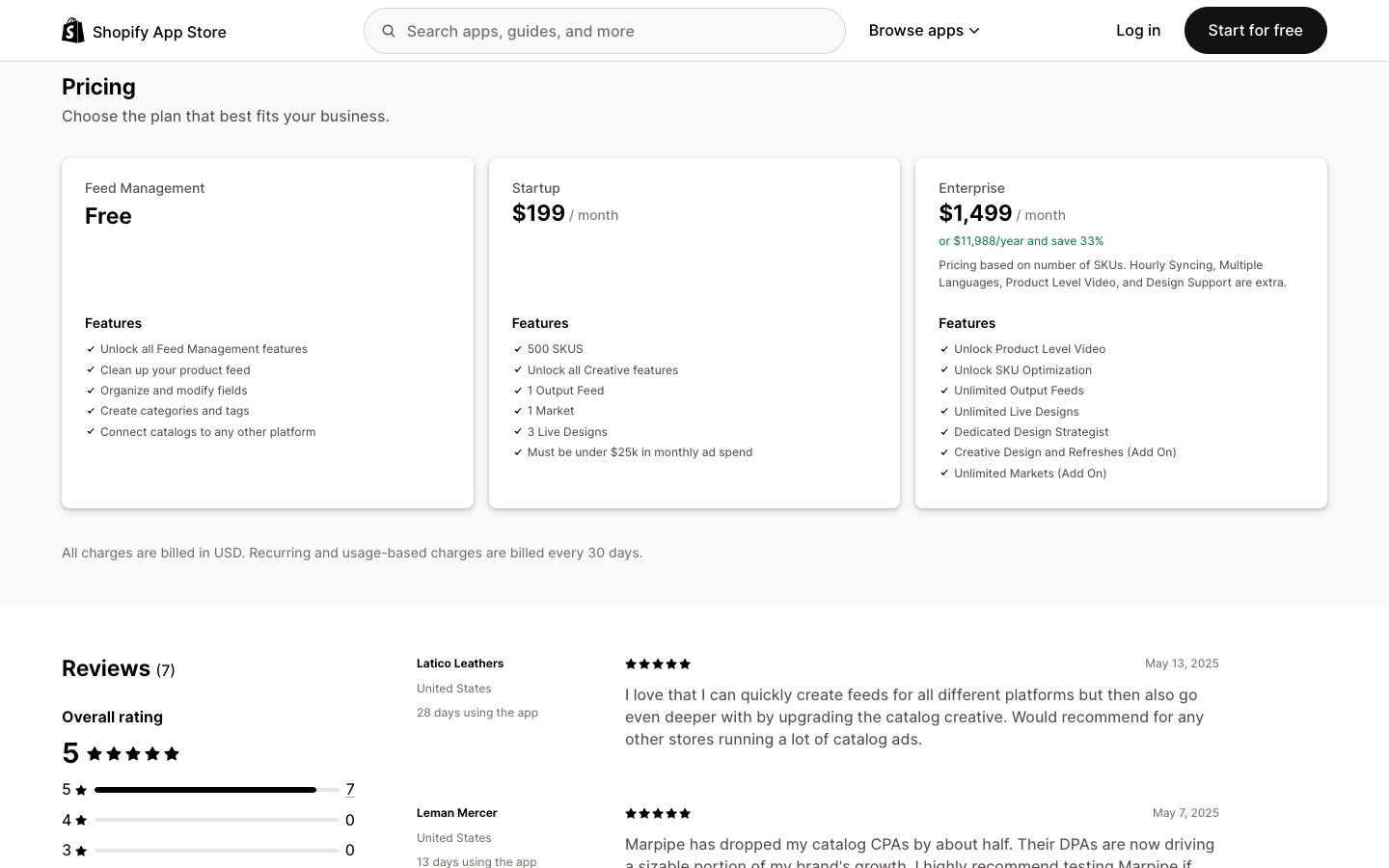
Enterprise is priced by SKU count. On October 7, 2026, it ran from $1,499 a month (monthly billing, under 500 SKUs) to $3,119 (monthly, under 10,000 SKUs).
Startup fits a first test, not the full playbook. 3 live designs give you a plain control plus 3 treatments, and every variant counts toward the 500-SKU cap.
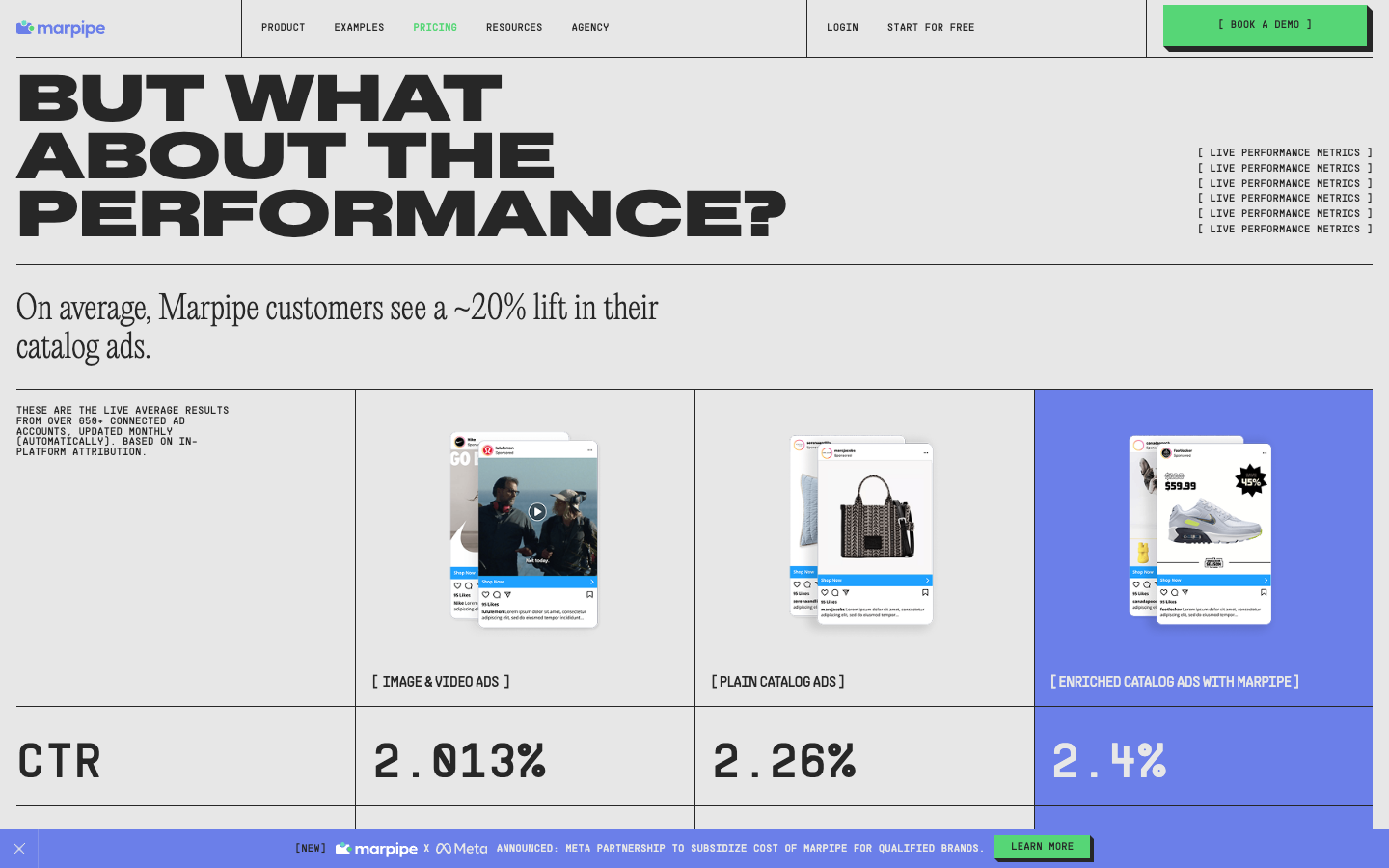
Treat 8.18 ROAS as Marpipe's own number. It averages 650+ connected accounts on in-platform attribution, and the pricing FAQ says results vary by client.
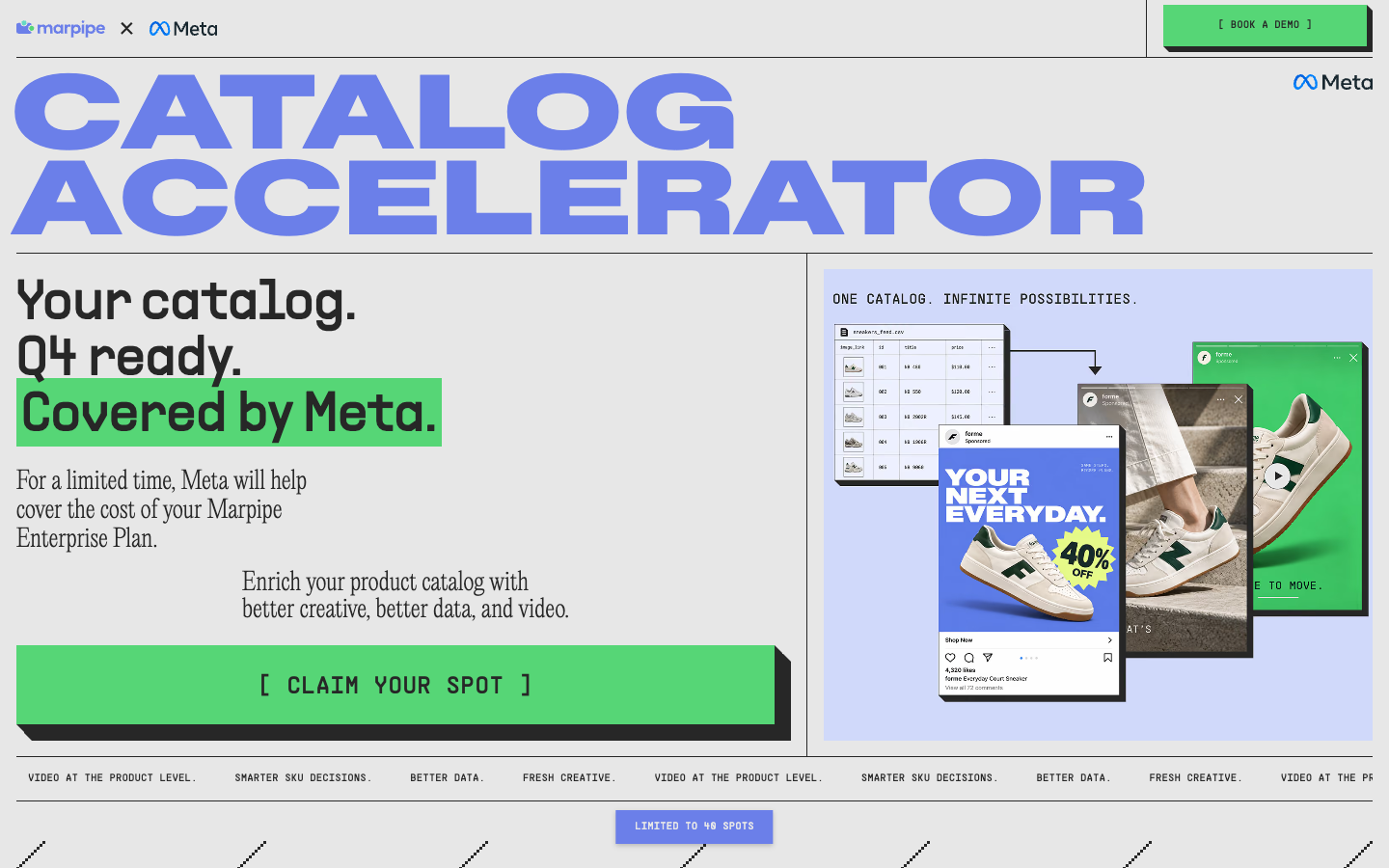
The Meta subsidy is short. Qualified brands new to Marpipe get 50% off 1 or 2 months of Enterprise, and enrollment closes October 9, 2026.
Why you can trust this Marpipe review
Nobody at Marpipe saw this review before it went live, and nothing here is paid placement. I moved the SKU slider and the billing toggle on Marpipe's pricing page myself, tier by tier, so the Enterprise prices below are the ones the page actually showed on October 7, 2026.
When a number is Marpipe's own claim, such as the ~20% lift or the 8.18 ROAS, it is labeled that way. Your account will not see a vendor average, so the budget math in this review uses your CPA, not theirs.
What Marpipe is in 2026: Catalog ads with a testing label
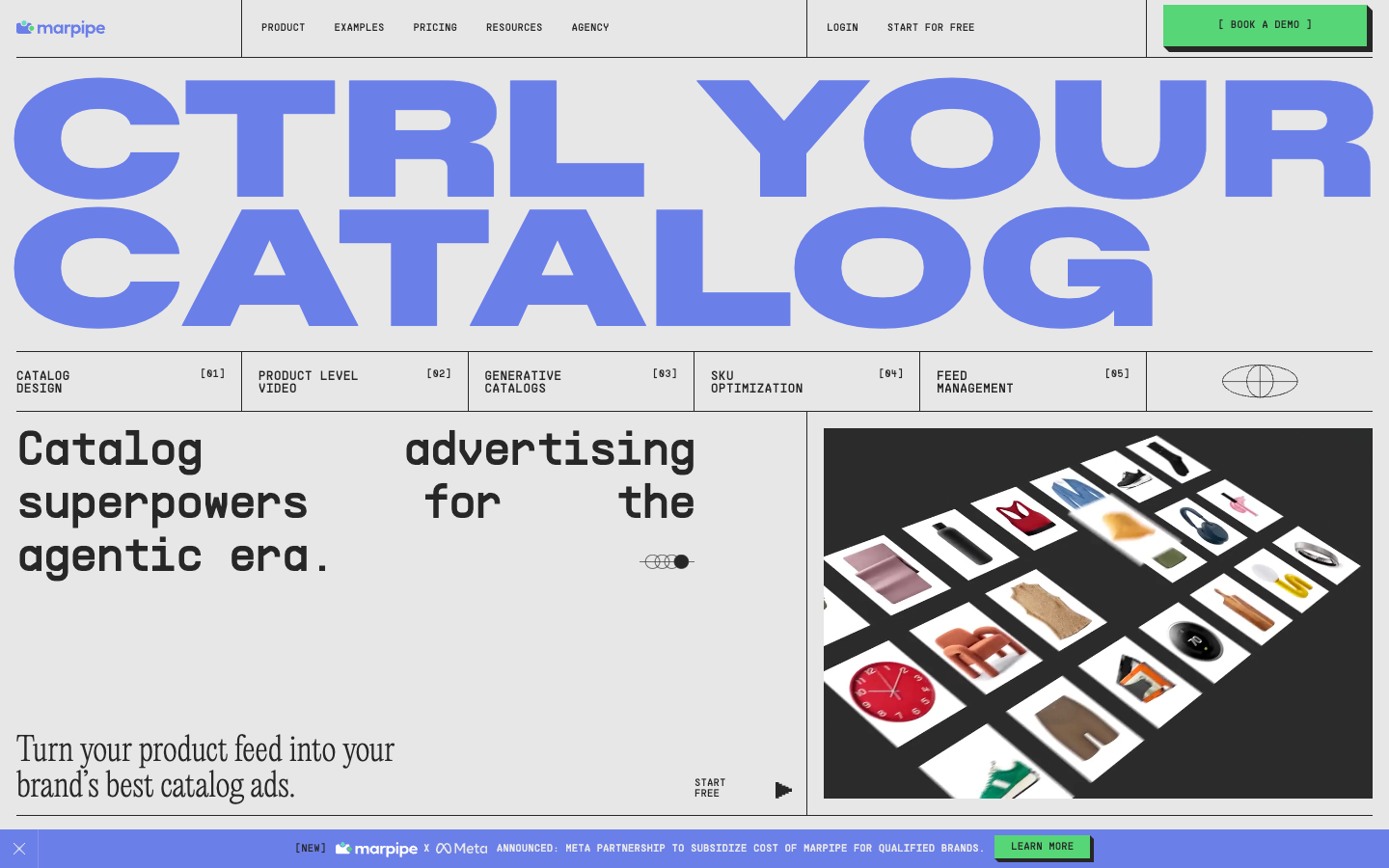
Marpipe is a rules-based tool that sits between your product feed and the catalog ads you run on Facebook, Instagram, TikTok, Snap, or Pinterest. You design a treatment once, and Marpipe applies it to every product in the feed.
Marpipe calls itself "the operating system for your catalog ads." Its homepage sums up the plain catalog tile in 3 labels: "Unbranded. No value props. Wasted ad spend."
The homepage claims 7,000+ marketers and $65 million in monthly ad spend, with logos from Crocs, Kate Spade, and Ridge. These are Marpipe's own figures. The site lists 5 modules, gated by plan:
Module
The job it does for your store
Plan
Catalog Design
Puts price drops, badges, and BNPL prices on every tile with dynamic fields such as Price Strikethru
Startup and Enterprise
Product Level Video
Turns each SKU's existing images into a short video
Enterprise, priced by SKU tier
Generative Catalogs
Labeled "GEN AI"; the Free plan lets you preview generative designs
Preview on Free
SKU Optimization
Cuts weak products using performance data
Enterprise
Feed Management
Cleans and maps your feed for each channel
Free self-serve; $0.80 per SKU done for you
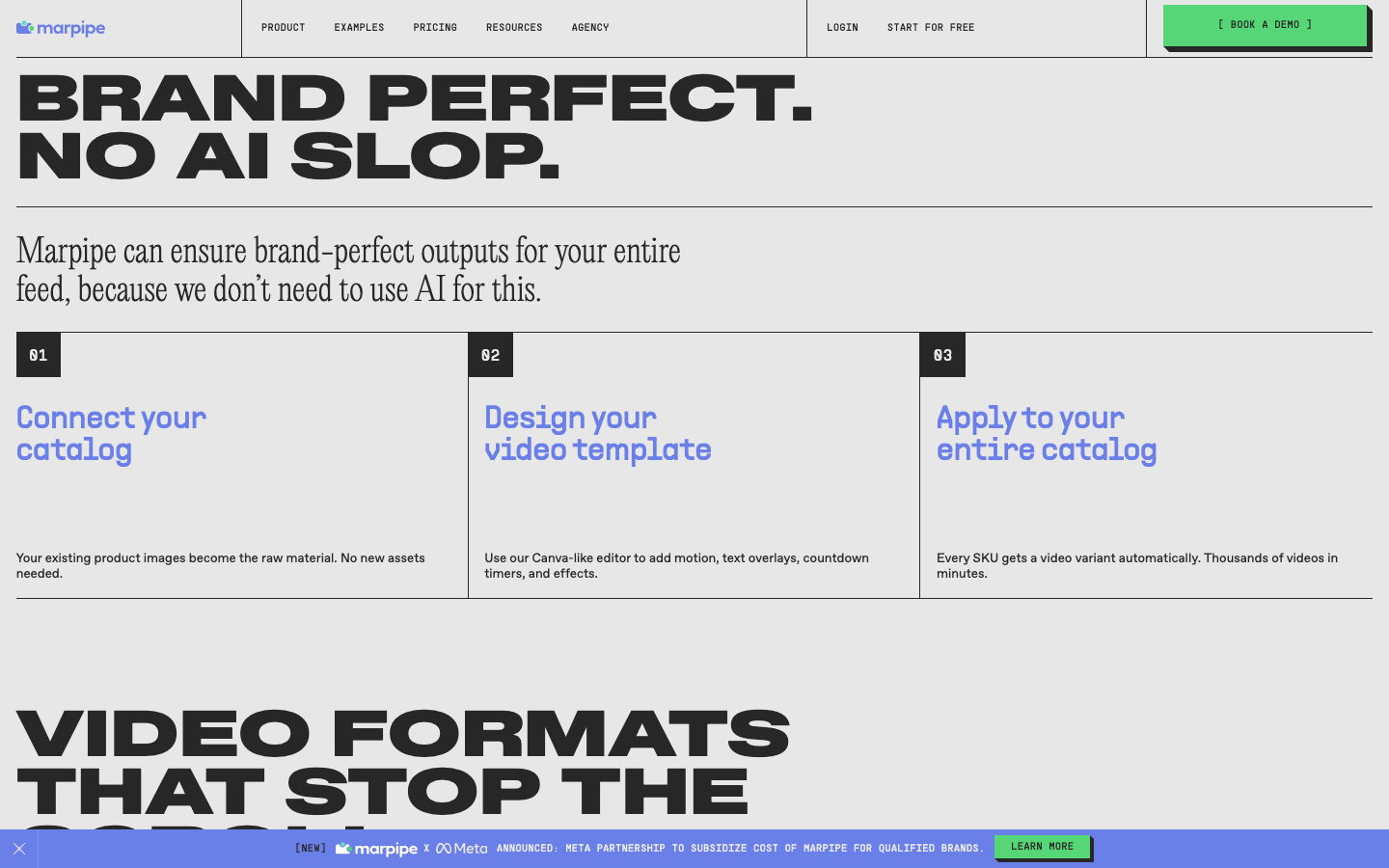
Marpipe's pricing FAQ answers "Are these ads created by AI?" with "No, they're not AI-generated, but they are automated." Every SKU gets the exact template you approved, with no drift on logos, and Marpipe multiplies your ideas without supplying them.
That last point decides who gets value from Marpipe. It scales a design you already believe in across thousands of products. It does not tell you which design to believe in, which is why Marpipe's own blog leans so hard on testing.
Marpipe's testing playbook: 50 times your CPA, 4 to 5 variants
Marpipe's own playbook sets 2 rules for catalog ad testing: budget 50 times your CPA per cell for at least 14 days, and test 4 to 5 variants that change 1 variable. Those rules decide whether Marpipe can earn back its fee.
Dan Pantelo's post "How the World's Best Media Buyers Test Catalog Ads," dated January 30, 2026, collects answers from buyers at Common Thread Collective, Ovative, Power Digital, and WITHIN. The budget rule reads: "If your CPA is $40, budget at least $2,000 per ad set for the test."
CPA x 50 buys about 50 conversions per cell, a rough floor for statistical significance in ad tests. Below it, the winner is often the cell that got lucky in week 1.
On variants, the post says to test 1 variable at a time with 4 to 5 variants, adding "Anything else muddies the signal." A clean test is a plain catalog control plus 3 or 4 designed treatments that differ in one element.
Limit: the playbook adds "A/B tests tell you which version won. Lift tests tell you whether any of it mattered." For a first test, the A/B result against your plain catalog is what has to justify the fee.
What one Marpipe catalog test costs at a $25, $40, and $60 CPA
A 4-cell Marpipe test costs $5,000 to $12,000 in media over 14 days at a $25 to $60 CPA, by our arithmetic from the playbook's rule. Four cells are a control plus Startup's 3 live designs, and 5 is the top of the range. Read the per-day columns:
CPA
Budget per cell
4 cells, total
4 cells, per day
5 cells, total
5 cells, per day
$25
$1,250
$5,000
about $360
$6,250
about $450
$40
$2,000
$8,000
about $570
$10,000
about $715
$60
$3,000
$12,000
about $860
$15,000
about $1,070
Marpipe's Shopify listing says Startup "Must be under $25k in monthly ad spend," about $830 a day at the ceiling. At a $40 CPA, the 4-cell test takes about 69% of that daily budget for 2 weeks, and at a $60 CPA it costs more than the whole ceiling.
The software is the smaller cost: $199 is about 2.5% of an $8,000 test. Most of the money at risk is media.
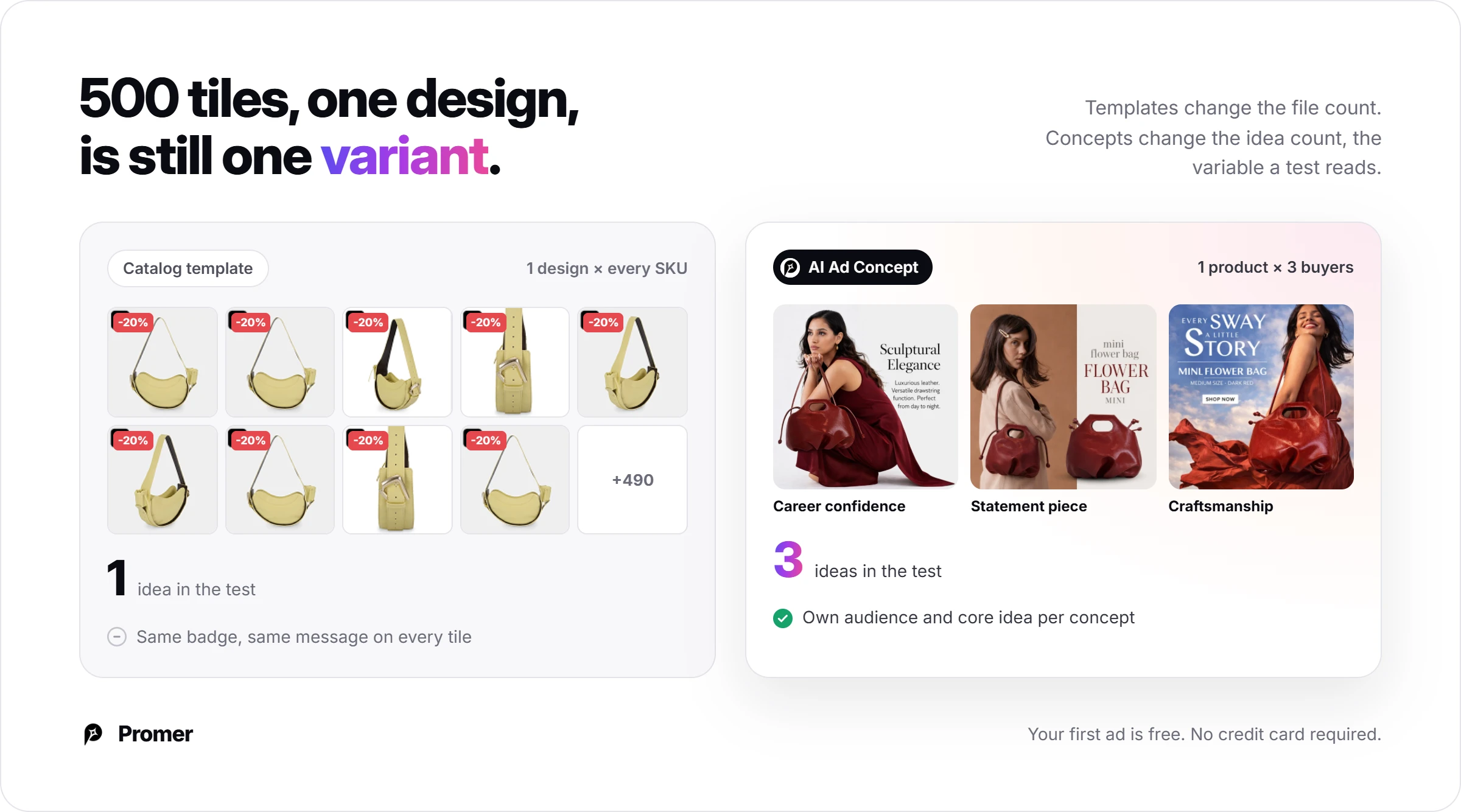
Marpipe changes the file count, not the idea count. One treatment becomes an ad for every SKU, but 500 enriched tiles sharing 1 design count as 1 variant in the playbook's sense.
Scenario: you sell 300 home goods at a $40 CPA and spend $15,000 a month on Meta. At about $500 a day, the 4-cell test's $570 daily cost exceeds your whole budget, so cut to a control plus 2 cells.
How a Marpipe catalog test runs: Feed to live design in 5 steps
Marpipe's pricing table, FAQ, product pages, and Shopify listing describe the same 5-step path from feed to live test:
Install "Marpipe Catalog Manager" from the Shopify App Store, or connect a custom feed. The install asks to view customers, products, orders, and discounts.
Check the free Feed Score for each channel before you pay. Marpipe says it handles multi-market, multi-currency, and multi-language catalogs.
Build a treatment in the "Canva-like" editor by placing dynamic fields that fill from the feed. Set rules for which designs apply to which products.
Assign live designs and sync the output feed. Startup allows 3 live designs, 1 output feed, and daily syncing.
Launch through Meta Ads Manager, read the A/B result, and on Enterprise use SKU Optimization to cut weak products.
A creative test matrix using only field names from Marpipe's homepage, with the overlay message as the single variable:
Cell
Treatment
A, control
Plain catalog image
B
Price Strikethru plus % Off badge
C
Realtime Social Proof
D
Inventory Countdown
E
BNPL Price
Lock the product set, audience, bidding, and destination across cells, and make no edits mid-test. On Startup, pick 3 of B to E against the control. The fifth cell needs Enterprise, which lists "19 Live (Meta Limit)."
Product-level video comes in 5 formats: Reveal More, Highlight Detail, Stop The Scroll, Show Lifestyle, and Stylize Sales. The page says you need no new footage, because "Your existing product images become the raw material," and claims video gets "2x more engagement than statics," which is Marpipe's figure.
Limit: treat static against video as its own test, since a format change plus an overlay change in 1 cell breaks the one-variable rule.
Marpipe pricing: $199 Startup, then Enterprise priced by SKU count
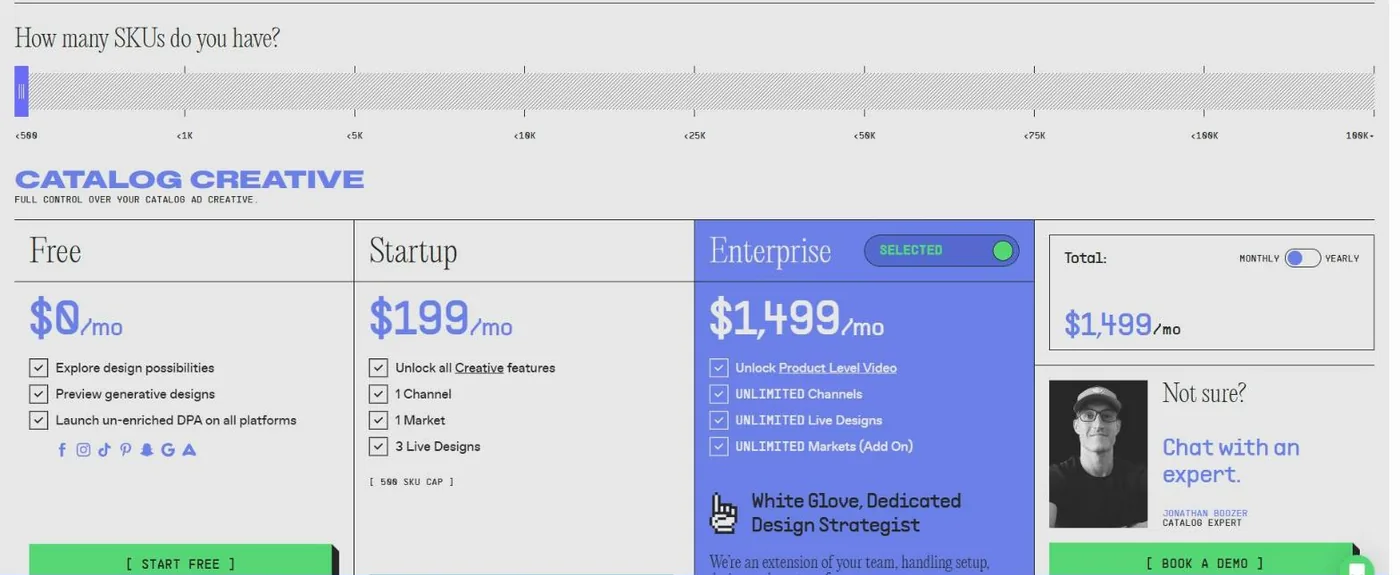
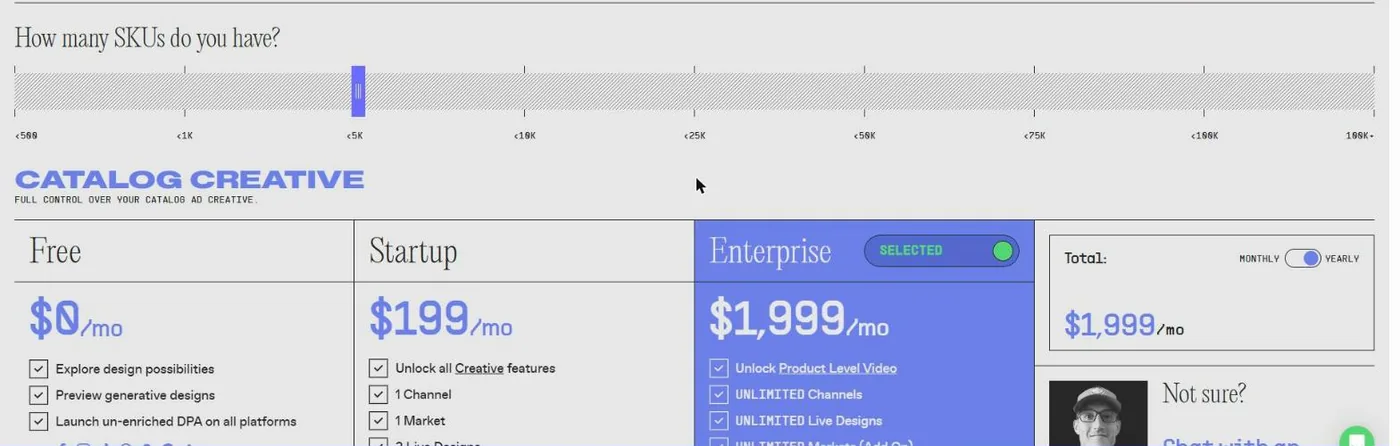
Marpipe pricing is a flat monthly fee with "No % of ad spend, no % of revenue, no usage pricing." Free and Startup are fixed. Enterprise moves with a "How many SKUs do you have?" slider and a monthly or yearly toggle, so the plan card alone does not show your price.
Here is what the Enterprise card showed on October 7, 2026, tier by tier:
SKUs in your catalog
Enterprise, monthly billing
Enterprise, yearly billing
Under 500
$1,499 a month
$999 a month
Under 1,000
$1,949 a month
$1,499 a month
Under 5,000
$2,599 a month
$1,999 a month
Under 10,000
$3,119 a month
$2,399 a month
That means the $999 you may have seen is the smallest catalog on yearly billing. The Shopify listing agrees: Enterprise at $1,499 a month or $11,988 a year, which is $999 a month. A store with 3,000 SKUs should budget $1,999 to $2,599 a month for Enterprise.
The rest of the plan table, from the pricing page and Shopify listing:
Row
Free
Startup
Enterprise
Price
$0
$199 a month
By SKU tier, from $999 a month yearly
SKUs in output feeds
0
500, variants included
By SKU tier
Live designs
0
3
19 (Meta limit)
Channels and output feeds
0 output feeds
1 and 1
Unlimited
Design strategist
No
Call on request
Included
Ad spend condition
None stated
Under $25,000 a month
50% off year 1 under $50,000 a month
The SKU cap is tighter than it looks, because the FAQ counts every variant as a SKU.
Scenario: you sell 100 shirts in 6 sizes, which is 600 SKUs. Marpipe's add-on of 200 SKUs for $100 takes Startup to $299 a month.
Startup also leaves design to you: the strategist is "Not included, we will do a call upon request," and support runs through Intercom chat. Ridge CEO Sean Frank is quoted on the pricing page calling Marpipe "a software I pay 5 figures for a year," which fits the Enterprise range.
Marpipe add-ons, the Meta subsidy, and cancellation terms
Marpipe's add-ons and discounts change the real bill more than the plan card does. The pricing page lists these add-ons:
Additional location feeds at $299 a month per feed.
200 extra SKUs for $100.
Hourly syncing instead of daily.
Product Level Video and countdowns, priced by SKU tier.
Done-for-you feed management costs $0.80 per SKU with a $400 minimum, and the card does not say whether that is monthly. The Shopify listing adds that languages and design support are extra on Enterprise.
Marpipe's September 21, 2026 post says Meta subsidizes 50% of Enterprise for qualified brands. Catalogs of 1,000 to 50,000 SKUs get 50% off month 1, and 10,000 to 200,000 SKUs get 2 months, with ranges that overlap as published.
The accelerator page says "LIMITED TO 40 SPOTS," limits it to brands "new to Marpipe," and requires product-level video. Against an $11,988 year, $499.50 to $999 off is a 4% to 8% discount, and enrollment closes October 9, 2026.
The pricing header promises "Cancel anytime," and the Shopify listing bills in USD every 30 days. Before you sign an annual agreement, ask Marpipe to put the cancellation and refund terms in writing, next to your SKU tier.
Marpipe's 8.18 ROAS claim: How to read a vendor average?
Marpipe publishes a live table of averages "from over 650+ connected ad accounts," based on "in-platform attribution." The table as published:
Ad type, per Marpipe
Click-through rate
ROAS
Image and video ads
2.013%
4.0
Plain catalog ads
2.26%
6.86
Enriched catalog ads with Marpipe
2.4%
8.18
The homepage claims "a ~20% lift." ROAS supports that, since 8.18 is about 19% above 6.86, while click-through rate moves about 6%.
Check 3 things before you forecast with it:
The figures use platform attribution, which can flatter catalog ads that reach shoppers who already viewed the product.
The accounts are those connected to Marpipe, not a random sample.
The pricing FAQ says "We can't guarantee a performance increase because results vary by client."
The more useful line is a test design. Sean Frank of Ridge is quoted: "In a multicell test, we saw performance improve 53% using Marpipe vs. BAU Meta catalog." Copy the design, enriched cells against a plain catalog, and treat the 53% as 1 customer's quote that Marpipe chose.
Marpipe reviews on Shopify: 5.0 from 7 reviews
Marpipe's Shopify App Store listing showed 5.0 out of 5 from 7 reviews on October 7, 2026, all at 5 stars. The app launched on the Shopify App Store on April 11, 2025.
The visible reviews are short:
Leman Mercer, May 7, 2025, after 13 days: "Marpipe has dropped my catalog CPAs by about half."
Latico Leathers, May 13, 2025, after 28 days: praises feeds for different platforms and upgraded catalog creative.
Ridge, September 11, 2025, after 3 days: "It was too easy to switch over!"
Seven reviews are a small sample. Two of the 3 visible reviewers also appear on Marpipe's site, and the CPA claim comes from 13 days, 1 short of the playbook's own 14-day minimum.
Weighed against Marpipe's pricing and documentation, the trade-offs look like this:
Pros
Cons
Flat fee, no share of ad spend
Startup's 3 live designs make only 4 cells
Unlimited seats and SSO on every plan
Enterprise climbs from $999 to $3,119 a month with SKU count
Template rules keep every SKU on brand
Video, hourly sync, and design support cost extra
Product-level video from existing images
Variants count toward the 500 SKU cap
Works on any channel with catalog ads
Startup support is Intercom chat, calls on request
Most of the cons share one cause: the plan that fits the playbook is Enterprise, not Startup.
Marpipe alternatives: Meta catalog ads, AdCreative.ai, and Promer AI
Each option below does a different job. If the budget math rules Marpipe out, the next question is where your test ideas come from. Here is how they compare on October 7, 2026:
Tool
Starting price
The job it does
Best for
Meta catalog ads
$0 beyond media
Shows your catalog with no branded overlays
The control cell, or catalogs under 500 SKUs
Marpipe Startup
$199 a month
3 live designs across 500 SKUs
A first enriched-catalog test
Marpipe Enterprise
$999 a month, yearly
Unlimited designs, product-level video
Catalogs past 1,000 SKUs
AdCreative.ai
$39 a month
Standalone static ads, 1 credit per download
Static variants for a few products
Promer AI
First ad free
Ad concepts and creatives from a product URL
New angles to fill test cells
Meta's own catalog ads, the free baseline
Meta's Advantage+ catalog ads, now labeled "Products from your catalog," cost nothing beyond media. Meta reports 9.3% lower cost per acquisition and 5.7% higher click-through rate with its Show products option, figures about its own product.
Meta's page describes no template editor for branded overlays across SKUs. Use it under 500 SKUs, or as the control cell for a Marpipe test.
AdCreative.ai, the static variant tool
AdCreative.ai generates standalone static ads and charges a credit per download. On October 7, 2026, its homepage listed Starter at $39 a month for 10 credits, about $3.90 per downloaded ad, with a 7-day free trial. It describes no catalog templating.
Promer AI, for the ideas that fill your test cells
Promer AI is an AI ad creative performance platform for ecommerce advertisers, and it does not manage feeds or apply templates across SKUs. If your catalog ads need work, Marpipe covers ground Promer AI does not attempt.
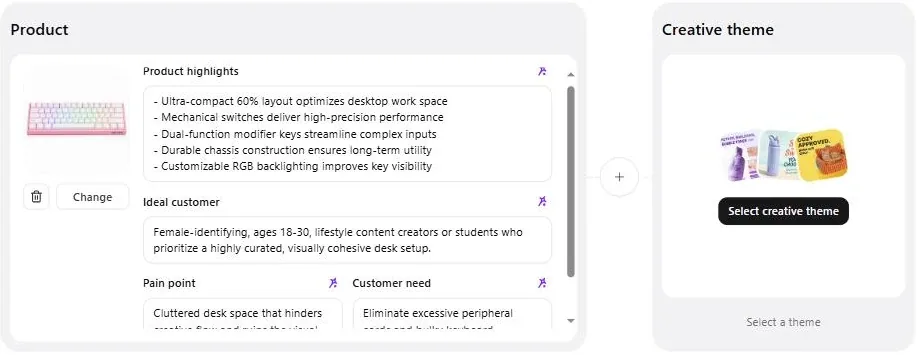
Promer AI fits the other half of the variant math: distinct ideas. Paste a product URL or upload a photo, and AI Ad Concept fills in Product highlights, Ideal customer, Pain point, and Need before it writes a single ad. Every field stays editable.
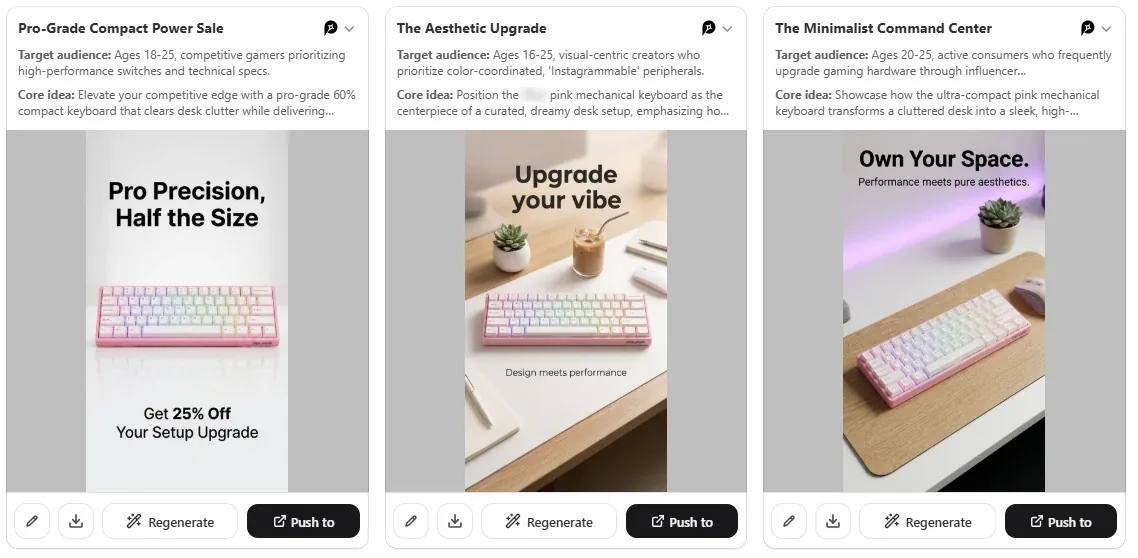
For a pink 60% mechanical keyboard, it wrote the buyer as "Female-identifying, ages 18-30, lifestyle content creators or students who prioritize a highly curated, visually cohesive desk setup." It then returned named concepts, each with a target audience, a core idea, and a finished creative.
Those 3 concepts, "Pro-Grade Compact Power Sale," "The Aesthetic Upgrade," and "The Minimalist Command Center," aim at 3 different buyers. That is 3 test cells that differ in the idea, which is the variable Marpipe's templates keep fixed.
Marpipe verdict: Worth it once you can fund the cells
Buy Marpipe if your catalog passes 1,000 SKUs, catalog ads already carry real spend, and a 4-cell test fits under half your 2-week budget. Skip it if you sell under 100 products or test 1 product at a time. Wait if your bottleneck is new angles, not formatting the catalog.
Next action, about 15 minutes: count your SKUs with variants, set Marpipe's SKU slider to that tier, and note the monthly and yearly Enterprise price. Then multiply your CPA by 50 and by 4, and compare the total with 2 weeks of spend.
If it fits, book the demo and ask for the Enterprise quote and refund terms in writing. If it does not, run a 2-cell test on Meta's own catalog first.
FAQ
Is Marpipe worth it?
Marpipe is worth it for large catalogs that already run catalog ads and can fund 4 or 5 test cells. Its playbook asks for 50 times your CPA per cell for 14 days. At a $40 CPA, that is $8,000 to $10,000 per test. A smaller store can use Startup to test 3 treatments against a plain catalog, but not the full 5 cells.
How much does Marpipe cost?
Marpipe costs $0 on Free, $199 a month on Startup, and Enterprise is priced by SKU count. On October 7, 2026, Enterprise ran from $999 a month on yearly billing under 500 SKUs to $3,119 a month on monthly billing under 10,000 SKUs. Product-level video, hourly syncing, extra SKUs, and location feeds cost extra. Marpipe takes no percentage of ad spend.
Does Marpipe have a free plan or a free trial?
Marpipe has a Free plan at $0 that lets you explore and preview designs. Free feed management lets you manage fields, create product sets, and see a Feed Score. The pricing table lists 0 SKUs in output feeds on Free, so running enriched catalog ads needs Startup or above.
Are Marpipe ads AI-generated?
No, Marpipe says its catalog ads are automated, not AI-generated. You design a treatment in Marpipe's editor, and rules apply it to every matching SKU. The product-level video page promises "No AI Slop" for the same reason. The homepage does list Video AI, Image AI, and Text AI fields, so some generative features sit beside the rules.
Does Marpipe only work with Meta?
No, Marpipe works with any ad platform that runs catalog ads. Its pricing FAQ names TikTok, Snap, Reddit, and Pinterest, and its Shopify listing adds Meta, Instagram, and AppLovin. Startup is limited to 1 channel and 1 output feed, while Enterprise has no channel limit, per the pricing page on October 7, 2026.
What is a good Marpipe alternative for a small Shopify store?
For a small Shopify store, Meta's own catalog ads are the free starting point. Marpipe's Startup plan suits catalogs near 500 SKUs. With fewer products, you often need different ad concepts more than templated product tiles, and Promer AI's AI Ad Concept builds concepts from a product URL.
Reference Sources
Marpipe. (n.d.). Marpipe: Control Your Catalog Ads. https://www.marpipe.com/
Pantelo, D. (2026). How the World's Best Media Buyers Test Catalog Ads. https://www.marpipe.com/blog/how-the-worlds-best-media-buyers-test-catalog-ads
Nana Phan has 16 years of experience across marketing, ecommerce, and SaaS, including running her own dropshipping business and nearly 8 years at FireGroup working on products for online merchants. Her experience spans both selling online and building software for the people behind those businesses.
As Head of Growth at Promer AI, she works across customer research, product, and marketing. She writes about ecommerce growth, ad creative, and practical applications of AI, informed by firsthand experience and conversations with merchants about the challenges they face.