UGC for Small Business: Why Most Advice Doesn't Apply Yet?
Category
Blogs
Date
Authored by
NaNa Phan
Summary
UGC for small business works in three stages, matched to your proof, not your budget. See what to do before, during, and after your first customers.
Every article about UGC for small business tells you to ask your customers for photos and videos.
That's good advice if you have customers. It's useless if you don't, and a lot of small businesses reading this today don't yet.
UGC for small business isn't one tactic, it's three, and which one applies depends on whether real customers exist yet to ask, not on the size of your budget.
A brand-new store with zero orders needs a different answer than a store with fifty happy customers, and neither one is the "real" version of doing UGC right.
Here's the three-stage version of that answer, and where the standard advice finally starts working.
Key Takeaways
The standard UGC advice (ask customers, incentivize submissions, repost their content) only works once real customers exist. It has nothing to offer a pre-launch or just-launched small business.
Real customer content is typically more trusted than brand-made content. That's worth conceding upfront, but it's not a reason to skip UGC before you have any customers to ask.
AI-generated UGC fills the gap before real customers exist, disclosed honestly as brand content, not passed off as a specific customer's review.
"UGC for SME" and "UGC for small business" are the same practice under different regional vocabulary. The framework doesn't change based on which term you searched.
Why "Just Ask Your Customers" Breaks Down for a Brand-New Small Business?
Start with the concession, because it's true and every competing article is right about it: content from a real customer typically converts better and reads as more trustworthy than anything a brand makes about itself.
If you have customers willing to talk about your product, use their words and their footage before anything else.
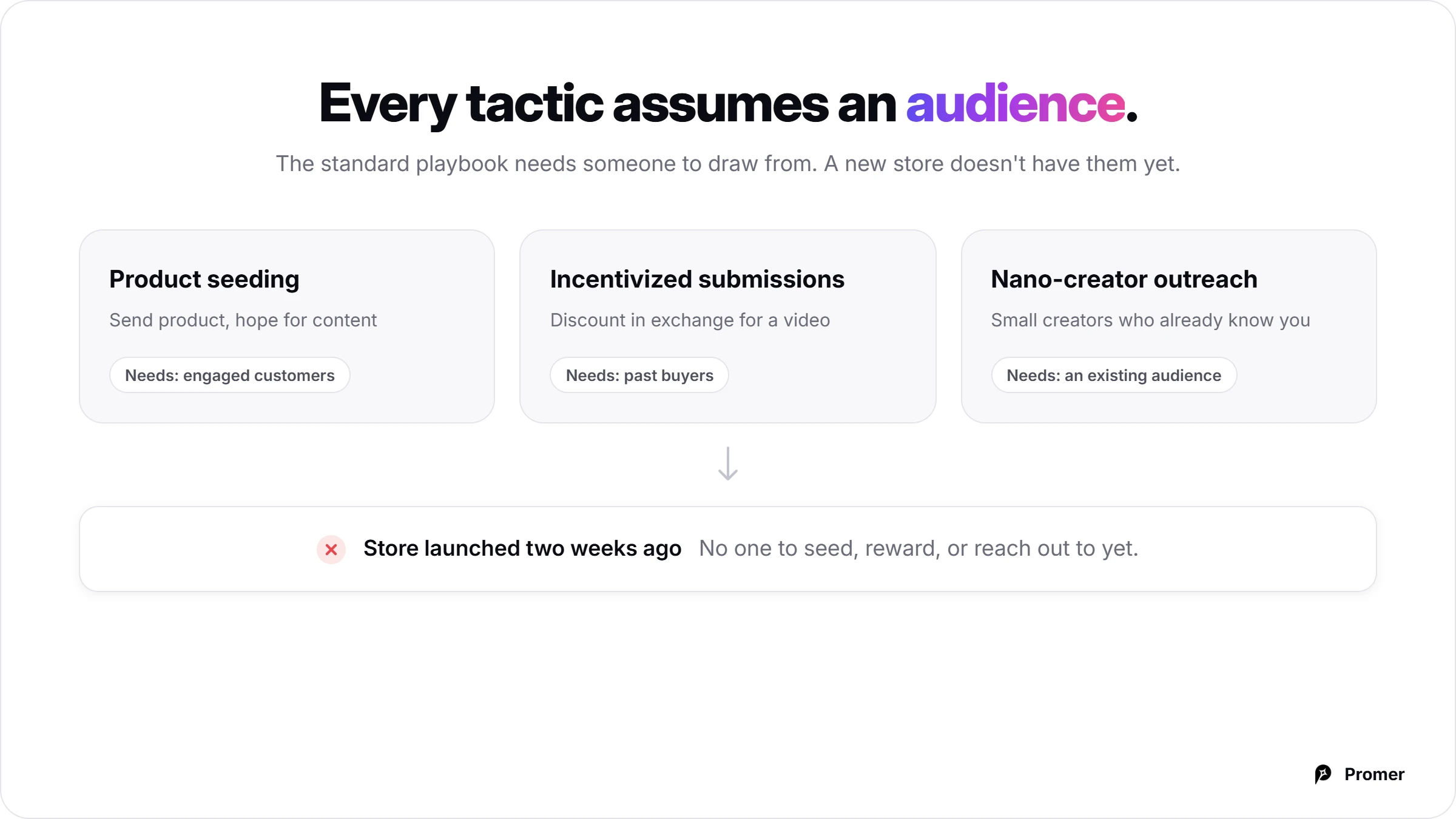
The advice runs into a wall the moment a small business has no customers yet, or has three orders and none of them answered the follow-up email. Product seeding, incentivized submissions, nano-creator outreach: every one of these tactics assumes an existing audience to draw from.
A store that launched two weeks ago doesn't have one. Neither does a founder still validating whether the product sells at all.
That's the gap this framework is built around: not "how do I get UGC" as a single question, but "what does UGC even mean at this stage."
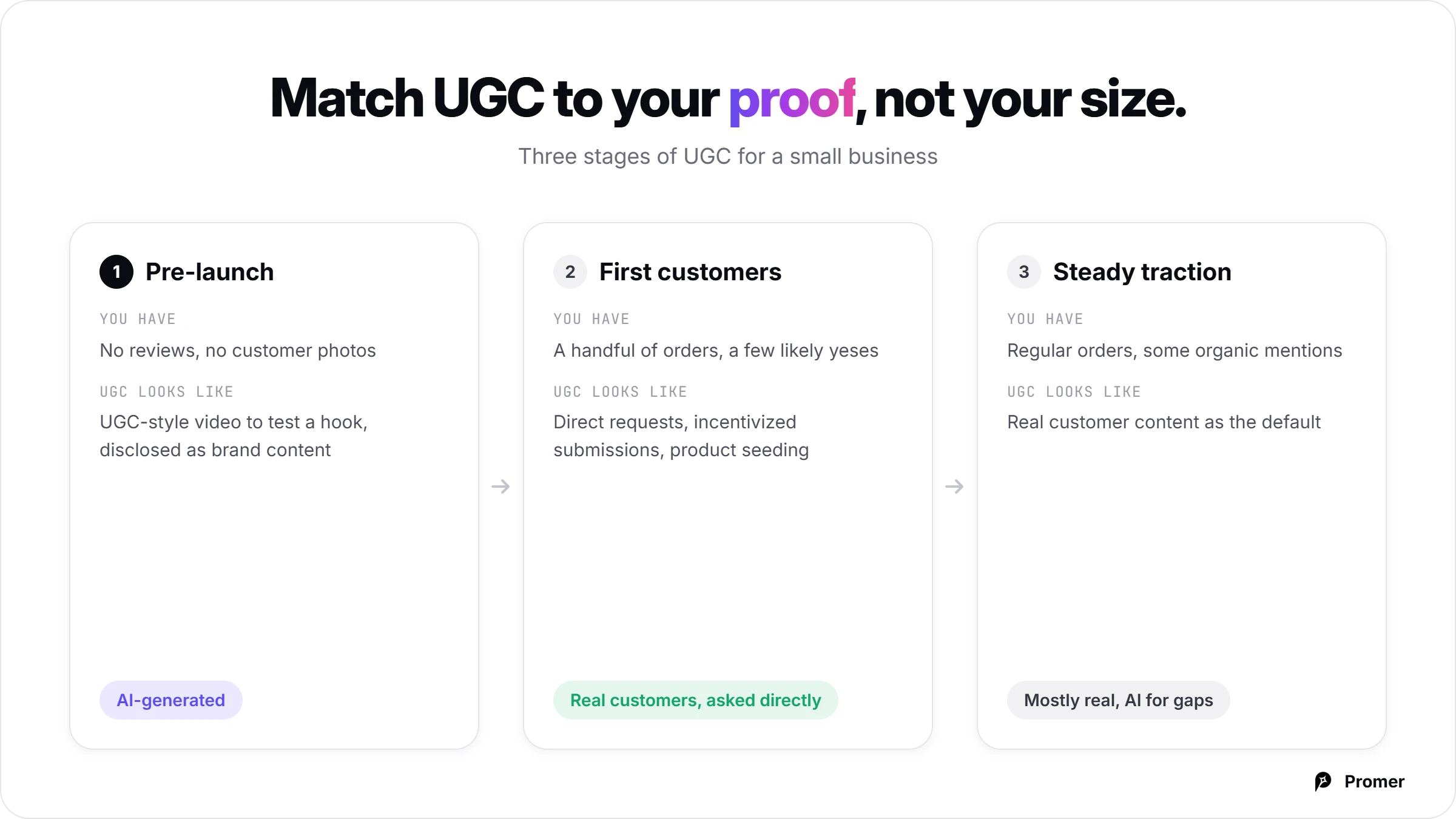
The Three-Stage Framework: Match UGC to Your Proof, Not Your Size
Instead of one answer, here's what changes at each stage, and why.
Stage
What you have right now
What UGC should look like
Where it comes from
1. Pre-launch or just launched
No reviews, no customer photos, nothing real to point to
UGC-style video that tests a hook or an angle, disclosed as brand content
AI-generated
2. First real customers
A handful of orders, a few people who'd probably say yes if asked
Direct requests, incentivized submissions, product seeding
Real customers, asked directly
3. Steady traction
A regular order flow, some organic mentions already happening
Real customer content as the default
Mostly real, AI for the gaps a customer hasn't covered yet
Each stage gets its own section below, because the tactic that works at one stage is the wrong move at another.
Stage 1: No Customers Yet, So the UGC Has to Be Synthetic
Start where most small businesses genuinely start: before a single order has shipped. If nobody has bought the product, nobody can make UGC about it.
That's not a workaround to feel bad about, it's just the honest state of a business at this stage. The only way to test a UGC-style hook, a testimonial angle, or a "how I use this" format before real orders exist is to generate it.
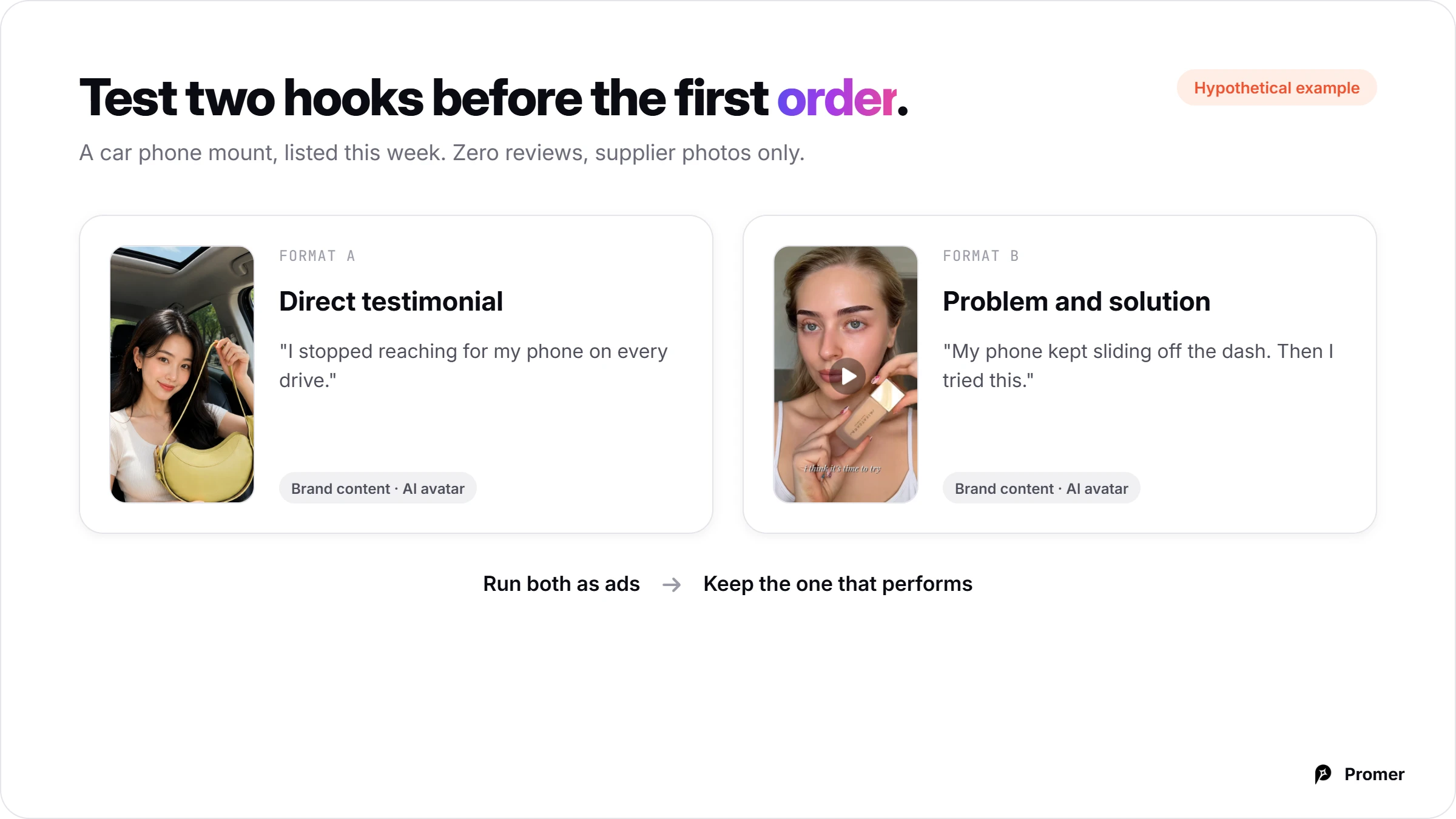
Picture a specific, if hypothetical, case: a solo founder lists a car phone mount on Shopify this week. Zero reviews, zero photos beyond the supplier's product shots.
Before spending on ads, they want to test whether a "direct testimonial" format or a "problem and solution" format gets a better hook. There is no customer to film either one.
Generating both, testing them, and keeping the one that performs is the only route to an answer that doesn't involve waiting weeks for organic content that may never arrive.
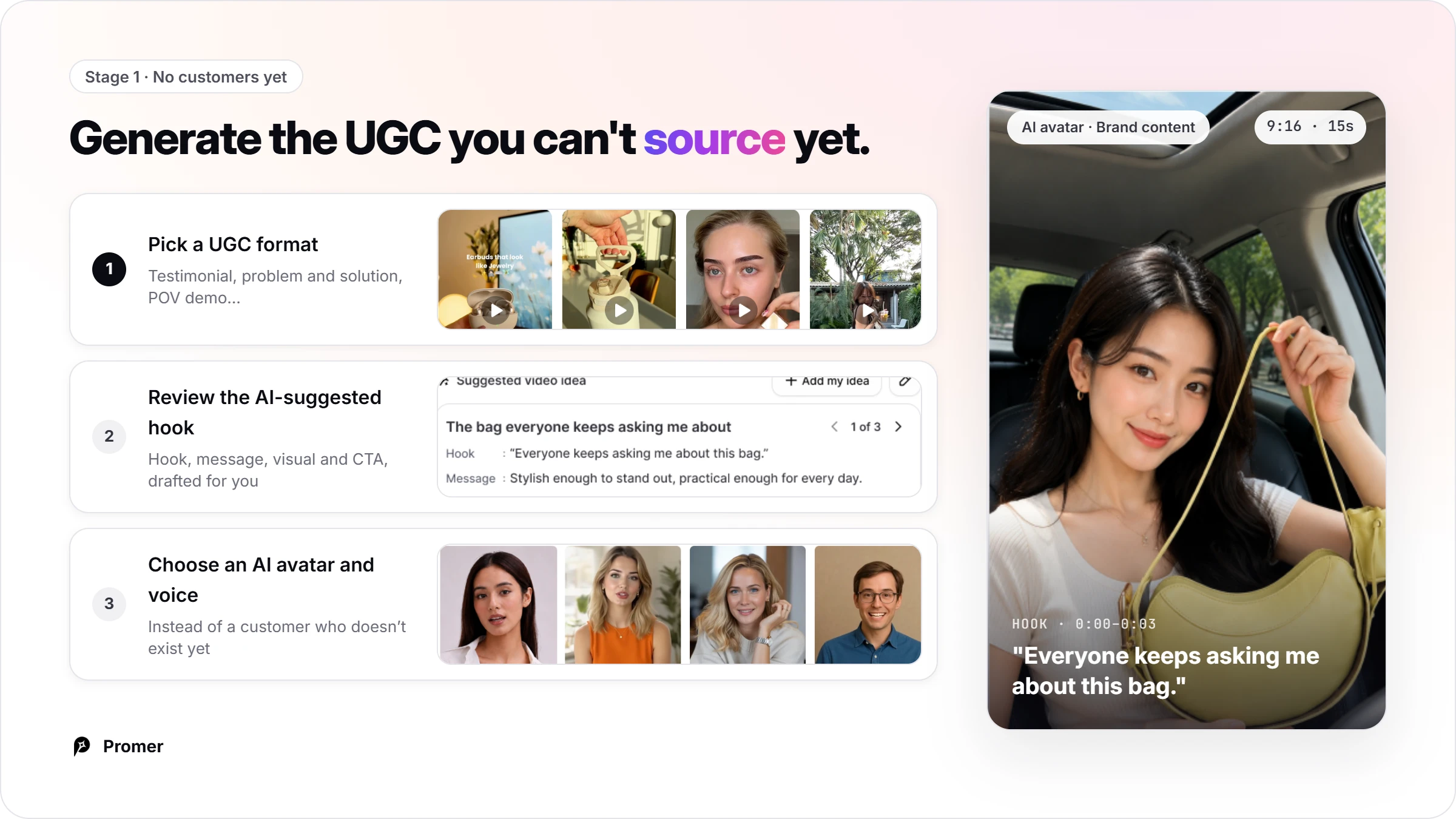
Promer AI's AI UGC video generator is built for exactly this gap: pick a product, pick a format, and an AI avatar delivers the script instead of a real person who doesn't exist yet as a customer.
The honest caveat, and the reason this stays Stage 1 rather than a permanent default: label it as brand content. Don't caption it as a specific named customer's review, and check the platform's policy on disclosing synthetic or AI-generated media before it goes live as an ad.
For the format and script decisions themselves (which UGC format fits a given product, how to structure the hook), a fuller walkthrough of the UGC decision sequence covers that in more depth than this piece needs to.
Stage 2: Sourcing Real UGC Once You Have a Handful of Customers
Once Stage 1's testing has done its job and real orders start landing, the tactic changes completely. This is where the standard advice finally applies.
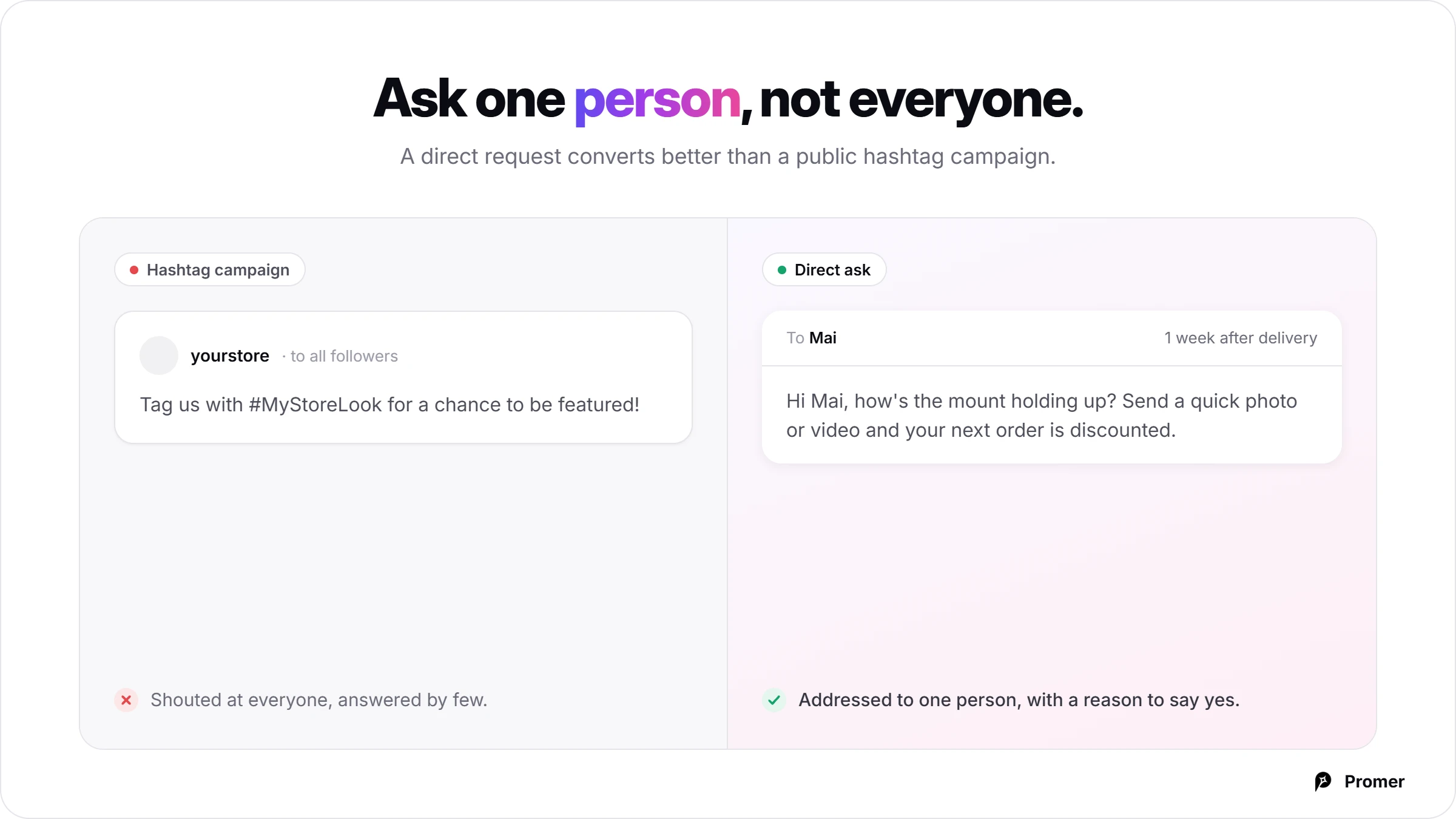
Ask directly. A short note in the order-confirmation email, or a follow-up a week after delivery, asking for a photo or a quick video in exchange for a discount on the next order.
That typically works better than a generic "tag us" hashtag campaign, mostly because it's addressed to one person instead of shouted at everyone.
Product seeding works the same way. Send it to the customers who've already engaged (left a comment, replied to a story, reordered) rather than seeding cold. They have a reason to say yes beyond a free product.
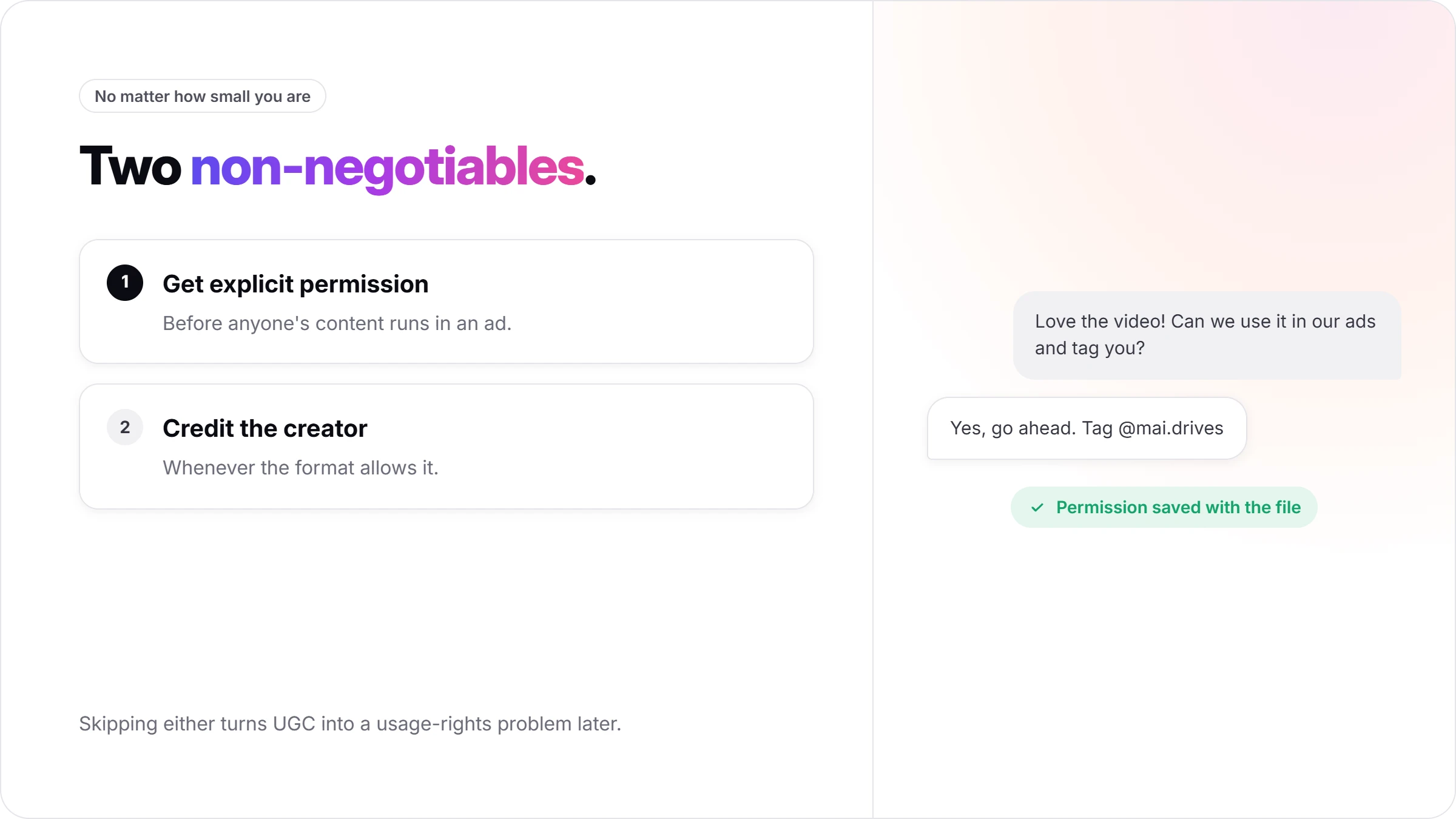
Two non-negotiables, regardless of how small the operation is:
Get explicit permission before using anyone's content in an ad.
Credit the person if the format allows it.
Skipping either is the fastest way a UGC strategy turns into a usage-rights problem later, and it costs nothing to do right the first time.
Stage 3: When Real UGC Should Take Over From AI-Generated?
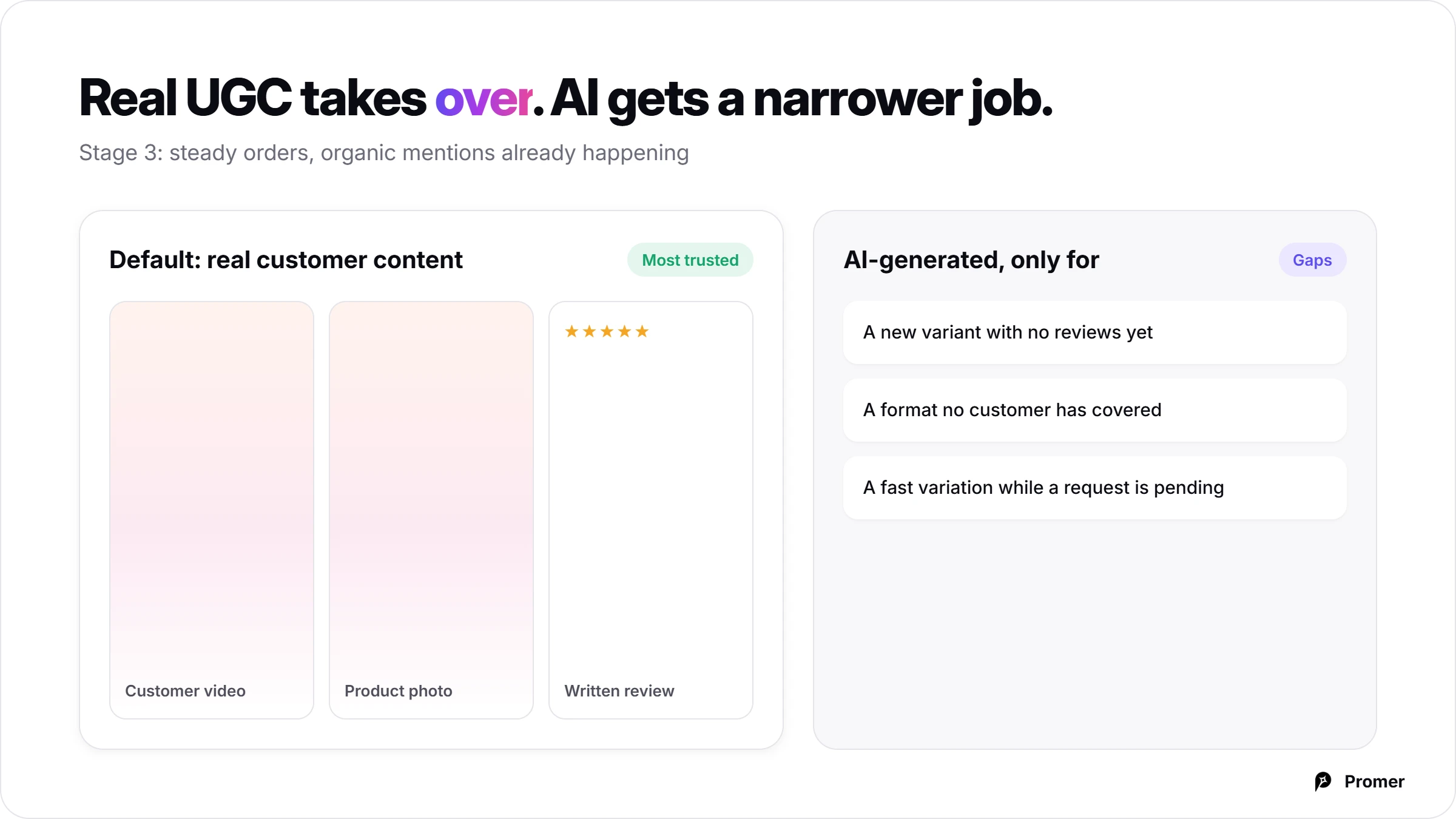
Real customer content doesn't stay a Stage 2 nice-to-have forever. Once a small business has a steady stream of orders and some organic mentions already happening, real customer UGC should become the default.
It's the more trusted format, and at this stage it's finally available. It also improves with volume, which Stage 1's generated content doesn't.
AI-generated UGC doesn't disappear at this point, it just moves to a narrower job:
Testing a new product variant that has no reviews yet.
Filling a format gap no customer has covered.
Turning around a variation fast while a real request is still pending.
The lesson holds whether or not a business ever touches an AI tool: the fix was never "AI versus real," it was matching the source to what the business had at the time.
"UGC for Small Business" vs "UGC for SME": Same Playbook, Different Vocabulary
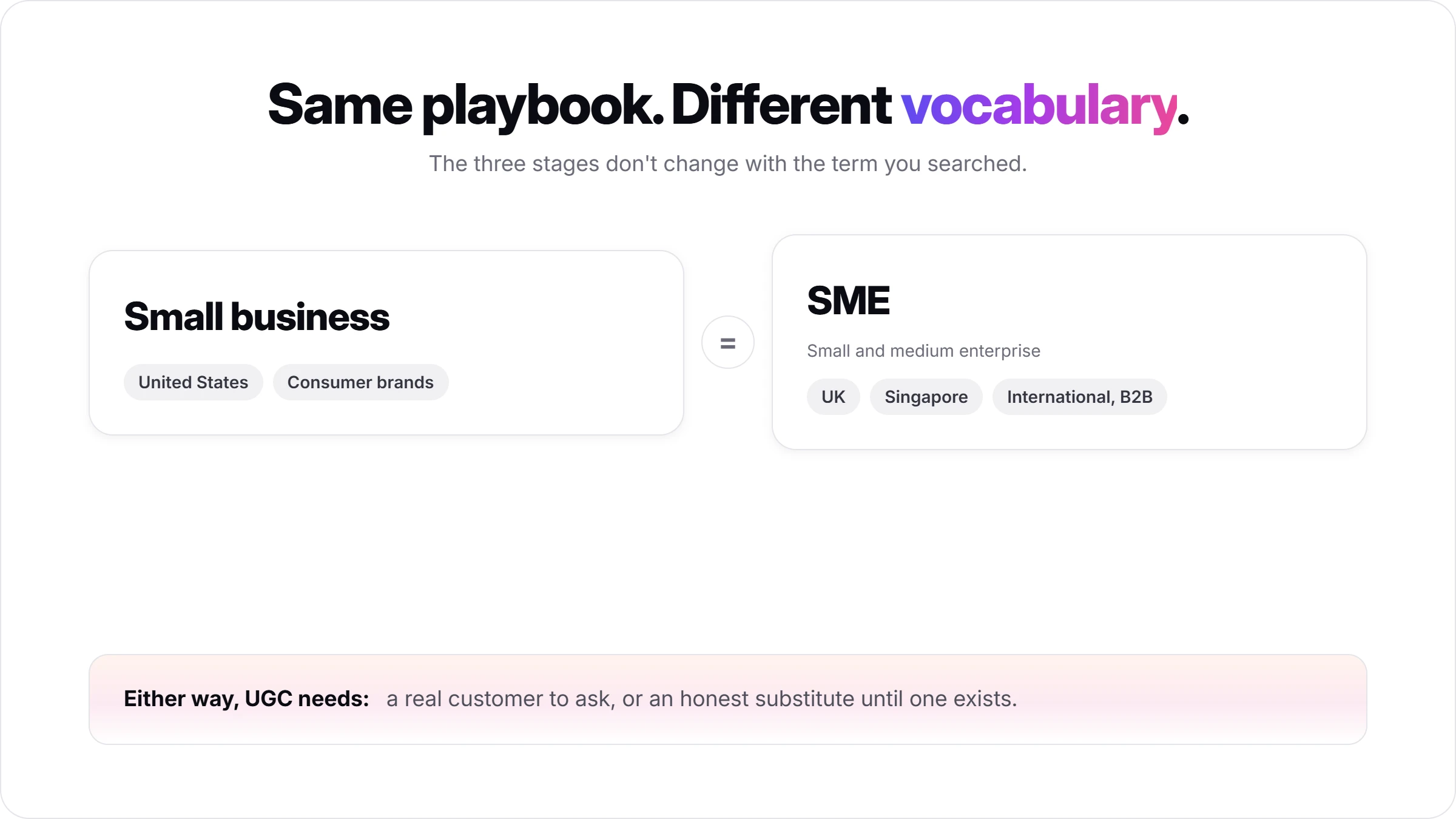
None of the three stages above change depending on which term brought you here.
"Small business" is the more common phrase in the US and in consumer-brand marketing. "SME" (small and medium enterprise) shows up more in the UK, Singapore, and broader international or B2B-adjacent contexts, often for a slightly larger operation than "small business" implies on its own.
Neither term changes what UGC requires: a real customer to ask, or an honest substitute while one doesn't exist yet.
Applying This to Your Own Stage
Knowing the three stages exist is one thing. Placing your own business on one of them is the part that decides what to do next.
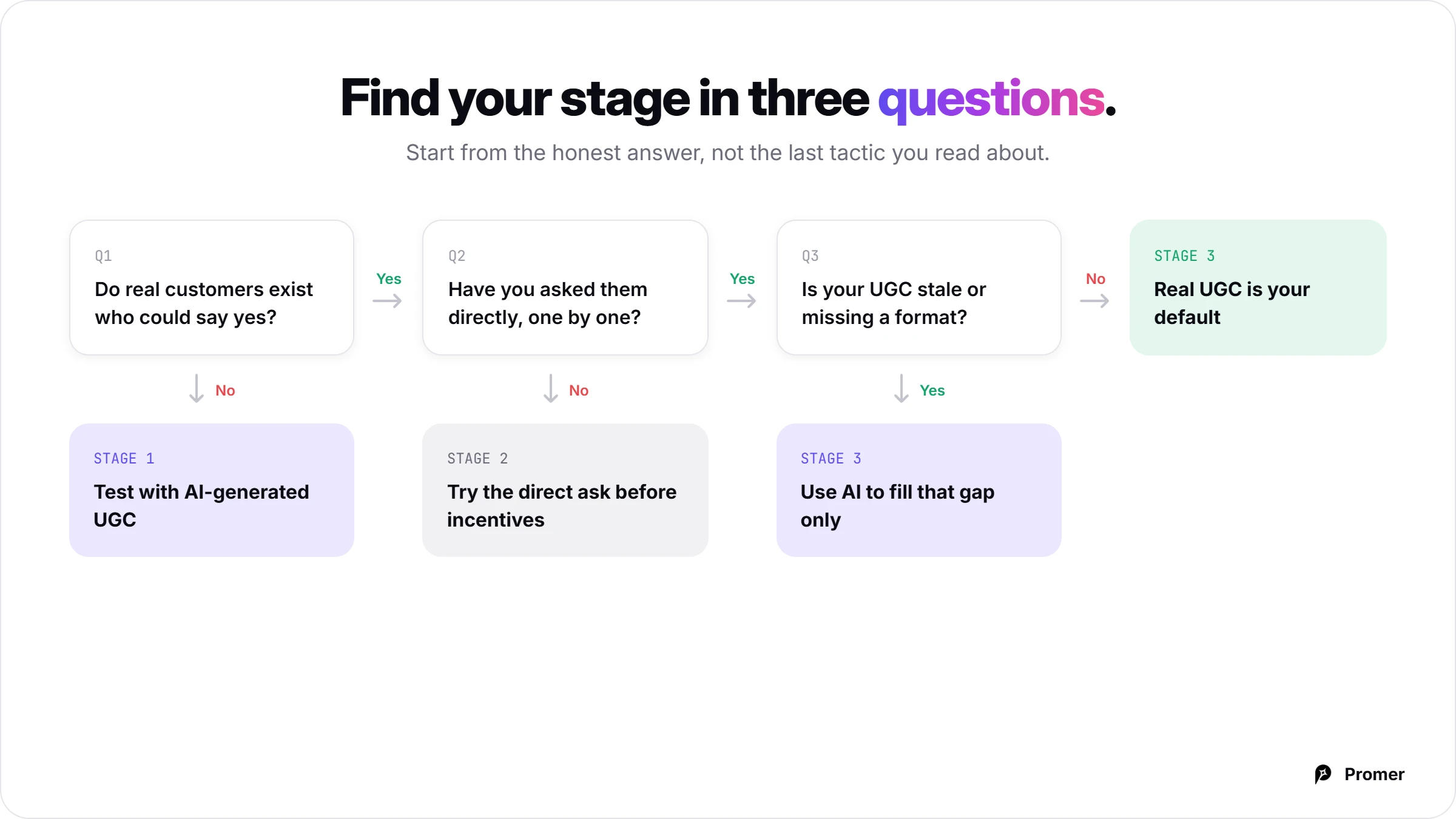
Before choosing a UGC tactic, answer three questions:
Do real customers exist yet who could plausibly say yes to a request? If not, you're in Stage 1, and testing with generated content is the realistic option, not a compromise.
Have you asked, directly and individually, rather than posting a generic call for content? Most small businesses skip straight to incentives without trying the direct ask first, and the direct ask usually works better.
Is any of your UGC now stale or format-limited compared to what a new product or angle needs? That's the narrow case for still using AI-generated content once real customers exist.
Start from wherever the honest answer lands, not from whichever tactic the last article you read happened to recommend.
If Stage 1 is where you are right now, the fastest way to see it in practice is to generate a first UGC-style video from a real product on the AI advertisement generator homepage.
FAQs about UGC for Small Business
Here are the specific questions that come up once you know which stage you're in.
Is UGC Worth It for a Small Business With No Reviews Yet?
Yes, but not in the form most advice describes.
With no reviews or customer photos yet, UGC-style content has to be generated rather than sourced. Use it to test a hook or format before real customer content becomes available.
What Counts as UGC for a Small Business, Exactly?
Any customer photo, video, review, or social post made by someone other than the business itself.
For a small business specifically, it also reasonably includes AI-generated UGC-style content used as a disclosed stand-in before real customer content exists.
Is AI-Generated UGC Considered Fake, and Will Customers Notice?
It's synthetic, not fake, as long as it's disclosed as brand content rather than presented as a specific real customer's testimonial.
The honest practice is labeling it clearly and checking the ad platform's policy on synthetic media disclosure before publishing.
How Do You Get Real Customers to Make UGC for a Small Business?
Ask directly, one person at a time, ideally in a post-purchase email or follow-up message, offering a small incentive like a discount on their next order.
This typically works better than a public hashtag campaign, and it only becomes possible once real orders exist.
Is "UGC for SME" the Same Thing as "UGC for Small Business"?
Yes.
The terms describe the same practice. "SME" is more common in UK, Singapore, and international business contexts, while "small business" is more common in the US. The stage-based approach applies identically under either term.
Do You Need to Pay for UGC as a Small Business?
Not necessarily at first.
A discount or free product is often enough incentive for an early customer's first piece of content. Paid nano-creator partnerships become worth considering once there's a budget and a clear sense of which format converts.
When Should a Small Business Stop Using AI-Generated UGC and Switch to Real Customer Content?
Once a steady flow of real customers exists who are willing to provide content, real UGC should become the default.
It's typically more trusted and converts better. AI-generated content still has a narrow, ongoing role for new products or angles that don't have real customer content yet.
How Long Does It Take to Get Usable UGC for a Small Business?
It depends on the stage: AI-generated UGC-style video can be produced in a single sitting, while sourcing real customer content often takes one to several weeks after a purchase.
Real content depends on someone responding to a request at all, which is a timeline a small business can't control directly.
Does UGC Work for a Service Business, Not Just Ecommerce?
Yes, though the format shifts from product-in-hand shots to client testimonials, before-and-after results, or a walkthrough of the service itself.
The same three-stage logic applies: no clients yet means testing with generated content, early clients mean asking directly, and steady clients mean real testimonials become the default.
Nana Phan has 16 years of experience across marketing, ecommerce, and SaaS, including running her own dropshipping business and nearly 8 years at FireGroup working on products for online merchants. Her experience spans both selling online and building software for the people behind those businesses.
As Head of Growth at Promer AI, she works across customer research, product, and marketing. She writes about ecommerce growth, ad creative, and practical applications of AI, informed by firsthand experience and conversations with merchants about the challenges they face.