Scaling ad production across markets fails when teams try to solve it with more headcount. The real constraint is not how many designers you have - it is how many usable, market-specific variants one product can produce without a new creative brief every time.
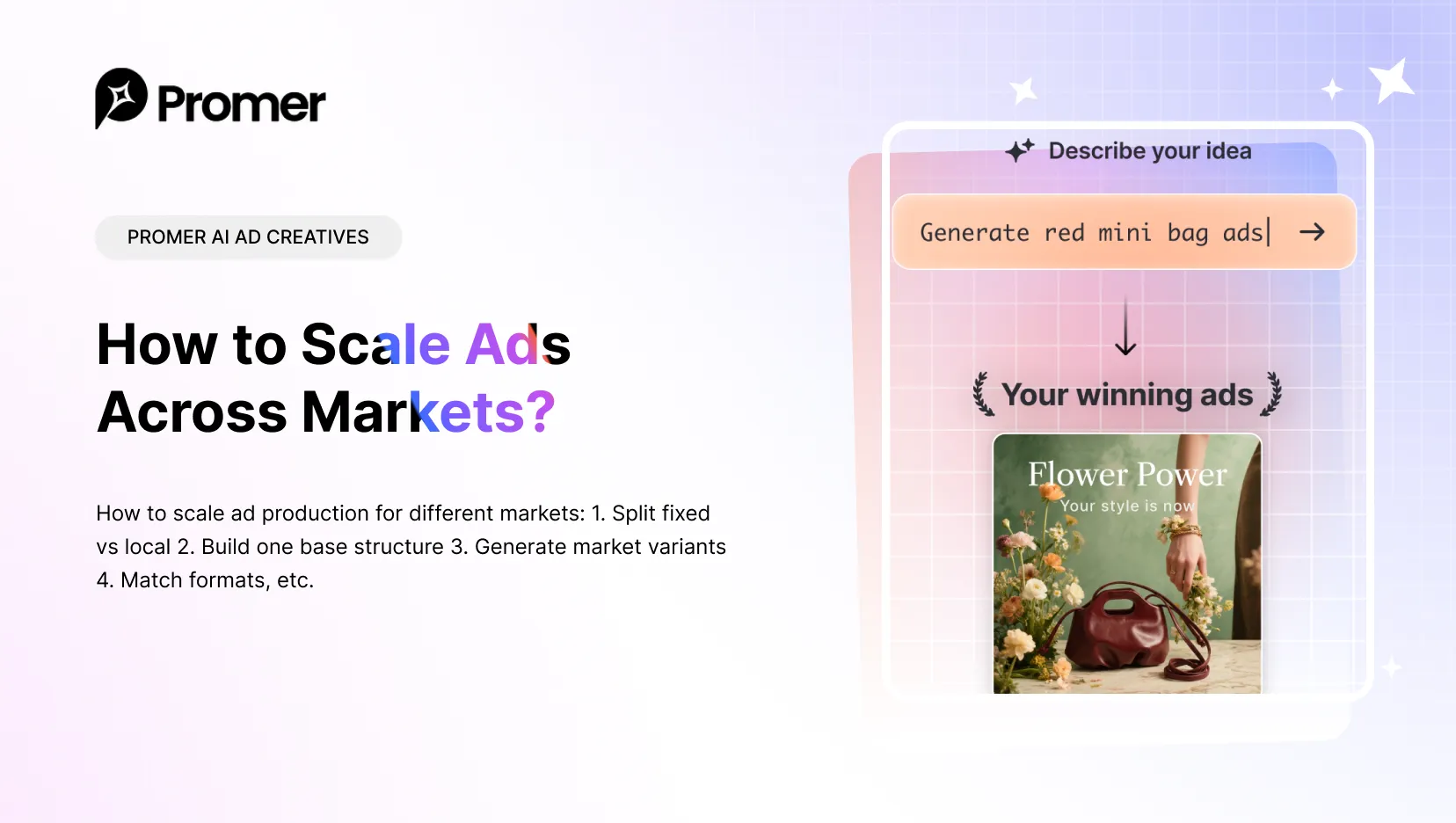
Most ecommerce teams expanding into new markets hit the same wall: every new country or language multiplies the number of ad variants needed, but the creative team, and the budget behind it, stays flat.
Every new market multiplies creative demand - more campaigns, more audience segments, more platforms, more stakeholders with opinions on the layout, while the pool of people who can actually produce the assets does not grow at the same rate.
This article covers a workflow for scaling ad production for different markets without increasing design costs - what to localize, what to keep centralized, and where an AI ad generator removes the per-market design bottleneck entirely.
Key Takeaways
- Scaling ad production across markets is a systems problem, not a headcount problem - the fix is lowering marginal cost per variant, not hiring more designers per market.
- Centralize the brand system (structure, offer logic, brand kit) and localize only what actually needs to change per market - language, imagery norms, and offer framing.
- AI-led workflows that start from product context let one team produce market-specific ad variations without a new design brief for every country.
- Not every market needs a fully custom creative - some need language and copy changes only, others need a different visual angle entirely.
- Typically, teams that scale well treat creative production as a repeatable pipeline with a review step, not a one-off project per launch.
What You Need Before Starting?
You need a working product page or product image for each SKU you plan to advertise, since ad generation starts from real product context, not a blank prompt. You also need a short list of target markets and, for each one, the language and platform mix (Meta feed, TikTok, Google Display) that market actually runs on.
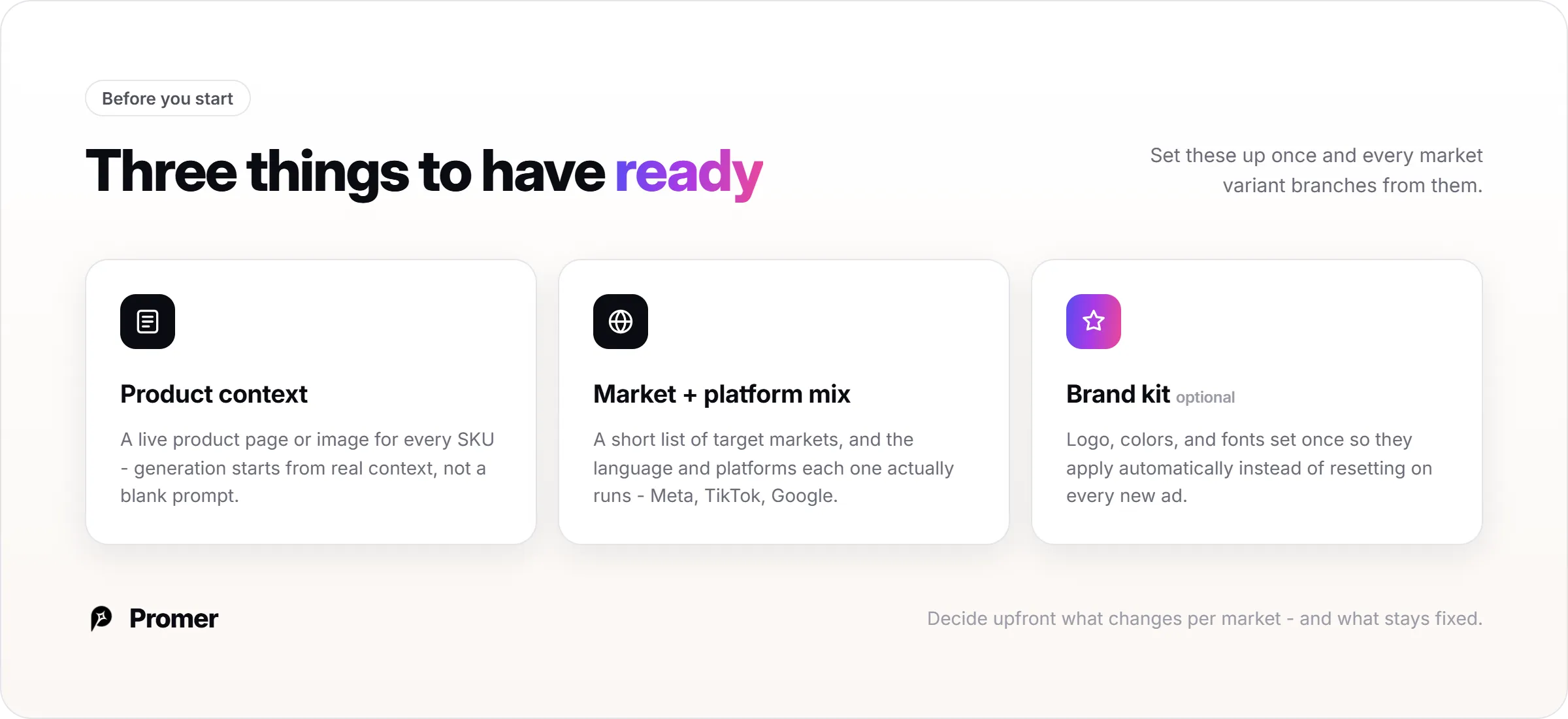
A brand kit - logo, colors, fonts - saves rework if you are producing variants across many markets at once, since it applies automatically instead of being reset by hand on every new ad. In Promer AI, this is a one-time setup step under Brand Kit.
Decide upfront which parts of the ad are allowed to change per market and which must stay fixed. This single decision prevents most of the back-and-forth that slows multi-market production down later.
How to Scale Ad Production for Different Markets? The Workflow at a Glance
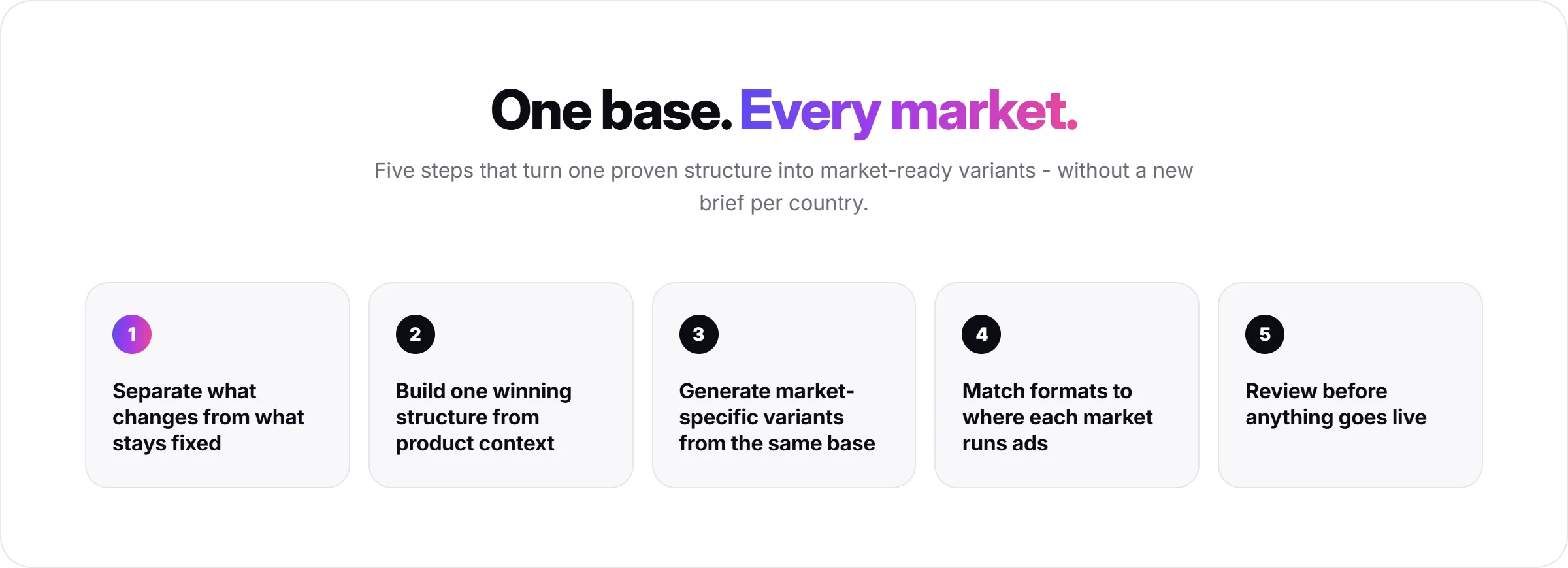
Before going step by step, here is the full sequence. Each step below maps to one of these:
- Step 1: Separate what changes per market from what stays fixed
- Step 2: Build one winning structure from product context
- Step 3: Generate market-specific variants from the same base
- Step 4: Match formats to where each market actually runs ads
- Step 5: Review before anything goes live
Step 1: Separate What Changes Per Market From What Stays Fixed
Before generating anything, split your ad into two layers: the structure (the proven angle, hook type, and layout) and the localization layer (language, currency, imagery norms, seasonal offer). The structure is what makes an ad a winning ad in the first place - it typically should not be reinvented for every market.
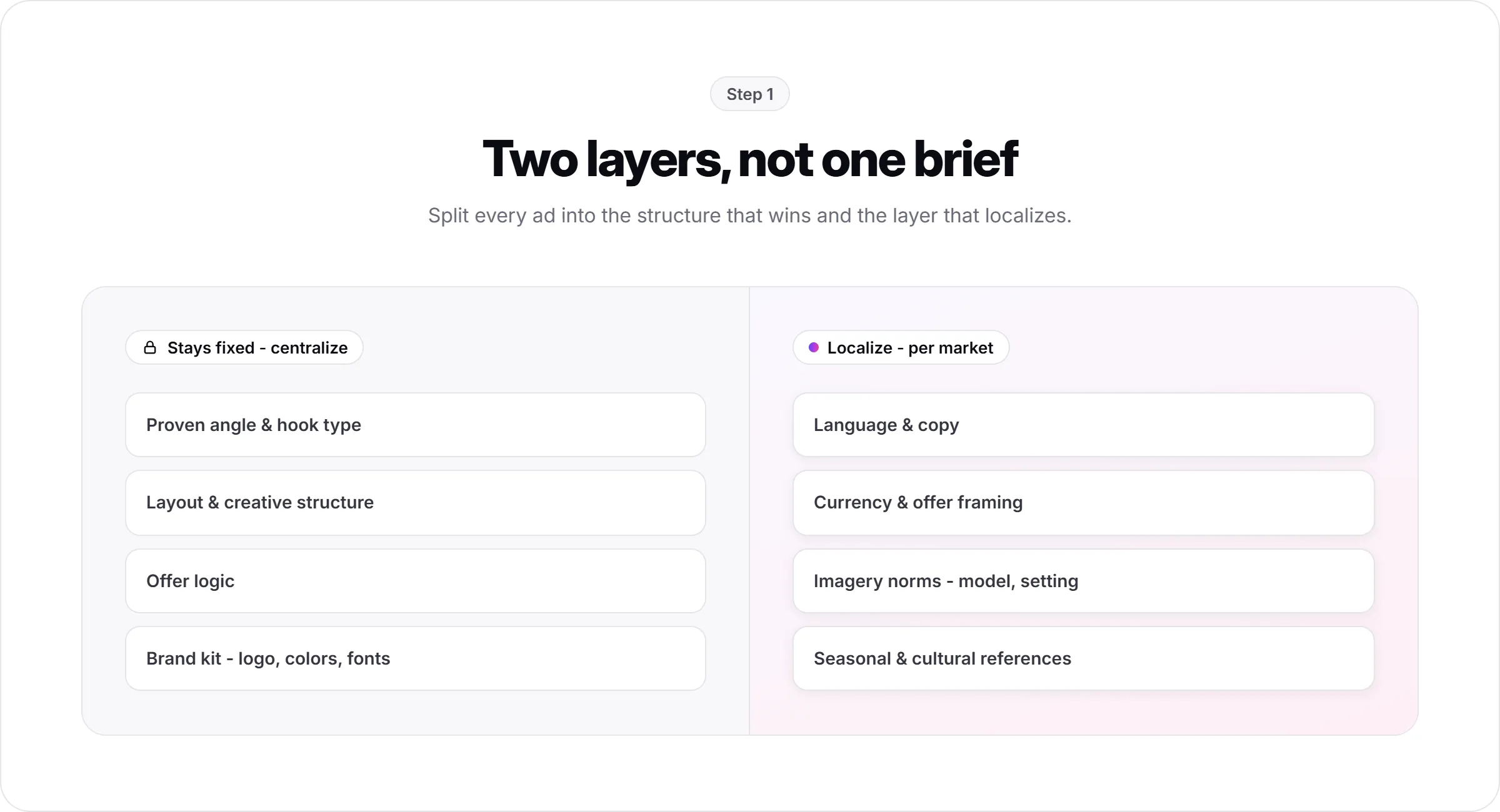
The localization layer is where markets genuinely differ. A hook that leads with urgency may work in one market and read as pushy in another; a testimonial angle may need a different face or setting depending on the audience. Name these differences explicitly instead of guessing.
This split is what keeps production fast. Teams that treat every market as a from-scratch creative brief end up rebuilding the same decisions over and over, which is the actual source of rising design cost - not the number of markets itself.
Step 2: Build One Winning Structure From Product Context
Start from the product, not a blank canvas. Paste the product URL or upload the product image into Promer AI's AI Ad Concept feature, which reads the page and surfaces product highlights, ideal customer, pain point, and need before any creative gets generated. This becomes the base structure every market variant will branch from.
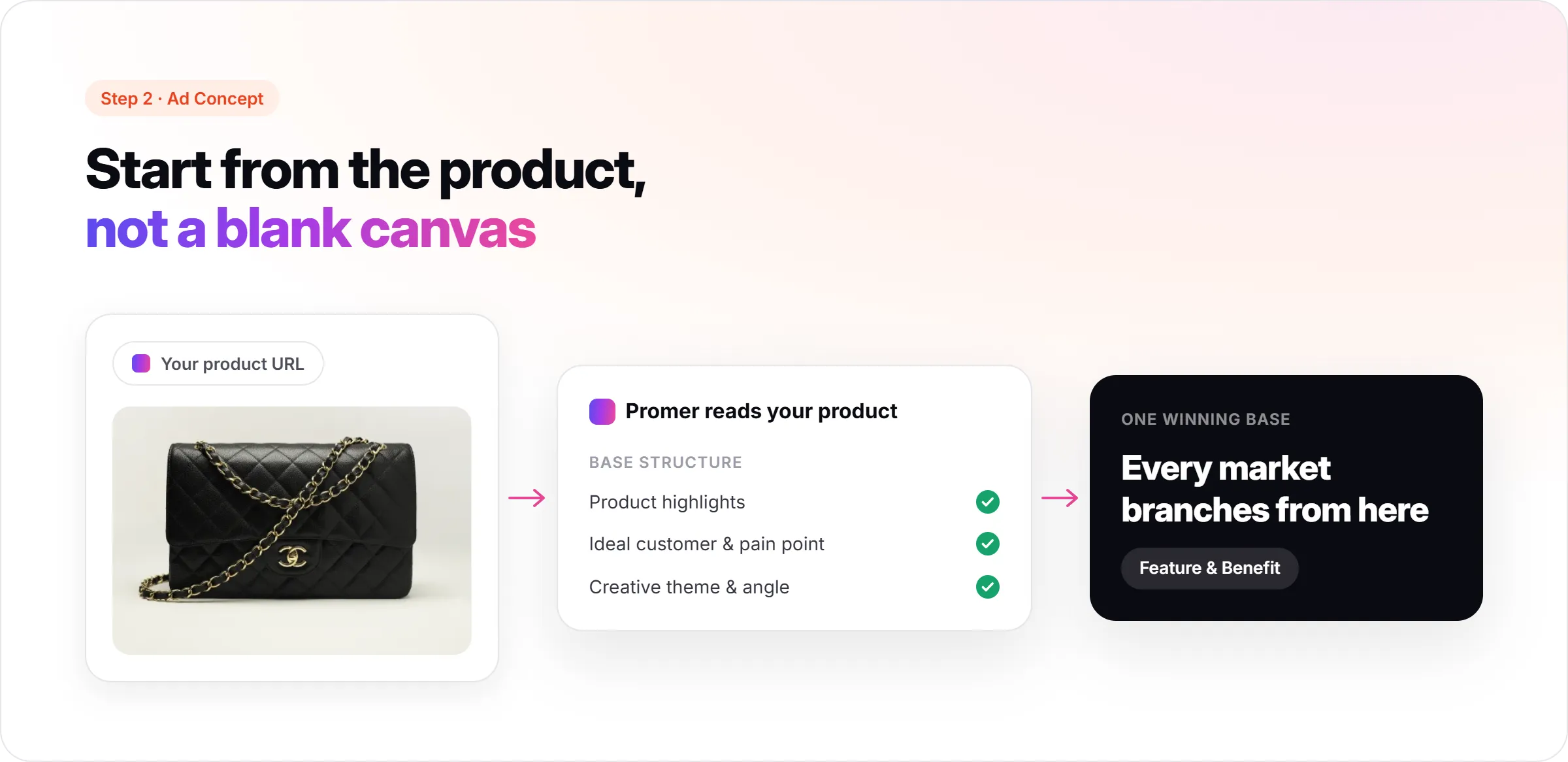
Pick a creative theme (Feature & Benefit, Offer & Sale, Before & After, and similar) that fits the product and the market you are launching first. This choice is the one that should stay consistent across most markets, since changing the core angle per country is what actually multiplies design work.
If you already have a reference ad that performs well - from your own library, from Ad Spy, or from the Winning ads library - use Promer AI's AI Ad Clone instead to recreate that proven structure with your product, rather than starting the concept step from zero.
Step 3: Generate Market-Specific Variants From the Same Base
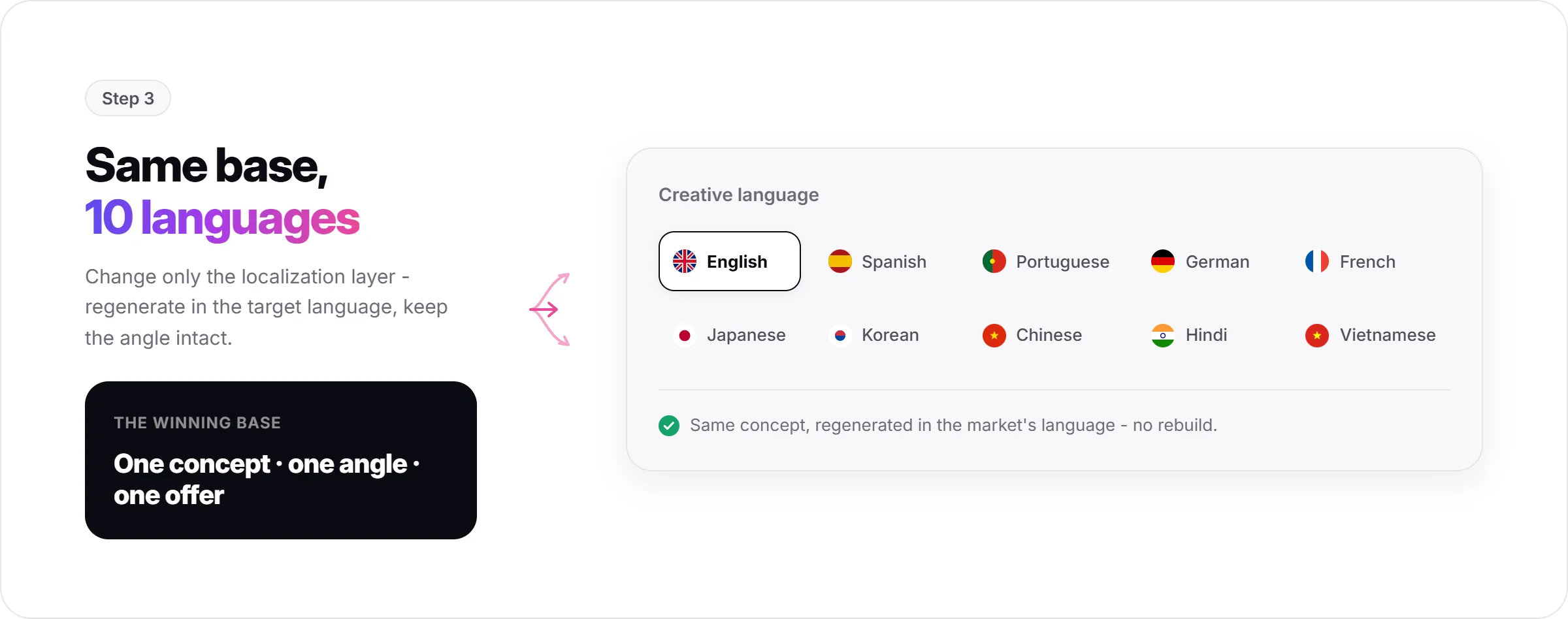
Once the base concept exists, generate variants per market by changing only the localization layer. Promer AI supports creative generation in 10 languages, including English, Spanish, Portuguese, German, French, Japanese, Korean, Chinese, Hindi, and Vietnamese - so the same concept can be re-generated in the target market's language without rebuilding the ad from scratch.
Use "More ad creatives" to produce additional variations from the same angle for markets that need a slightly different visual treatment - a different model, background, or overlay style - while keeping the same underlying concept and core message intact.
For markets where only copy needs to change - not the visual - regenerate just the headline, body text, and CTA rather than the full creative. This is typically the fastest path and the one most teams skip by mistake, generating a brand new image when only the words needed to change.
Step 4: Match Formats to Where Each Market Actually Runs Ads
Not every market runs on the same platform mix. A market where TikTok dominates needs 9:16 video-first assets; a market still concentrated on Meta feed needs 1:1 and 4:5 statics. Generating every format for every market regardless of where the budget actually goes is one of the most common sources of wasted design effort.
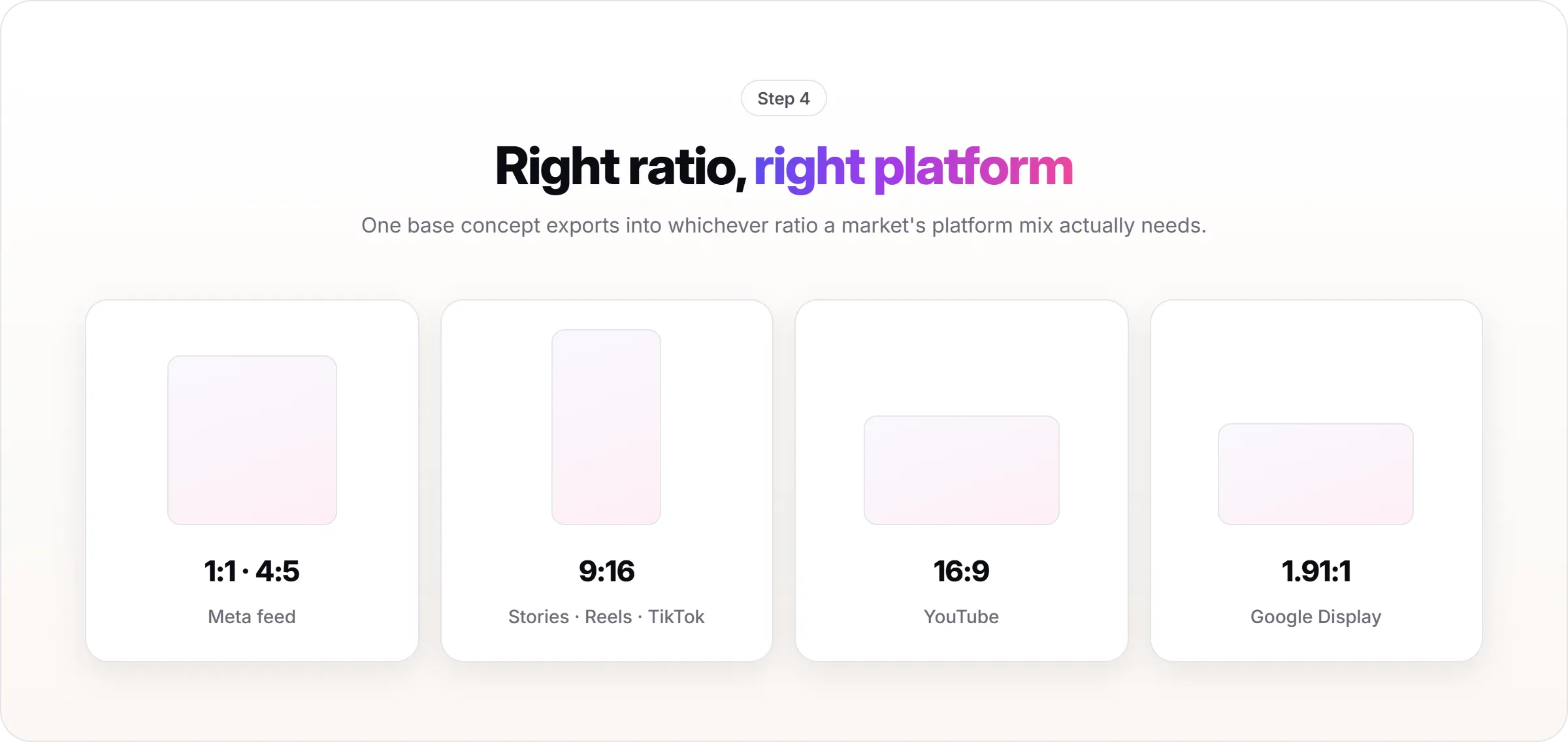
Promer AI generates in platform-ready ratios directly - 1:1 and 4:5 for Meta feed, 9:16 for Stories/Reels/TikTok, 16:9 and 1.91:1 for Google Display/YouTube - so the same base concept can be exported into whichever ratio a given market's platform mix actually needs, without a separate design pass per format.
For markets where a static creative already performs and video is the missing piece, turn the static into a short video ad with Promer AI's AI Ad Animation instead of briefing a new video shoot for that market alone.
Step 5: Review Before Anything Goes Live
AI-generated creatives can contain mistakes - a mistranslated phrase, an overlay that reads oddly in a specific market, a cultural mismatch a native reviewer would catch immediately. Every market variant needs a human review pass before it runs, ideally by someone familiar with that market's language and norms.
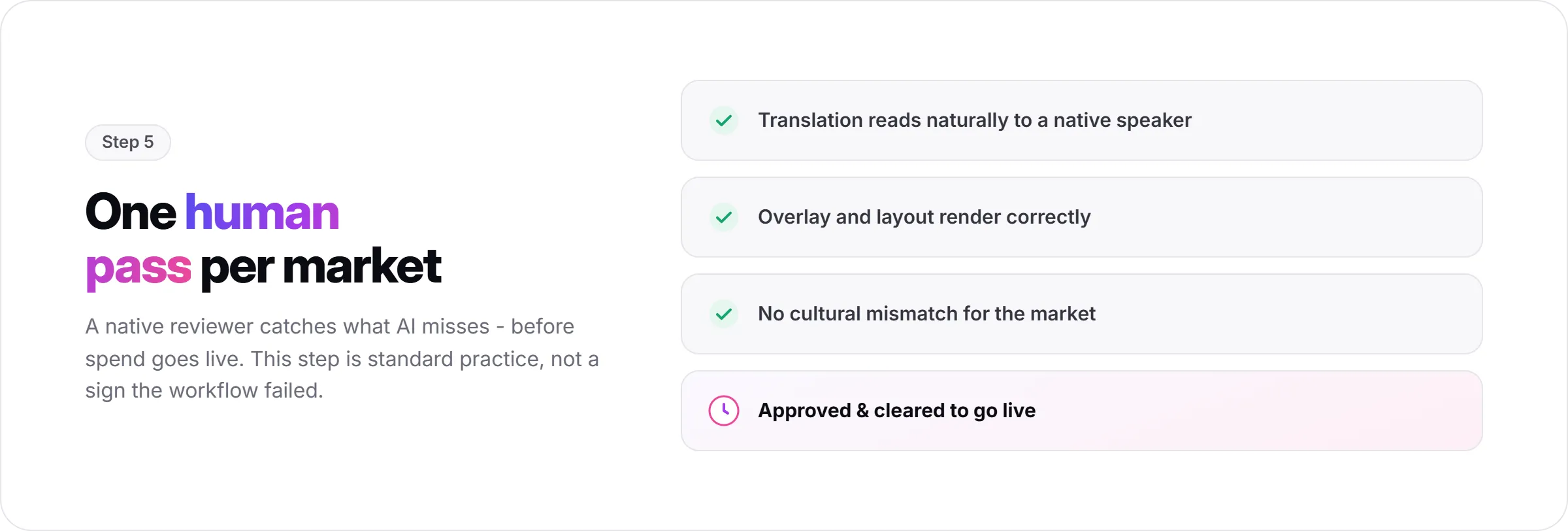
This review step is not optional and it is not a sign the workflow failed - it is the same discipline any ad production pipeline needs, whether the first draft came from a designer or from AI. Skipping it to save time is where most localization mistakes in ecommerce ads actually come from.
What Good Output Looks Like?
A working multi-market pipeline produces one proven structure that branches into several market-ready variants - not a separate creative brief written from zero for every country. Copy, language, and minor visual details change per market; the underlying angle and offer logic typically stay the same unless a market's data says otherwise.
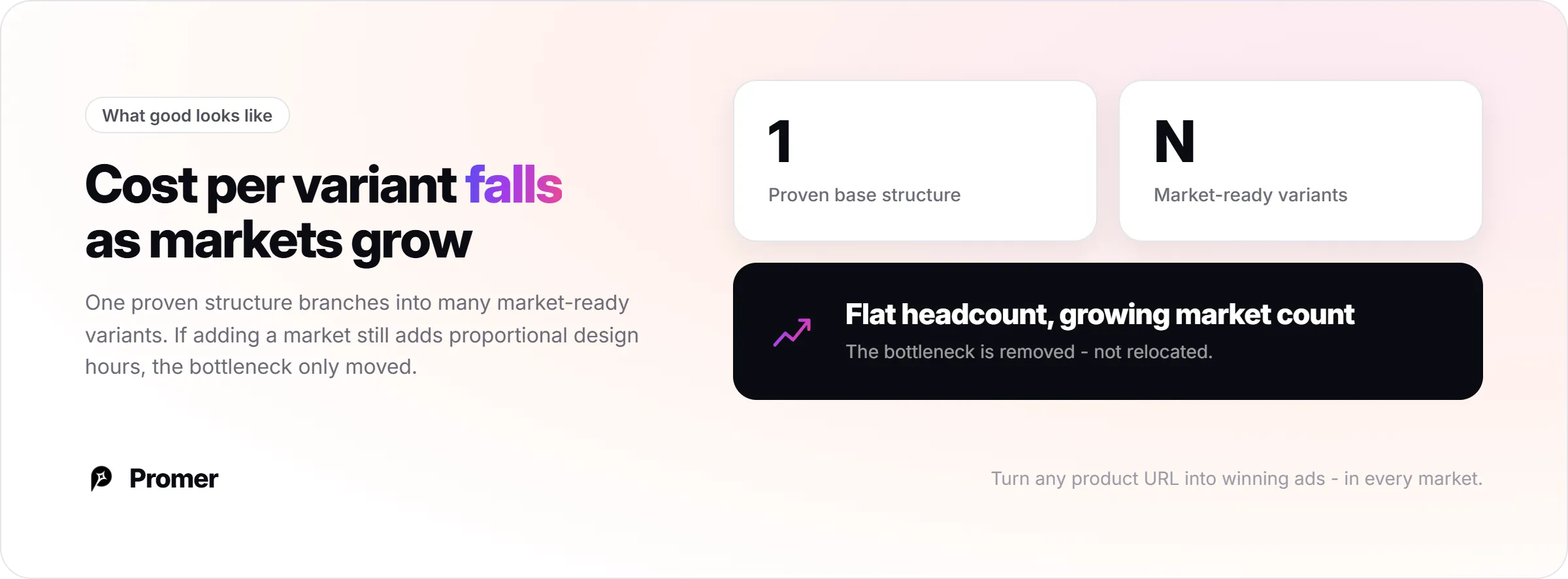
Cost per variant should fall as the number of markets grows, not rise with it. If adding a market still means adding a proportional amount of design hours, the workflow has not actually removed the bottleneck - it has just moved it.
Common Mistakes
Rebuilding the full creative brief for every market instead of branching from one base structure is the most common and most expensive mistake. It multiplies work that did not need multiplying.
Generating every platform format for every market regardless of where that market's ad spend actually goes wastes production time on assets that will never run. Match format effort to actual platform mix per market.
Skipping native-language review because the copy "looks right" is a frequent source of localization errors that a first-language reviewer would catch in seconds. Machine-translated or AI-suggested copy still needs a human check per market.
FAQs about Scaling Ad Production Across Markets
How do I scale ad production for different markets without increasing design costs?
Separate the proven ad structure from the localization layer, and only rebuild the layer that actually differs per market. Language, offer framing, and minor visual details usually need to change; the core angle and layout typically do not. Tools like Promer AI's AI Ad Concept let you generate market-specific variants from one product-context base instead of briefing a new design per country, which is what keeps marginal cost per variant low as markets increase.
Should every market get a completely custom ad creative?
No - most markets need copy and language changes more than a fully new visual. A fully custom creative is worth the extra production step when a market's imagery norms or customer expectations genuinely differ (for example, a different type of model or setting). For markets where the audience and platform are similar to an existing one, regenerating headline, body text, and CTA in the local language is typically enough.
What should stay consistent across markets, and what should change?
Keep the core angle, hook type, and offer logic consistent; change language, cultural references, and platform format per market. Brand elements like logo, colors, and fonts should also stay fixed - this is what a brand kit is for. Depending on your product category, imagery may need to change if the target customer or context looks meaningfully different between markets.
How many ad variants does each market actually need?
This depends on ad spend and platform mix in that specific market, not a fixed number. A market with a small budget on one platform may only need 3-5 active variants rotating on a refresh cycle; a market running multiple platforms at higher spend needs format-specific variants for each. Start from your highest-spend markets and scale variant count down for smaller ones.
Can AI-generated ads be published directly without review in each market?
No - AI-generated creatives should always be reviewed before going live, especially for language and cultural fit. AI-suggested copy and translations can contain mistakes or phrasing that reads oddly to a native speaker, even when the underlying structure is correct. A short native-language review step per market is standard practice, not an extra safeguard.
Does scaling to more markets always mean scaling the design team?
Not if the workflow branches variants from one proven structure instead of starting each market from a blank brief. The teams that end up hiring proportionally to market count are usually the ones treating every country as a new creative project. A repeatable, product-context-first workflow is what keeps headcount flat as market count grows.
Reference Sources
AdxMagic. (2026). How to scale ad creatives - Producing volume without losing quality.
Fuze32. (2026). Scaling creative production across markets without losing it.
Nest Commerce. (2026). How to scale ad creative production.