






What Do Massage Advertising Examples Sell?
The massage advertising examples in this library sell relief from one specific discomfort - tension, tired feet, stiff hands, a stressful week - and show it in a way the buyer can picture. The keyword looks like one niche but covers three businesses: spa and massage therapy services, massage devices, and oils and aromatherapy products.
Service ads sell atmosphere and a reason to book now. They use soft light, a face at rest, white towels and a single line of copy, such as a seasonal discount or a phrase like "A Ritual of Relaxation." There is almost nothing technical on the image, because the buyer is choosing a feeling.
Device ads have the opposite job. They show the product working on a body part - a foot on a roller, a glove on a hand, feet resting on a platform - and then add the proof: an offer with a deadline, a symptom grid, a handwritten testimonial or a trial period printed on the product.
Underneath both sits one rule of wording. Lines about soothing, relaxing and easing tension are common, while claims to treat or cure a condition are what platforms and regulators look at closely. Keep that in mind as you read the massage ad samples below.
Top Massage Ad Examples to Learn From
Here are seven massage ad samples from the library, with spa and massage therapy services first and devices after. Each one shows what the creative does and what you can borrow for your own.
Example 1: Spa Black Friday Special (Offer & Sale, 1:1)
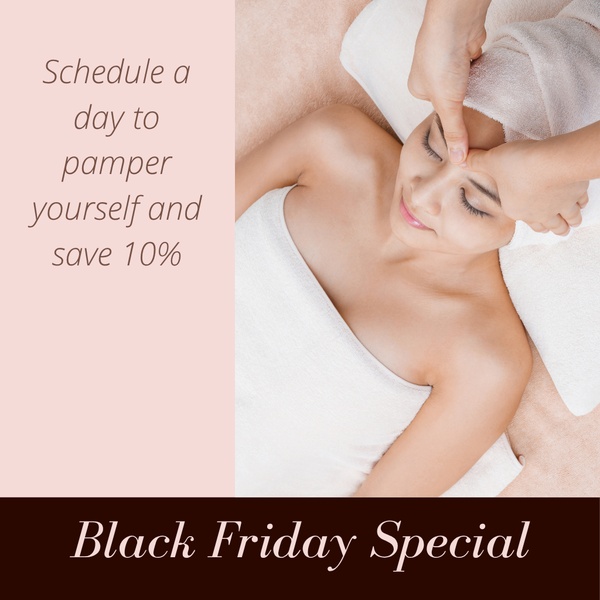
A pale pink panel carries one sentence - "Schedule a day to pamper yourself and save 10%" - next to a photo of a facial massage, with a dark brown band underneath reading "Black Friday Special." The offer and the occasion are both readable in a second.
Borrow: a single seasonal offer paired with the treatment photo. A flat percentage is the simplest version, and a first-visit offer or a package fits the same layout.
Example 2: "A Ritual of Relaxation" Spa Ad (Headline, 4:5)
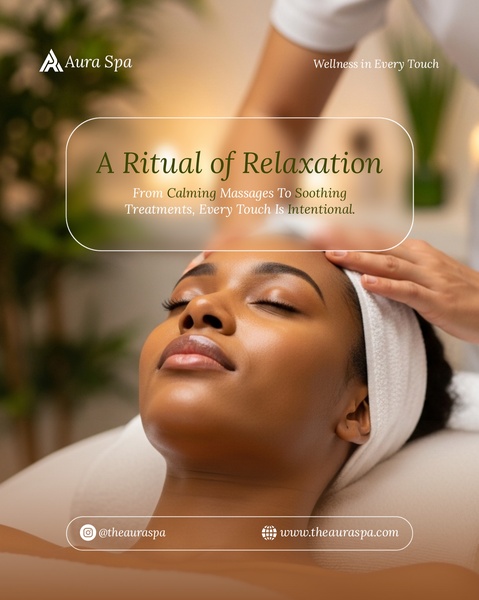
A tight, warm-toned close-up of a client's face with the therapist's hands at her temples. The headline sits in a frosted frame in the middle, with one supporting line about calming massages and soothing treatments, and the spa's handle and website along the bottom.
Borrow: a headline that names the experience rather than the service, and contact details on the image itself. For a local massage therapy business, the handle and website do the job of a CTA.
Example 3: "Release Stress, Relax Yourself" Benefit Callouts (Feature & Benefit, 4:5)
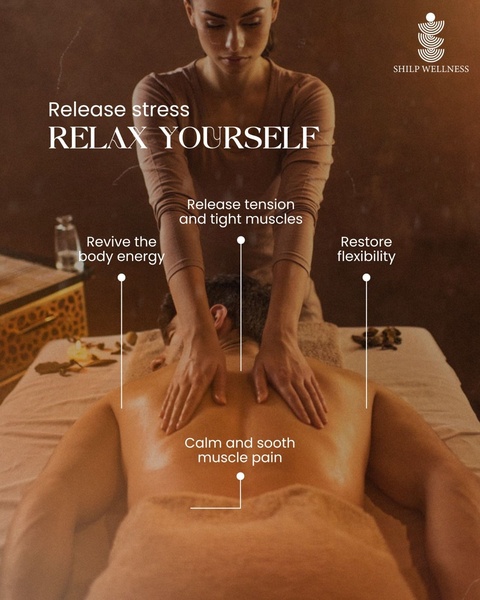
A therapist works on a client's back in dim, warm light. Four thin lines run from the photo to short callouts - revive the body energy, release tension and tight muscles, restore flexibility, calm and soothe muscle pain - under a two-line headline.
Borrow: the callout structure, which turns a service nobody can see the result of into a short list of outcomes. Keep each line to what you can stand behind, and word it as easing or supporting rather than treating.
Example 4: Massage Roller With a 40% Off Sale (Offer & Sale, 1:1)
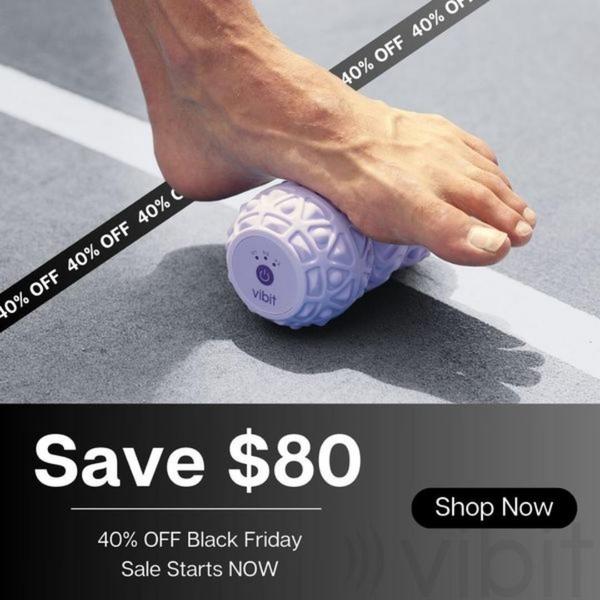
A bare foot presses down on a lavender roller, so the product's use is clear before any text is read. Diagonal "40% OFF" tape crosses the photo, and a dark panel below states "Save $80," the sale terms and a Shop Now button.
Borrow: showing the offer in dollars as well as percent, since "Save $80" tells the buyer what they keep. Pair it with a product-in-use photo so the ad is not just a price.
Example 5: Hand Massager Glove With a Symptom Grid (Problem & Solution, 1:1)
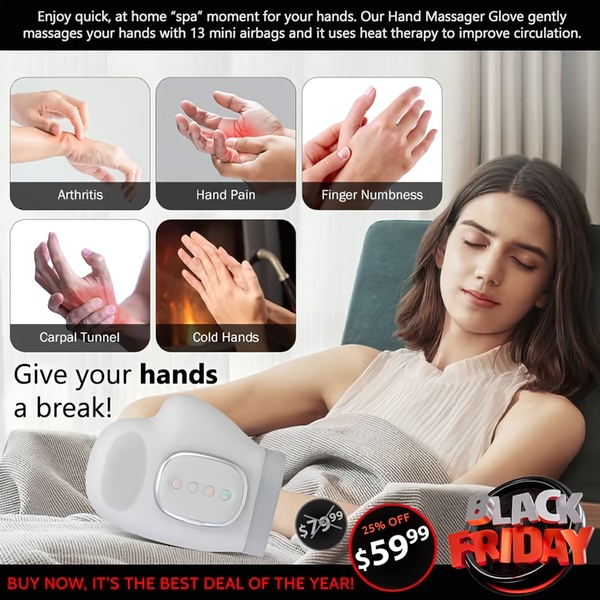
Five small photos labeled arthritis, hand pain, finger numbness, carpal tunnel and cold hands sit above a woman resting with the glove on. A headline reads "Give your hands a break!" and a Black Friday badge marks the price drop from $79.99 to $59.99.
Borrow: the contrast between a problem row and a calm lifestyle shot. Be careful with the condition labels, since naming medical conditions in the image is the part most likely to run into platform policies and substantiation requirements.
Example 6: Handwritten Testimonial on the Palm (Testimonial, 1:1)
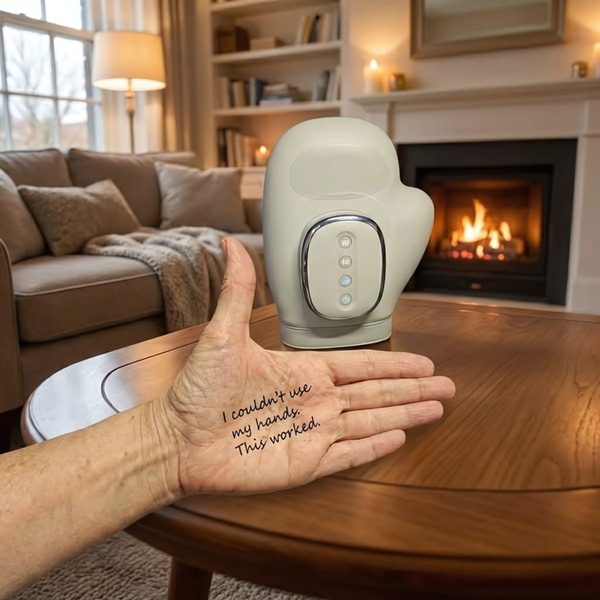
The camera takes the user's point of view: an open palm with "I couldn't use my hands. This worked." written across it, and the massager sitting on a coffee table in front of a fireplace. The testimonial is the headline, and the product is the supporting character.
Borrow: a first-person frame that looks like a real moment. Use a real customer's words, because testimonials are generally expected to reflect honest customer experience.
Example 7: Sticky-Note Trial Offer (Bold Claim, 1:1)
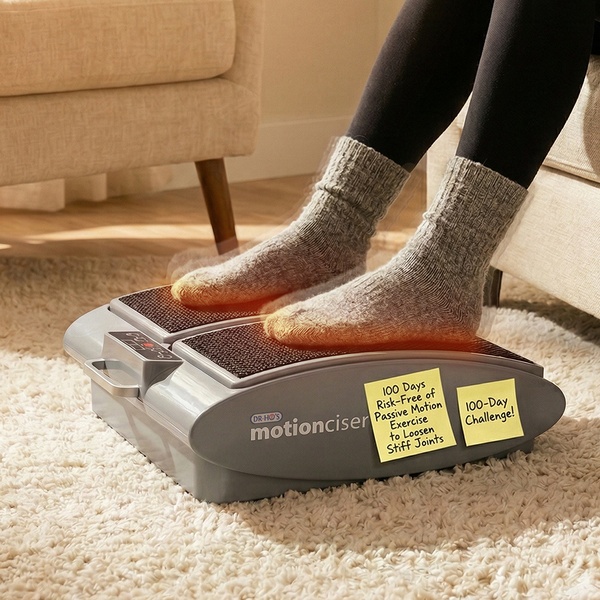
Feet in wool socks rest on a passive-motion foot device in a living room, and two yellow sticky notes on its side carry the message: a 100-day risk-free trial and a "100-Day Challenge!" The device sits close to massage rather than inside it, but the format carries over.
Borrow: putting trial terms on a physical note instead of a digital banner, so the guarantee reads like advice from a person. Any benefit wording on it, such as loosening stiff joints, needs the same substantiation as in any health-adjacent ad.
Massage Advertising Ideas to Borrow From These Examples
- Seasonal offer on a treatment photo - one discount, one occasion, one image (Example 1).
- A headline about the experience - name the ritual or the feeling, then put the booking details on the image (Example 2).
- Outcome callouts - three or four short lines pointing at the body (Example 3).
- The product in use plus a deadline - show the body part and state the saving in dollars (Example 4).
- A real customer line - handwritten or quoted, with the product behind it (Example 6).
- Trial terms on the product itself - a note, a tag or a label with the guarantee (Example 7).
How Does Promer AI Turn a Massage Product or Service Page Into Ad Creatives?
Knowing which of these styles fits your business still leaves the headline, the photo and the CTA to produce. Promer AI, an AI ad generator, handles that, and each feature below works on its own, so you can start wherever you are.
Promer AI's AI Ad Prompt is the direct route. Describe the scene and the message - a client at rest under warm light with "A ritual of relaxation" in a frosted frame - and Promer AI generates the creative straight away, with no other feature in between. A product image and a reference ad are optional but make the result closer to what you sell.
If you want to work out the angle first, Promer AI's AI Ad Concept reads your product page and returns product highlights, ideal customer, pain point and need, then builds concepts from them. Those last two fields map onto the problem-first structure many of the examples above use.
Promer AI's AI Photoshoot turns photos you already have of a roller, a bottle or a treatment room into studio-quality images with guided style and composition picks.
Promer AI's AI Ad Clone rebuilds a reference from the library around your product - the benefit callouts, the sale tape, the symptom grid - and suggests the headline, body and CTA, each editable. Outputs come in ratios such as 1:1 and 4:5.
Review everything before it publishes. AI-generated creatives can have mistakes, and with devices the common one is a product shape or control panel that does not match what ships. In the US, health and pain-relief claims need substantiation, ad platforms restrict copy that asserts or implies a viewer's health condition, and massage therapy is licensed in many states, so avoid wording that reads as medical treatment.