Static ads are single-frame image creatives - fast to produce, low cost, and built for audiences who already know what they are looking at. Meanwhile, animated ads use motion to stop the scroll, tell a story, and build recall in audiences that have never seen the product before. Neither format wins outright. Performance depends on the product, the audience, and the funnel stage.
This guide breaks down how each format performs, where each one fits, and how to run both without doubling your production workload.
Key Takeaways
- Static ads load faster, cost less to produce, and convert well at the bottom of the funnel where the viewer already knows the product.
- Animated ads generate up to 41% higher engagement than static and perform better at the top of funnel where stopping the scroll is the primary job.
- The format decision should follow the funnel stage - not the budget or the team's production preference.
- The biggest risk with animated ads is creative fatigue: motion that repeats too long stops being noticed and starts being skipped.
- The fastest path to both formats is animating a winning static creative rather than producing animated ads from scratch.
What Are Static Ads?
Static ads are single-frame image creatives - one fixed visual, one headline, one call to action, no movement. They are the baseline format for paid social and display advertising: fast to produce, accepted everywhere, and easy to iterate. For ecommerce, static ads typically include a product image, a benefit or offer statement, and a CTA.
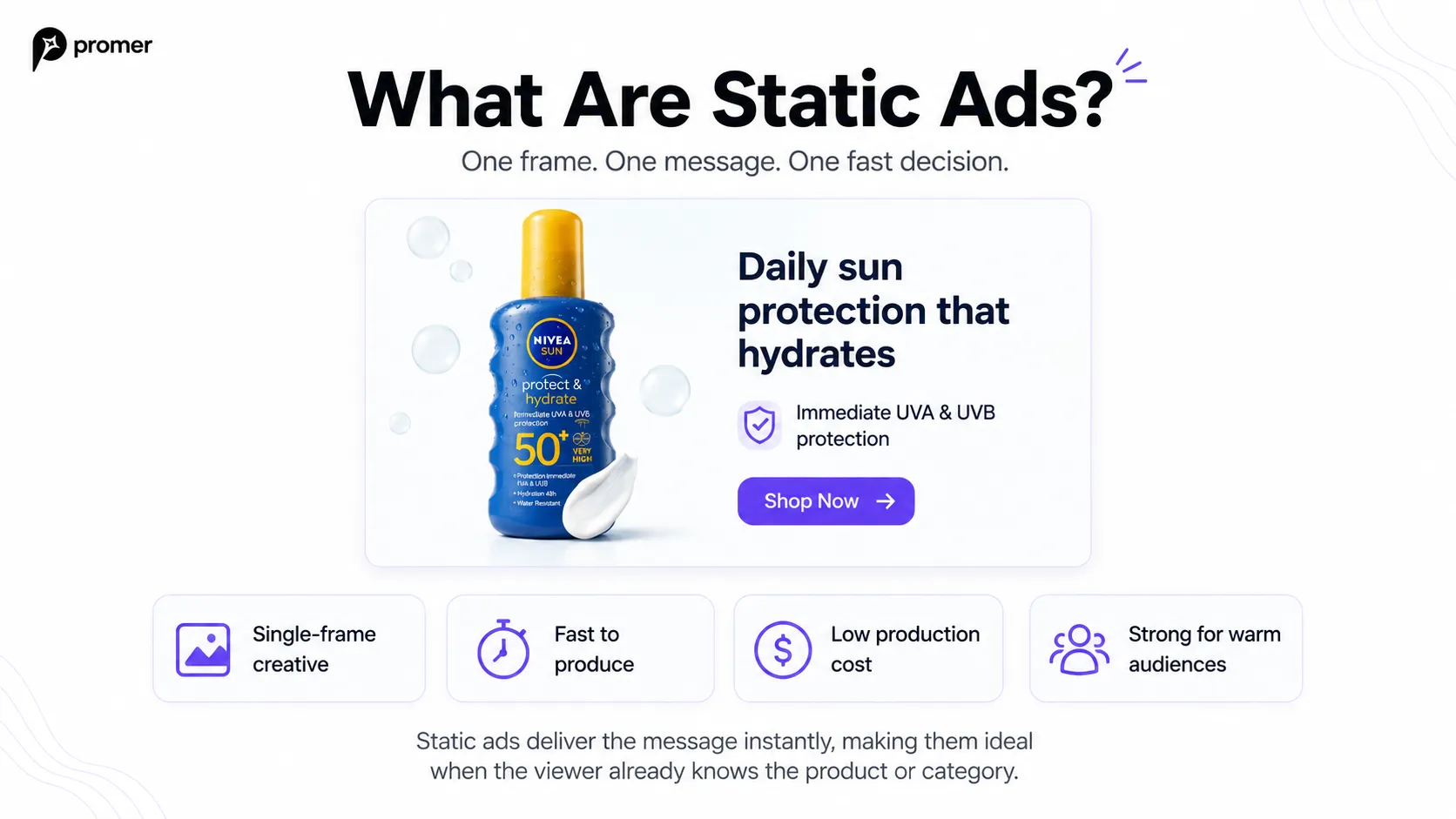
Static ads work because they demand almost no cognitive effort from the viewer. The message is delivered in under a second. For audiences who already know the brand or the product category, that speed is an advantage - the viewer does not need to be walked through anything, they just need the right offer at the right moment.
The limitation is attention. In a feed where video and motion content are the norm, static images face banner blindness - viewers learn to filter out non-moving content without consciously deciding to. The format does not trigger the same instinctive response to movement that animated content does, which matters most in environments like TikTok and Reels where motion is the baseline expectation.
What Are Animated Ads?
Animated ads are creatives that use motion - GIF loops, short video clips, or frame-by-frame animation - to deliver the ad message across time rather than in a single frame.
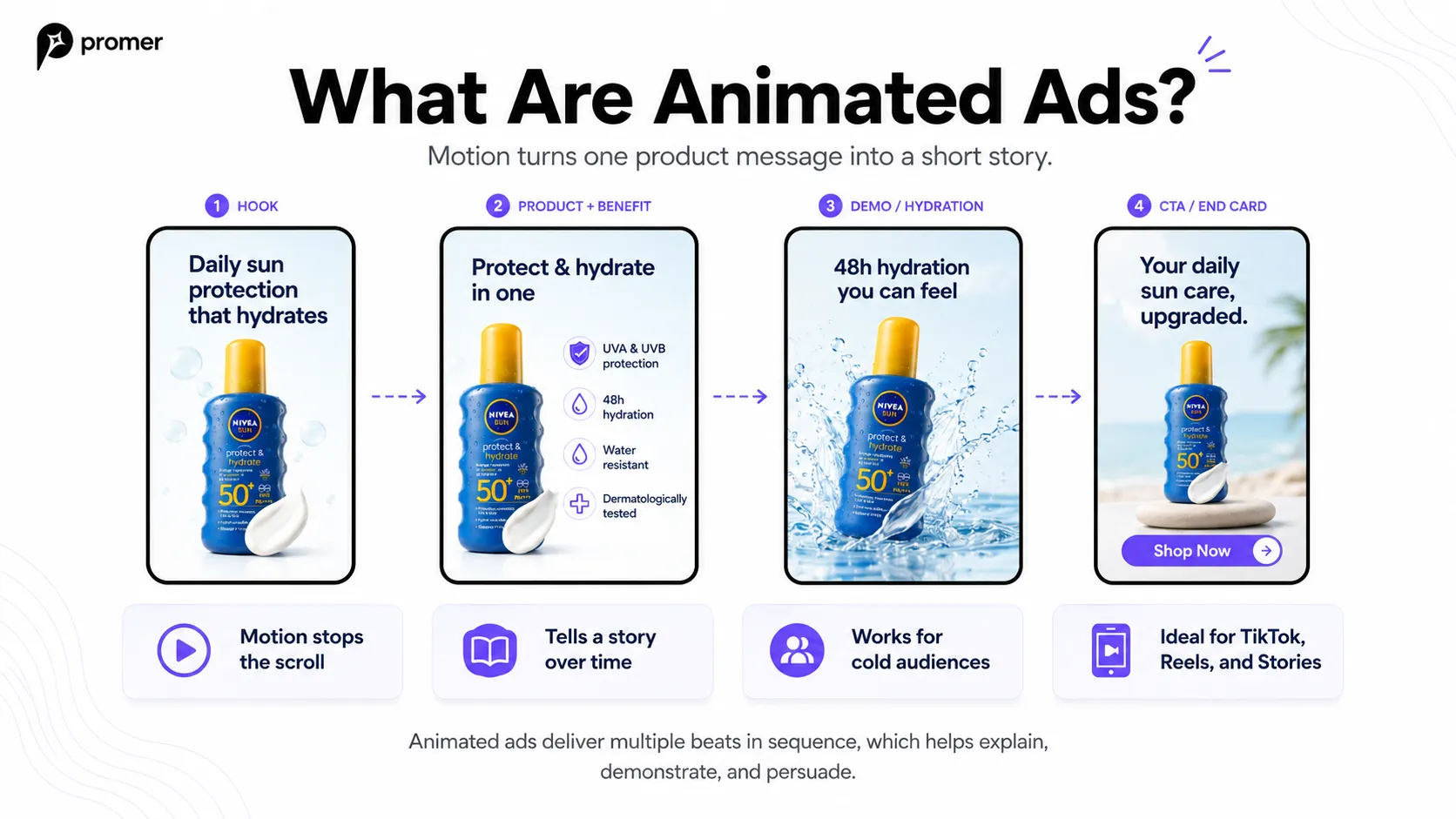
In ecommerce paid social, this most commonly means short-form video ads (15 to 30 seconds) or animated static creatives where the product image or text elements move.
The core advantage of animation is biological: human brains are wired to register motion faster than static objects. That instinct - originally a survival mechanism - is what makes animated ads harder to scroll past. Motion captures attention before the viewer has made a conscious decision to engage with the content.
Animated ads also allow more information to be delivered in the same space. A static ad communicates one message. An 8-second animated ad can show the product, name the problem it solves, demonstrate the transformation, and deliver the CTA - all while the viewer is still deciding whether to keep scrolling. That sequential storytelling capability is what drives the 41% higher engagement rate animated formats consistently show over static.
Static vs Animated Ads: Head-to-Head Comparison
Here is how the two formats compare across the dimensions that matter most for ecommerce advertisers:
When Static Ads Win?
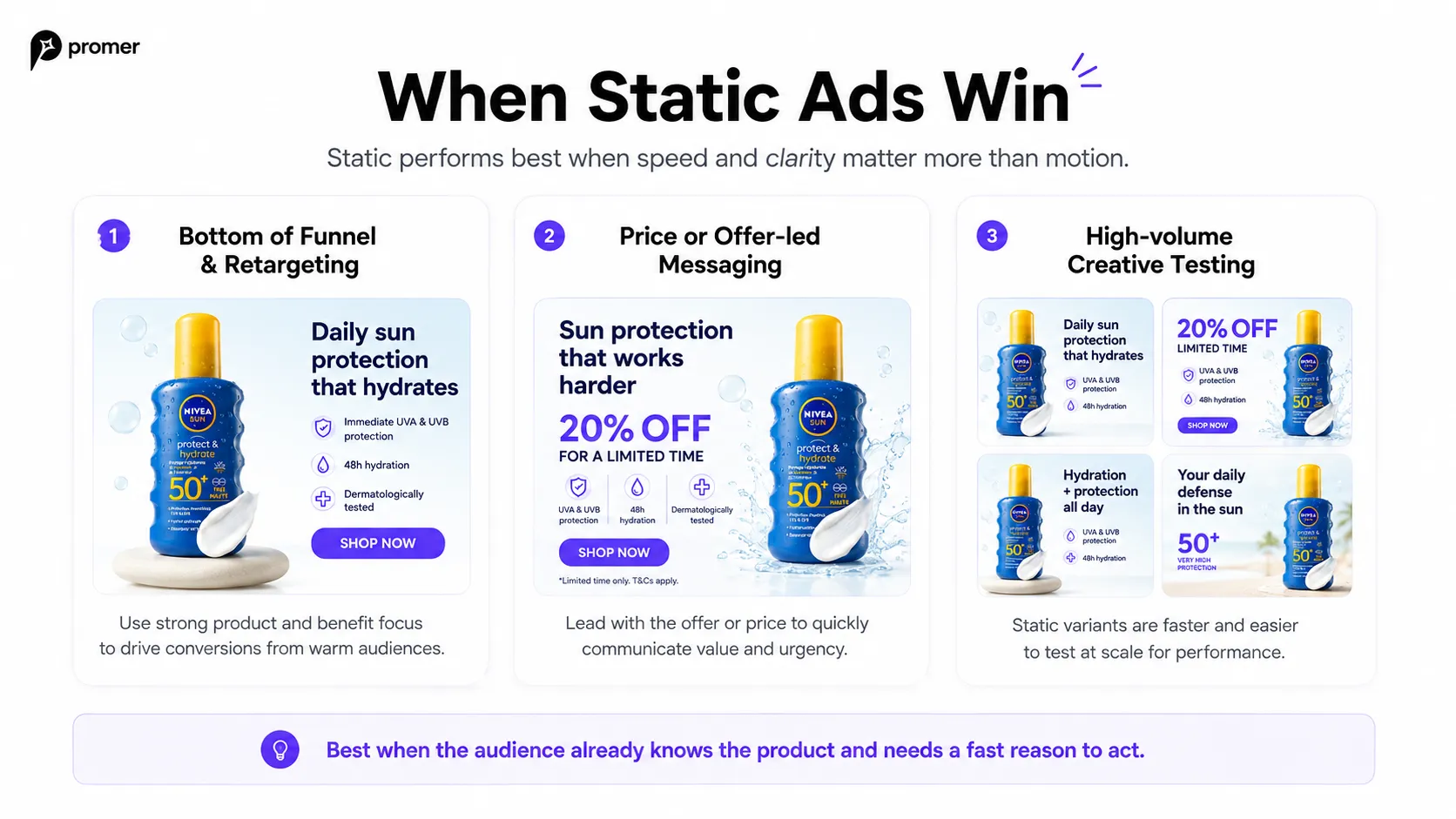
Static ads are not the weaker format - they are the right format in specific situations. Understanding when static outperforms animated is as important as knowing the general engagement advantage that motion holds.
Bottom of funnel and retargeting
When an audience already knows the product, the job of the ad changes. The viewer does not need to be convinced of relevance - they need a reason to act now. A clean static creative with a direct offer - a discount, a deadline, a specific benefit - delivers that message faster than an animated ad requires the viewer to watch through. Retargeting campaigns consistently see strong performance from static formats precisely because the awareness work has already been done.
Price or offer-led messaging
When the primary message is a number - a discount percentage, a sale price, a bundle deal - static communicates it instantly. Animation adds processing time without adding persuasion. For flash sales and promotional campaigns, static is the faster, cheaper, and often higher-converting choice.
High-volume creative testing
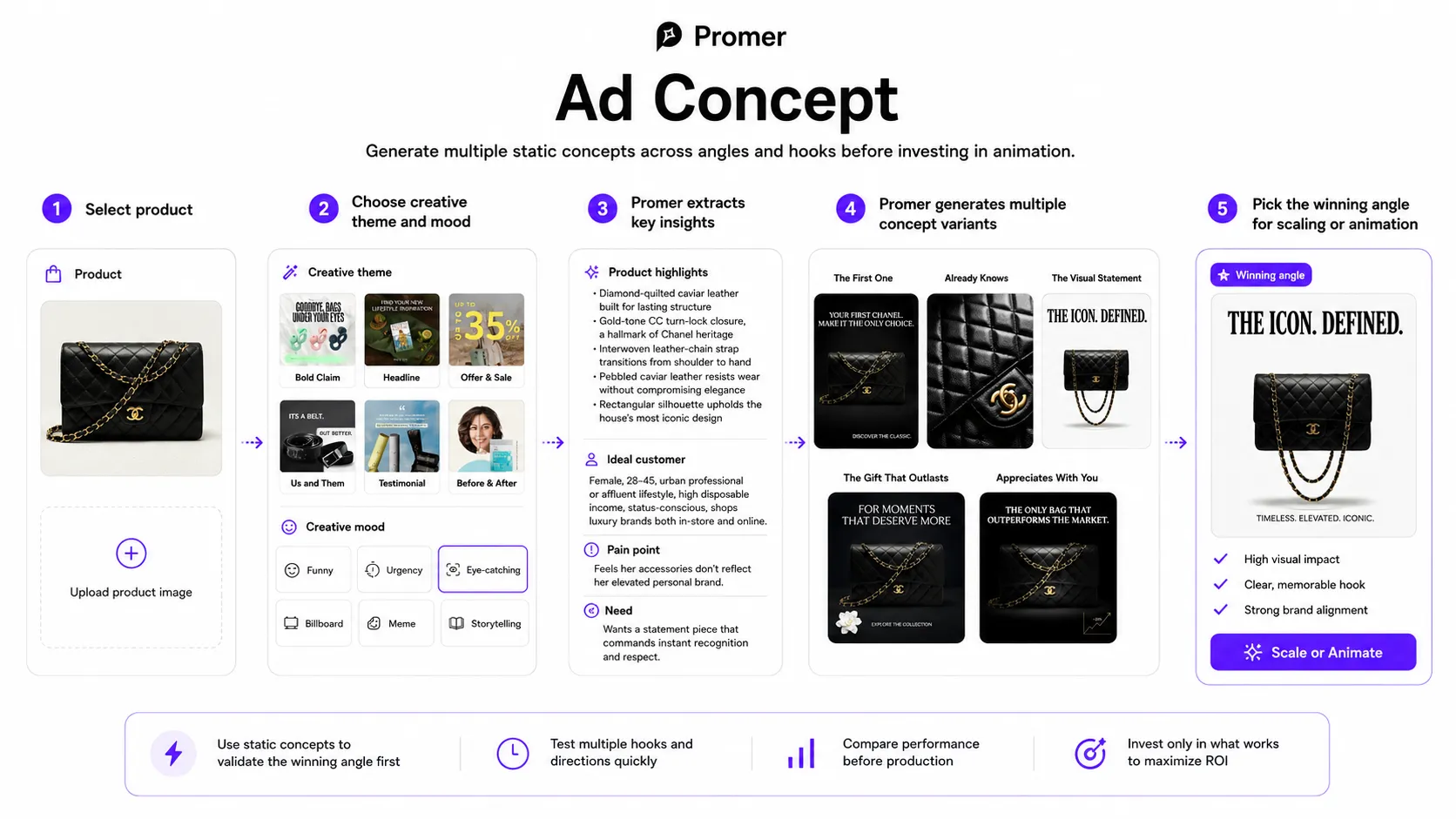
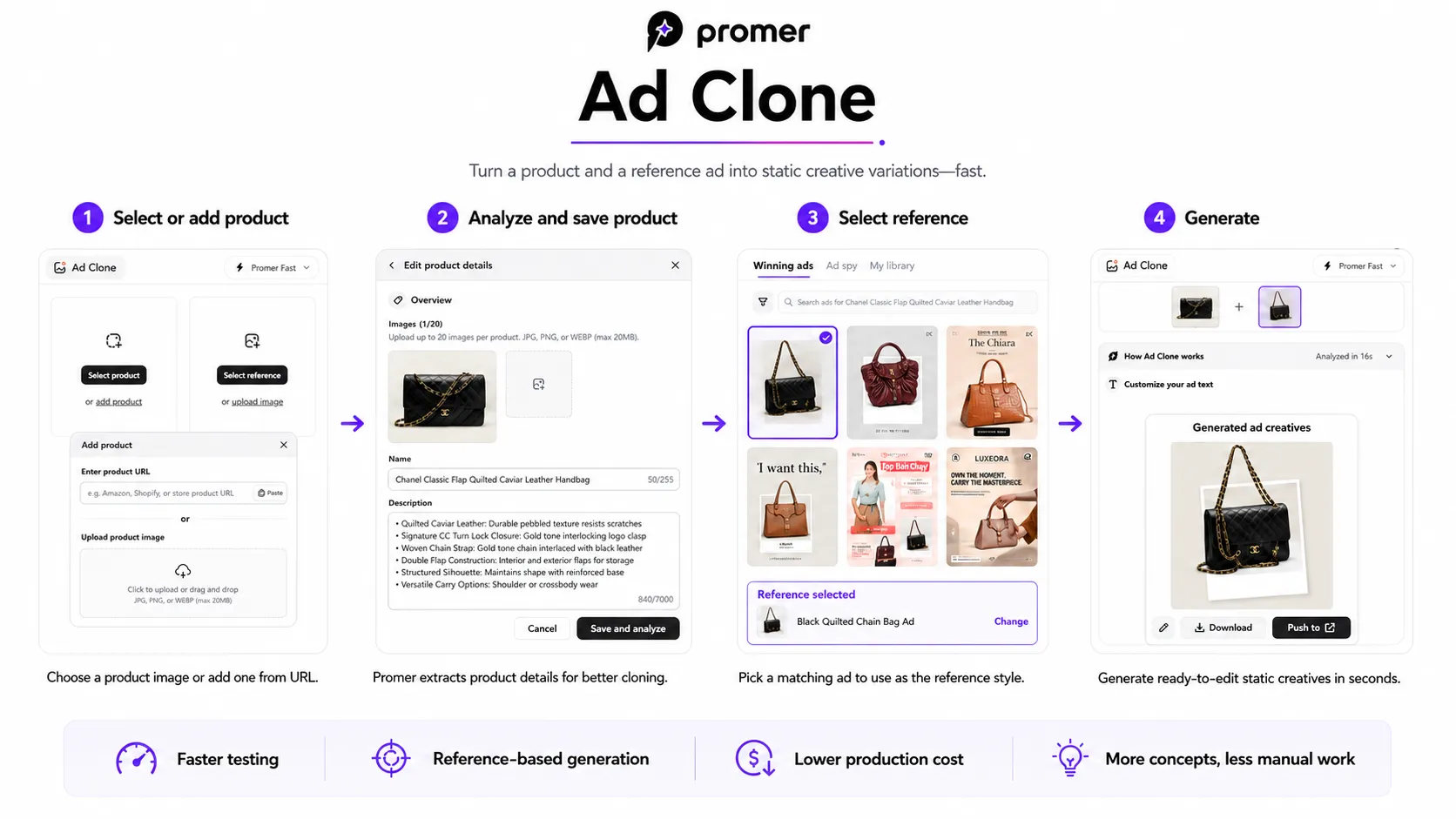
Testing 10 different angles across 5 audience segments requires 50 creative variants. Producing 50 animated ads is expensive and slow. Producing 50 static ads is fast and affordable. When the goal is identifying which angle the market responds to - before investing in production - static is the right format for the testing phase.
Tools like Promer's Ad Concept and Ad Clone make this faster: start from a product URL, generate multiple static concepts across different angles and hooks, and let performance data decide which one earns the animated treatment.
Display and programmatic placements
Google Display Network, programmatic environments, and email campaigns often impose file size limits that favor static. In these environments, a well-designed static creative with strong visual contrast performs reliably. Animation can help here too, but the production overhead rarely justifies the marginal lift for placements that already have lower intent signals.
When Animated Ads Win?
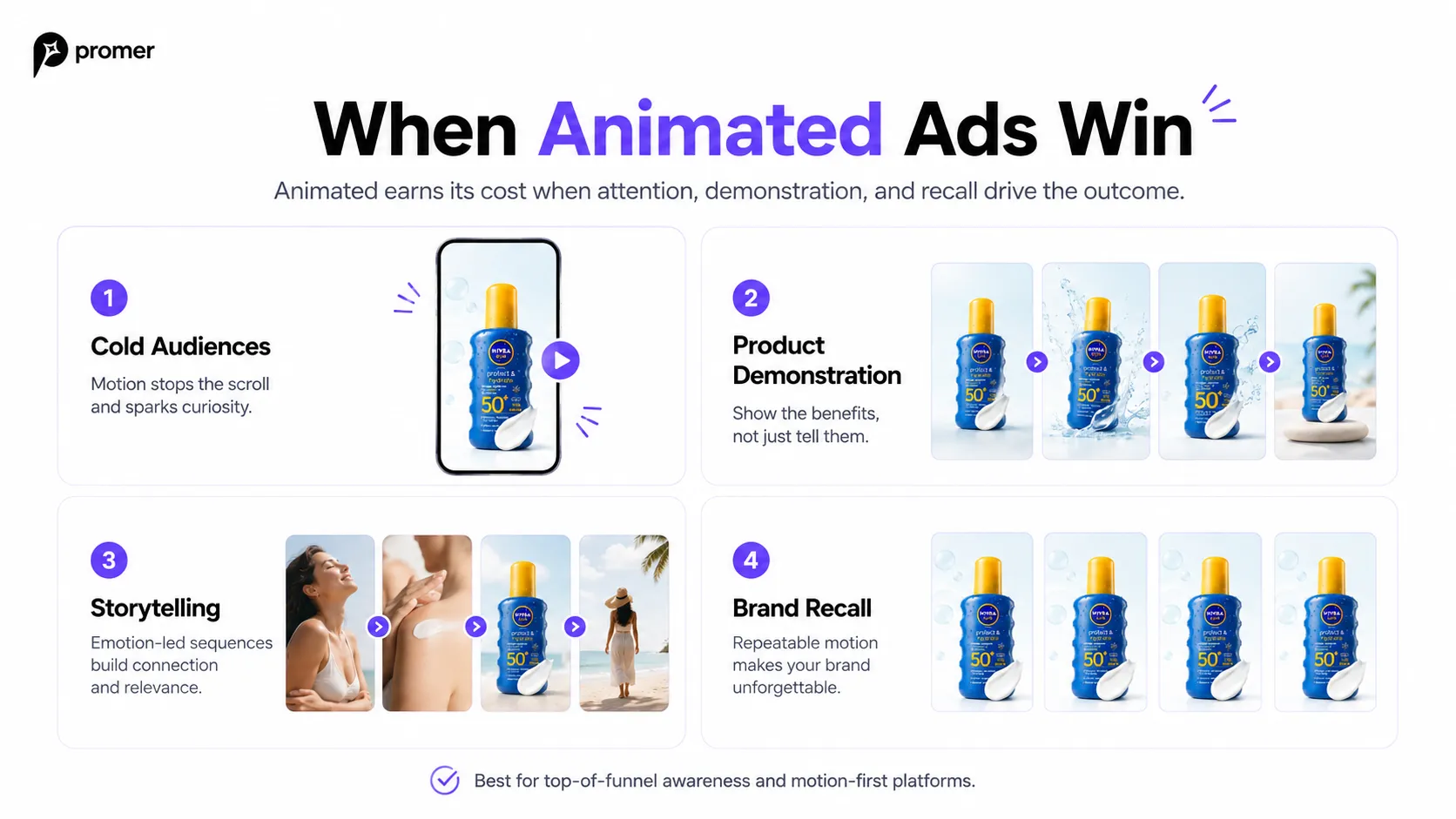
Animated ads earn their production cost in four situations - where the format's ability to stop the scroll, tell a story, or build recall directly drives the outcome the campaign needs.
Cold audiences at the top of funnel
When the viewer has no existing relationship with the brand or product, the first job is to stop the scroll. Motion does that better than static in almost every platform environment where video content is the native format. TikTok, Instagram Reels, and Meta feed are motion-first environments - a static image competes against video content for the same attention budget. For top-of-funnel cold traffic, animated ads consistently deliver higher CTR and lower CPM because the format fits the context.
Products that need demonstration
Some products are hard to understand from a single image. A skincare product that shows a before and after transformation. A kitchen tool that demonstrates the problem it solves. A supplement with a complex mechanism of action. When the product requires context to be convincing, animation earns its production cost by doing the persuasion work that a static image cannot.
Storytelling and emotional products
Products where the emotional connection matters as much as the rational case - apparel, lifestyle brands, gifts, home goods - perform better in animated formats. Animation can pace a story, build feeling, and land a message with timing that static cannot replicate. Consumers are 155% more likely to recall a brand after seeing an animated display ad compared to a static one in the same placement.
Awareness and brand-building campaigns
When the goal is recall and brand familiarity rather than immediate conversion, animated formats consistently outperform static. Wyzowl's research found that 93% of video marketers say video has directly increased brand awareness. That recall compounds at the moment of purchase decision - a brand already in memory wins consideration over one that is not.
The Creative Fatigue Problem and Why It Hits Animated Harder
Creative fatigue is when an audience has seen an ad so many times that they stop responding to it. Every format experiences fatigue - but animated ads hit it faster.
The reason is the same psychology that makes animation effective in the first place. Motion triggers attention automatically. But once the brain has processed that motion pattern, it learns to filter it. A looping animated ad that a viewer has seen 15 times does not get scroll-stopped the same way it did on the first impression. It gets actively skipped - and the CPM cost keeps running.
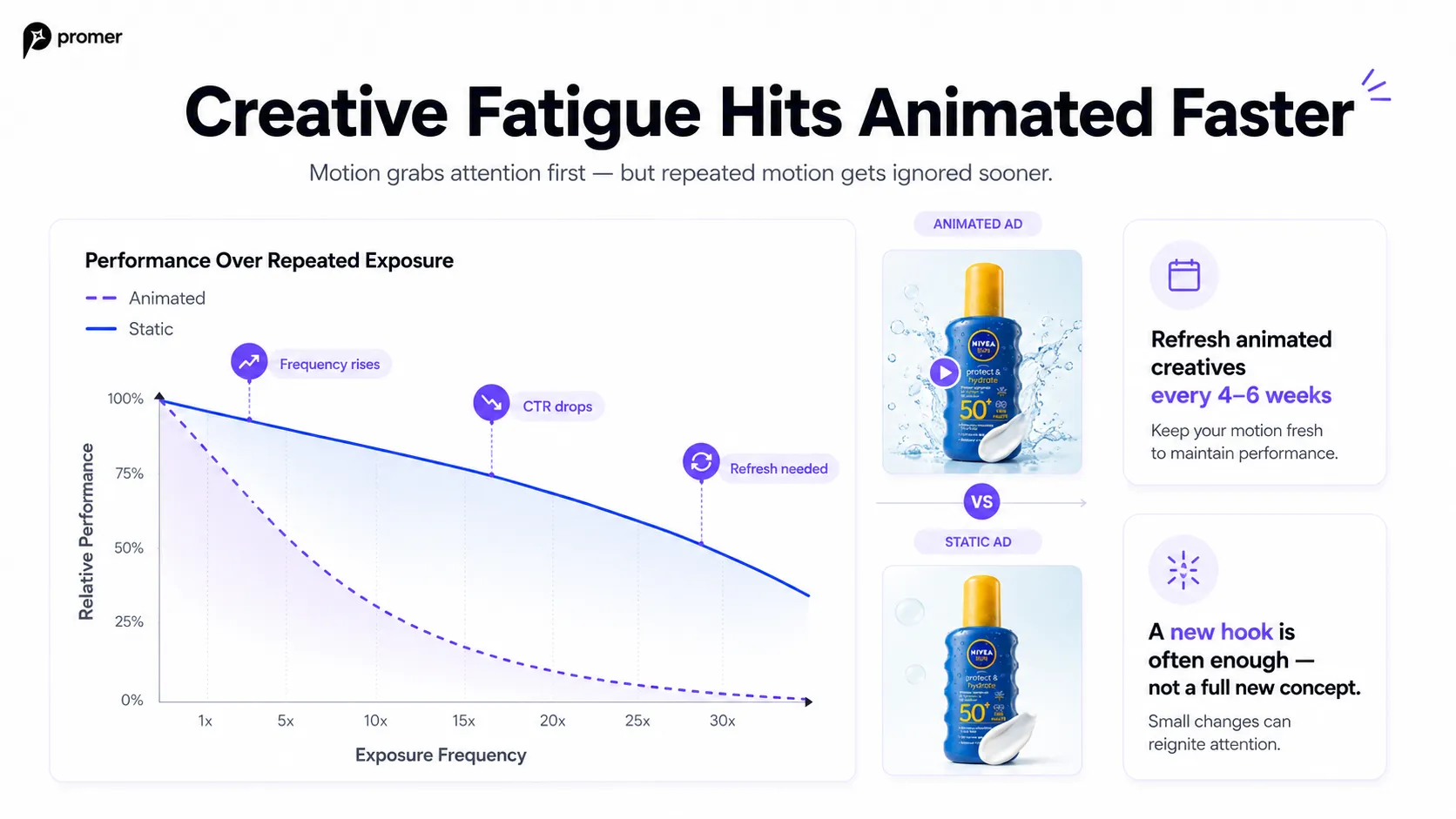
Static ads fade out more quietly. A viewer who has seen a static creative many times may not click, but they are less likely to develop negative associations with the repeated exposure. The fatigue is passive rather than active.
The practical implication: animated ads need a creative refresh system built in from the start. Ecommerce teams that invest in animated production without planning for refresh cycles end up spending more to sustain the same performance than they would have with a static-first approach that rotates variants regularly.
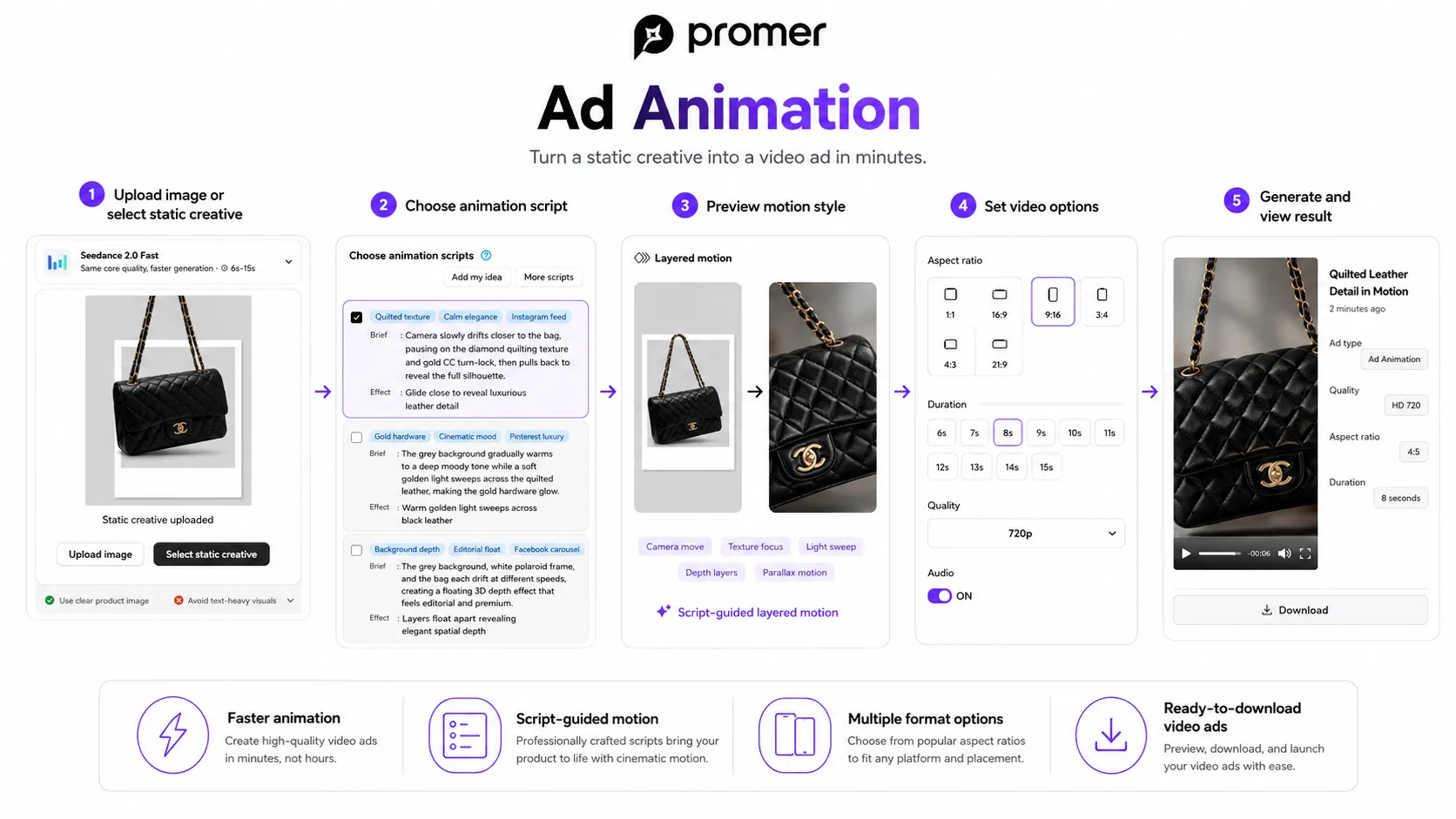
One of the fastest ways to extend the life of a winning animated concept is to animate from a static creative that has already proven its angle. Promer's AI Ad Animation feature takes a static creative from your library and turns it into an 8-second video ad using motion frameworks - so the proven concept gets a new format without rebuilding the creative strategy from scratch.
For the exact steps, see how to create animated ads from a static creative.
How to Run Both Formats Without Doubling Production Work
The most common objection to running both static and animated is production cost. Teams either pick one format and commit to it, or they stretch resources across both without a system - and end up with too little of each to test properly.
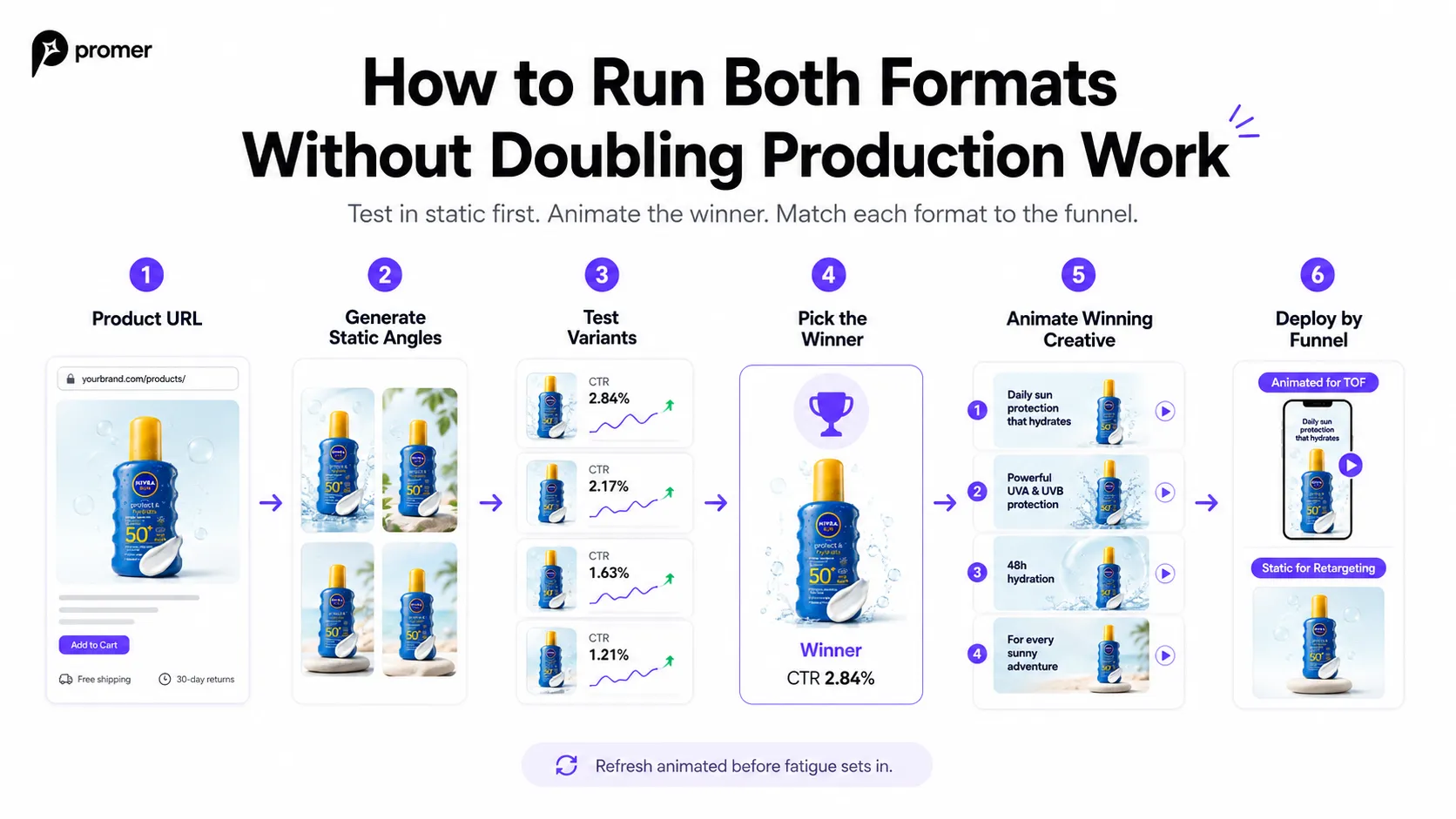
The right approach is a format hierarchy built around the funnel:
- Start with static for angle testing. Before committing to animated production, use static variants to identify which angle - which hook, which pain point, which benefit emphasis - the market responds to. Static is fast and cheap enough to run 5 to 10 angle tests without meaningful budget risk.
- Animate the winning angle. Once a static creative has demonstrated performance signal, animate it. The concept is already validated - the animation adds scroll-stop power without the risk of investing production budget in an unproven idea.
- Use static for retargeting while animated runs top of funnel. Run animated formats against cold audiences where scroll-stop is the primary need. Run static formats against warm and retargeting audiences where the message needs to be fast and direct.
- Refresh animated before fatigue sets in. Plan for creative refresh at 4 to 6 weeks for animated ads in active campaigns. The easiest refresh is a new hook on the same validated angle - not a full new concept.
Promer supports this workflow end to end. Start with Ad Concept or Ad Clone to build and test static angles. When an angle performs, use Ad Animation to turn that static creative into an 8-second video ad - 9:16 for TikTok and Reels, 16:9 for YouTube. The winning angle stays consistent. The format changes to match the audience and the funnel stage.
Platform-by-Platform Format Guide
Format fit is not universal - the right choice depends on where the ad runs:
- TikTok - animated and video only. Static images do not appear in the TikTok feed. Short-form video (15 to 30 seconds) is the native format. Creator-style animated content performs best.
- Instagram Reels and Stories - animated strongly preferred. The format is motion-first. Static can appear in Stories but competes poorly against video content. 9:16 ratio required. Promer's AI Instagram ad maker generates animated 9:16 creatives directly in this ratio, skipping manual resizing.
- Meta Feed (Facebook and Instagram) - both formats work. Static performs well for retargeting. Animated and video outperform for cold audiences. 1:1 and 4:5 ratios dominate.
- Google Display - static is the reliable baseline. Animated GIF and HTML5 can lift engagement in display placements but file size limits apply. Static is easier to scale across the full display network.
- YouTube - video only for in-stream. Static can appear in companion banners. 16:9 ratio for main units.
Frequently Asked Questions
Do animated ads always outperform static ads?
No - animated ads show higher engagement on average, but static ads regularly outperform animated in retargeting and bottom-of-funnel campaigns.
The performance difference depends on funnel stage, platform, audience familiarity, and creative quality. A poorly executed animated ad will underperform a well-executed static creative in almost every context. Format is a factor in performance, not the determining one.
How long should an animated ecommerce ad be?
Most high-performing ecommerce animated ads run 8 to 30 seconds, with 15 seconds being the most common sweet spot for cold audiences on Meta and TikTok.
Shorter is not always better - the ad needs to be long enough to deliver the hook, the benefit, and the CTA. But every second past 30 seconds loses a significant percentage of the remaining audience. If the message cannot fit in 30 seconds, the concept is too complex for a paid social format.
Can I turn a static ad into an animated ad without rebuilding the concept?
Yes - and this is often the most efficient path to animated creative. If a static ad has already demonstrated performance, animating it preserves the proven concept while adding motion.
Tools like Promer's Ad Animation feature take an existing static creative and apply motion frameworks to produce an 8-second video ad. This approach validates the angle before investing in full video production.
How do you know when an animated ad is hitting creative fatigue?
The signal is a rising frequency alongside falling CTR - the audience has seen the ad enough times to filter it, even when they are technically being reached.
Watch for CPM increasing while CTR drops. A healthy animated creative should maintain CTR stability as frequency rises. When CTR starts falling at moderate frequency levels (3 to 5 impressions per user per week), the creative needs a refresh - not necessarily a new concept, just a new hook or new visual treatment on the same angle.
Should ecommerce brands use static or animated ads for product launches?
Both - in sequence. Launch with animated to maximize awareness reach and scroll-stop in cold audiences. Once the audience is warm, shift to static for direct response and conversion messaging.
If budget is limited, start with static to validate the angle, then animate the winner for the awareness push. Trying to animate before knowing which concept works risks expensive production on an unproven idea.
Conclusion
Static vs animated ads is not a competition - it is a system. Static ads are faster, cheaper to produce, and built for audiences who already know what they are looking at. Animated ads stop the scroll, tell a story, and build recall in audiences that have never seen the product before. The teams that consistently outperform on creative are the ones running both formats with a clear logic for where each one belongs in the funnel.
The most efficient path: test angles in static, animate the winners, refresh before fatigue sets in. Promer makes that workflow faster - from product URL to static ad concept, to animated video creative, without rebuilding the brief or the angle each time. Start with the right concept. Put it in the right format. Run it at the right funnel stage. That is what creative performance looks like in practice.