How to Create Effective UGC Ads for Ecommerce With 7 Steps?
Category
Blogs
Date
Authored by
Promer Team
Summary
How to create effective UGC ads: define the concept, build the brief, pick the right theme and hook, and use product context to scale winning variations.
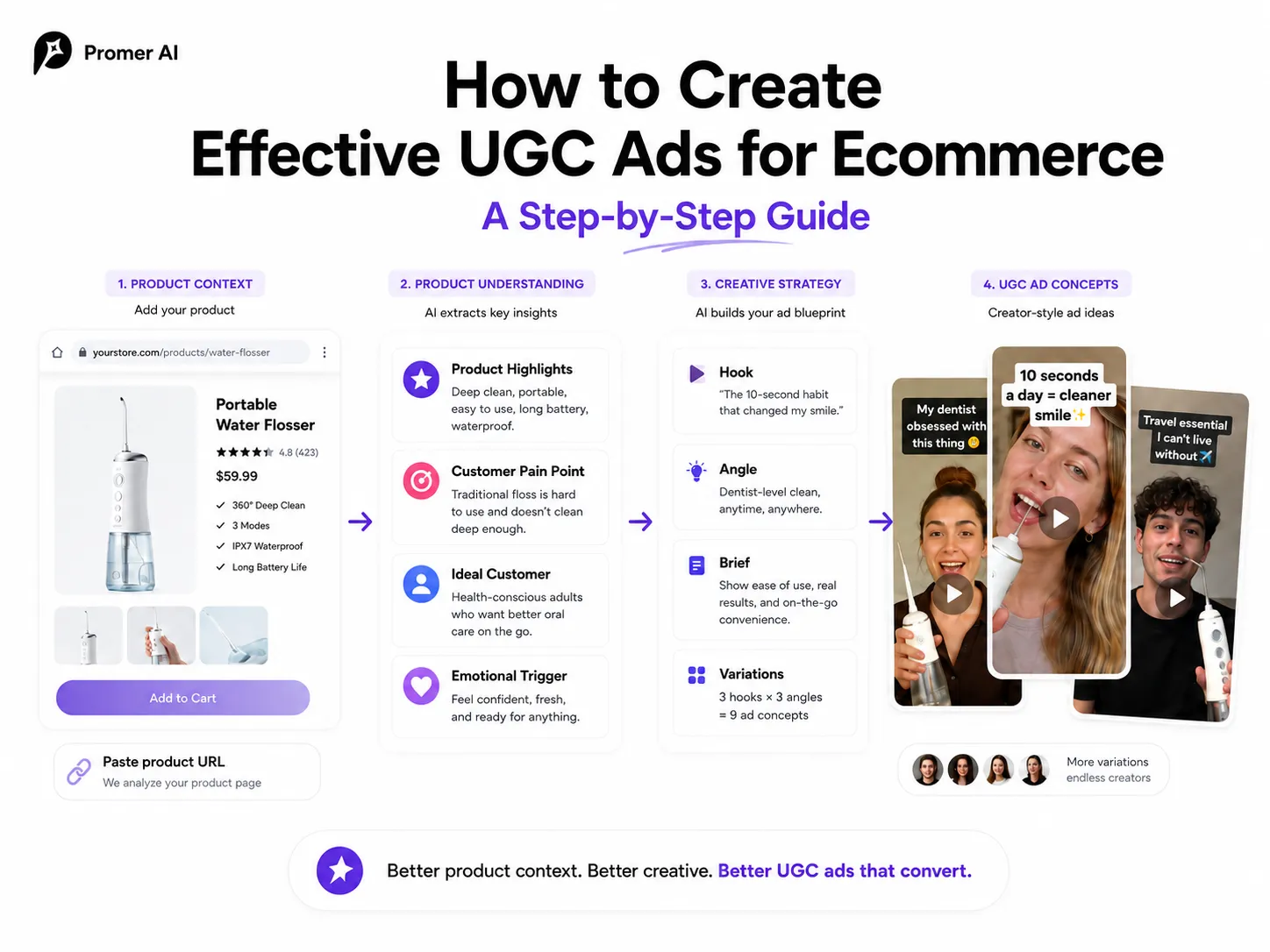
Creating effective UGC ads means starting from product context - not just finding a creator and hoping for the best. Most ecommerce teams treat UGC as a sourcing problem: find the right person, send them the product, wait for the clip. The brands that actually win with UGC treat it as a creative strategy problem: what angle, what hook, what emotional trigger makes this product feel real to the right customer.
This guide walks through the full process - from defining the concept to building variations that scale.
Key Takeaways
Effective UGC ads start with a concept and brief, not a creator search - the angle determines whether the content converts.
The hook is the most important element: the first 2–3 seconds decide whether the viewer keeps watching or scrolls past.
Product context - highlights, pain points, ideal customer - is the raw material for every strong UGC angle.
UGC ads work across all funnel stages, but the messaging structure should change: awareness hooks differ from retargeting hooks.
Scaling UGC means testing multiple angles systematically, not producing more of the same concept.
What Makes a UGC Ad Effective?
A UGC ad is effective when it feels native to the platform, builds trust fast, and moves the viewer toward a decision. The format that performs best is creator-style content: short, direct, and built around a single problem-solution or transformation story. It does not need to be perfect. It needs to be believable.
The reason UGC outperforms polished brand creative is not aesthetics - it is psychology. Audiences trust creators more than brands because creators look like peers, not sellers. That peer credibility triggers social proof and reduces purchase anxiety. UGC ads get 4x higher click-through rates and 50% lower cost-per-click than standard ads, and 92% of consumers trust peer recommendations over branded content.
But most ecommerce teams underutilize this format because they skip the strategy layer. They source content that looks authentic but does not carry a strong enough concept - so it blends into the feed without stopping anyone. Effective UGC ads require a brief, a defined angle, and the right product context before a single frame is shot.
Step 1 - Extract Product Context Before Writing Any Brief
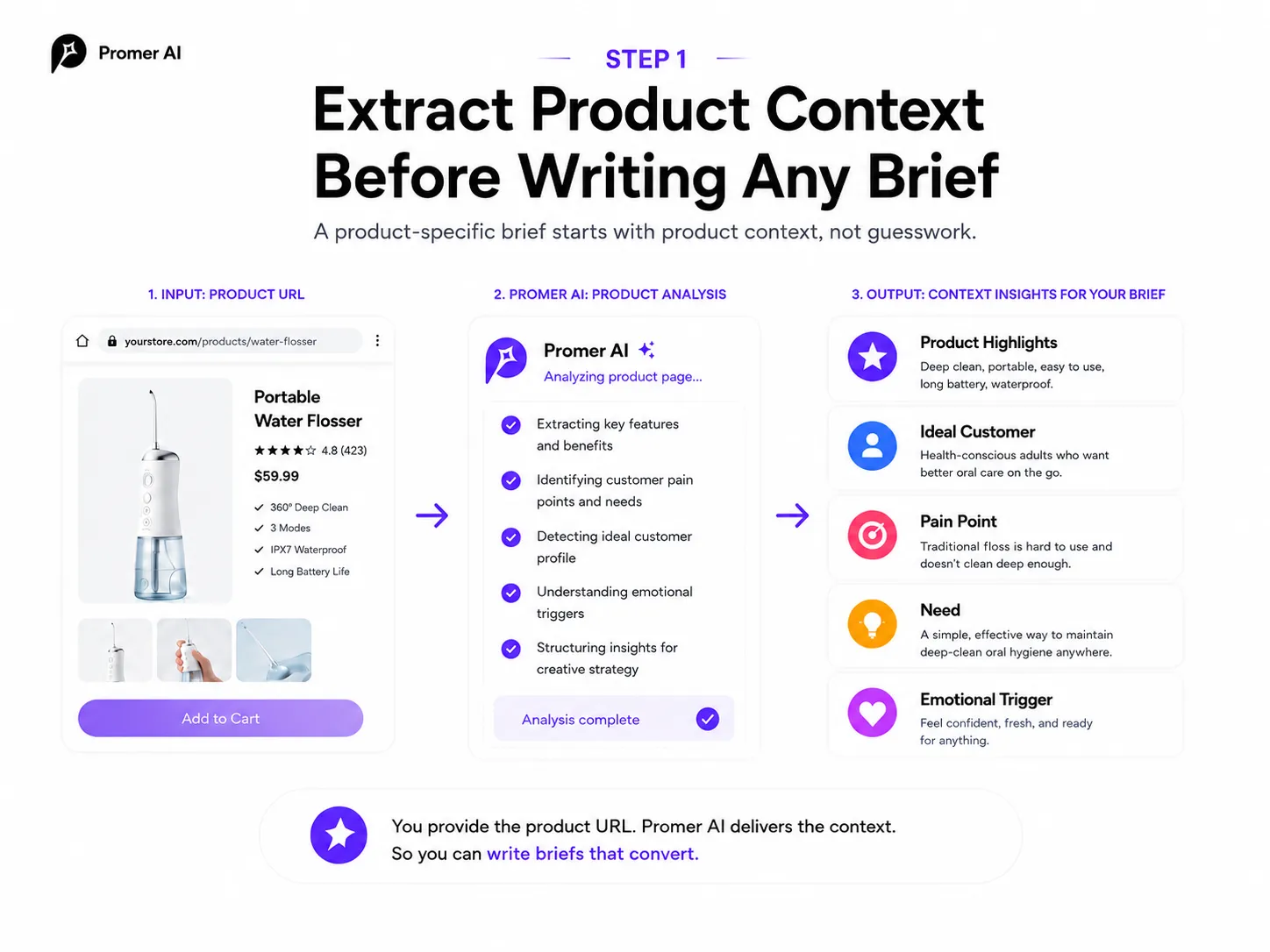
The biggest mistake in UGC production is writing a brief without grounding it in the product first. A generic brief produces generic content. A product-specific brief - one that names the real pain point, the ideal customer, and the core benefit - produces content that converts.
Before briefing any creator, extract these five elements from your product:
Product highlights - the specific features or qualities that set this product apart from alternatives the customer is already considering.
Ideal customer - a real, specific person: age range, lifestyle, the specific moment they feel the problem your product solves.
Pain point - what the customer is frustrated about before they discover this product. The more specific, the more the ad resonates.
Need - what the customer is actually trying to achieve. Not "a better moisturizer" but "skin that doesn't break out two days after a night out."
Emotional trigger - the feeling that drives the purchase: confidence, relief, control, status, belonging.
Tools like Promer AI automate this extraction step. Paste a product URL and Promer pulls product highlights, surfaces the ideal customer profile, identifies the pain point, and maps the need - all before you generate a single creative. This is what separates a data-driven UGC brief from one built on guesswork.
Step 2 - Choose the Right Creative Angle
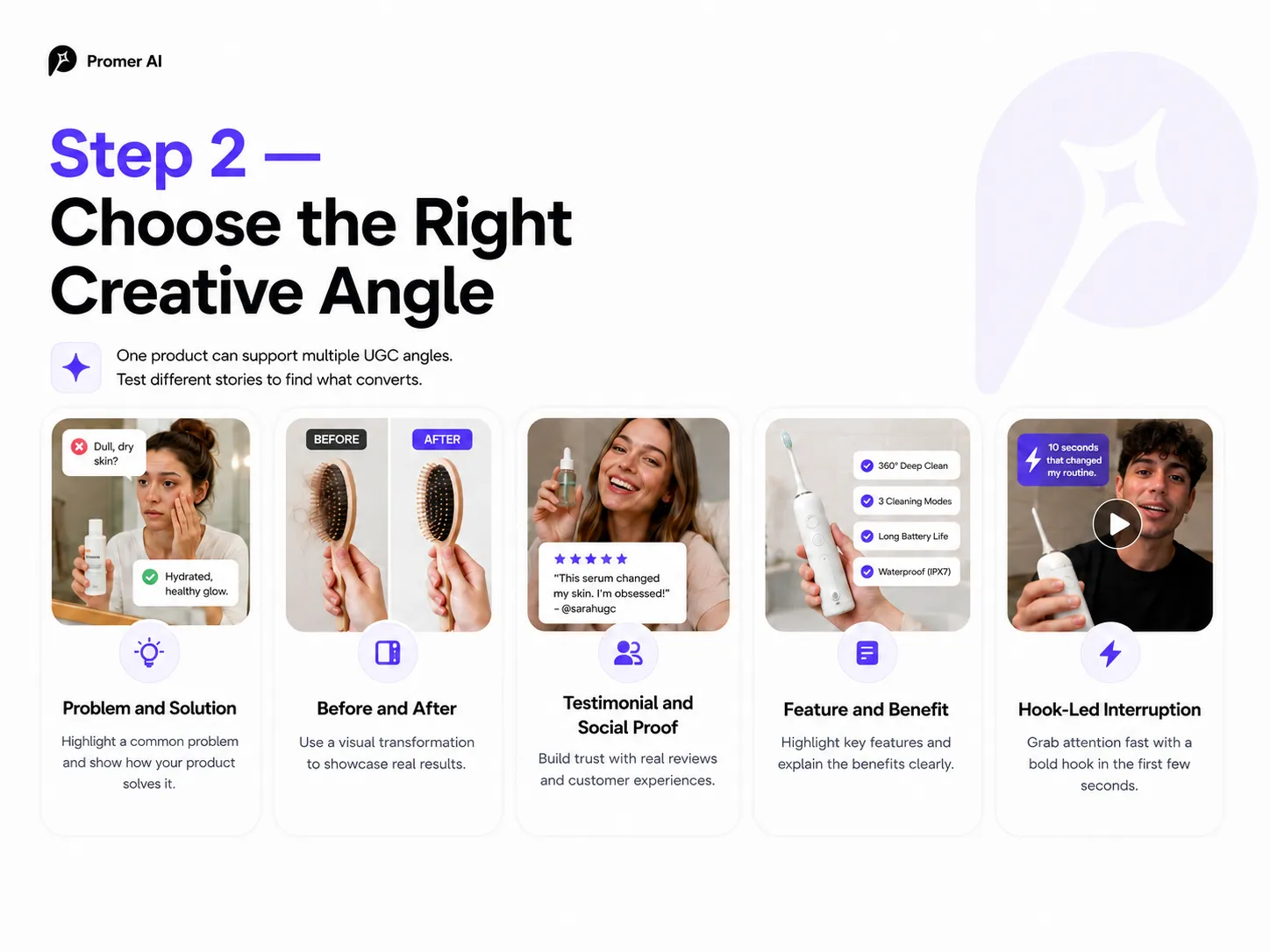
The creative angle is the lens through which the UGC ad tells the product story. One product can support multiple angles, and testing angles is where most of the performance lift comes from.
These are the core UGC angle types and when each one works:
Problem and Solution
The creator opens by naming a specific frustration - ideally one the target customer has already felt - and then shows how the product solved it. This angle works best for products that replace something that was not working: a skincare product that fixes a recurring issue, a supplement that addresses a gap, a gadget that removes friction from a daily task. It maps directly to the awareness and consideration stages of the funnel.
Before and After
The ad shows a visible or felt transformation. Before states and after states both need to be specific - vague transformation claims ("I feel so much better") perform poorly. The more concrete the contrast ("I was reordering every three weeks because nothing lasted, and now I've been using this for two months without a restock"), the higher the trust signal.
Testimonial and Social Proof
First-person delivery, direct to camera, structured around a single recommendation. Testimonial ads follow a problem-to-solution narrative that feels personal rather than promotional. These formats convert well because they mirror how customers talk about products in social media posts and comment sections. The key is specificity: name the exact reason for the recommendation, not a general positive experience.
Feature and Benefit
The creator walks through what the product does and connects each feature directly to a real customer outcome. This angle works best at the consideration and conversion stages, where the viewer already knows the category but has not committed to this product specifically.
Hook-Led Interruption
Opens with a scroll-stopping statement designed to create curiosity or tension - "I almost returned this" or "Nobody told me this about [product category]." Use this angle when the product is in a crowded category where awareness is high but differentiation is low.
Step 3 - Write a Brief That Produces Usable Creative
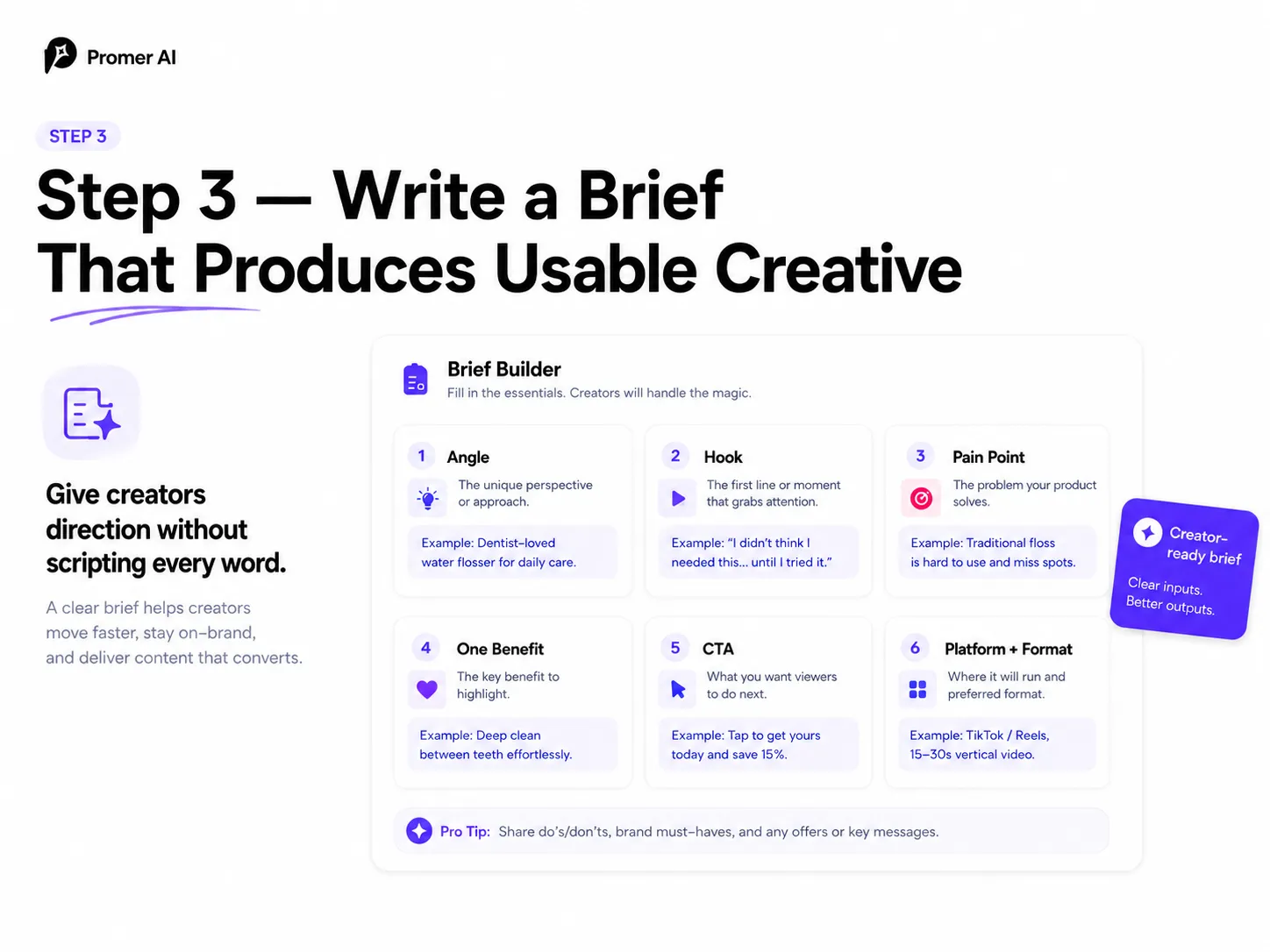
A UGC brief has one job: give the creator enough context to produce the right content without scripting every word. Over-scripted UGC loses authenticity. Under-briefed UGC misses the angle entirely.
A strong UGC brief covers these six elements:
The angle - which of the angle types above, and the specific product story being told.
The hook - the exact opening line or premise, written out. This is the one part of a brief that should be explicit. A vague hook instruction produces a weak opening.
The pain point to mention - taken directly from the product context extraction in Step 1. The creator should name the problem in their own words, but the brief tells them which problem.
The one product benefit to emphasize - not three benefits. One. The ad has 15–30 seconds of attention. Use it on the strongest signal, not a feature list.
The CTA - where the viewer should go and what action to take. Keep it simple: "link in bio," "tap to learn more," "use code [X]."
The platform and format - 9:16 for TikTok and Reels, 1:1 or 4:5 for Meta feed. The creator needs to know the final destination before filming.
Step 4 - Build the Hook First
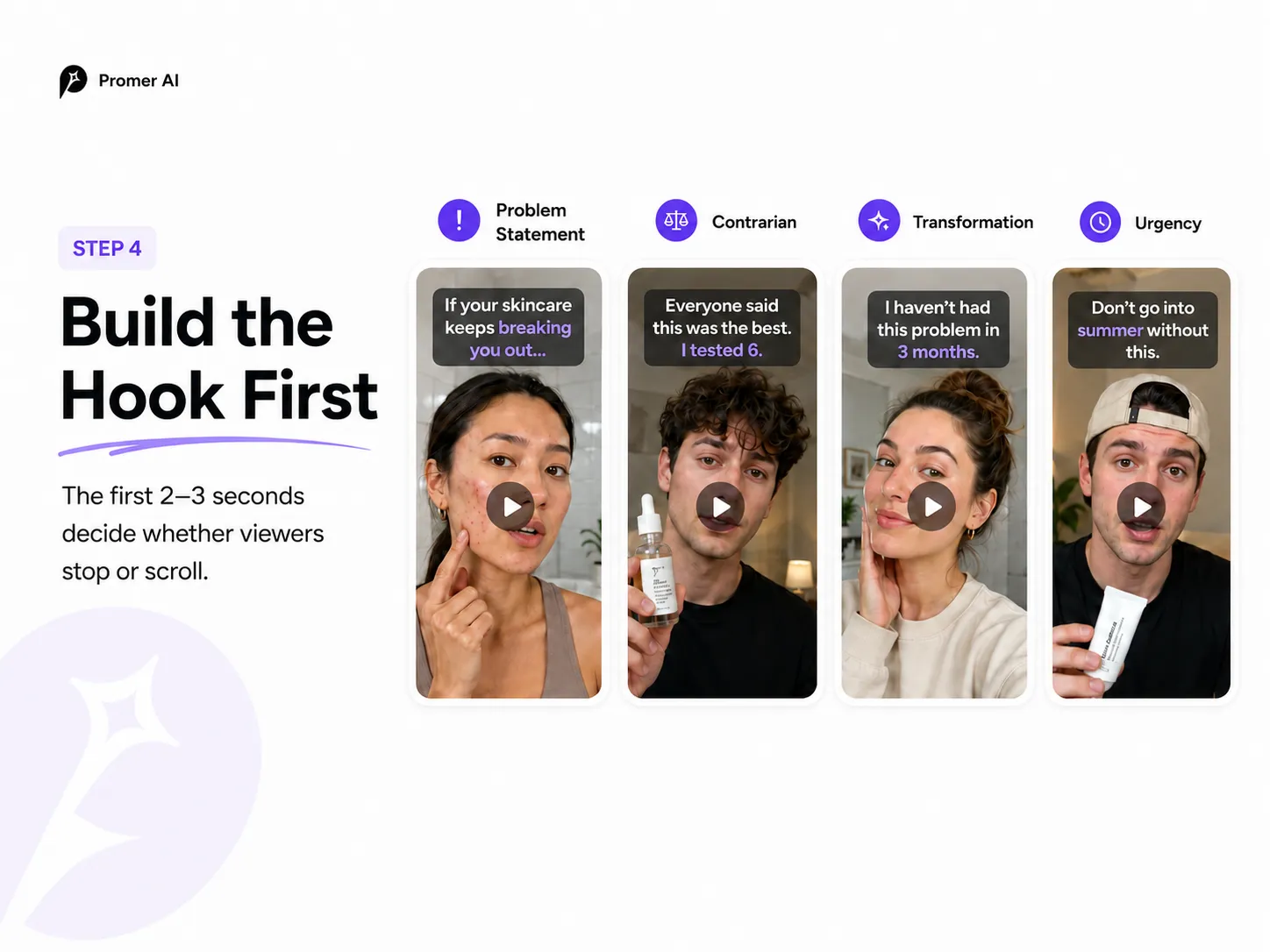
The hook is the single most important element of a UGC ad. Platform-specific optimization matters. A UGC ad that crushes on TikTok will flop on Facebook if you don't adjust the aspect ratio, pacing, and visual style. But across every platform, the first 2–3 seconds determine whether anyone watches the rest. A strong concept with a weak hook will underperform a mediocre concept with a strong hook - every time.
Hook structures that consistently perform in ecommerce UGC:
The problem statement hook - Opens by naming the pain: "If your [product category] keeps doing [problem], it's not you." Stops the right viewer immediately because it names their experience.
The contrarian hook - Challenges a common belief: "Everyone said [category standard] was the best. I tested 6 and this is the one I kept." Creates curiosity and signals a conclusion worth staying for.
The transformation hook - Opens with the outcome: "I haven't had [problem] in 3 months and this is why." The viewer stays to learn the method.
The urgency hook - Names a trigger moment: "If you're going into [season/event] without this, you're going to regret it." Works well for seasonal products and limited inventory.
When using a tool like Promer's Ad Concept feature, the AI generates concept suggestions with a defined angle, hook direction, and core idea - each tied to the product's specific pain point and ideal customer profile. This removes the blank-page problem for teams that need to produce multiple UGC angles quickly.
Step 5 - Match the Angle to the Funnel Stage
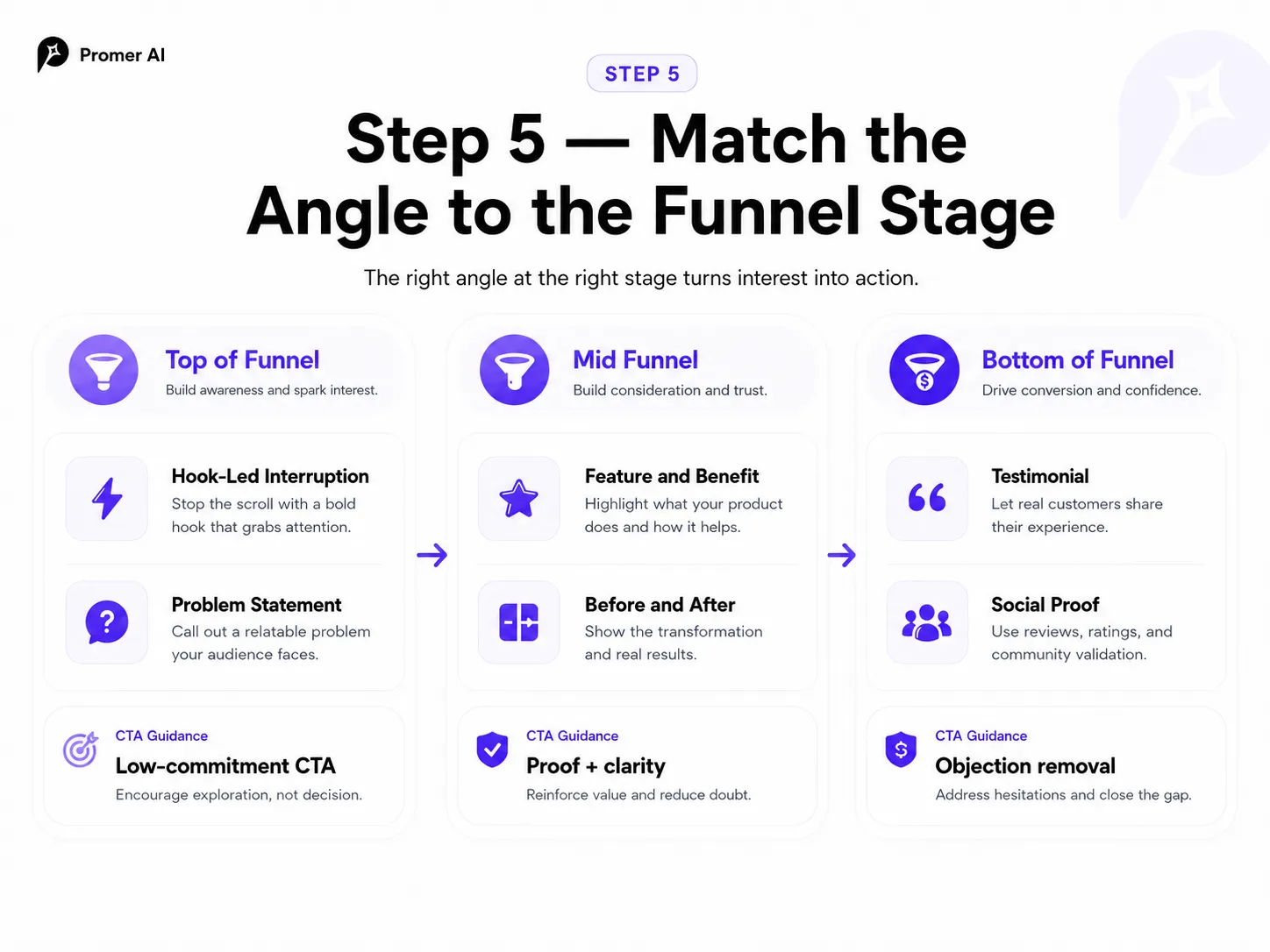
UGC ads perform at every funnel stage. At the awareness stage, they stop the scroll. At consideration, they explain benefits naturally. At conversion, they remove objections. Retargeting campaigns especially benefit from UGC creatives because the audience already knows the brand - they need reassurance, not explanation.
The angle and message structure should shift depending on where the viewer is:
Top of funnel (cold audience) - Hook-led interruption or problem statement. The viewer does not know the product. Open with the pain, not the solution. Keep the CTA low-commitment.
Mid funnel (warm audience) - Feature and benefit or before-and-after. The viewer has seen the brand. Give them the proof they need to consider it seriously.
Bottom of funnel (retargeting) - Testimonial and social proof. The viewer knows the product but has not bought. Remove the last objection: "Is this actually worth it?" Use real specificity here - outcome, time to results, comparison to alternatives they may have already tried.
Step 6 - Test Multiple Angles Before Scaling Any One
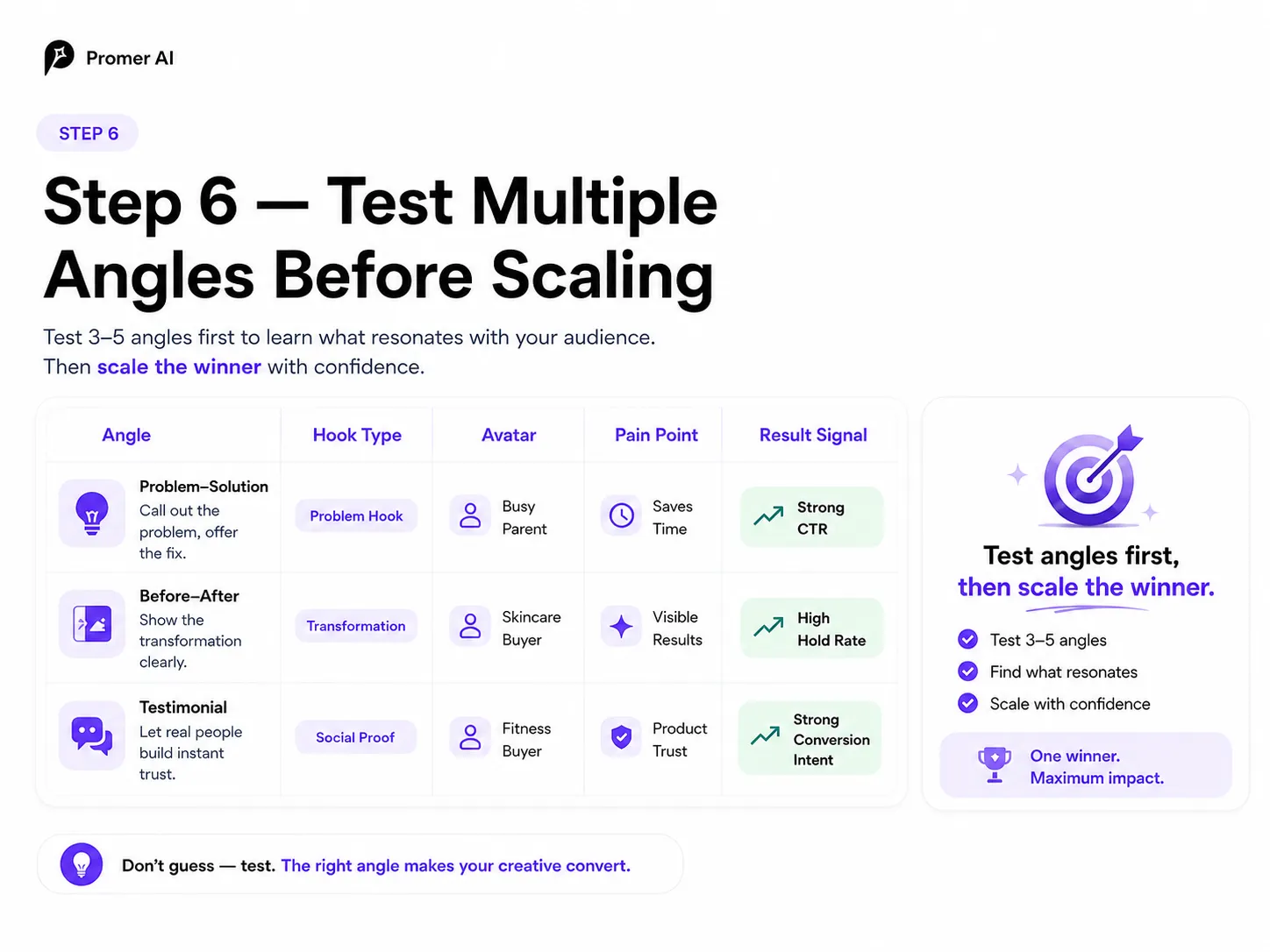
One of the most common UGC production mistakes is scaling production before testing angles. Teams produce 10 variations of the same concept rather than testing 5 different angles with 2 variations each. The first approach optimizes execution. The second finds the angle that the market actually responds to.
A practical testing matrix uses three variables: hook type (problem-focused, benefit-focused, or transformation-focused), avatar demographic matching your top customer segments, and the primary pain point addressed. Running all variations simultaneously with equal budget allocation for 3–5 days produces statistically significant signal before committing resources to a single direction.
When an angle starts to perform, build variations from that specific angle - not from the creative format. Changing the creator, the setting, or the visual style while keeping the same angle and hook preserves the performance signal while reducing creative fatigue risk.
Step 7 - Use Ad Library Data to Validate Angles Before Production
Before investing production budget in an angle, validate that the angle has already demonstrated performance in your category. Ad libraries - both platform-native and third-party tools - show which creative structures are actively running and which have been scaled, which is a strong proxy for performance.
An ad that is still running after 30+ days in a competitive niche is almost certainly profitable. Study the hook, the angle, the overlay text structure, and the CTA - not to copy, but to understand the pattern the market has rewarded. Then build a product-specific version of that pattern with your own product context.
Promer's Ad Spy feature surfaces top live Meta ads by keyword or brand, filterable by country, showing what competitors are actively spending behind right now. Pair that with the Winning Ads library - 6,000+ curated top-performing ads organized by industry and creative theme - and the angle validation step becomes a data exercise, not a guessing game.
Common UGC Ad Mistakes That Kill Performance
Most underperforming UGC ads fail for the same structural reasons:
No defined angle in the brief - The creator was told to "talk about the product naturally." Natural without a defined concept is unfocused. Every UGC ad needs one angle, one pain point, one benefit.
Weak or missing hook - The ad opens with the brand name or product shot. On TikTok and Reels, that loses 70%+ of viewers in the first second. Open with the pain or the pattern interrupt.
Too many messages - The ad tries to cover five product benefits in 30 seconds. Viewers retain one thing from a short ad. Choose the strongest signal and commit to it.
Generic social proof - "I love this product, it's amazing" is not social proof. Specific social proof - "I switched from [competitor] three months ago and my [metric] went from [X] to [Y]" - is what removes purchase hesitation.
Platform-wrong format - Shooting a horizontal video for TikTok, or a talking-head clip with no captions for a sound-off Meta feed. Format discipline is part of the brief, not an afterthought.
Frequently Asked Questions About Ways to Create Effective UGC Ads for Ecommerce
What is the difference between UGC ads and influencer marketing?
UGC ads are paid media assets owned by the brand; influencer marketing relies on the creator's audience for distribution. In UGC advertising, the brand controls placement, targeting, and spend - the creator produces the creative asset. In influencer marketing, the creator's organic reach is the primary channel. UGC ads can use creator-style content without the creator having any follower base at all. Results vary, but UGC ads typically offer more predictable performance because the brand controls the media buy.
How long should a UGC ad be?
Most high-performing ecommerce UGC ads run 15–30 seconds, though the right length depends on the platform and the funnel stage. TikTok and Reels favor 15–20 seconds for cold audiences. Mid-funnel and retargeting can support 30–45 seconds if the content earns the view. The metric to watch is average view duration - if viewers are dropping before the CTA, the hook or the pacing is the problem.
Do UGC ads need to look low-quality to feel authentic?
No - authenticity comes from the angle and the delivery, not from poor production quality. The sweet spot is content that looks intentional but not overproduced. Clean audio, good natural light, and a stable shot are baseline requirements. What needs to feel unscripted is the delivery and the narrative - not the technical execution.
How many UGC ad variations should I test at once?
Test 3–5 different angles before scaling any single one, with 2 variations per angle at minimum. This gives you enough signal to identify which concept the market responds to, not just which execution performs. Once a winning angle is confirmed, produce more variations within that angle - different creators, different hooks, different settings - while keeping the core concept consistent.
What creative themes work best for UGC ads?
Problem and Solution, Testimonial, and Before and After consistently outperform in ecommerce UGC, particularly for cold audiences. Feature and Benefit works best at the consideration stage. The right theme depends on the product category and where the viewer is in the funnel. Analyzing active competitor ads in your niche - via an ad library or ad spy tool - is the fastest way to validate which themes the market is currently rewarding.
Can I create UGC-style ads without hiring a creator?
Yes - AI-generated UGC-style creatives and animated static ads are both viable paths to UGC-format content without creator sourcing. The tradeoff is authenticity signal: human creators deliver stronger trust cues for testimonial-format ads. For concept testing and angle validation, AI-generated variations let teams move faster before committing to creator production. Once a winning angle is identified, investing in human creator content for that specific angle maximizes return on production spend.
Conclusion
Creating effective UGC ads is a creative strategy problem before it is a production problem. The angle, the hook, and the product context determine whether a UGC ad converts - not how authentic the creator looks or how many variations get produced. Start from the product: extract the highlights, the pain point, the ideal customer, and the emotional trigger. Build a brief around one angle and one hook. Test multiple angles before scaling. Use ad library and ad spy data to validate before investing production budget.
Tools like Promer AI compress the upfront work - product URL to brief to ad concept - so ecommerce teams can move from product context to testable UGC angles in a fraction of the time it takes to build that brief manually. The creative performance difference between a brief built on guesswork and one built on product and market data is measurable. Start with the product. Build the brief. Test the angle. Scale what wins.