What Is an Ad Creative Strategy? How to Build One?
Category
Blogs
Date
Authored by
Promer Team
Summary
An ad creative strategy is the system that defines what your ads say, who they speak to, and how they are built to convert. Here is how to develop one.
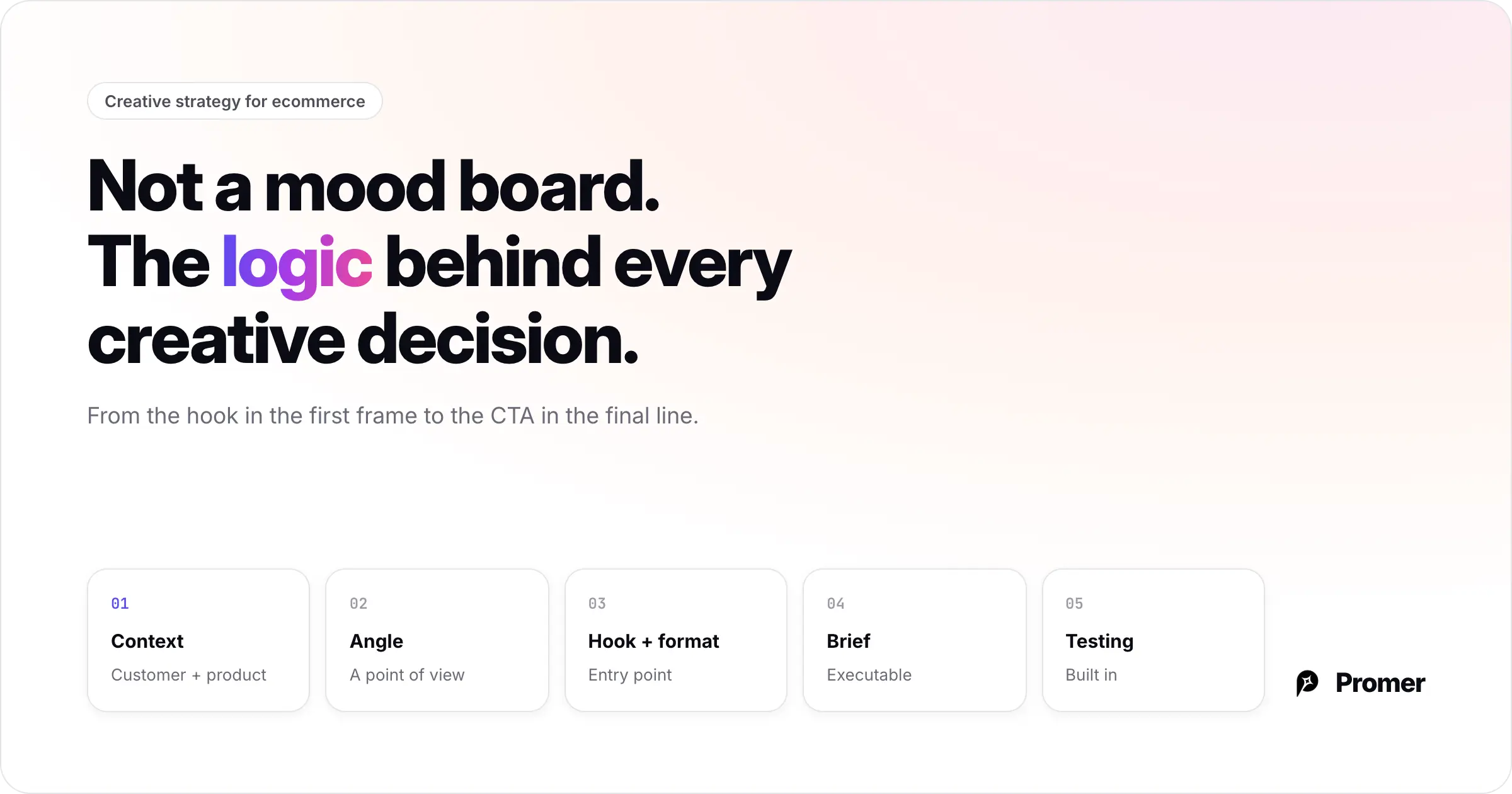
An ad creative strategy is the system that determines what your ads say, who they are built for, what angle they take, and how they are tested and refreshed over time. It is not a mood board or a brand guideline. It is the logic behind every creative decision - from the hook in the first frame to the CTA in the final line.
Most ecommerce teams run ads without a creative strategy. They have a budget, a product, and a design tool - but no system for deciding which angle to run, which hook to test first, or what to do when a creative stops performing. The result is random creative output: some ads work, most do not, and the team cannot explain why either happened.
This article defines what an ad creative strategy is, breaks down its key components, explains the difference between brand awareness and direct response creative strategy, and walks through how to build one that produces consistent, testable, scalable output for ecommerce.
Key Takeaways
An ad creative strategy defines what your ads say, who they are for, and how they are built to convert - it is a system, not a style guide
Direct response creative strategy and brand awareness creative strategy serve different goals and require different structures
Every creative decision - hook, angle, format, CTA - should come from product context and customer truth, not from design instinct
A creative brief is the operational output of a creative strategy - without it, every ad starts from zero
Testing is built into the strategy from the start: one variable at a time, measured against a control
What an Ad Creative Strategy Is?
An ad creative strategy is the set of decisions that governs how your ads are built before production begins. It covers four things: who the creative is for, what message it delivers, what structure it follows, and how it will be tested and iterated over time.
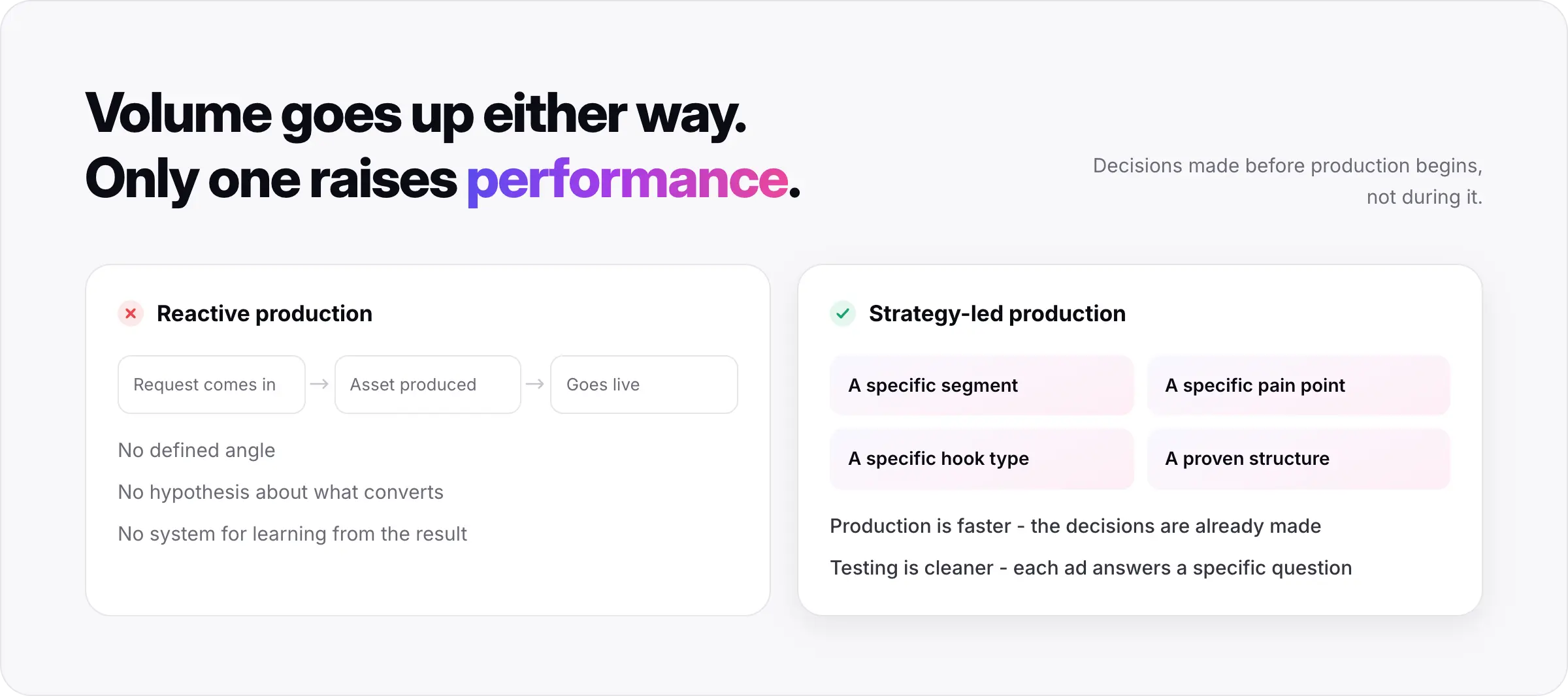
Without a creative strategy, ad production is reactive. A product goes live, someone requests a creative, a designer produces an asset, the asset goes live. There is no defined angle, no hypothesis about what will convert, and no system for learning from the result. Volume increases but performance stays inconsistent.
With a creative strategy in place, every ad is built from a defined starting point: a specific customer segment, a specific pain point, a specific hook type, and a specific structure proven to work for that product and audience. Production is faster because the decisions have already been made. Testing is cleaner because each creative is built to answer a specific question.
Direct Response vs Brand Awareness Creative Strategy
Before building a creative strategy, ecommerce advertisers need to be clear on what type of creative they are building - because the structure, the metrics, and the definition of success are fundamentally different.
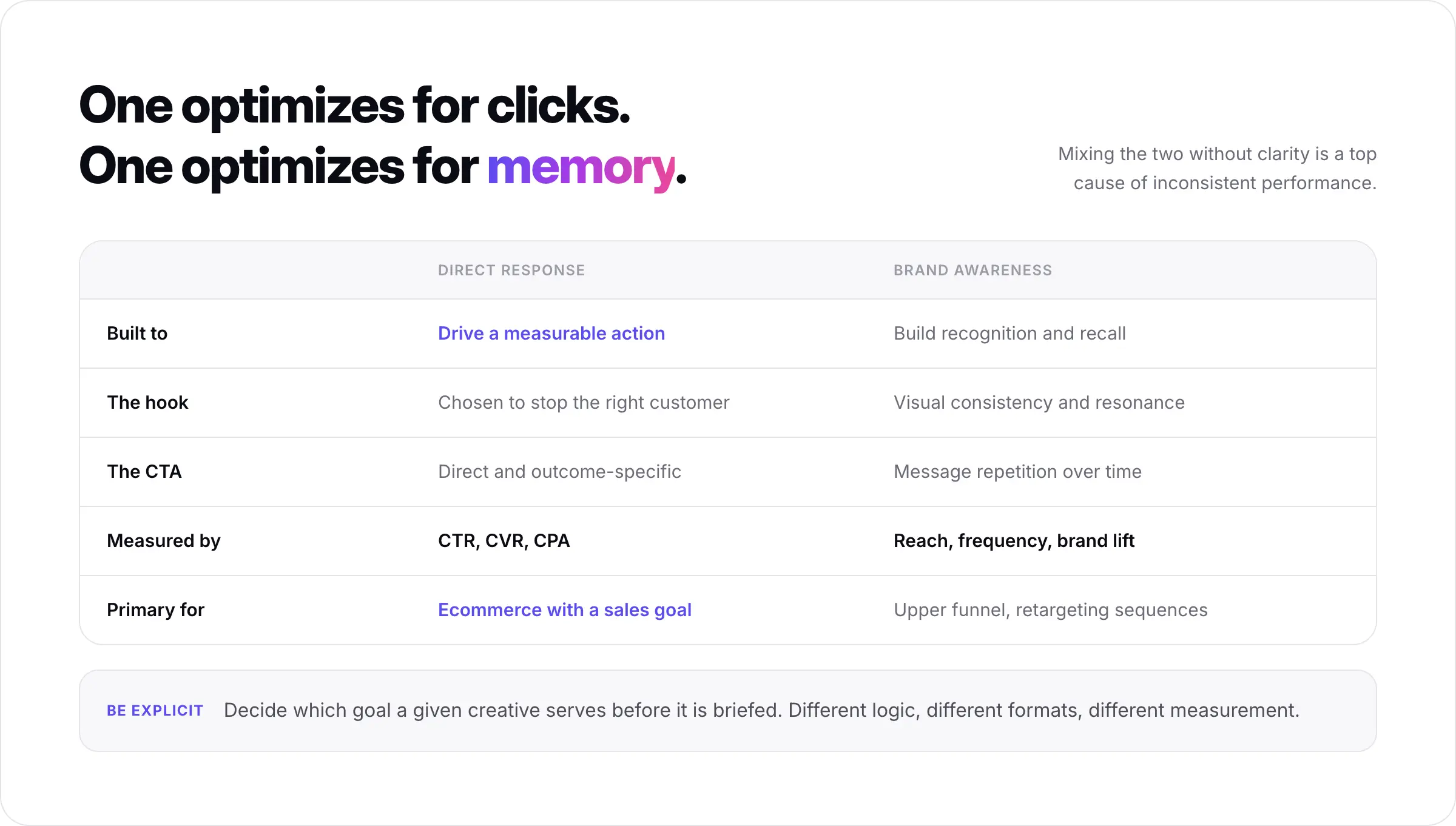
Direct response creative strategy is built to drive a specific, measurable action - a click, an add-to-cart, a purchase. Every element of the creative serves that action. The hook is chosen to stop the right customer. The angle is chosen to match the product to a real pain or desire. The CTA is direct and outcome-specific. Success is measured by CTR, conversion rate, and cost per acquisition.
Brand awareness creative strategy is built to build recognition, recall, and brand association over time. It prioritises visual consistency, emotional resonance, and message repetition over immediate conversion. Success is measured by reach, frequency, and brand lift studies. It does not optimise for clicks - it optimises for memory.
For most ecommerce teams running paid ads with a direct sales goal, direct response creative strategy is the primary focus. Brand awareness creative has its place - particularly in upper-funnel campaigns or retargeting sequences - but it requires different creative logic, different formats, and different measurement. Mixing the two without clarity on which goal a given creative serves is one of the most common reasons ecommerce ad performance is inconsistent.
The Key Components of an Ad Creative Strategy
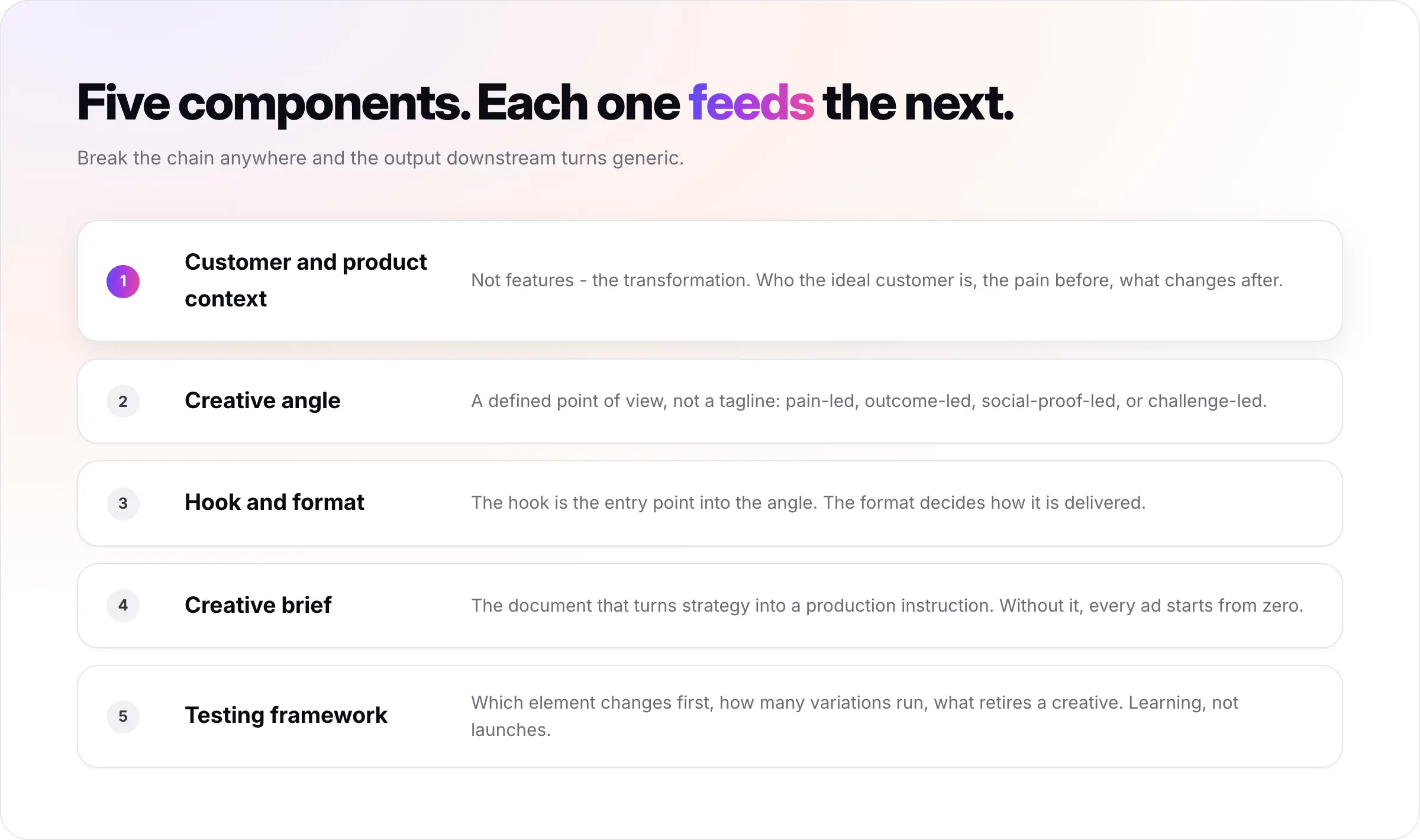
A complete ad creative strategy for ecommerce has five components. Each one feeds into the next.
Customer and product context The starting point of any creative strategy is understanding what the product does for the customer - not just its features, but the transformation it delivers. Who is the ideal customer? What pain are they in before they find this product? What changes for them after they use it? This context is what makes hooks specific, angles relevant, and messages land.
Creative angle The angle is the specific lens through which the creative approaches the customer. An angle is not a tagline - it is a defined point of view: pain-led ("struggling with X"), outcome-led ("how to achieve Y"), social proof-led ("why Z people switched"), or challenge-led ("what most brands get wrong about X"). A creative strategy defines which angles to test first, based on what is known about the customer's current state and what the product delivers.
Hook and format The hook is the first thing the audience sees - the opening line of a static ad, the first frame of a video. It is the entry point into the angle. The format - static, video, carousel - determines how the hook is delivered. A creative strategy defines the hook types to test for each angle and the formats most likely to perform for the product category and placement.
Creative brief The brief is the operational document that translates the strategy into a production instruction. It defines the angle, the hook, the key message, the CTA, the format, and the visual direction for each creative. A brief is what separates a production request from a creative strategy. Without it, every ad starts from zero and carries the same uncertainty as the last.
Testing and iteration framework A creative strategy is not complete without a defined approach to testing. Which element changes first when a creative underperforms? How many variations run at once? What metrics determine whether a creative moves forward or is retired? The testing framework turns creative production into a learning system rather than a series of disconnected launches.
How to Build an Ad Creative Strategy for Ecommerce?
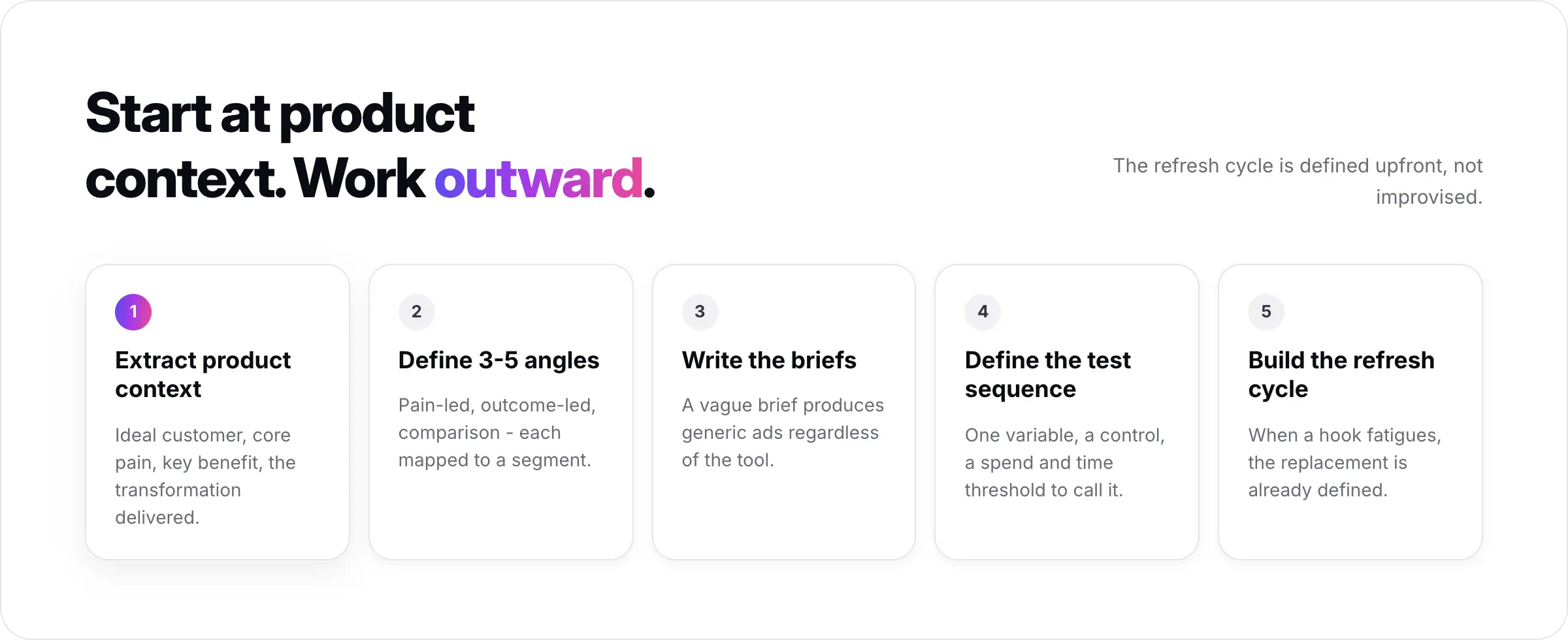
Building a creative strategy starts with product context and works outward to execution. Here is the sequence.
Step 1: Extract product context Before writing a hook or choosing an angle, extract what the product actually does for the customer. The product URL is the starting point - it contains the name, description, imagery, and often the brand's own positioning language. From that, define the ideal customer profile, the core pain point, the key benefit, and the transformation the product delivers. This is the foundation everything else is built on.
Step 2: Define the angles to test From the product context, develop 3-5 distinct angles - each addressing the customer from a different direction. A pain-led angle speaks to the problem before the product. An outcome-led angle leads with the result the product delivers. A comparison angle positions the product against the alternative the customer is currently using. Map each angle to the customer segment most likely to respond to it.
Step 3: Write the creative briefs For each angle, write a creative brief that defines the hook, the key message, the CTA, the format, and the visual direction. The brief is what the production team - or an AI creative tool - uses to produce the actual creative. A strong brief produces strong output. A vague brief produces generic ads regardless of the tool used to execute it.
Step 4: Define the testing sequence Decide which angle to test first and why. In most cases, the angle most directly tied to the customer's primary pain point is the best starting test. Set up a controlled test: one variable changes at a time, one control creative runs alongside each test variant, and a defined time period and spend threshold determines when the test is called.
Step 5: Build the refresh cycle into the strategy A creative strategy is not a one-time document. It defines how the creative pipeline continues after the first round. When a hook fatigues, what is the replacement? When an angle is exhausted, how is the next one developed? The refresh cycle should be defined upfront - not improvised when a creative starts to decline.
How to Write a Creative Brief That Actually Works
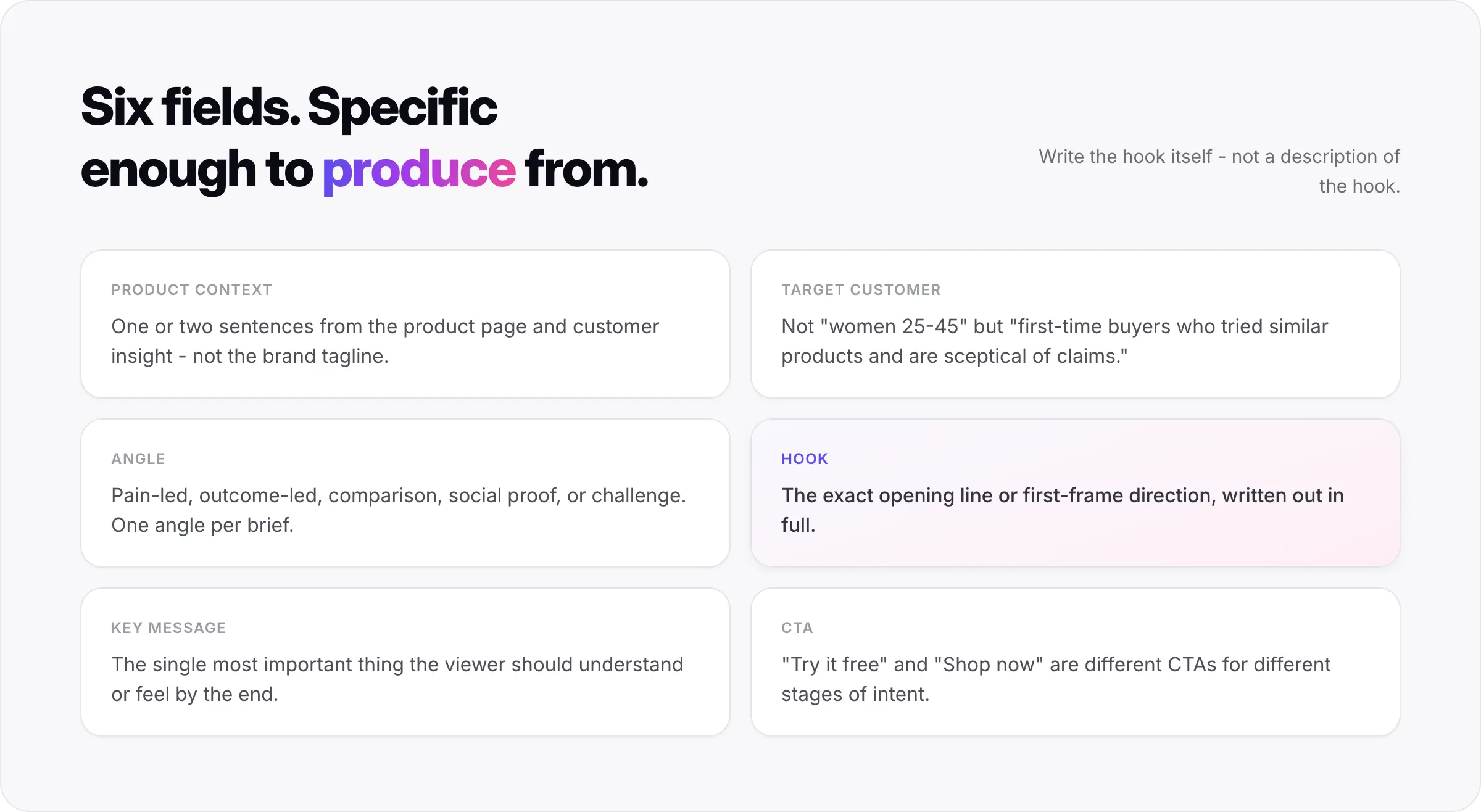
A creative brief is only useful if it is specific enough to produce a clear, testable creative from. These are the six fields every ecommerce creative brief needs.
Product context - what the product does and for whom. One or two sentences pulled directly from the product page and customer insight, not from the brand tagline.
Target customer - the specific segment this creative is built for. Not "women 25-45" but "first-time buyers who have tried similar products before and are sceptical about claims."
Angle - the specific creative direction. Pain-led, outcome-led, comparison, social proof, or challenge. One angle per brief.
Hook - the exact opening line or first-frame direction. Not a description of the hook, but the hook itself written out.
Key message - the single most important thing the viewer should understand or feel by the end of the ad.
CTA - the specific action the ad is driving and how it is worded. "Try it free" and "Shop now" are different CTAs for different audiences and stages of intent.
The Role of Data in Ad Creative Strategy
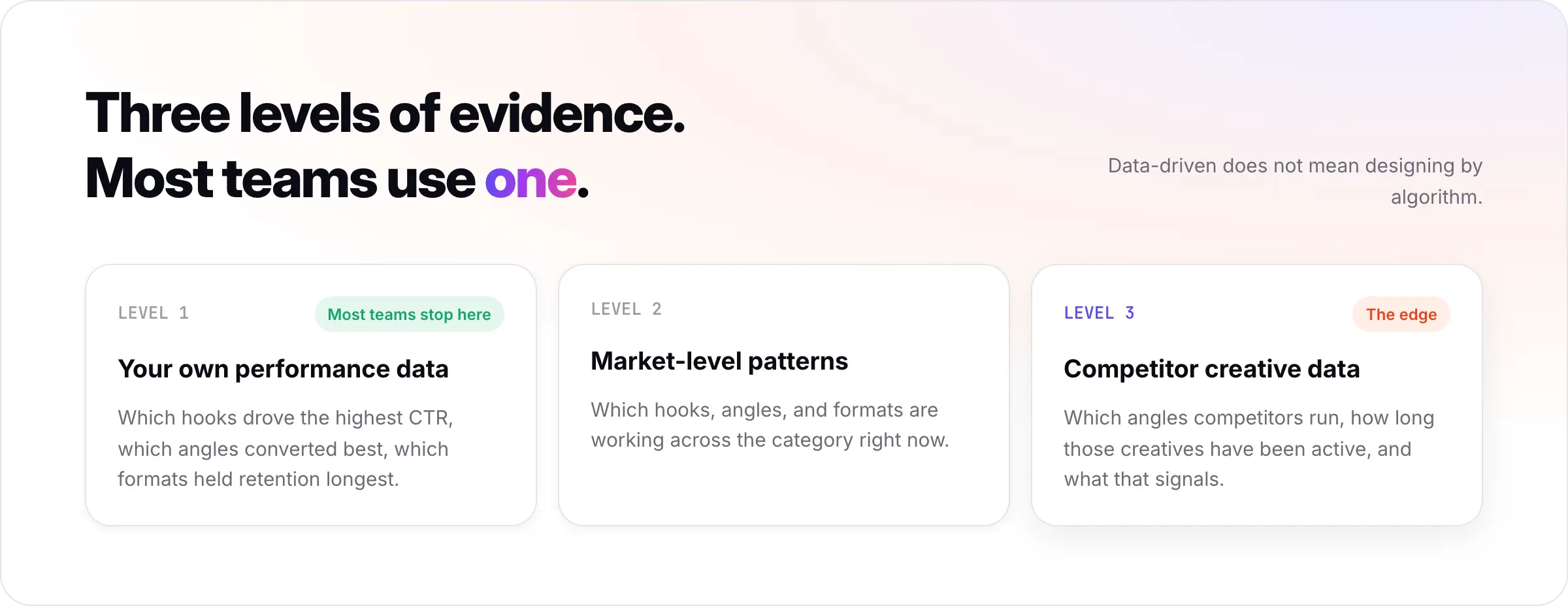
A data-driven creative strategy does not mean designing ads by algorithm. It means every creative decision is informed by evidence rather than instinct - what has performed before, what patterns appear across winning ads in the category, and what the current audience data says about who is converting and why.
There are three levels of data that inform creative strategy for ecommerce. First, your own performance data: which hooks drove the highest CTR, which angles produced the best conversion rates, which formats held retention longest. Second, market-level patterns: what hooks, angles, and formats are working across the category right now. Third, competitor creative data: what angles competitors are running, how long those creatives have been active, and what that signals about what is working in the market.
Most ecommerce teams only use the first level. The teams that build stronger creative strategies use all three - their own results, market patterns, and competitor signals - to inform what to test next.
Common Mistakes in Ad Creative Strategy
No defined angle. The most common mistake is producing creatives with no clear strategic direction - the hook is generic, the message is broad, and nothing is designed to speak to a specific customer in a specific situation. Every creative should be built from a defined angle, not from a visual prompt.
Changing too many elements at once. When a creative underperforms, teams often rebuild from scratch rather than isolating the variable that caused the drop. Changing angle, hook, visual, and copy simultaneously produces a new ad but generates no useful learning.
Treating the brief as optional. Briefs feel like overhead - they slow down production. But production without a brief produces generic output regardless of how good the tool or designer is. The brief is where the strategy becomes executable.
Separating creative strategy from testing strategy. A creative strategy that does not define how creatives will be tested is incomplete. Testing is not a post-launch activity - it is designed into the creative from the brief stage.
Building strategy around the brand instead of the customer. Brand guidelines matter, but they are not a creative strategy. A creative strategy starts from customer truth - what the customer needs to feel or understand to take action - and works backwards to execution.
How Promer AI Fits Into a Creative Strategy?
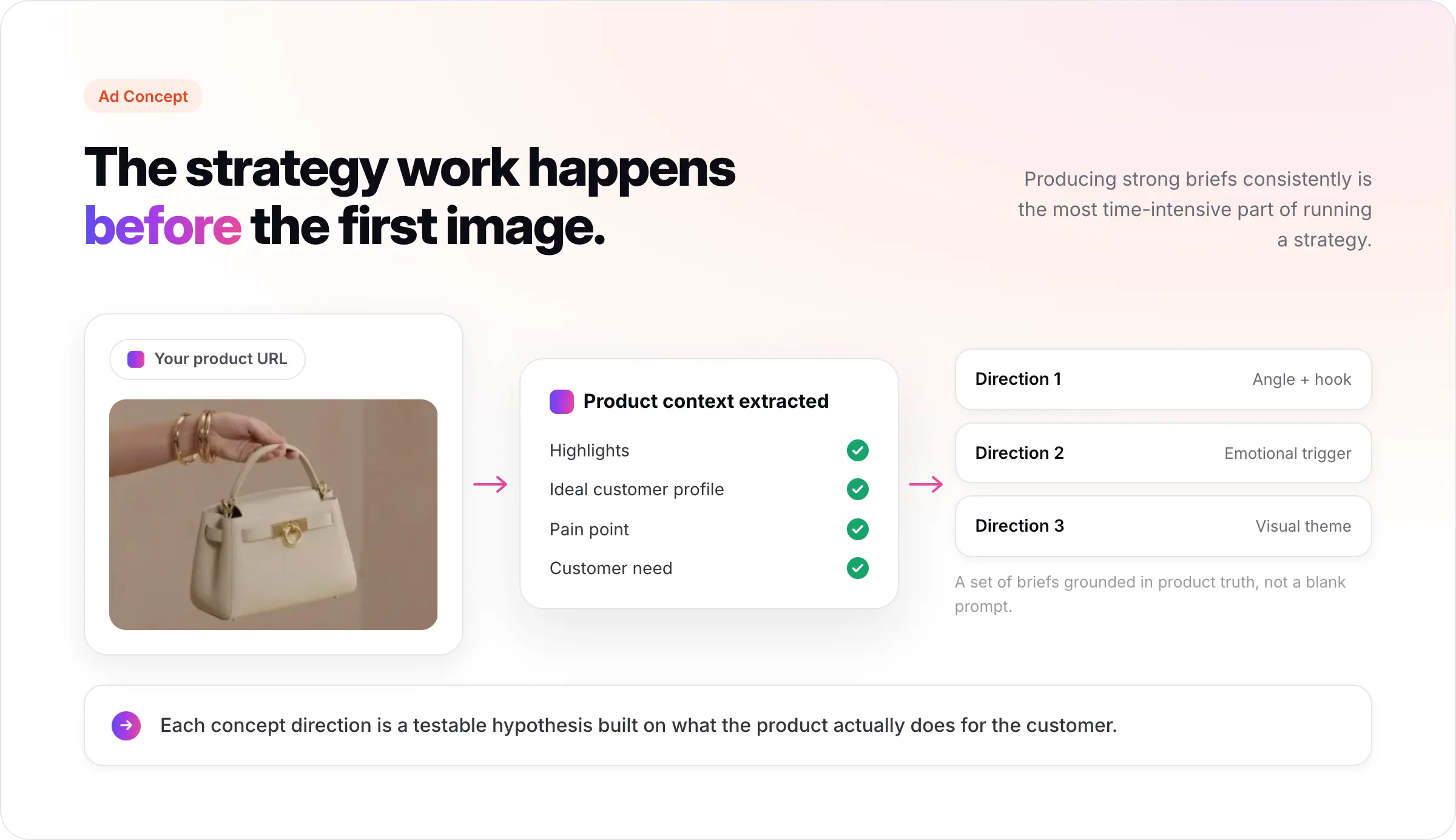
The most time-intensive part of running a creative strategy is producing strong briefs consistently - extracting product context, developing angle directions, writing hooks, and keeping that process running across multiple products and refresh cycles.
Promer AI is built to handle the front end of that process. You paste a product URL into app.promer.ai and Promer extracts the product context automatically - highlights, ideal customer profile, pain point, and need. From that context, it generates structured ad concept directions, each with a defined angle, hook, emotional trigger, and visual theme. The output is a set of creative briefs grounded in product truth, not generated from a blank prompt.
This means the creative strategy work - product context extraction, angle development, brief writing - is done before the first image is produced. Each concept direction is a testable hypothesis built on what the product actually does for the customer, which is what gives the resulting creative a real shot at performing in a direct response campaign.
FAQs About Ad Creative Strategy for Ecommerce
What is an ad creative strategy?
An ad creative strategy is the system that defines what your ads say, who they are built for, what angle they take, and how they are tested and refreshed over time. It is not a brand guideline or a visual style guide - it is the logic behind every creative decision. For ecommerce advertisers running direct response campaigns, a creative strategy is what separates a production process that generates consistent, testable output from one that produces random results and cannot explain why some ads work and others do not.
What is the difference between direct response and brand awareness creative strategy?
Direct response creative strategy is built to drive a measurable action - a click, an add-to-cart, a purchase. Every creative element serves that action and success is measured by CTR, conversion rate, and CPA. Brand awareness creative strategy is built to build recognition and recall over time, measured by reach, frequency, and brand lift. For ecommerce teams with a direct sales goal, direct response strategy is the primary focus. Mixing the two without clarity on which goal a given creative serves leads to inconsistent performance and unclear test results.
What are the key components of an ad creative strategy?
The five key components are: customer and product context, creative angle, hook and format, creative brief, and a testing and iteration framework. Each component feeds into the next. Without product context, angles are generic. Without a defined angle, hooks have no direction. Without a brief, production is inconsistent. Without a testing framework, the strategy produces output but not learning.
How do I develop an ad creative strategy for a new product launch?
Start with product context extraction before anything else - what the product does, who it is for, and what pain it solves. From that context, develop 3-5 angles that address the customer from different directions. For a new product, prioritise the pain-led and outcome-led angles first, as they are most likely to resonate with customers who do not yet know the product exists. Write briefs for the first round of test creatives from those angles, set up controlled tests with one variable per variant, and define the refresh cycle from day one rather than improvising when the first creative fatigues.
How often should I refresh ad creatives as part of my strategy?
The refresh cycle should be defined in the strategy upfront, not improvised when performance drops. For most ecommerce teams spending $100-$500 per day per ad set, creative fatigue typically sets in within 2-4 weeks on a cold audience. The practical approach is to monitor frequency weekly - when frequency exceeds 2.5-3 impressions per person over 7 days on a cold audience, begin preparing a hook refresh. The strategy should ensure replacement concepts are in production before they are needed, not after the current creative has already collapsed.
How do I adapt my ad creative strategy for seasonal campaigns?
Seasonal campaigns require a variant of the existing creative strategy, not a replacement for it. Take the angles that are currently performing and adapt the hook and offer to reflect the seasonal context - a sale event, a holiday, a product launch moment. Keep the underlying angle and creative structure intact. Seasonal creatives built from scratch take longer to optimise and typically underperform proven structures with a seasonal overlay. The exception is a genuinely new product or audience segment introduced for the season, which warrants a new angle development process from product context.
What metrics should I track to evaluate my ad creative strategy?
Track signals at three stages. The hook stage - CTR and early video retention in the first 3 seconds - tells you if the creative is stopping the right people. The message stage - add-to-cart and initiate checkout rates - tells you if the angle and copy are building enough belief to move someone forward. The conversion stage - cost per purchase relative to margin - tells you if the full creative is profitable. Evaluating by stage tells you which part of the strategy is working and which needs to change, rather than just whether an overall campaign is above or below target.